Home Blog Page 29

Sowing the Seeds of Resistance

0

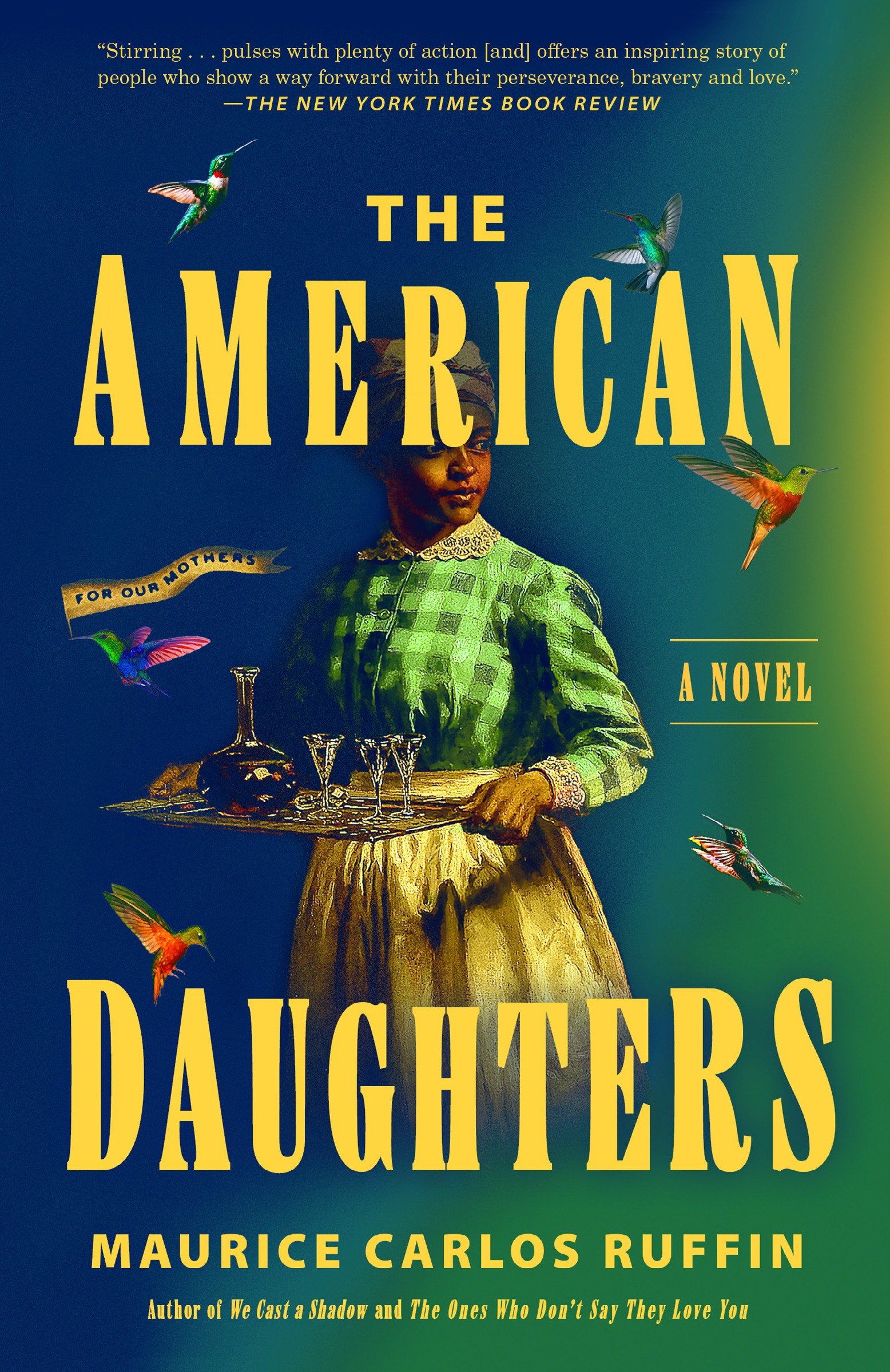
Book Review by Dr. Brenda M. Greene

“What you need to know for now is that it was just like this. I wasn’t running away. I was running toward myself.”                                  

                                                From The American Daughters by Maurice Carlos Ruffin

We know that spies have always been necessary and crucial to people and countries engaged in warfare. During the Civil War, there were famous and secret networks of spies on both the Union and Confederate sides. The most well-known Black spy on the Union side was the abolitionist Harriet Tubman who organized Black soldiers to scout behind Confederate lines. She is especially renowned for her extraordinary work as an underground railroad conductor and for  leading at least 300 enslaved Black people to freedom. Maurice Carlos Ruffin’s novel The American Daughters (One World, 2025) introduces the Daughters, New Orleans Black women who served as spies in the Civil War. The central themes underlying the novel are the impact of the “Daughters” on the development of the southern confederacy and the effect of the cruel and inhumane conditions of slavery on the love between a woman and her daughter.

In The American Daughters, Ruffin describes the ways and means that a network of enslaved and free Black women sow the seeds of resistance to secure freedom for themselves, their daughters, mothers, grandmothers, and inevitably for Black people throughout the south. These acts include sabotaging efforts by slavers, running away, poisoning meals, slowing down work, forging documents, feigning illness, and sending messages through music, dance, and hidden materials. Resistance also involves taking on aliases. One of the American Daughters informs Ade the protagonist, that “My dear, most of the people who work here use aliases. It is the nature of our society that demands it.”

Sanite, the mother of Ady, is the first person who embodies resistance in Ady’s life. She keeps her daughter close and instills in her the importance of being free, doing what is necessary to work towards that freedom, and remembering that she is a person first. She says to her daughter, “What you need to know for now is that it was just like this. I wasn’t running away. I was running toward myself.”  Running thus becomes a necessary act in acquiring one’s freedom.

            Ruffin knows how to engage readers and his literary techniques foreshadow events and present readers with an omniscient narrator who goes back and forth in time. Readers also encounter original documents from slavers, newspapers, and letters that provide a context for this period in the history of New Orleans.

When the novel begins Ady is a grown woman. She describes her current situation as an “entertainer” in a New Orleans Hall and then reflects on her memories of lying beside her mother as they rode in a slave catcher’s wagon with other enslaved men and women who were shackled to the floor. Readers witness Ady’s growth and maturity as she loses her mother and is forced to find a way to cope with her devastating loss. Her meeting of The Daughters, a network of women spies, is a turning point in the novel. Ady desperately wants to become one of the Daughters.

The Daughters who had many aliases . . . had been operating locally since Napoleon handed the territory off to Thomas Jefferson, if not before. Many of the Daughters had been killed in their clandestine endeavors. Whatever actions they took-whether successful or failed- were elided from all records.

Ady understands that whatever the Daughters accomplish will be forgotten, but this knowledge does not deter her; rather it strengthens her resolve to work with them.

            We are familiar with the organizations Daughters of the Revolution (DAR), an organization for women who are directly descended from a patriot of the American Revolution

and the United Daughters of the Confederacy (UDC) founded in 1984 for women descended from Confederate soldiers. Ruffin’s The American Daughters, an imagined record of the acts of resistance by enslaved Black women, reminds us that all the stories of the perseverance of Blacks in America have not been told.

At a time when educational curricular across the nation are being revised to omit the presence of Black people in American history and literature, when books are being banned, when free speech is censored, and when constitutional rights are ignored or taken away,  Ruffin’s novel is significant, in that it adds depth to the presence and resilience of Blacks in America and documents their strategies for resisting slavery.  Additionally, his novel emphasizes the bond between a mother and child and is part of a counternarrative that can provide readers with knowledge of the multiple forms of resistance that enslaved people may have used to secure their freedom.

            The American Daughters is a New York Times Editor’s Choice. Ruffin is the recipient of many awards and the author of The Ones Who Don’t Say They Love You and We Cast a Shadow. He is an associate professor of creative writing at Louisiana State University.

            Dr. Brenda M. Greene is Professor Emeritus and Founder and Executive Director Emeritus of the Center for Black Literature at Medgar Evers College, CUNY. For more information, visit https://www.drbrendamgreene.com
Million Man March: 30 Years Later

Minister Henry Muhammad Reflects 30 Year Later

By Mary Alice Miller
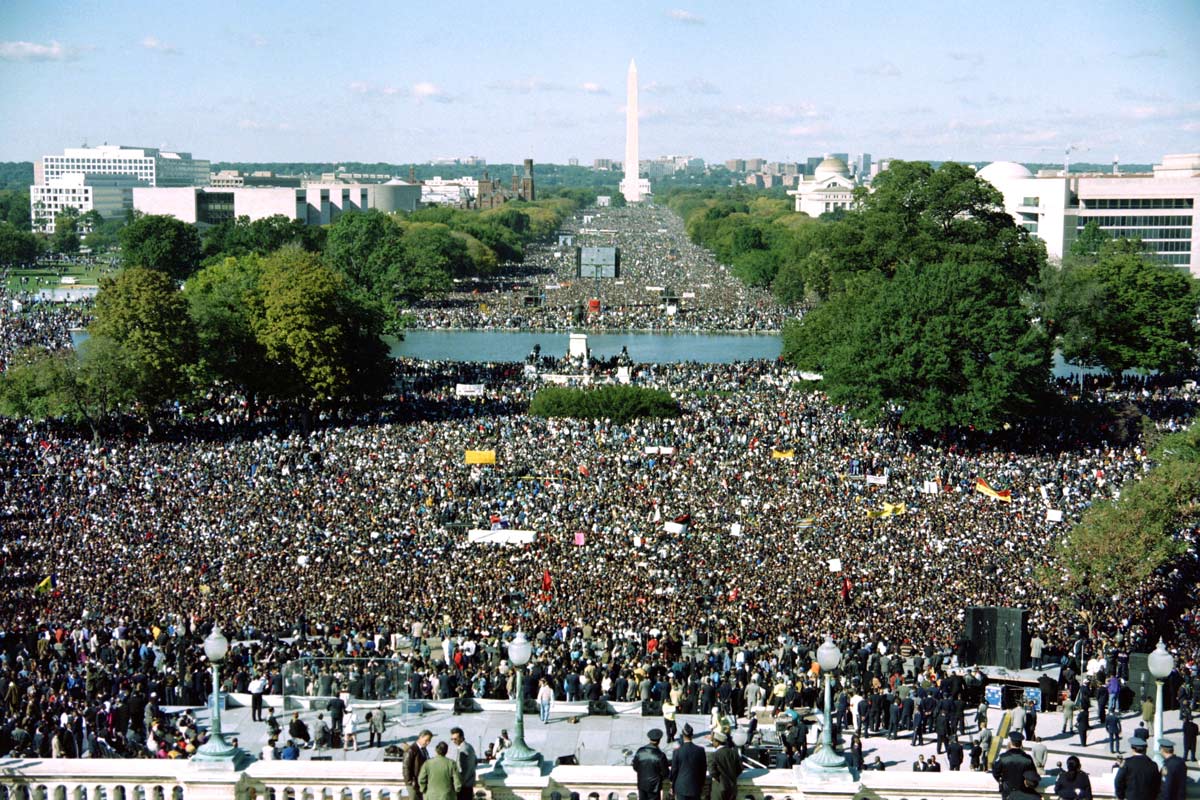
As the 30th anniversary of the historic Million Man March approaches, Minister Henry Muhammad, Minister Farrakhan’s Student Minister of Muhammad Mosque #7C in Brooklyn, New York looks back at the culture at that time and the impact then and now.
“Just thinking about it brings back good nostalgia,” said Min. Henry Muhammad.

“The Million Man March didn’t happen in a vacuum,” Min. Muhammad said. “This was over a ten-year period of the Honorable Minister Louis Farrakhan doing tours of ‘Stop the Killing’ messages to our people in the late ‘80’s after he had come to Madison Square Garden in ‘85. A couple of years after that he had been doing “Stop the Killing” tours because of the fratricidal homicides that was taking place so much in different areas where our Black youth were around America. That was around the time of the crack epidemic.”

The last part of the tour in 1993 was at Jacob Javits Convention Center.
Min. Muhammad continued his recollection: “The Minister said at that meeting on December 18, 1993, ‘I would like to come back and speak to the men. Just the men. If I come back, would you all come out?’ And the crowd said ‘Yes.’”
In January 1994 the Minister came back to the 369th Armory in an all men meeting and 15,000 came out.

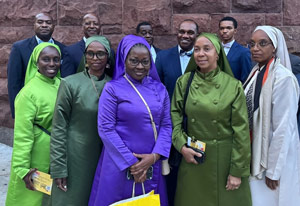
Minister Henry Muhammad, Minister Farrakhan’s Student Minister (back row, second from right) with members of Muhammad Mosque #7C engaged in community service at shelter on Bedford and Atlantic Aves on Oct 7 in commemoration of Founder of Nation of Islam Honorable Elijah Muhammad’s birth date.


“All throughout 1994 the Minister was having all men meetings. But it was at that first meeting at the 369th Armory that the Minister was inspired to say, ‘I would like to take a million men to Washington, D.C.,’” said Min. Muhammad. “He said when he saw the words coming out of his mouth he wanted to pull them back. But it just came to him.”
The seed of that idea was planted.

Farrakhan was filling up armories and other places where men could gather. The momentum started building. In 1994 weekly Manhood Training meetings were held and Local Organizing Committees were formed, building more fervor for the Million Man March.

Min. Muhammad recalled that the O.J. Simpson slow speed chase and Johnni Cochran as his legal representative during Simpson’s criminal trial gave more fuel to Black people regarding the Million Man March.

“God has his way of bringing things around,” said Min. Muhammad.
While promoting the Million Man March talking to grassroots people and the average brother in the streets Min. Muhammad said some expressed concern about their personal safety if they attended.
But, Min. Farrakhan set the tone.

“The Minister said ‘I don’t want this to be where we are looking for sponsors to sponsor us for what we need to do for ourselves and then those sponsors dictate to us based off of money what we can do and what we can’t do, what we can say and what we can’t say. We are going to pay our own way; we are not looking for someone else to pay our way. He was very adamant about that,” Min. Muhammad recalled.

He further explained Min. Farrakhan’s position: “‘This march is about us. We are not going to protest the government. We are not going there to appeal to the government to give us this and that. We are going there to appeal to God for not having our responsibility as men, as fathers, as sons. We are going there to atone and get reconciliation from God for what we did not do standing on the shoulders of our ancestors. We are going to the same place where they sold us as slaves to make an appeal to God before the world.’”


The Million Man March was about atonement, reconciliation, and responsibility.
The date of the Million Man March was also a Day of Absence with no shopping, school or work.

President Bill Clinton and Congress also had their form of a Day of Absence. They were so fearful of a million Black men coming to Washington, D.C. that they all left the district.
“The police in Washington, D.C. had already sat with the Minister and his security team for a plan of evacuation if things started rocking on how they would get the Minister out of there,” Min. Muhammad continued. “The Minister told them ‘If things go down and my people start getting attacked you all better not put your hands on me. I will die right there with my people.’”

There was a sense of danger.
But love, peace, freedom, and brotherhood permeated throughout the mall. Eighty-five percent of the brothers that were there were not Muslim.
“We were shoulder to shoulder so tight that there was a brother in a wheelchair who needed to relieve himself. These brothers picked him up and everybody passed him across each other until he could get to a secure place to put him down until he could be moved,” said Min. Muhammad.

The entire event was 14 hours.
Min. Muhammad recalled that “At a certain point there were brothers on that mall who got tired of hearing all the different speakers and started saying “Farrakhan! Farrakhan!” They were like ‘I came to hear the man who drew us all out here.’”
According to Min. Muhammad, the immediate impact of the Million Man March was measurable.


Voter registration went up astronomically. There were over 25,000 adoptions that started taking place in 1995 by Black men going back into the community adopting Black children. The crime rate went down. One of the instructions given was to go and join an organization in your community. Churches and Black organizations were starting to fill up. Black me were ready to go and be a producer in his community rather than a detriment to his community.
The marriage rate started growing from the influence of that day. Between 1994 and 1996 the birth rate went up by 70%.

“I guess the Black man said, ‘I am going to be more appreciative of my Black woman and I am going to show more responsibility,’” said Min. Muhammad.
“Many of us in the Black community will not talk about it. That needs to be corrected,” Min. Muhammad said, warning that the Million Man March is being written out of history. “Regardless of any critiques or criticisms that we may have, because no one is perfect, we have a man amongst us who was able in the midst of controversy and negativity against him still was able to get a million or more men to come to Washington, D.C.”

Recordings of the Million Man March, Million Family March, Millions More Movement, the 10/10/15 20th anniversary of the Million Man March: Justice or Else are available on NOI.org.
The 30th commemoration of the Million Man March will take place on October 19 at Muhammad Mosque #7C at 202 Pennsylvania Avenue in Brooklyn and Muhammad Mosque #7 at 106-8 W127th St, in Harlem at 10 am. The event will also be livestreamed at NOI.org.

NYC Mayoral Race – The Next Episode

0

A revealing book, Adams Albania flight, and an upcoming Zohmentum Bed Stuy town hall

By Nayaba Arinde
Editor-at-Large

Incumbent Eric Adams withdrew from the mayoral race two weeks ago, but he is still making headlines. After speaking glowingly about his former Senate colleague at the street renaming of Hon. Bill Perkins Way in Harlem on Saturday, Adams flew to Albania on a four-day trip, but not before responding to last week’s Our Time Press article featuring Public Advocate Jumaane Williams.

Last week, Williams told Our Time Press, “When Mayor Adams was elected, there was real promise and potential to make progress on issues where New Yorkers broadly agree — and where a previous version of this mayor claimed he did. Sadly, his tenure has been marked by an inability to self-reflect or course-correct after sustained and continued bad decisions, squandering potential and ensuring that the second Black mayor in our city’s history will, once again, not have a second term — overshadowing any real achievements along the way.”

Adams responded, telling Our Time Press, that as of “January of 2022, when I first got in office Jumaanee was attacking me. So one cannot say he attacked me due to something I did as mayor. He was attacking me at the start and never stopped. So it is difficult to believe anything he said. He did not have that energy during Bill’s mayoralty. I did more for Black and Brown people than any mayor in history.”

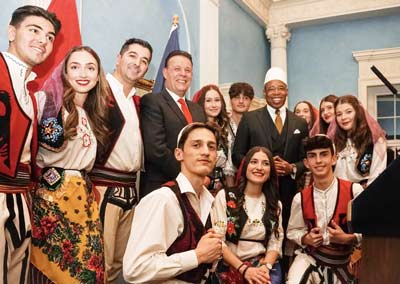
Albanians at Gracie Mansion event with Mayor Adams, June 21st.. Such events are a regular occurrence at the Mansion.


In response, Williams told the paper “For clarity, I was one of the few people (if not only person) on the left who, in hindsight, regrettably ranked Eric Adams during the last election. I, and many others, worked to give New York’s second Black mayor a lot of grace, sadly he continually chose to abuse that grace.

His administration has repeatedly relied on lies and misinformation, and this is just the latest example. Anyone can look at my record with Mayor de Blasio and see that I held him accountable — as part of my job. I hoped that the Mayor would’ve used his final months to focus on redemptive words and actions, but it appears he’s intent on leaving office in the same detrimental way he governed throughout his tenure.”
Meanwhile, last week, news broke that Adams’ former girlfriend, Jasmine Ray, had written a tell-all about their relationship, which happened a decade ago.

Knowing each other since his days as Brooklyn Borough President, Adams later gave her a $160,000 job as the director of the Mayor’s Office of Sports, Wellness, and Recreation.


Released on Sunday, October 5, 2025, her self-published e-book is titled “Political Humanity, a Memoir of Love, Legacy, and New York City Politics.”
While Adams said nothing publicly, a source alleged to Our Time Press, “She showed him the book before the press saw it, so he already read it.” This, as there have been some rumblings that there are other folks in the community attempting to convince Adams to return to the campaign. Ray said he is “Resolved,” and Adams himself told Our Time Press, “I have done this for forty years. Time to enjoy life.”

MSNBC analyst and Columbia Professor Basil Smikle told Our Time Press, “I think voters have moved on at this point. Unless there’s any legal jeopardy, he’s not in much danger of any political consequences.”
Current November 4th mayoral contenders include frontrunner Queens Assemblyman Zohran Mamdani, Democrat and Independent-line former Governor Andrew Cuomo, and Republican Curtis Sliwa.


“This could not have been scripted any better,” John Jay College Adjunct Professor and Black Star News publisher, Professor Milton Allimadi, told Our Time Press. “When he was a candidate, Adams said he would create opportunities for Black and Brown New Yorkers who are in business. Some were even tempted to believe he would do what the great Marion Barry did in DC, where the mayor pushed legislation that required 35 percent of contracts go to Black and Brown, and a strong middle class was created.

That’s why even after the drug scandal, Barry won another term later. Our people are forgiving so long as you deliver. When Barry died, President Obama sent a condolence note. In New York, what did we get under Adams? No Black middle class, but instead stop and frisk went up.”

Adams faced five federal indictments last year. President Donald Trump has spoken about how he made them go away, widely reported in exchange for support of his controversial immigration policy. The charges had included bribery, corruption, and questions about his many pre-mayoral office trips to Turkey, and his alleged urging as Brooklyn Borough President to then Fire Commissioner Daniel Nigro, that the 35-story glass tower in midtown Manhattan, the Turkevi Center, receive a Certificate of Occupancy despite documented reservations. Numerous reports indicate that, with many potential voters, he appears to have had difficulty shaking off the Trump connection.

As for this week’s Eastern European trip, Adams may have telegraphed his intention this past summer. On June 21, 2025, speaking on a proposed Albanian Day parade at a cultural reception at Gracie Mansion to the “200,000 strong Albanians [who] live in New York City,” Adams declared, “We will make it happen, and we will ensure that it is one of the finest parades that you will see…From Little Albania in the Bronx to Little Albania in Queens, you have grown and you have a strong foothold, and your political strength is unprecedented. I say to you, thank you for making this city what it is.”

He told the gathering, “And my son, I’m so jealous of him, he went to Albania and participated in one of your concerts.”
This spring, Adams’ son, aspiring rapper Jordan Coleman, 29, competed in the Albanian version of American Idol and released a Balkans travel-inspired EP.
His dad said, “I can’t wait until I get to Albania and enjoy the beautiful rivers and seas and mountains and all that you have to offer.”

On Tuesday, Adams, on his closed-to-the-press,“official visit” to Albania, was scheduled to meet with Albanian Prime Minister Edi Rama, and Minister of Defense Pirro Vengu. The Mayor’s office said that the four-day trip is to “foster business relationships for the city, not to explore any ambassadorships or future job opportunities.”

Back in New York, with four weeks to go before the General Election, Mamdani is preparing to appear in a town hall at Restoration Plaza in Brooklyn on Tuesday, October 14th.
With “over 50,000 volunteers who paved the path to our victory in the primary to keep the momentum flowing,” Mamdani is hitting the streets hard, laser-focused on picking up each and every stray vote.


Lekha Sunder, Zohran Deputy Communications Director told Our time Press, that, having attended events in Manhattan, Brooklyn and Queens, “He is absolutely engaging with the Black community.”
Sliwa visited Brownsville on Tuesday, as his campaign announced that he has received the endorsement of controversial former NYC mayor Rudolph Giuliani.

Educator and author Allimadi concluded, “It’s fitting that Mamdani, a candidate who speaks for the working class and dares to challenge the kind of capitalism on steroids that’s taken over New York and this country, is poised to become mayor.”0

Dr. Brenda M. Greene to be honored by Harlem Writers Guild October 24

Since 1950, the Harlem Writers Guild (HWG) has nurtured and championed some of the most influential Black voices in literature and the arts. On Friday, October 24 to celebrate the institution’s 75th anniversary, literary scholar Dr. Brenda M. Greene will be honored with the Inaugural John Oliver Killens Literary Leadership Award at the historic Schomburg Center for Research in Black Culture.


Dr. Brenda M. Greene, Founder and Executive Director Emeritus of the Center for Black Literature, Medgar Evers College, CUNY Professor Greene, is renowned for heading the National Black Writers Conference (NBWC), one of the country’s leading Black literary events. Her life’s work and passion as an educator, scholar, literary activist, author, and radio host have been devoted to education and institution building.

A professor of English, she is host of Writers on Writing on WNYE, 91.5 F.M. She is editor of The African Presence and Influence on the Cultures of the Americas and co-editor of Resistance and Transformation: Conversations with Black Writers; Meditations and Ascensions: Black Writers on Writing; Redefining Ourselves, Black Writers in the Nineties; and Rethinking American Literature and she has written extensive essays, book reviews, and grants in English Studies. Her Black literature column for Our Time Press earned the 2024 American Book Award from the Before Columbus Foundation.

For over 50 years, she has made a major impact in educational leadership and professional accomplishments in literature scholarship. Professor has been inducted into the International Literary Hall of Fame for Writers of African Descent.

Her awards include the Lucille Rose Living Legend Award from the Brooklyn Chapter of the NAACP; the Zora Neale Hurston Literary Award from the Brooklyn United Scholarship Association, the Lifetime Achievement Award from the Brooklyn Oldtimers Foundation, the Lynnette Velasco Community Impact Award sponsored by the Harlem Arts Festival, the Educational Leadership Award sponsored by the MEC Community Council, the City College Women in Arts and Culture Award, and the Betty Smith Arts Award from the Brooklyn Borough President’s Office. Dr. Greene is the proud mother of two sons, Talib Kweli Greene, an internationally known hip hop artist, Jamal K. Greene, Professor of Constitutional Law at Columbia University.


In addition, she has been honored in Brooklyn with the Phenomenal Women in Media Awards, which was originated, developed and produced by Legacy Ventures for Charlotte and Lemuel Mial of Herbert Von King Park. Also, the Spirit of Africa Awards, originated, developed and produced by Legacy Ventures and Pierre Thiam. “Brenda Greene has made a phenomenal impact on Black culture and literature in Brooklyn and beyond,” said Bernice Green, co-founder of Our Time Press and President of Legacy Ventures. “It’s been a great experience to feature her insights on Black literature in Our Time Press.”


The Harlem Writers Guild was founded by John Oliver Killens, Rosa Guy, Dr. John Henrik Clarke, Willard Moore, and Walter Christmas. The Harlem Writers Guild has been instrumental in the careers of some legendary Black voices in literature and the arts.

Its members have included Dr. Maya Angelou, Audre Lorde, Paul Robeson, Lorraine Hansberry, Sidney Poitier, Ruby Dee, Ossie Davis, Louise Meriwether, Valerie Wilson Wesley, Terry McMillan, Grace F. Edwards, Alice Childress, Walter Dean Myers, and many others.


The evening’s keynote address will be delivered by Kevin Powell, acclaimed poet, author, humanitarian and Grammy-nominated spoken word artist, whose works explore race, identity, and social justice. The event theme — “When We Write, We Free the World” — reflects both the transformative power of storytelling and HWG’s enduring mission to inspire, challenge, and liberate through the written word.

“For 75 years, the Harlem Writers Guild has been a guiding light for African American literary voices,” said Diane Richards, Executive Director, of the Harlem Writers Guild. “This celebration is not only about honoring our history, but also about promoting our future—using our stories to empower, inspire hope, and remind the world that when we Write, Speak, and Act, We Free the World.”
For more information, contact HWG75thAnniversary.eventbrite.com

Bertha Lewis: The Black Institute, A Think Tank Through a Black Lens

0

Fern Gillespie
After having a career as frontline activist that spans over 50 years, Bertha Lewis, founder and board chair of the Black Institute (TBI) and the Black Leadership Action Coalition (BLAC) in Brooklyn, will be retiring. For 15 years she has been heading these Black think-tank organizations with a mission to take action. On October 30, she will be honored at the organization’s 15th Annual Gala Fundraiser Celebration for her instrumental activism in advancing racial justice, equity, and empowerment.

“For over the past 15 years, the Black Institute and the Black Leadership Action Coalition have focused on Black people and people of color in education, economics, the environment and immigration,” Lewis told Our Time Press. “We felt as though there needed to be a very direct and clear organization just focused on the issue of people of color and Black people in particular, since the demographics of the United States is changing and the majority of people will be people of color.

All of our research and the reports that we do is through a Black lens.”
Prior to launching TBI, a Black-led policy, and “action” think tank institution, Lewis was he was the CEO and Chief Organizer of the nonprofit social justice organization ACORN, which had 400,000 members across the U.S. “After ACORN, I wanted a think tank that could take action. In looking what I wanted to do post-ACORN, I realized that White people were telling Black people what they should do. How they should think.

What their research should be,” she said. “So, I felt that there needed to be a think tank. But a think tank that could take action. So we call ourselves an action tank. You take knowledge, research and data and you research it through a Black lens. How is healthcare affecting Black people? How our economy affecting Black people? How is education affecting Black people? How is immigration affecting Black people? How is the environment affecting Black people?”


As environmental justice advocates, in 2021, TBI was instrumental in passing a law to get rid of all pesticides in public parks. “But, here we are four years later, still forcing the City of New York to implement that law to protect our environment and protect public parks,” she said. “There’s also diesel trucks and all kinds of vehicles come through black and brown neighborhoods and pollute our air, which causes health problems for us.”

For immigration reform, TBI has been focusing on the needs and rights of Black immigrants. “We want Black immigrants in this conversation about immigration reform. When people think of immigrants they don’t think of Black people. We had to fight Obama in order to have Black children of immigrants included in DACA. Because the children of Black immigrants were not included in DACA,” she explained.

“Yet, the most educated and professional immigrants come out of the continent of Africa. We have many Black immigrants from the Caribbean. And, we have generations of West Indian folks who have intermarried with Black folks that come up from the South and slave holders. Many of us have West Indians in our family.”

At TBI, the organization has been advocating for Black-owned businesses, lobbying for New York City government to set aside one percent of the city’s pension funds to invest in minority and women businesses. Minority business advocacy extends to legalized recreational marijuana. “The law’s supposed to be reinvestment in the communities harmed through the war on drugs,” she said. “We have not seen an equitable share of invested back into our communities. We have not seen minority entrepreneurs having an equal and open share of the legalized marijuana market.”


Lewis was born in Jim Crow era Florida and has been a frontline activist all her life. “I was born in 1951. I grew up during the last vestiges of legal segregation. I grew up within civil rights movement, the anti-war movement, the women’s liberation movement, the gay liberation movement, South Africa’s apartheid,” she said.

“I was born at a time of constant revolution. I keep on keeping on. I have no choice. I’m a Black woman in America. I have seen how Black women are at the bottom of the totem pole. I’ve seen my mother’s and my aunties and my sisters struggle. I draw inspiration from that.”

The conservative push to destroy DEI diversity initiatives was not surprising to Lewis. “For years, we warned that this day was coming. And we’ve seen this before. I created The Black Institute, because of the changing demographics of this country. This country shortly, if not already, will be a majority country of color,” she said. “White people done lost their minds. Now they say publicly what they would only whisper behind closed doors. Trump was inevitable. He is a racist. He is a fascist. This country is only 200 plus years old. We’re very young country and White people are coming to terms with what this may mean to be in the minority.”

At the gala, Tuulikki Robertson, MBA, will be officially welcomed by Lewis as the incoming executive director of The Black Institute and the Black Leadership Action Coalition. “This country’s new generation has something to say. They have far more tools than my generation had,” said Lewis. “They have the commitment, the creativity, the organizing and the awareness. I’m very, very hopeful, very optimistic.”

The Black Institute (TBI) and the Black Leadership Action Coalition (BLAC) will be honoring Bertha Lewis, founder and board chair, at the organization’s 15th Annual Gala Fundraiser Celebration on October 30 at Giando on the Water. The black-tie affair will celebrate over 15 years of advancing racial justice, equity, and empowerment. For more information, visit www.theblackinstitute.org