
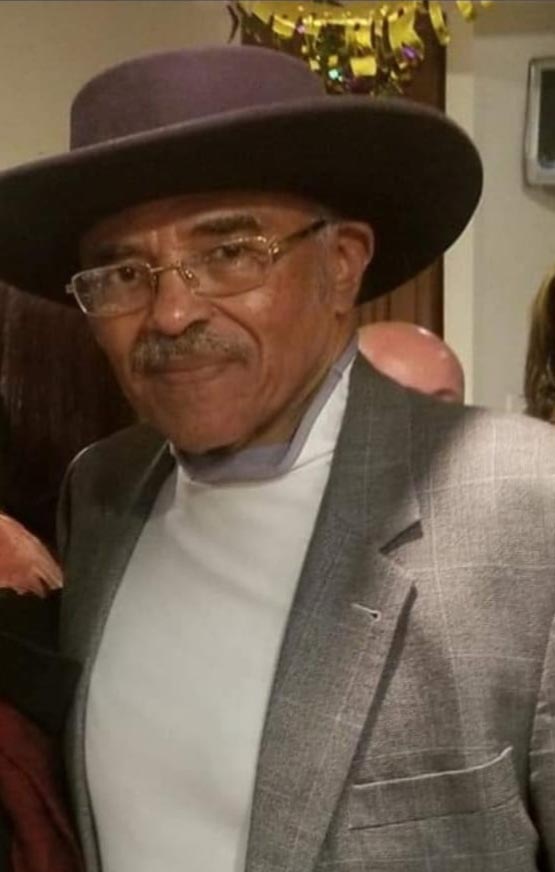
Bedford-Stuyvesant, Brooklyn-raised Thomas Henry Watkins, founder, owner, and publisher of the New York Daily Challenge, passed away on Friday, 19th, December, 2025.
“I am sad to hear of the passing of a legitimately acclaimed Black giant in the person of Tom Watkins,” Rev Al. Sharpton told Our Time Press.
Dr. Ben Chavis, President and CEO of the NNPA–the National Newspaper Publishers Association and long-time Tom Watkins friend, associate and colleague, told Our Time Press, “Publisher Thomas Watkins was an icon in the evolution of the Black press of America. He was the former chairman of the NNPA and was an outspoken leader who cherished the value of truth-telling for freedom, justice, and equality.
Our responsibility today is to keep the legacy of Thomas Watkins alive and impactful.”
Succumbing to health challenges, a key figure in the Brooklyn community for decades, Tommy Watkins was the smooth, charismatic, cowboy hat-wearing, community-centered businessman, that many around the state can point to receiving his helping hand – both in political advancement, education and sports, small business and community achievement.
Legendary broadcaster Imhotep Gary Byrd told Our Time Press, “Giving deepest and sincere condolences to Tom Watkins’ family/extended family and thankfulness to him for embracing the ‘calling,’ he accepted and embraced as a warrior on the Battlefield of the Black Press. The Daily Challenge was the perfect complement to my daily radio broadcast: ‘The Global Black Experience’ on WLIB, and ‘Live from the World Famous Apollo Theatre.’
It was an invaluable service to the community, which gave us a critical media foundation and presence in an often hostile media environment. Tom was a true friend, and a Beautiful Brother–who we acknowledge as a ‘GBE’– a true ‘Giant of the Black Experience.’ May he rest in peace and power.”
With the upliftment of, and constant positive communication with, the Black community, originally based in the massive offices above the Restoration Plaza post office, Watkins created the city’s only Black Daily, the aptly named Daily Challenge, in 1972.
Full disclosure, this reporter began her journalistic career in New York at the paper, and saw firsthand his genuine commitment to the community in which he was raised.
A property-owner, and well-connected businessman with a deep-rooted allegiance to the community in which he grew, a family who had houses, horses, and liquor stores, Thomas Watkins Jr., the one-time boxer, Renaissance man of this time and space, maintained community growth his raison d’etre.
With what at least one admirer describing his “Matinee idol good looks,” seen around town, striding with confidence and purpose with his signature cowboy hat, boots, and ponytail, Chavis continued that Watkins had a “Full baritone voice that always resonated with a consciousness on behalf of Black America.”
Sharpton added, “I have known Tom Watkins and his father all my life. I remember when I was growing up as a boy preacher in Bed Stuy–the New York Recorder, which his father published, and then Tom took over. People aspired to be on their most influential list every year.
They were the ones [reporting] every year, when I was 12 years old and joined Operation Breadbasket–the arm of Dr. King’s organization in New York, led by Reverend William Jones, and Rev. Jesse Jackson, I was the youth director.
The only organ that we had was the Daily Challenge and the New York Recorder, which pushed where the Amsterdam News and others would follow suit. Tom was fearless. If we were boycotting someone, he would cover it every day in the Daily Challenge. If we were dealing with a police issue, he was there.
If we were dealing with a political campaign, he was there. He had the integrity that, in my opinion, was unparalleled by anyone, and he was committed to the cause. He never wanted to bend, buckle, or bow.
I am indebted to them because they invested in me with coverage and encouragement before anyone saw any possibilities of me doing anything that would be worthy of their support. So, I join people all over the diaspora in mourning a true giant, a person that stood up for us, and told our stories, way before you got big ad dollars to get it. Tom Watkins Jr., may he rest in peace.”
Former Daily Challenge columnist the right Reverend Herbert Daughtry told Our Time Press, “I go back with Tom’s father Senior, who used to attend Operation Bread Basket, chaired by Rev. William Jones, Rev Sharpton was the Youth Leader, I was the Executive Vice Chair. The intention was to make corporate America respond to the Black community.
“The old man raised his son in the right way. He was a different kind of publisher and newspaperman. He was very active in the community. He attended private organizing meetings. I feel deeply indebted to him because he gave me an opportunity to write weekly articles in the Daily Challenge and the Afro Times, and improve my feeble writing skills. I hold him responsible because I have now written over 20 books. In every one I felt his influence.”
New York Black media in the 1990s and early 2000s followed a particular strategic playbook. Daughtry stated that, “The Daily Challenge followed the example of Percy Sutton in media, as we in the Black community who were activists, had a media outlet– Percy Sutton with WLIB, and Tommy Watkins with the Daily Challenge. We had a daily feed of information. Not only was he concerned with local affairs, he was very active in the national media trying to bring his organizing skills to that arena.”
A self-described capitalist and promoter of Black community activism and vibrant entrepreneurship, with his Daily Challenge since 1972, Watkins championed the independent Black press, supporting hundreds, if not thousands, of new, young, and established journalists and photographers. There was not a social, economic, political, educational, or other issue affecting the local, national, or international Black community that did not grace the pages of his newspapers over the decades.
Watkins allowed the showcasing of the Black perspective on a myriad of topics. The Daily Challenge became known for comprehensively covering stories and subjects ignored by the mainstream, as they were often popular front-page articles, reporting on, and even stimulating grassroots activism around issues like police brutality, the I-95 gun pipeline, housing and educational inequity, inner city disparities, and movements to challenge violence in the five boroughs.
Watkins allowed for the coverage of politicians and their campaigns, and those of judges, union and business leaders, neighborhood-based leaders and community-focus organizations. Internationally, too, Watkins was not afraid to run analyses and narratives that exposed entrenched false narratives about members of the Black community, leaders, and elected officials. He pushed the envelope to permit accurate reporting void of institutionalized racist bias, forming the foundation.
From national awards like the National Newspaper Publisher Association (NNPA) for articles written about President Robert Mugabe, to giving voice to people like the late educator activists Jitu Weusi, Charshee McIntyre and Herman Ferguson, grassroots advocates Minister Khalid Abdul Muhammad, Abubadika Sonny Carson, and Mumia Abu Jamal, and organizations like CEMOTAP, the Nation of Islam, the December 12th Movement, African Helping Africans, the Patrice Lumumba Coalition.
Now printed weekly, the offices relocated from Restoration Plaza in the late 1990s to their current location on Atlantic Avenue, between Nostrand and Bedford Avenue.
Born in 1937, raised in Bedford-Stuyvesant, the influential Watkins family worked in media and the community. From the co-founding of Restoration Plaza, and supporting the Central Brooklyn Coordinating Council. Thomas Watkins Sr., who worked at The New York Amsterdam News, went on to create The New Recorder, and Tom Jr. followed up with the New York Daily Challenge, the Afro Times, and the New American.
Former managing editor of the Daily Challenge, Dawad Philip, said, “The passing of Thomas H. Watkins Jr, at age 88, is a significant personal blow. On December 20th, 1986, when a mob of white youths chased 23-year-old Trinidadian Michael Griffith from a pizza shop in Howard Beach, and running for his life alongside his stepfather, Cedric Sandiford, Griffith was struck and killed by a speeding car.
That incident sparked a volatile and bitter climate in racial and political tensions citywide over the winter, and brought The Daily Challenge into the national spotlight, signaling the rise of Rev. Al Sharpton, attorneys Michael Warren, Alton Maddox, and C. Vernon Mason, and activist Sonny Carson and Rev. Herbert Daughtry to the forefront of the fight for justice.
It is well chronicled that the city’s Black media with Peter Noel, Lem Peterkin, Nayaba Arinde, Andre Pennix Smith, Wilford Harewood, Utrice Leid, and Andy Cooper [City Sun), Gary Byrd, Vinette Pryce, and so many others would have led that clarion, often with life threats and bomb scares.”
Philip, who led the paper with socially and politically impactful and culturally relevant content continued, “Tom was your classic capitalist, concerned with the bottom line, but when history demanded more, to his credit, Tom stepped up, time and again stood up to wannabe presidents Bill Clinton piggybacking on Sister Souljah all the way to the White House, the Tawana Brawley case, Trump and the racist New York media in the contentious Central Park rape and so much more. The Daily Challenge and Black media stood firm.
For those reasons (for telling our story and coverage of liberation struggles from Namibia, to Zimbabwe, South Africa, Cuba), we owe Thomas H. Watkins a huge debt of gratitude.
My sincere condolences to the Watkins family, his son TJ III, daughter Kerry, and his grandchildren and family. A champion in Black media is no more. Still so, so much to say. Go Brave, Tom!”
Editors, writers, clergy folk, businesspeople, electeds, community activists, and longtime Daily Challenge readers waxed lyrical this weekend over the historic legacy Watkins created.
“Working with Tom Watkins meant bearing witness to some of the most critical moments in Black New York that I’ve experienced from the mid-1980s through the 2000s,” WBLS-FM Openline host and producer Brother Fatiyn Muhammad told Our Time Press.
“Tom covered stories that deeply affected our community—police brutality cases, housing displacement, education inequities, the crack and HIV/AInDS crises, and the ongoing fight for political and economic justice—always with balance, dignity, and truth.”
Reiterating Watkins’ status as a media pioneer, Muhammad continued, “His work reinforced why the Black press matters: to tell our stories when others would not, to challenge power when it failed us, and to ensure our community’s pain, resilience, and progress were never erased. Tom Watkins helped document the real history of Black NYC, and that legacy continues to matter.”
For the most part, many Black journalists always know each other, whether it is through working in the field, covering current affairs, or meeting up at National Newspaper Publishers Association (NNPA) or National Association of Black Journalists (NABJ) events.
Veteran Daily News columnist Jared McCallister told Our Time Press that Tom Watkins “was an innovative businessman and Black press advocate who allowed the stories of the community to be told for decades on his many platforms.
“Tom Watkins was a news icon and an invaluable source of information for the Black community through the Daily Challenge, the Afro Times, and other publications.”
Reporter, editor, and October 22nd Coalition to Stop Police Brutality member J. Andrée Penix-Smith told Our Time Press that she joined Watkins’ Challenge Group in late 1993 as managing editor of the Afro Times, and later an editor and writer for the Daily Challenge, with an intention “to cover every segment of the community, from the Black bourgeoisie to those who suffered the brunt of poverty, discrimination and racism in America.
In my then 25 years as an editor, I had spent many a day fighting with newspaper publishers and broadcast executives who seemed to cater more to the former while skimming over the struggles of the Black community.”
Frontline grassroots activists knew that they could turn to the paper with their news and agendas from addressing socio-economic disparities throughout the inner-city traumas, to fighting for improved housing, to supporting political prisoners, to advocating for parental control of schools, to confronting neo-colonial machinations on the Continent, and reporting on everyday people’s victories and struggles across in the Caribbean. Daily Challenge writers had their ears close to the ground and stayed on top of the stories in the community.
“After working several months at the paper, I took a chance and, without Tom’s permission, changed the tri-colors of the banner from red, white, and blue to Red, Black, and Green, knowing that it may have been the last edition I sent to the printer,” said Penix-Smith. “Remarkably, it was fine with Tom, and I remained with the Challenge Group for nearly a decade.“
“Nana Thomas Watkins, his family and team have been stalwarts of journalism, and giants in African American media institution building,” Dr. Segun Shabaka told Our Time Press. The Executive Director of the International AFRICAN ARTS FESTIVAL, formerly the executive director of the East Cultural Center and editor of its communication organ, Black News.
“To envision, build, and maintain a decades-long daily newspaper with a focus on the issues of the Black community is more than admirable; it calls for high praise. Having edited a monthly newspaper (Black News) for a number of years, I think about the daily task of pulling together the content around local, national, as well as international issues of politics, economics, education, religion, arts, culture, sports, etc. Then, the finances to print the newspaper and distribute it.
It seems overwhelming. But he, picking up and carrying forward the legacy of his father, has done it for decades. May God be good to him and the joy he left lasts forever.
Cinque Brath, activist and son of the late Pan Africanist advocate and educator Elombe Brath, told Our Time Press, “I was saddened by the passing of Tom Watkins, a legendary publisher and tireless advocate for Black journalism and community empowerment. As the publisher of Daily Challenge, Afro Times, and New American, Tom often allowed my father Elombe Brath to get his stories published. For several years, the Daily Challenge was a ritual for him.
My father loved to provide content because he believed Tom had dedicated his life to amplifying the voices of Black New Yorkers and ensuring stories that mattered most to our communities were seen and heard. His work helped sustain independent Black media in Brooklyn and beyond, shining a spotlight on issues of justice, equity, and opportunity for generations of readers.
Known for his entrepreneurial spirit and deep commitment to community, Tom leaves behind a powerful legacy of advocacy, connection, and unwavering support for the freedom of the press. His contributions will continue to inspire journalists, activists, and citizens alike. Rest in power, Tom Watkins — your impact will not be forgotten.”
Kwasi Akyeampong. Editor/Publisher at TheBlackList.net, said, “No other newspaper compared to The Daily Challenge. It was the only paper to get the real news from Africa and the diaspora. I used to travel from the Bronx to Brooklyn and I would change trains at Columbus Circle just to buy the Daily Challenge. It inspired me to create TheBlackList.
Speaking on the passing of Assemblyman Al Vann in July 2022, Watkins could have been quite easily describing himself when he said, “Al Vann, a man who always focused his energies for the betterment of the community.”
“My experience with Mr. Watkins was that he injected capital into my business when I was starving for funds. In addition, he sent lots of business my way that gave me life support throughout my early days of my business,” businessman Kwame Odesanya told Our Time Press. In the 2000s, he was the founder of Clinton Hill’s OBE Computers, which offered computer time for hire and printed everything from newspapers to posters and pamphlets. “A very strong community fighter of small Black businesses. Thank you, Mr. Watkins, for all your help and commitment to the Black community.”