

“Healthcare is a Right, Not an Opportunity”
by Bernice Elizabeth Green
The continuing fight to keep Interfaith Medical Center alive and running received reinforcement… and new armor … when Harry Belafonte led a post-play talk inside the Brooklyn facility in Central Brooklyn on Atlantic Avenue on February 1, 2014.
Mr. Belafonte’s visit to the ailing medical center included a viewing of New Brooklyn Theatre’s presentation of Edward Albee’s 1958 one-act play “The Death of Bessie Smith,” directed by Jonathan Solari. This “opening act” for the Belafonte talk was set in a 1937 segregated hospital in the South, and it touched on human rights/human dignity themes that have coursed through Mr. Belafonte’s comments to groups and people all over the world over the years. “Healthcare is a right, not an opportunity.”
Belafonte was at home in the doctors’ conference room, doubling as a mini-Little Theatre with an audience of approximately 60 people in fold-up chairs. Play props – a Victrola, Screenplay Magazine, a gooseneck light, telephone, and even one doctor’s pair of saddle shoes – were accurate to the historical period. Interfaith’s hospital examination room served as the male dressing room, and the lobby was substituted as the ‘green room” waiting area for the actors.
The theatrical and the medical were so intermeshed that when actual latecomers to the play entered the hospital and saw “doctors” in “bloodstained gowns” pacing and requesting “medical records” (script sections), they thought they were witnessing a triage. In one sense, they were. The “Death of Bessie Smith” production, billed as a play inside a play, parallels the day-to-day life-and-death struggle unfolding over the past two years at Brooklyn’s Interfaith and other hospitals throughout New York City. Belafonte, a Civil and Human rights activist, has witnessed this kind of drama related to medical and health inequities for more than seven decades all over the world, and he chooses not to be silent about it.
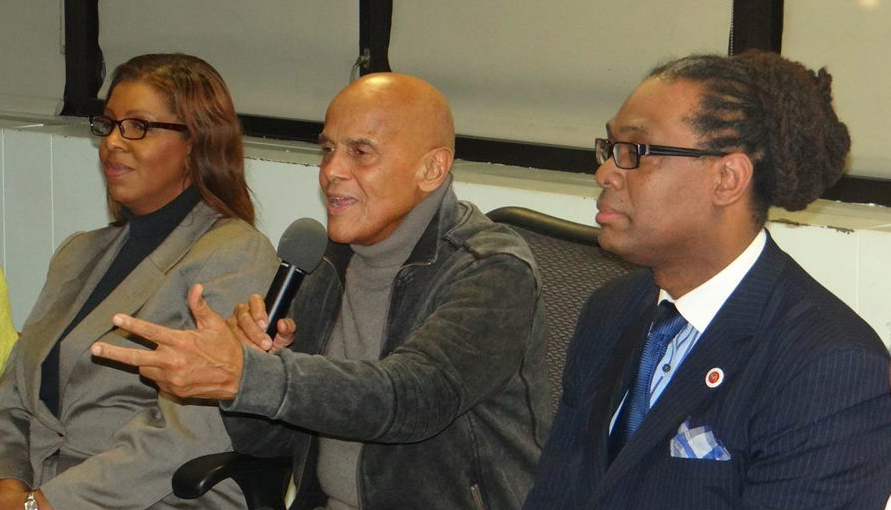
At the end of the 90-minute play, the audience, along with Mr. Belafonte, was directed to the cafeteria next door, where staff members, including nurses, supporters, physicians, and community advocates, were waiting. Mr. Belafonte’s discussion partners included representatives from 1199 SEIU, medical doctors, and political leaders Letitia James, New York City’s Public Advocate, and NYC Councilman Robert E. Cornegy, Jr. (D-36).
“This effort was designed to bring attention to the plight of Interfaith,” said a moderator. “It also illustrates the power of the arts to move people and fuel movements. Something Belafonte knows about. He has experienced almost every major human and civil rights action nationally and internationally during, as he said, his ‘almost 100 years of life’.”
The actors’ brought him back to his early career in the opening of the discussion, moderated by NBT’s Andrea O’Neal and Jeff Strabone. “Belafonte (always) used his art to impact the community. And like Miss Dee and Mr. Davis, he raised his voice on issues that affected them unfairly. In churches, apartments, and rooms, he would say, ‘Our communities gave us the platforms. They planted the seeds for us and gave us a wonderful harvest.’ ”
From that introduction, Belafonte segued to the problems at Interfaith and their relation to world scenes. He revealed how he was appalled at the lack of consideration and concern for the health needs of the community and the Brooklyn community’s uphill battle to demand “a right.”
He applauded the actions of community leaders in keeping the struggle alive, comparing them to “warriors” who did not run away but who “stepped into the fray. “Give me a Robeson, a Roosevelt, give me the people in the trenches; they are a validation of all people.”
He called for the grassroots to stand and raise their voices; he called for the activation of the American promise to the people to embrace and improve the lives of the most vulnerable, the tired, and the poor.
He talked about the new “changing” Brooklyn and how all of the people must become part of it. “But you can’t change and leave (others) behind.”
He spoke of his admiration for 1199, a mainstay for workers for decades, reminding his audience of how, from small groups and small tasks, big movements are built. He reminded how 1199 consisted of several hundred mostly Euro workers. “Now it’s well over 400,000 voices … the largest local in the U.S., deeply committed to healthcare.”
He declared that change could happen if we all work together, reflecting on global connections and “common ties that bind us together.”
In the audience was Ramon Rodriquez, who identified himself as a worker at Wyckoff Hospital, where he happens to hold the title of President and CEO. “Change can happen if we work together and go up to Albany with a plan. If my child were living in Bed Stuy, he would have to travel to another neighborhood to get the services he can get right here at this hospital!”
And in the plan, noted Belafonte, should be strategies for a new way of doing things: of working together, of human relations. It’s also about the struggle, making choices, and demanding the freedom to choose. “It’s about class, equality, as well as health care.” And it’s about everyone being humanitarian to the core, he noted.
One participant commented that Brooklyn’s effort to save Interfaith could be its “Rosa Parks” moment. “It’s not just a hospital concern; it’s a justice concern.”
Belafonte’s words were uplifting, and the ones unspoken were the most powerful: center stage must move to where the people are, or the people must demand and take center stage.
The great giant of an actor and of a man admonished that the word quality must be added to education and, by extension, healthcare.
“When a hospital closes, people die,” said Mr. Belafonte. “Education and healthcare are rights. We can’t view them as opportunities. To be purchased.”