
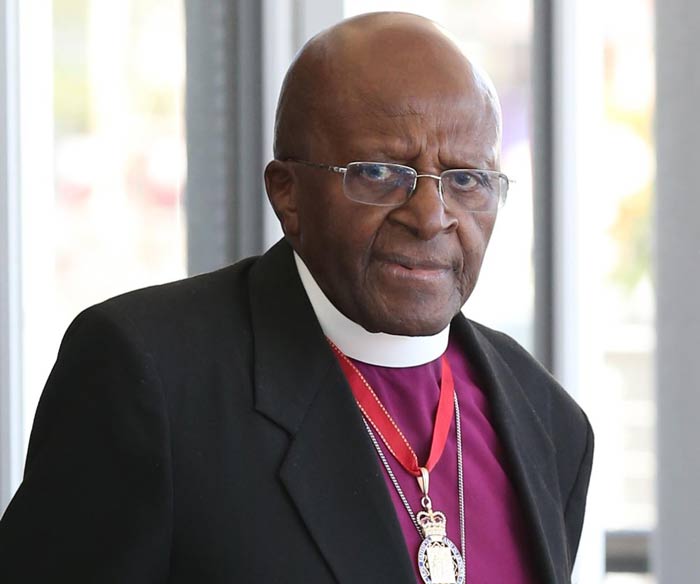

JOHANNESBURG, Dec 26 (Reuters) – Archbishop Desmond Tutu, a Nobel Peace Prize laureate and veteran of South Africa’s struggle against apartheid who was revered as his nation’s conscience by both Black and white, died on Sunday aged 90.
Tutu won the Nobel prize in 1984 in recognition of his non-violent opposition to white minority rule. A decade later, he witnessed the end of that regime and chaired a Truth and Reconciliation Commission, set up to unearth atrocities committed under it.
Ever outspoken, he preached against the tyranny of the white minority.
After apartheid ended, he called the Black political elite to account with as much feistiness as he had the Afrikaners, but his enduring spirit of reconciliation in a divided nation always shone through, and tributes to him poured in from around the world on Sunday.
South African President Cyril Ramaphosa described Tutu in a televised address as “one of our nation’s finest patriots” adding, “our nation’s loss is indeed a global bereavement.”
U.S. President Joe Biden said Tutu followed his spiritual calling to create a better, freer, and more equal world. “His legacy transcends borders and will echo throughout the ages.”
“Archbishop Desmond Tutu was a mentor, a friend and a moral compass for me and so many others,” former President Barack Obama said. “He never lost his impish sense of humour and willingness to find humanity in his adversaries.”
Bill Clinton called Tutu’s life “a gift.”
TWO NOBELS ON ONE STREET
Born near Johannesburg, Tutu spent most of his later life in Cape Town and led numerous marches and campaigns to end apartheid from St George’s Cathedral’s front steps.
Tutu died “peacefully” on Sunday morning in a Cape Town nursing home, a representative of his Archbishop Desmond Tutu IP Trust said. He will lie in state at St George’s on Friday before his funeral service there on Saturday, it said.
Looking frail and in a wheelchair, he was last seen in public in October at St George’s Cathedral in Cape Town – a one-time safe haven for anti-apartheid activists – for a service marking his 90th birthday.
He was diagnosed with prostate cancer in the late 1990s and was later hospitalized several times to treat infections associated with treatment for it.
In his final years he also regretted that his dream of a “Rainbow Nation” had yet to come true, and often fell out with erstwhile allies at the ruling African National Congress party over their failures to address the poverty and inequalities that they promised to eradicate.
Just five feet five inches (1.68 metres) tall and with an infectious giggle, Tutu travelled tirelessly through the 1980s to become the face of the anti-apartheid movement abroad while many of the leaders of the then rebel ANC, including future President Nelson Mandela, were behind bars.
Long-time friends, Tutu and Mandela lived for a time on the same street in the South African township of Soweto, making Vilakazi Street the only one in the world to have been home to two Nobel Peace Prize winners.
“His most characteristic quality is his readiness to take unpopular positions without fear,” Mandela once said of Tutu. “Such independence of mind is vital to a thriving democracy.”
‘A PROPHET AND A PRIEST’
Having officially retired from public life on his 79th birthday Tutu – who once said of himself: “I wish I could shut up, but I can’t, and I won’t” – continued to speak out on a range of moral issues.
John Steenhuisen, leader of opposition party The Democratic Alliance, said Tutu’s spirit would live on “in our continued effort to build a united, successful, non-racial South Africa for all.”
In 2008, Tutu accused the West of complicity in Palestinian suffering by remaining silent.
In 2013, he declared his support for gay rights, saying he would never “worship a God who is homophobic.”
Archbishop of Canterbury Justin Welby on Sunday hailed Tutu as “a prophet and priest” while Pope Francis offered heartfelt condolences to his family and loved ones.
In a letter to Tutu’s daughter Reverend Mpho Tutu, Tibet’s spiritual leader, the Dalai Lama, said the world had “lost a great man, who lived a truly meaningful life.”
“We are better because he was here,” said Martin Luther King’s daughter Bernice.