

by Fern Gillespie
The first and largest battle during the Revolutionary War happened in Brooklyn and Black soldiers on both the British Loyalist side and the American Patriot side were there.
From July 1–November 15 at Lefferts Historic House, Prospect Park Alliance will showcase the exhibit “Black People and the Battle of Brooklyn.” The exhibit, which ties in with the 250th anniversary, explores the Revolutionary War’s Battle of Brooklyn and the roles Black people played. The Continental Army’s General George Washington and the British Loyalist’s General William Howe were there as opposing commanders.
The battle happened in August 1776, after the signing of the Declaration of Independence. Over 50,000 soldiers fought in the battle. This included the collaboration of 32,000 British and Hessian soldiers, in addition to 19,000 American Patriots. After the Battle of Brooklyn, the British would occupy Brooklyn for seven years. Our Time Press spoke with the team that created the exhibit.
“Over the course of the war, for seven years, the British recruited 10,000 to 20,000 Africans enslaved in the southern states. On the American side it was 5,000 to 10,000 both enslaved and free,” Dylan Yeats, Director of Museum Programs and Operations at Lefferts Historic House Museum, told Our Time Press. There were both enslavers and abolitionists within the American Patriots and British Loyalists. Both armies recruited enslaved Africans offering the possibility of freedom.
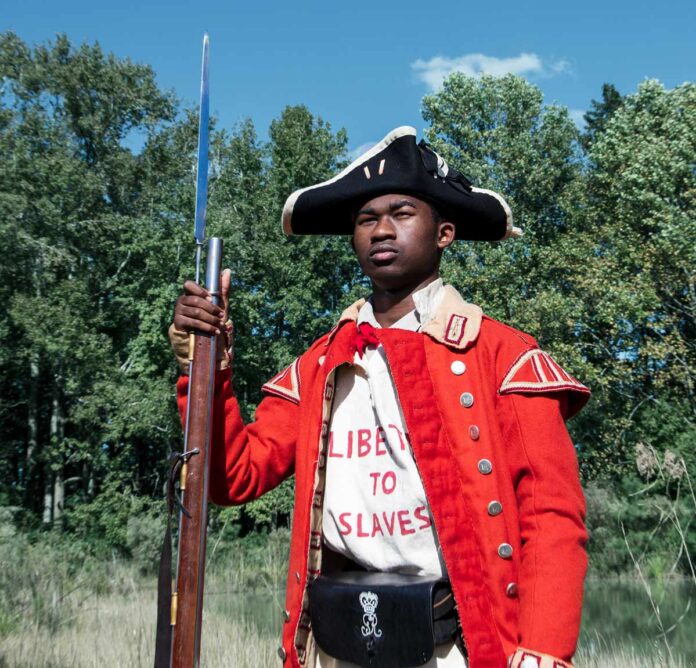
An estimated 800 Black soldiers fought as British Loyalists at the Battle of Brooklyn. This included members of the Royal Ethiopian Regiment. The regiment was started in Virginia by Lord Dunmore, who had been governor of New York and Virginia. He was also a slave-owner. “As the revolution was breaking out, Lord Dunmore put out a call that persons enslaved by American supporters could join the regiment and were promised their freedom,” said Yeats. “When the British decided to make New York the focus of their response to the Declaration of Independence, they sent the Ethiopian Regiment to Staten Island, where they trained. Then, they were part of the invasion of Brooklyn. They wrote on their uniform Liberty to Slaves.”
At the Battle of Brooklyn, there was the American 14th Continental Regiment, and integrated unit that included Black boat men. “There was this regiment from Marblehead, Massachusetts of Black boat men, who were whalers,” Yeats added. “There were dozens or hundreds of Black boat men who were instrumental in the retreat of the American army across the East River.”
It was common for slave-owners to send enslaved Blacks to fight the war in their place. “There were Black people who did fight in the war who were drafted and sent on behalf of their enslaver. When they got into the war, there were struggles they had to go through. Like not being in the books and some who were killed in battles were listed as deserted,” said Natasha “Tash” Fearon, Museum Educator and Public Programs Coordinator at the Lefferts Historic House Museum.
“It was interesting that some people got their freedom. They could’ve disappeared after the war, but chose to go back to a place that they knew really didn’t afford them any good. They went back to hard work. They went back to being enslaved. It makes you start to think about what they really had to go through. What they were struggling with. Should they leave their freedom? Should they find their families? Or should they go back to devil that they knew because, there were things that were drawing them back home?”
During the British occupation, there were enslaved Black colonials in Brooklyn who were involved with the British as spies, soldiers, engineers and various kinds of workers. “General Howe’s secretary, a man named Ambrose Serle, writes about paying enslaved people to gather intelligence about how many Americans were here and where are the forts,” said Yeats.
“The Battle of Brooklyn has so many major players that you see in coverage of the Revolution and they are all coming together right here in Brooklyn. Having this information, gives more context about what this period of war and occupation was like for people who would have been enslaved here in Lefferts,” said Riah Kinsey, Public Programs Manager at Lefferts Historic House. “Although our research doesn’t specifically address individuals that have been enslaved here, it does raise a lot of possibilities about what they would’ve been encountering.
They would be encountering Black people from Virginia and Maryland who had come up to fight with the British. People who would’ve been from a very different background from them. Even language wise. The people enslaved here would have been Dutch speakers.
So, I imagine coming face-to-face with people who are also Black fighting for the British, who are also enslaved but coming from a different language and environment, I wonder what that would’ve been like. I wonder if that interaction could’ve played into decisions that people made whether to stay or try their hand at escaping.”
Prospect Park has been collaborating with the Black Loyalist Heritage Center in Nova Scotia, Canada to research Black New Yorkers that migrated after the Revolutionary War. The British had offered freedom to enslaved Africans that were soldiers or working for British.
In the Treaty of Paris, Americans wanted to reclaim those Black people that were working for the British. The British refused, but agreed to list Blacks they emancipated. Instead, the British evacuated the 3,000 Black British Loyalists to Canada after the Revolutionary War. Some of them were New Yorkers.
On August 22, there will be a Battle of Brooklyn 250th Anniversary Reenactment and Commemoration from 10:00am – 12:00pm at Prospect Park. The exhibit “Black People and the Battle of Brooklyn” is located outside of the Lefferts House Museum. The public is invited to view the eight-panel educational display, a special feature of Prospect Park’s 250th celebration. For more information, visit www.prospectpark.org/lefferts