

Fern Gillespie
The Emancipation Proclamation abolished slavery throughout the United States when it was signed by President Abraham Lincoln on January 1, 1863; yet slavery did not end in Texas until June 19, 1865. Black people remained enslaved in Texas for over two years under the control of Confederate enslavers.
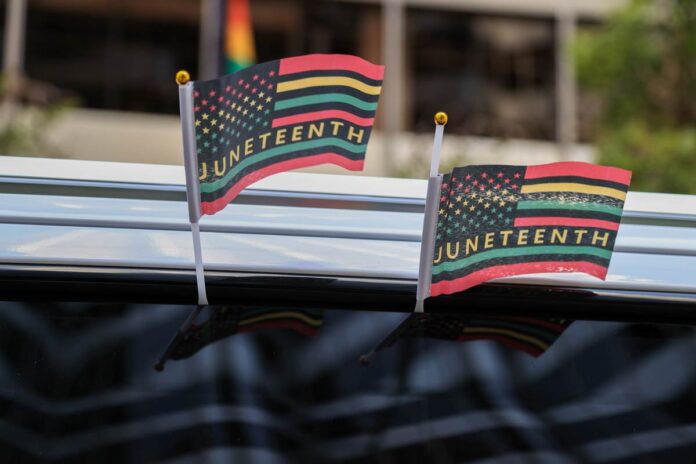
Juneteenth celebrates the date when Union troops invaded Galveston, Texas, to free Black enslaved people and enforce the Emancipation Proclamation. In 2021, President Joe Biden signed the Juneteenth National Independence Day Act into law.
For generations, many Black communities have honored June 19th as the official abolishment of slavery through celebrations. “The people in Augusta, Georgia had us calling it Family Day. Every June 19, we would get together and have a big celebration and church people would be cooking out. It would be a big joyous time,” recalled Brenda Brunson-Bey, founder of the Co-Operative Culture Collective and head of Brooklyn’s oldest Juneteenth celebration, told Our Time Press.
“I don’t care what day it was on, we had to go. It didn’t matter if June 19 was a school day, we would just not go to school. Many churches did it, but it was more the people-oriented churches that did it. The kind of so-called Negro churches.”
Historian Dr. Lynda R. Day, Professor of Africana Studies and Director of Africana Research Center at Brooklyn College has observed themes of Juneteenth that have been handed down for generations. “There have been traditional symbols of Juneteenth celebrations such as wearing red, serving red themed foods such as strawberries and red velvet cake.
Some people bring these elements into their celebrations,” she told Our Time Press. “Juneteenth celebrations are an affirmation of America’s commitment to freedom for all of its citizens. The end of the long nightmare of state-sanctioned enslavement of one class of Americans called into question the basic ideals outlined in the Declaration of Independence.”
It wasn’t until Brunson-Bey was a student at HBCU Morris Brown College in the 1960s, that she discovered the history behind Family Day. She would still return home to Augusta to take her grandmother to Family Day. “It was our connection and ritual,” she said. “Then a classmate from Houston told me that she was going home for Juneteenth. That was the first time I realize we were celebrating the same thing.”
On Friday, June 19, Brunson-Bey will host the Juneteenth Pan African Street Celebration’s 29th anniversary from 12:00 noon to 6:00pm at Sista’s Place, located at 459 Nostrand Avenue. Spring McClendon, her longtime partner in producing the event, died this year. This is the sixth year a Sista’s Place.
The theme, “Standing on Their Shoulders and Walking into Our Future,” focuses on Black youth. There will be teen age singers, musicians and poets. There will be a fashion show and vendors. “This is a way of introducing our youth to their history,” said Brunson. I want to focus on this to give youth more of our stories. Because it’s their stories now.”
For 17 years, Athenia Rodney Founder and CEO of Juneteenth NYC and Executive Director of Umoja Events, has staged Juneteenth NYC events in Brooklyn. This year, from June 12 through June 20, Juneteenth NYC will host events ranging from a Black Kings Gala in Queens honoring Black men, a Brooklyn Black-owned restaurant crawl, and a virtual empowerment and education summit.
On Saturday, June 20, Juneteenth NYC will host its festival celebration at Gershwin Park at 871 Vermont Street with a fashion show, parade, live performances, Kidzone, sports clinics and a major vendor market.
Juneteenth NYC is a family friendly community event. “Our pillars center around and empowerment and education,” Rodney told Our Time Press. However, during the current Trump administration, her African American celebration has confronted resistance in marketing and funding. “During this administration, we’ve had a lot of challenges. Meta had removed our Instagram page three times.
They basically state that we have posted inappropriate material! Everything on our page has been nothing but education and our history.
We had over 10,000 followers and our page was removed and taken down. Then we had to start over,” she said. “We had a lot of corporate sponsorships. This year, all of them have chosen to stop and step back because they don’t want to have any engagement, because Juneteenth talks about diversity. So corporate sponsors have removed themselves from engaging with us and participating.”
The Trump administration’s anti-diversity agenda has had disastrous effects on many African American nonprofits receiving funding from corporations and foundations.
The anti-diversity agenda has expanded to ceasing free-admission days to National Parks on Martin Luther King Day and Juneteenth. The parks were sites of major Juneteenth celebrations and Martin Luther King Day volunteer “day of service” activities.
“I was celebrating Juneteenth in the 1980s before it became a holiday. I knew what Juneteenth was. It’s part of our legacy and part of our history. People should know about what happened to the folks in Galveston Texas. It’s historically important.” Peter Williams, a professor of civil rights at Medgar Evers College and on meritocracy and inclusion at Harvard University, told Our Time Press.
Williams is a longtime civil rights activist and official. He is a former Executive Vice President for Programs at the national NAACP and his late wife Jacqueline Berrien was a leading civil rights lawyer and former chair of the Equal Employment Opportunity Commission under President Obama.
Although he is a longtime advocate of Juneteenth, Williams does not believe it was necessary to become a legal holiday. “Juneteenth is important, but it’s not contemporary legislation that that would really impact us politically and economically in this country,” he said. “So, I always felt that they passed this legislation so they could say we did something for Black folks. It’s not timely and doesn’t impact public policy. I thought that at that point we needed other legislation around voting rights that were much more critical. Like the John Lewis Voting Rights Advancement Act.”
Brunson-Bey and her family have been celebrating Juneteenth at picnics and barbeques for generations before it became a national holiday. It was part of their life. “I remember I was around nine or 10 years old and I asked my grandmother: ‘Grandma, why do we have to go there every June 19?,’” she said. “My grandma told me ‘That’s our Freedom Day. That’s about our freedom.”
This year in Brooklyn, other Juneteenth celebrations include: Weeksville Heritage Center Food Festival, BRIC Juneteenth Family Celebration, Prospect Park Cookout Party, Brooklyn Children’s Museum, Brooklyn Museum’s Museum on Wheels in Fort Greene, and Herbert Von King Park.