

By Mary Alice Miller
In 2025, over 3,000 violence victims came through Brookdale Hospital Medical Center’s Emergency Department. Brookdale has developed a trauma-informed care system that meets the needs of those affected.
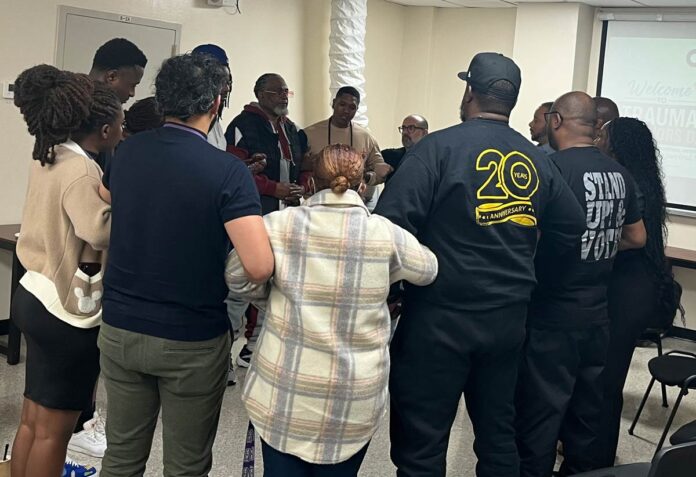
Brookdale celebrates an annual Trauma Awareness Day that recognizes the rejuvenation of the mind, body, and spirit in honor of Trauma Awareness Month. Hosted by Akeisha Knights-Ogudoro and Dr. Roy Lacey, this year’s keynote focused on mental health support as part of the healing process.
Trauma Medical Director Dr. Abdel Naby said, “It takes a lot of work to get people safe and back home to their families. There is not only a bodily injury, often times it is an injury to mental health, social well being, and families.”
Dr. Jermaine Traudry, Director of Social Medicine in the Emergency Department, said, “The Emergency Room is the entry point for trauma care in the hospital. When we are trying to address the scourge of violence in the community, it takes a team, an interdepartmental approach within the hospital. In addition, Brookdale does not exist in solitude; it exists within the community. We all need to work together to address violence
Dr. Roy Lacey, Trauma Director of Community Outreach/ Injury Prevention, spoke about the significance of Trauma Awareness Day.
“Due to the nature of our work, sometimes we get tunnel vision because we are so hyper-focused on the acute situation,” said Dr. Lacey. “Once a year, this day gives us a chance to refocus on the resilience of the survivors and spend time getting to know the person rather than the patient.”
Dr. Lacey added, “In my work, most of the time when people come in they cannot talk to you, there is blood, and a lot of things happening all at the same time. But here we can actually sit down and interact as normal people after the recovery has been ongoing out of the acute setting. I rarely get to see that.”
Akeisha Knights-Ogudoro, LMSW, Director of Community Violence Prevention, said, “Recovery does not happen in isolation; it happens in a community atmosphere. We recognize community partners, anti-violence teams from Man Up, Inc., All Kings, Inc., and Elite Learners. We cannot do this work in isolation.”
Keynote Speaker Dr. Jason Hershberger, Chair, Department of Psychiatry, talked about the role of mental health in healing from trauma.
“Traumatic injury is a special kind of life event. It’s not something most people plan for. It doesn’t ask permission. It usually begins suddenly with a fall, a crash, an accident, an act of violence, a moment of danger, a phone call, a siren, or a rush to the hospital.
“For the injured person, there may be pain, shock, confusion, or fear.
“For the family, there may be panic, helplessness, and a desperate need to know whether the person they love is going to survive.
“Survivors are not only given emergency treatment but a chance to heal, recover, adapt, return to their lives, and sometimes build a life that is different from what they imagined, but still meaningful, still full, and still theirs.
“Today is a day to honor people who have endured something profound, something frightening that may have changed their bodies, their lives, their families, their sense of safety. Surviving traumatic injury requires extraordinary physical resilience, endurance, the ability to adapt to pain, limitation, therapy, uncertainty, and the slow pace of healing.
“As a psychiatrist, I know that traumatic injury does not only happen to the body. It happens to the mind, the heart, and the soul. The unexpected nature of traumatic injury challenges all three.
“The mind asks what happened? What will my life look like? Will I be the same? Will I recover? Will I be safe again?
“The heart, meanwhile, has its own work to do. The heart has to process fear, anxiety, grief, anger, vulnerability, and sometimes the risk of despair.
“And then there is the soul. The soul asks some of the hardest questions of all. How could this happen to me? Why did my life change this way? What am I supposed to do with this?
“These are deeply human questions, and they don’t always have easy answers. Sometimes they don’t have answers at all. At least not right away.
“But, they matter because recovery is not just about getting through the injury. It is about finding a way to live with what happened, to accept what must be accepted, to struggle with what’s difficult, and keep moving forward.
“Sometimes healing means becoming someone who carries the injury, the memory, and the scars – visible or invisible – and still finds a way to move forward.
“No one should have to do that alone.
“I am always moved and often amazed by the support; people come to terms with their post-injury situation.
“Recovery requires a community of support. Family, loved ones, and faith can help people understand, accept, and struggle with their injury and their recovery.
“Sometimes the nature of the injury or its meaning requires even more support. That is when mental health care can sometimes add support.
“Sometimes, just talking helps a person find a path to recovery. Talking can help organize what feels overwhelming; it can help a survivor tell a story of what happened in a way that becomes less frightening over time. It can help with grief, fear, anger, guilt, or sadness.
“It can help families, too, as they adjust to the change that traumatic injury can bring.
“And sometimes medication can help soothe the frayed nerves and emotional overdrive that traumatic injury can evoke. It can help with anxiety, sleep, depression, panic, and the sense that the mind and body are still living in a state of alarm.
“There is no shame in needing that help. It is part of healing. The mental, emotional, and spiritual wounds can heal, too.
“Today, I have the honor of celebrating people who are on this path.”
Several patients were given awards for their dedication to their healing and recovery, including Ayodele Jinane, James Culmar, and others.
In addition, ten staff members were recognized for their work in the trauma recovery healing process.