
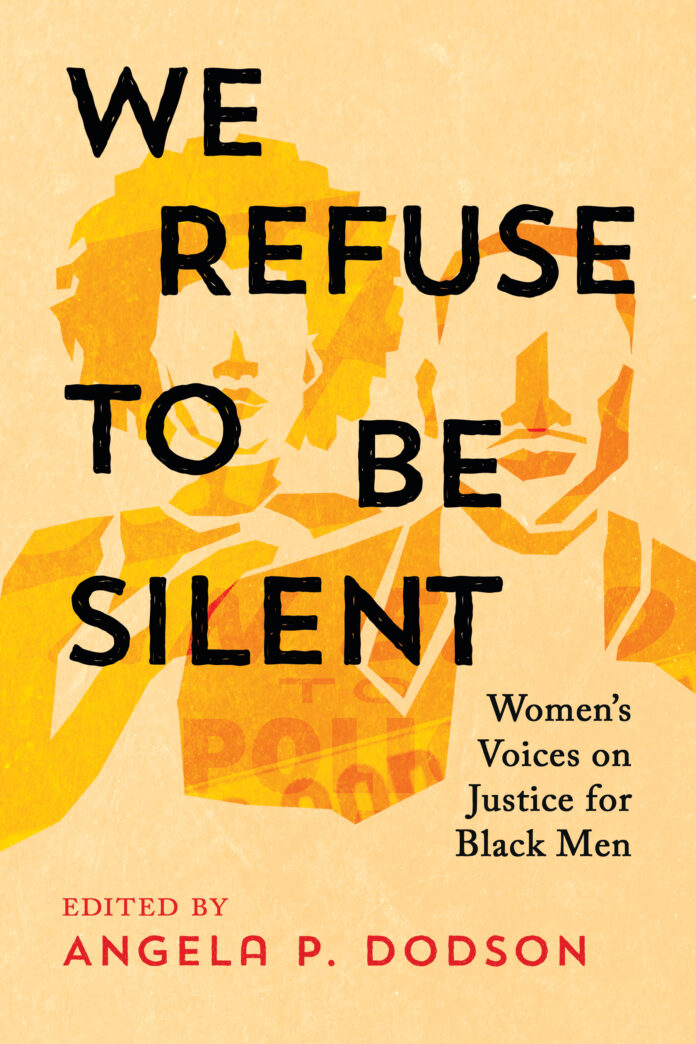

Women’s Voices on Justice for Black Men
We Refuse to Be Silent: Women’s Voices on Justice for Black Men
Edited by Angela P. Dodson
Broadleaf Books, 33 pages. 2024
“When I think about my son sometimes, I can’t breathe. I can’t allow myself to even visualize him out of the world, moving, just being a young man in America. If I did, I would never let him out of my sight.”
Donna Hill, Author
“A Mother of Suns” in We Refuse to Be Silent
Donna Hill’s fear for her son speaks to the premise of Angela P. Dodson’s edited collection of compelling essays in the book, We Refuse to Be Silent: Women’s Voices on Justice for Black Men (Broadleaf Books, 2024). Dodson’s book contributes to the national conversation on the nature of injustice and the strategies needed to address police brutality, reforms in policy, prison reform, systemic racism, the rise of a police state, and the violent arrests and brutality levied towards Black men and, more recently, immigrants of color in this country. Drawing on essays by 35 women journalists, scholars, psychologists, and ministers, Dodson has compiled a powerful testament that documents Black women’s refusal to remain silent regarding injustice and their responses and analyses of this state of affairs in the United States of America.
The introduction to We Refuse to Be Silent opens with the words “Another Black man, some mother’s son, some woman’s husband, somebody’s brother, some child’s father will die.” “Emotion” and “Activism,” parts one and two of the volume, present essays from writers including Elizabeth Alexander, Donna Brazile, Tananarine Due, Audrey Edwards, Gloria Browne-Marshall, and Isabel Wilkerson, among others.
“The Trayvon Generation.” This is the name that Elizabeth Alexander gives to young people who have grown up in the past 25 years. These are the young people who have been witnesses to the killing of Trayvon Martin, George Floyd, Breonna Taylor, Eric Garner, Tyre Nichols, Sean Bell, and others. The media has inundated them with images and stories of violence and tragic killings in a variety of public spaces.
Alexander advocates immersing our sons in experiences that give them joy and the power of communal self-expression. She provides examples of poets, filmmakers, playwrights, musicians, and artists who have given us ways to express our fears. “We are no longer enslaved. Langston Hughes wrote that we must stand atop the racial mountain ‘free within ourselves’” are the closing lines of her essay.
In “I’m Just Different;’ Disabled at High Risk of Harm by Police,” Dodson recounts the tragic story of Elijah McClain, a twenty-three year old massage therapist and violinist who, while walking home from a convenience store in Aurora, Colorado, is stopped by police officers because someone has called in about seeing a suspicious character. Elijah is wearing a ski mask because he is cold.
When the officers approach him, they put him in a carotid-control while he pleads to them: “ I was just going home. I’m an introvert. I’m just different. That’s all. I’m so sorry. . .” His words are a desperate call from a man who may have mental challenges. Elijah is eventually taken to the hospital and is announced dead as a result of cardiac arrest. An image of his words goes viral on social media, and cam video footage of the officer’s violent actions becomes available.
The response to Elijah highlights the fact that many Black men who are targeted by the police suffer from some form of disability or mental illness. Dodson cites research documenting the fact that up to half of all people killed by police in the United States are disabled and that almost all well-known cases of police brutality involve a person with a disability.
Jackie Jones’s story of her 20 year old son being arrested because of mistaken identity in the essay “Two Tonys: Black Man and Prison,” is a chilling account of what can happen to Black men who do not have the support and resources to turn to when they are subjected to intense interrogation by police officers because they may have the same name as another person. Her son, Anthony P. Jones, narrowly escapes being sent to the penitentiary. Jones’s opening statement, “Every parent of a teenager or young adult fears the phone call in the middle of the night,” will resonate with many mothers.
Keeanga-Yamahtta Taylor in the essay “The Emerging Movement for Police and Prison Abolition,” introduces readers to Mariame Kaba, an educator and organizer whose book We Do This Til We Free Us: Abolitionist Organizing and Transforming Justice provides an overview of the literature on abolitionist politics. Writers in the book advocate that increasing rates of incarceration have a minimal impact on crime rates.
In other words, if there is a mismatch between crime and harm, what is the intent of the criminal justice system? Kaba argues that the criminal justice system is really a “criminal punishment system.” This concept is at the core of abolitionist politics, a concept based on the belief that people can change in changed situations. It is antithetical to the current criminal justice system, which assumes that millions of people require policing, surveillance, containment, and prison.
Gloria Browne-Marshall, in her essay “Why They Kill Us,” issues a call to action: “We can heal generational trauma and push back against the murders with litigation, legislation, and protest.” Her statement affirms Rev. Dr. Martin Luther King Jr.’s warning that “Injustice anywhere is a threat to justice everywhere.”
Angela P. Dodson is a journalist, author, a former senior editor for the New York Times, and a former executive editor of Black Issues Book Review.
Dr. Brenda M. Greene is Professor Emeritus and Founder and Executive Director Emeritus of the Center for Black Literature at Medgar Evers College, CUNY. For more information, visit https://www.drbrendamgreene.com