

By Mary Alice Miller
Research Day is an exciting time at Brookdale Hospital. For nine years Brookdale has hosted Annual Research Day, an opportunity for residents, students, fellows, and staff of all departments to showcase their work.
Medical professionals at One Brooklyn Health see and treat a wide variety of patient health issues. Research Day allows those medical professionals to choose a topic of interest to them and present it. During the pandemic, Research Day had many topics related to Covid-19.
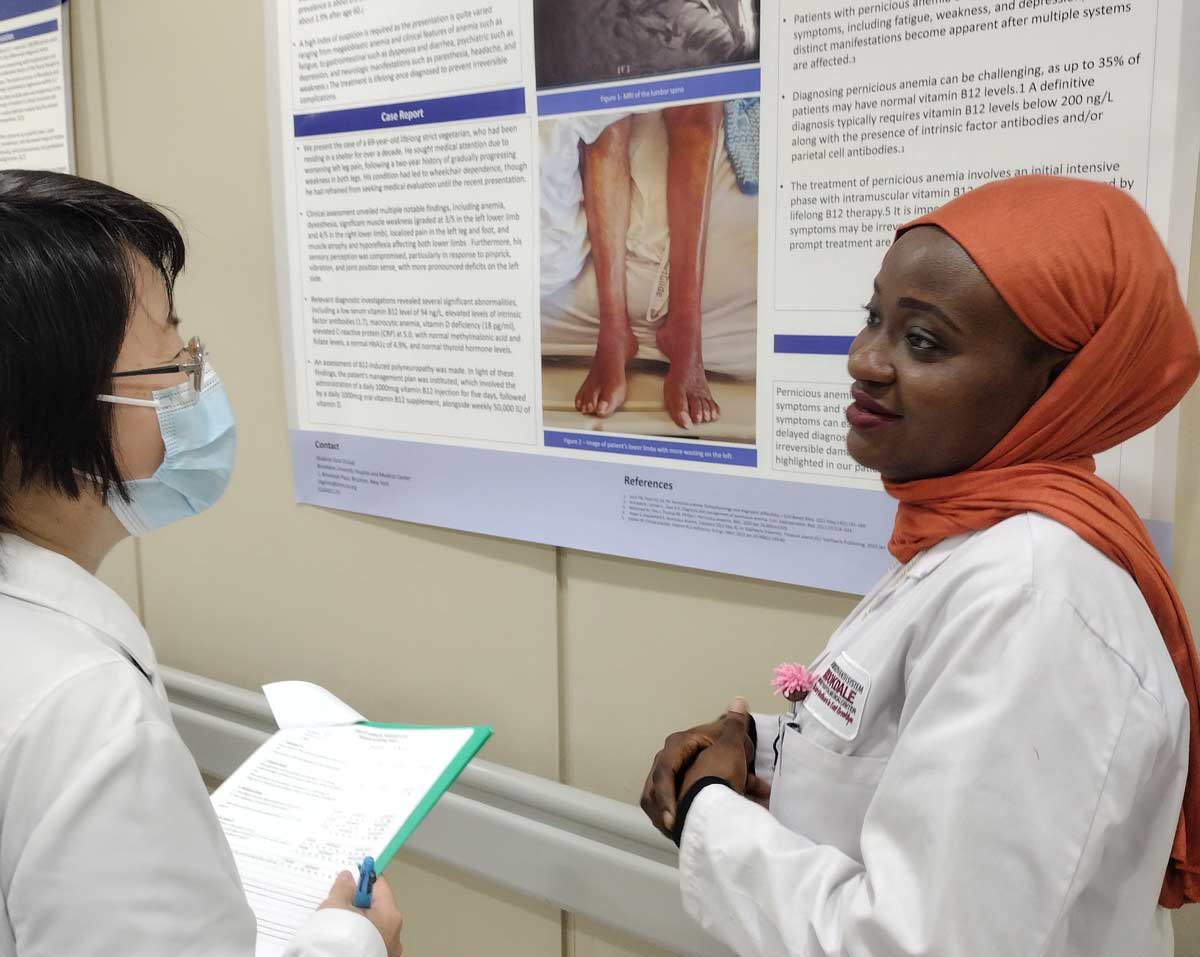
Shakirat Gold-Olufadi MD researched a 69-year-old lifelong strict vegetarian who had been residing in a shelter for over a decade. He sought medical attention due to worsening left leg pain following a two-year history of gradually progressing weakness in both legs. His condition has led to wheelchair dependence. After investigation, the patient was found to have pernicious anemia, a rare autoimmune condition characterized by impaired vitamin B12 absorption and vitamin B12 deficiency. Treatment was five days of B12 injections followed by daily oral B12 supplements for the rest of his life.
Donald Tchapmi MD investigated obstructive pulmonary artery disease in HIV patients. His research found that men with HIV may have an elevated risk of cardiovascular disease, necessitating the importance of cardiovascular risk assessment and management in this population to mitigate adverse cardiac events.
Vasilii Khristoforov saw a middle-aged male who experienced an altered mental state after consuming poppers (amyl nitrites). Poppers are a drug that people use to get a euphoric effect and erection. In this case, this gentleman was found unresponsive in a hotel room with his girlfriend. EMS brought him to the hospital, exhibiting convulsions, foaming at the mouth, and severe respiratory distress. His skin was blue and dark. When the blood was drawn, it was chocolate-colored. This was a symptom of methemoglobinemia, a condition in which oxygen delivery to tissue is inhibited. The treatment is methylene blue administration. Within three hours, his oxygen transfer to cells was normal.
Yevheniia Andriushchenko researched pain assessments in the rheumatology clinic, typically with patients with rheumatoid arthritic, osteoarthritis, lupus, and fibromyalgia. She found that using a written questionnaire to assess the ability to conduct daily functions is more helpful than simply asking patients how bad their pain is. The questionnaire asks if patients can tie their shoelaces, hold a cup, or open a jar. If the patient is in pain, the joints in the hand are inflamed. Patients were asked if they think the survey is helpful, and they said it is easier to explain what they are facing to the doctor. The survey also makes it easier for the doctor to understand what is happening with the patient because when a patient says their pain is bad, doctors don’t know how bad.
Zakaria Sheikh MD, researched a 64-year-old woman who had a total knee replacement. During physical therapy, three days after surgery, the tendon tore from the replacement. Surgical repair was done, and the patient went on to successfully complete inpatient rehabilitation.
There were other research projects such as racial and gender disparities in alcoholic liver disease; vaping use that led to lung injury and heart failure in a 35-year-old male bodybuilder; decreased adherence to conventional therapies in patients with inflammatory bowel disease who use complementary and alternative medicines; uncommon presentation of gout of the wrist; unusual Potts Puffy tumor (frontal skull bone infection) in a 20-week pregnant 37-year-old woman; rare infection of the soft tissues at the back of the eye; fractures in the root of teeth and associated aesthetic dental treatment; misalignment of the jaw leading to obstructive sleep apnea; and health risks of obesity in rheumatology patients.
Other projects included a 53-year-old man who had a stroke after cocaine use and later developed compartment syndrome in which increased pressure led to insufficient blood supply to the tissue that can cause irreversible muscle and nerve damage; laughter intervention to address nurse burnout; substance use in heart failure; autoimmune hepatitis type 1 in a 6-year-old child with sickle cell disease; the role of pharmacists in diabetes treatment; a rare noncancerous facial tumor in a non-compliant patient; bleeding in the lungs caused by fentanyl inhalation; pediatric caregiver perception towards Covid-19 pandemic and vaccination of pediatric population; and malnutrition and failure to thrive in African American children.