Home Blog Page 859

Gamechangers: Alabi, UFT, Robinson, Brooklyn Patrol North, Taking Stand Together For Public Safety

Olanike Alabi, State Committeewoman, District Leader, 57th A. D.

Last week, Olanike Alabi, State Committeewoman/District Leader of AD 57,  announced her sponsorship —  in partnership with community advocates, labor organizations and law enforcement — of a series of major crime prevention briefings to take place March 8, 14, 17, 23 and 31 in Brooklyn North; and April 6 and 21 in Brooklyn South.  (See below flyer for dates and locations of Brooklyn North briefings.   Brooklyn South sessions will be reported next week.)
This effort is part of Mayor De Blasio and NYPD Bill Bratton’s “One City: Safe and Fair –Everywhere” neighborhood policing  program unveiled last June.  This new Brooklyn initiative was launched on January 1 of this year.  It encourages and establishes partnerships between “neighborhood coordinating officers” and the community in sourcing the causes of crime and violence.

In past years, these kinds of  briefing sessions were led solely by law enforcement professionals.  In recent years, the Justice Department, Local and state district attorneys, and city officials have recognized … and now herald …  the importance of direct community involvement in crime prevention and reduction.

Taking a stand with her on this effort are Jeffrey Maddrey Patrol Borough Brooklyn North (PBBN);  Michael Mulgrew, President, United Federation of Teachers (UFT), and Taharka Robinson, founder  and of the Brooklyn Anti-Violence Coalition (BAVC).

Michael Mulgrew, President, United Federation of Teachers

“We were inspired to convene Public Safety and Crime Prevention Briefings based on the crimes and random acts of violence that have occurred throughout the city,” District Leader Alabi told Our Time Press. “The establishment of the new Neighborhood Coordination Officer (NCO) program and its implementation in several Brooklyn North Precincts supports the perspective that residents should not view themselves as victims.  Working in partnership with law agencies, we can feel empowered with information to try to reduce it by utilizing existing resources in the community to prevent it.

Taharka Robinson, President, Brooklyn Anti-Violence Coalition

“Crime is multi-faceted,” she adds, “and, too often, caused by forces beyond our immediate control.   Yet, there are strategies we can share and tactics  we can learn from each other that may have an impact on threats to public safety.”
“The United Federation of Teachers is proud to take part in this public safety and crime prevention initiative in Brooklyn North.,” says Anthony Harmon, Assistant to the President and Director, Community & Parent Outreach. “We are partners with the community – both in and out of school.”

“The Public Safety and Crime Prevention Briefings bring a heightened awareness of public safety in the community and it also allows people to understand that there is no divide here,” Taharka Robinson told Our Time Press, Tuesday. “When two officers were shot last Saturday on Malcolm X. Blvd., they were doing their jobs. We went out in force immediately to support them.

Jeffrey Maddrey, Commander, Patrol Borough Brooklyn North

“The community comprises individuals in public service, unions, educators, law enforcement — all walks of life — who have a large impact on our neighborhood, and on the lives and learnings of our children.  So this is a collaborative effort;  we are partners in law enforcement.”   For more information: 718-398-0750.

WHAT’S GOING ON: HARLEM  UPDATES


By Victoria Horsford

 TRUE OR FALSE:   Atlah Worldwide Church, located at 38 West 123 Street and Lenox Avenue, is a place of worship and the source of community
enmity.  Its Pastor David Manning is known as the ‘Hate Pastor of Harlem” because of the inflammatory, anti-Obama and homophobic signs prominently displayed along the church’s Lenox Avenue façade. These signs grow more offensive each year and the community has been unsuccessful in eliminating divisive, intolerant messages.  Manning has close ties with the GOP far right, birthers and has endorsed Donald Trump’s presidential run.   Alas, a plot twist emerges.  The Atlah Church is to be sold at a public auction on February 24 because of its antsy creditors and its $1.2 million of debt.  To be sure, scores of developers, investors, and gay organizations will compete at the auction.  However, combative, obstreperous Pastor Manning, will not go quietly into the night!


Maya Angelou, the late literary lioness, internationalist, civil rights advocate is still dominating headlines.  Her fully rehabilitated brownstone, located at 58 West 120, in Harlem’s historic Mt. Morris Park District, is on the market with a $5.1 million price tag.  Last year most of her artwork was sold at auction and fetched more than $1 million. A few years ago, she donated the Maya Angelou Collection of Personal Papers to the Harlem-based Schomburg Center for Research in Black Culture. It was a gift of inestimable value, arguably her greatest asset.

A Harlem-based journalist, Victoria Horsford can be contacted at victoria.horsford@gmail.com


Union Plumbers Volunteer to Help Flint Residents With Water Crisis

More than 300 union plumbers from cities across Michigan came to Flint recently to volunteer to replace faucets and filters.  Photo: Tracy Samilton

BY TRACY SAMILTON / MICHIGAN RADIO

Since October, plumbers with United Association Local 370 in Flint have been volunteering to install filters and faucets to get lead out of people’s tap water.
On Saturday, the local guys got some help – from a small army of more than 300 plumbers driving in from Lansing, Detroit, Saginaw and other cities across Michigan.
They get a rousing, union-pride welcome from Local 370 official Harold Harrington.
“We did not cause this American tragedy in Flint,” Harrington tells the group, “but we certainly can help correct the damage that has been done!”
Outside the union hall, Genesee County sheriff deputies direct traffic to make sure all the trucks and vans can get in and out safely.
Call 911, the plumbers are told, if they feel unsafe in a neighborhood or at a particular home, and a sheriff’s deputy will arrive to escort them into the home so they get the work done.
Everyone is paired up, given instructions and a list of addresses.
Jordan Belill and his cousin Tyler get their list, grab armloads of donated faucets, filters and test kits, and head out to the home of Berdie Johnson.
The faucets were donated by Plumbing Manufacturers, International, which represents major companies like Moen, Brasscraft, Speakman, Delta and American Standard. Hodges Supply of Flint also kicked in items.
Johnson’s home is like practically every house in Flint; she has cases of bottled water stacked in her spotless kitchen.
She says in a way, it was lucky her water didn’t look right two years ago. That was when the city switched from Detroit water to Flint River water in order to save money.
“I was buying the water before we even realized they said all the lead was in it,” says Johnson, “because the water was brown. Looked like Kool-Aid!”
Jordan Belill finds out Johnson needs a specific kind of faucet that he doesn’t have. She’ll be put on a list for a follow-up visit. In the meantime, he installs a filter in the laundry room.
“See how that light’s blinking green?” Belill explains.  “That tells you that your cartridge is good. It would turn yellow when it’s telling you it’s getting close to being used up and would blink red when it’s time to change it. ”


UA Plumbers install a faucet in the home of Loyce Driskell. Her old faucet wouldn’t fit to the water filter. Photo: Tracy Samilton / Michigan Radio

Next stop is the home of Loyce Driskell. This time the faucet replacement is successful. Driskell laughs, because they’re replacing a brand-new custom faucet with one exactly like the one she just got rid of.
Then she turns serious. She and her family only stopped drinking the water three months ago.
“We think if we’ve been drinking this water for a couple years – and that’s how long it’s existed – that these efforts, at this point, I mean the damage is almost done,” she says grimly.
That may or may not be true for her family. Recent tests appear to show the water in many homes is under the federal action level for lead.
But a few homes have so much lead that filters may not work.
The plumbers visit 1,100 homes by the end of the day. Local 370 will keep on volunteering.
Money, too, is starting to come in, including $28 million from the State of Michigan.
Officials with the agencies responsible for causing the problem in the first place now say they are here for the long haul, and will not abandon Flint until everything possible has been done to repair the damage.  (Follow Tracy Samilton @ http://michiganradio.org/)

Mary Ward: A Life on Hold

By Akosua Albritton

Mary Lee Ward

How does one go from being toasted in 2010 by Andrew Cuomo, then-State Attorney General, for sparring with predatory lender Delta Funding to restarting one’s life at age 86? Ask Mary Lee Ward. Ward was evicted from her home at 320 Tompkins Avenue in Brooklyn on August 14, 2013. She considers herself “homeless, going from couch to couch” since that eviction.

She remembers the eviction being an intense, frightening experience that occurred at 10:00 AM. She remembers seeing the sheriff and police cars in front of her home and the “yelled order” to open the door or they would come in with guns drawn and take her out of the building. “They pushed me out of the door with my shopping cart that I hurriedly filled with items,” recounted Ms. Ward. She left her furniture and motorized wheelchair inside.

Ward describes the current state of the house as “just sitting locked in disuse with my property still inside”. Can anyone imagine being elderly and being ousted from one’s home of 38 years? Ward visited the 79th Police Precinct some time after the eviction to get details; the police officer at the front desk said they had nothing to do with the eviction.

320 Tompkins Avenue had been owned by Mary Ward. NYC Department of Finance’s ACRIS records reveal that on November 19, 1975, Ward obtained the deed and mortgage to this property. Yet, by June 12, 2008, the house was foreclosed.

“I received the notice the day before. One Bruce Goldstein was appointed referee to the sale at the foreclosure. Mr. Choudhury bought the house that same day for $345,000,” explained Ms. Ward. Apparently, Mr. Choudhury is part of 768 Dean, Inc., as this is the party of record in ACRIS.

Moving to current times, Ms. Ward sent a letter to Governor Andrew Cuomo on May 2015, requesting his help with her current state of affairs. Ward contacted Gov. Cuomo because on “October 18, 2000, she had been on television with then-State Attorney General Cuomo and US Senator Charles Schumer regarding their effort to bring predatory lenders to justice”. One such lender, Delta Funding, was ordered to distribute $12 million to 400 past customers. Ms. Ward—one of the 400—used Delta Funding to refinance her home in order to cover an adoption battle.

The governor’s response to Ward’s plea for help in a letter dated June 22, 2015 was that “he turned over the matter to his administration”.

In June 2015, Ward went to a realtor to find a place to rent. She chose a unit at 147 Schenectady Avenue in Brooklyn, owned by Rudolph Moses. The living arrangement is one where she has a separate entrance into her bedroom and living room but shares the kitchen and bathroom with another tenant. She agreed to pay half of the Con Edison bill, though the bill is in the name of the other tenant.

With a monthly Social Security allotment of $1,019 to live on, she applied for the Senior Citizens Rent Increase Exemption (SCRIE) in August 2015 and was found qualified for the program, however, her domicile was not legal. Similarly, her application for rental assistance from the NYC Human Resources Administration was turned down for the same reason.

Falling behind in her rent, she received a 30-day notice on January 7, 2016 from her landlord, wherein she has by February 29, 2016 to get current in her rent or face court proceedings for eviction. She’s turned to South Brooklyn Legal Services for counsel and representation.

Her relationship with her landlord (Rudolph Moses) deteriorated to a point where “he’s threatened her and broke the lock on her door”. Ward has an Order of Protection on Mr. Moses, which expires July 2016.

Ms. Ward is determined to turn her household situation around. She joined a Fort Greene Council Senior Center in December 2015, not only for comradery, meals and recreation, but to access all social services that are provided through Department for the Aging-funded agencies. She is registered with Workforce One Career Center, at age 86, to occupational training and to secure a job.

Slave Theater: Symptom of a Bigger Problem

“There is the lack of understanding about estates and how to protect your estate even in your demise.”
Councilman Robert Cornegy
By Mary Alice Miller

Mr. Clarence Hardy holds a picture of Judge John Philips in Front of the Slave Theater – which he claims his family owns. Photo: Hiroki Kobayashi

The recent private sales and proposed development of the Slave Theater and adjacent properties have exposed raw wounds. The properties, first sold in 2013 to Fulton Halsey Development Group after the 2008 death of Judge John Phillips for $2.5 million, then resold in 2015 for $18.5 million to Fulton Halsey Holdings, LLC, are slated to become central Brooklyn’s first office tower complex with a Manhattan-style atrium. Preliminary architectural plans reveal an atrium to replace the Slave Theater that leads to a proposed office complex on the Halsey Street property.
The community’s fond remembrances of the Slave Theater and all it stood for may not agree with erasure of yet another icon of Black history and culture. But the developer can build as-of-right, with no requirement for public input.
When Judge John Phillips decided to run for district attorney, prompting a declaration of temporary incompetence in 2000, it seemed as though Phillips also lost control of his real estate holdings including the iconic Slave Theater. But the Clarence Hardy family states Phillips transferred the properties to them in 1999. Since then, the Hardy family alleges all manner of deed fraud, including an ACRIS record that lists John Phillips as a party to a 2013 transaction for the Slave Theater’s 1215 Fulton Street address, years after Phillips’ 2008 death, as well as various actions taken by Samuel Boykin, who presented himself as a blood relative of Phillips.
Confronted by a conundrum that began long before he came into office, Councilman Robert Cornegy is being pressured to step in and save the Slave Theater for its alleged rightful owners and the community. Pending the commencement of any criminal investigations into deed fraud, Cornegy can only attempt to mitigate complete erasure of the Slave Theater and Judge John Phillip’s vision. In that light, Cornegy has offered two propositions to the developer.
“If it goes forward and, this is very important, there is no way to show fraud, and the developer is able to keep the property and go forward with the timeline for demolition with filed plans to begin deconstruction, and if he is able to secure all the permits necessary, I gave him two proposals,” said Cornegy. “One was a public/private partnership similar to what is being done with the Kings Theater in Flatbush, where there would be a full renovation done, a commitment of capital resources from my office, plus their commitment that we could have a 100-year lease and let us have the first entertainment venue in central Brooklyn so that shows and talent from our communities could be displayed and is not cost-prohibitive for local nonprofits or people to use it as a theater space. I asked him to wait until I could get the projected revenue for comparable theaters, i.e., Kings Theater, BAM and other theaters of similar size. We can’t realistically expect a level of altruism on the part of the developer. I have to be able to show them in real numbers how there is revenue that could be generated and goodwill simultaneously for a space that has been important to our community for a long time like the Slave Theater. That is Proposal #1.”
Cornegy continued, “Proposal #2 was a set-aside in that atrium to display the rich culture and legacy of the Slave Theater through pictorials and memorabilia if they would be open to it.”
However, the Hardy family wants no part of that. They will not be satisfied until there is a transfer of that property into their hands. The land battle has been long, protracted and convoluted.

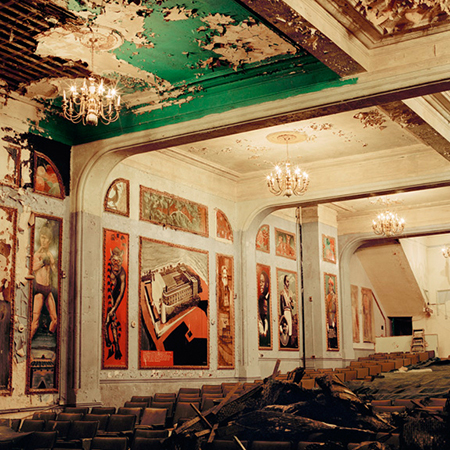
Slave theater interior. Photo: Hiroki Kobayashi

“I made two commitments to the Hardy family. One was that I would organize city, state and federal elected officials to be part of a phone call to see what we could do on the city, state and federal level to uncover any fraud and a commitment that we would pool our resources if there was any fraud that got approved for investigation,” said Cornegy. That phone call took place two weeks ago.
“My office, in particular, would file an injunction to stop demolition if the D.A.’s Office were to illustrate (from paperwork they were given) any indication of fraud. I cannot file a motion without an indication of the D.A. commencing an investigation,” said Cornegy. “That project is an as-of-right project, which means there is no intervention from the city, state or federal government. They did not ask for any tax credits. They are not asking for any help from the city. There is no necessity for me to sign off on anything. They bought it as if anyone would purchase private property.”
Cornegy explained: “We are trying to craft a robust plan that certainly includes a projected revenue stream that is comparable to what they would get in any other circumstance. The concern is the cost. They cannot repair the theater because the infrastructure is crumbling. The best thing they can do now is to demolish it and then build it back. The increased cost of doing that makes it improbably that the developers would do it. My response is let’s work out a public/private relationship in which I would commit capital dollars toward reconstruction if they would commit to a 99-year lease with the city or state to show commitment on both private and public parts. I would be willing to do that. I would commit $3, 6 million or whatever is necessary if we know the theater is going to be in the possession of the community.”
Cornegy has introduced legislation to address deed theft. In addition, Cornegy is working with the Dept. of Finance who has flagged about 95 potentially fraudulent deed transfers to find out if they rise to illegality. “Fraudulent deed transfers occur all over the city but happen to a greater rate in central Brooklyn,” said Cornegy. “There are seniors who did not know that someone transferred their deed until the marshal shows up and they are evicted from a home paid off a long time ago. This is unfortunately incredibly deeper than the Slave Theater.”
“The biggest travesty, in my opinion, is a constant, pervasive issue in our community where the transfer of wealth through real estate and property is not maintained correctly,” said Cornegy. “There is the lack of understanding about estates and how to protect your estate even in your demise.”
According to Cornegy, the situation surrounding the Slave Theater is a symptom of this underlying problem. “The symptom is fraudulent transfer of deeds and property and tax and water liens. We arrived here because of inappropriate estate planning. Had it been very concise as to whom the transfer of property would be and it wasn’t convoluted, we wouldn’t even be having this conversation,” said Cornegy. “I hope members of the community would evaluate and reassess whatever transition plan, or lack thereof, is present in their families so that whatever happens doesn’t rise to this level based on the lack of appropriate estate planning.”