Home Blog Page 825

Day Laborers Coping with Lean Times

BY EDWIN MARTÍNEZ

SOURCE: EL DIARIO/LA PRENSA

| TRANSLATED BY K. CASIANO FROM SPANISH

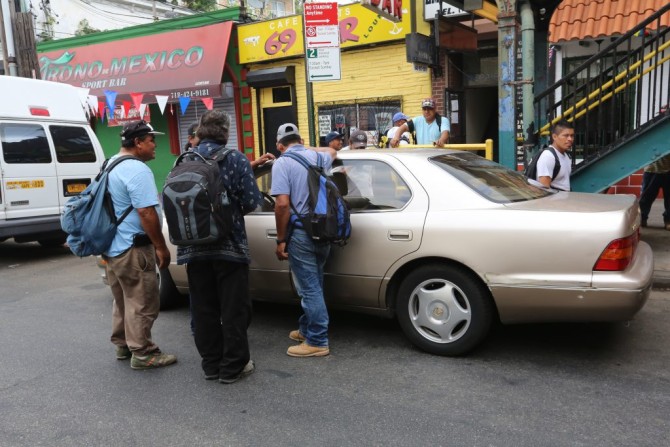
It is 9 a.m., and the corner of 69th Street and Roosevelt Avenue in Queens is packed with men carrying backpacks, ready to work. There are more than 150 of them. Most are from Colombia, Mexico, Peru and Ecuador. Two are from the Dominican Republic, and there is even one from India. All of them wear the same type of boots and have the same desire to make a few dollars to live on. A block down the street, alone on a corner, Ramón Rodríguez, from Guatemala, sits on the sidewalk.

The harsh sun shows no mercy against his nape and his weathered skin, but that is nothing when the stomach starts growling from hunger and the pockets are empty. In the last two weeks, the 58-year-old has only been hired to work one day in a house move, for which he got $60. The lady who rents him a room for $500 in Sunnyside cannot put up any longer with his failure to pay.

“Things are very shitty here. There isn’t much work anymore and, if you’re old, they don’t even want to take you,” complains Rodríguez, who has been in the capital of the world for 11 years and who continues to smile in spite of his luck.

“Ten years ago, we were having good times. Then we got lean times and, now, they are beyond lean, they are just scrawny, almost dead,” says the worker, adding that employment options for him and his fellow laborers on the street are gradually dwindling. There is little demand and, for newcomers, “not a lot of fishing gets done anymore in a river with few fish.”

That is something fellow worker Carlos Lema, 51, understands all too well. He left behind his native town of Pereira, Colombia, and his wife and daughter to find a better future. All he has found is the streets, where few people come by to offer work and, when they do, laborers pounce and end up “giving themselves away” for a few dollars just to be taken to work.

“Things here are very hard, and if I don’t leave it’s because things over there are even worse, and so we have to face up to it here,” says the worker, adding that, ironically, it is in New York where he has been the hungriest in his life. “This week, I have only worked one day. It was three hours in a house move, and they gave me $40. We sometimes eat breakfast, but if it wasn’t for the people who come by to give us food, we would have to skip it. They say that it used to be really good here before and that now it’s fallen apart.”

Everyone on this street complains that business has indeed gone down. Although no official study has been performed on what has happened to the job prospects of the over-10,000 workers presumed to exist in the city, the people closest to them confirm that the “lean times” rumor is a reality for many of these immigrants.

“It’s not the way it used to be, that’s true, because now there is more competition. Not necessarily from the job centers in the city – because only three of us exist – but competition from workers who stay as regulars at the companies that need them,” says Manuel Castro, executive director of the New Immigrant Community Empowerment (NICE) which helps nearly 800 day laborers per year.

The community leader explained that one of the many reasons for the reduction in the demand for day laborers is that the construction business is currently seeing growth, and employers no longer need people for just a few days but in a more stable fashion.

“Even the internet has changed things, because now, if a homeowner seeks someone to fix something or to paint, instead of going to the streets, he can find them through an app and make the request online,” he says. “Ten years ago, none of that existed. There are several things going on, and we must adapt to the new times.”

The three job centers that have been built in New York have emerged precisely as part of this adaptation. Aside from guaranteeing that employers pay fair and dignified salaries to immigrants, they promote training and workshops to help workers develop skills in different service areas to make the labor environment easier for them.

“They don’t want anyone here that isn’t able to do specific things anymore. They pick you up and, when they take you to the work area, if you don’t know how to do plaster or flooring or laminating, they give you $5 for the train ride and send you back,” says Dominican laborer Aníbal Medina. “When a day laborer learns to do his job and specializes in something, he can make up to $200 in a day. Otherwise, no.”

The plus side, says Castro, is that the city is supporting them for the first time. In a historic move, the city assigned $500,000 last year to boost and support the three job centers located in Brooklyn, Staten Island and Queens. For fiscal year 2017, a larger amount has been approved with the goal of having at least one of these centers in every borough.

City Council Speaker Melissa Mark-Viverito has demonstrated her commitment to day laborers.

“The Council is proud to have assigned $500,000 in funding from last year’s budget and to raise it to $570,000 from this year’s budget to help day laborers have a space to gather, obtain job support services, legal services to deal matters such as wage theft, and worker training and development,” said a City Council spokesman.

“The day laborer movement needs our support to make sure that each worker, regardless of their immigration status, is treated with dignity and respect through a stern protection of their salaries and safety standards,” said Council member Carlos Menchaca.

Ligia Guallpa, from the Workers Justice Project, an organization assisting more than 500 laborers per year in Brooklyn, says that there seems to be more work in that county due to an increased number of developments. She called on the laborers who stand on the streets to join the job centers, since together they can make employers respect their rights and achieve a better quality of life.

“As workers, whether they have papers or not, they have a right for their work to be valued, and there is no reason for them to risk their lives. [Their work] needs to be dignified, and they need to be treated fairly,” says Guallpa.

And while hundreds of day laborers continue to stand on the streets every day in the hope of seeing job opportunities and money increase, Peruvian worker Carlos González, 45, says that he has no choice but to be patient.

“I know that this drought will pass,” he says, as he runs alongside eight other immigrant laborers after a car arriving on 69th Street looking for two workers. The driver negotiates to see who will do it for the lowest price.

Today was not his day, but he didn’t “give himself away” either.

 

BP ADAMS AND BROOKLYN ARTS COUNCIL ENCOURAGE SMALL LOCAL CULTURAL ORGANIZATIONS TO APPLY FOR LATEST ROUND OF DESTINATION>BROOKLYN MINI-GRANTS

BROOKLYN, NY, August 25, 2016

Today, Brooklyn Borough President Eric L. Adams and the Brooklyn Arts Council (BAC) encouraged the borough’s small local cultural organizations through the second annual Destination>Brooklyn mini-grant program. Funded by Borough President Adams and NYC & Company Foundation, Destination>Brooklyn makes $1,500 awards available for the creation, production, and distribution of print promotional materials that represent the organization’s artistic and cultural activities, with an emphasis on borough tourism. In the last two years, $73,500 in mini-grants have been awarded to 49 local cultural organizations in more than a dozen neighborhoods across Brooklyn, which has led to the production of more than 165,000 pieces of marketing materials. Applications are now open and will be accepted at brooklynartscouncil.org through Wednesday, September 21st.

“Destination>Brooklyn is a vehicle for communicating the cultural bounty of our borough far and wide, showcasing the small local arts groups that give our communities character and help define the world-famous Brooklyn brand,” said Borough President Adams. “Through the valued partnership of BAC and the NYC & Company Foundation, these grants make it possible to push cultural tourism forward in neighborhoods from Clinton Hill to Coney Island, including for residents that are looking to discover some of the artistic treasures in their own backyards.”

“BAC is proud to roll out a new season of Destination > Brooklyn support for cultural organizations from every Brooklyn ZIP code,” said Charlotte A. Cohen, executive director of BAC. “These grants are vital to the development and sustainability of the artists and cultural groups who engage with our communities in ways that are critically needed in our borough today. Print promotional materials are integral to bringing our artists’ and cultural organizations’ work to the public. These materials build awareness of the incredible cultural spirit in our borough. They help foster Brooklyn’s tourism and creative economy by showcasing the wealth of great works and performances that take place here every day. We are so proud to partner with Borough President Adams and NYC & Company Foundation to offer this support to Brooklyn artists.”

“NYC & Company Foundation is proud to partner with Borough President Adams in helping to support some of Brooklyn’s most interesting, innovative cultural organizations,” said Fred Dixon, president of the NYC & Company Foundation. “Cultural diversity and vibrancy makes Brooklyn a wonderful place for New Yorkers to call home, and a wonderful place for visitors to explore.”

New applicants, and applicants who have not received a BAC grant since the 2014 funding cycle, are required to attend an information session in order to be eligible, although all applicants are strongly encouraged to attend. Information sessions are offered in person across the borough and online. Those seeking more information, including full eligibility guidelines and application materials, are encouraged to visit the “For Applicants” section of brooklynartscouncil.org, located under their Grants menu’s “Who We Fund” section.

We Need a New National Anthem

View From Here

By David Mark Greaves


Thank you Colin Kaepernick for drawing attention to the national anthem, and especially thank you to Shaun King for writing in the New York Daily News an eye-opening column on the white supremacist history of the Star-Spangled Banner and its author, Francis Scott Key.

In explaining why he will never stand for the Star-Spangled Banner again, King writes, “Key’s full poem actually has a third stanza which few of us have ever heard. In it, he openly celebrates the murder of slaves. Yes, really.

“It goes like this:

No refuge could save the hireling and slave

From the terror of flight or the gloom of the grave,

And the Star-Spangled Banner in triumph doth wave

O’er the land of the free and the home of the brave.

“While it has always been known that the song was written during American slavery and that when those words about this nation being the “land of the free” didn’t apply to the millions who had been held in bondage, few of us had any idea that the song itself was rooted in the celebration of slavery and the murder of Africans in America, who were being hired by the British military to give them strength not only in the War of 1812, but in the Battle of Fort McHenry of 1814. These black men were called the Corps of Colonial Marines and they served valiantly for the British military. Key despised them. He was glad to see them experience terror and death in war — to the point that he wrote a poem about it. That poem is now our national anthem.”

And as for Key himself, King says, “He came from generations of plantation-owning bigots. They got wealthy off of it. Key, as District Attorney of Washington, fought for slavery and against abolitionists every chance he got”.

Let “America the Beautiful” be the anthem.   I join Mr. King when he says, “I’ll never stand for that other song again”.

Bed-Stuy, Brownsville School Districts Lead Borough with Homeless Students

By Kings County Politics

Bedford-Stuyvesant’s District 16 and Brownsville’s District 23 were the top two school districts in Brooklyn in the school year 2014-15 with homeless students, which contributed to lower test scores and higher dropout rates in those neighborhoods, according to a study the Institute for Children, Poverty and Homelessness (ICPH) released last week.

Overall, the study found that one out of every eight children attending public school in SY 2014-15 experienced homelessness within the past five school years. It also gave a detailed picture of homeless students within the city’s educational system: where homeless students go to school, what kind of supports they might need, what their academic outcomes look like, what differences exist by the type of homelessness a student experiences and what the lasting impacts of homelessness are educationally—even after a student’s housing instability has ended.

In District 16, the study found one out of every five children, or 16%, were homeless and another 7% were formerly homeless, utilizing 274 shelter units and 16 family shelters. Of those living in shelters,54% had a chronic absenteeism rate as compared to 32% of their peers that were housed.

Additionally, only 11% percent of the homeless students passed the math proficiency tests for grades 3-8 and 14% percent passed the English exams. By contrast, 23% of the students in the district passed the math exams that came from homes that made enough money to not be eligible for a free lunch, and 26% passed the English exams.

District 15, covering Carroll Gardens, Park Slope and Sunset Park had the lowest amount of homeless students of the borough’s 12 school districts. They have both zero shelter units and zero family shelters. Of the four percent homeless in the district’s student population there is a 48% chronic absenteeism rate for those students living in shelters compared to an only 8% chronic absenteeism rate for those students in the district that live in homes not eligible for free lunches.

In both districts and overall, the study found the dropout rate of homeless students is about double that of their peers that come from stable housing. Similarly, the suspension rate for homeless students is about double that of students coming from a stable home.

The study comes as the de Blasio Administration has allocated $30 million in supports for students in temporary housing earlier this year to counteract the growing homeless numbers citywide. The money will pay for placement of social workers in schools along with new school-based health centers in schools with high homeless populations. The allocation will also cover the hiring of attendance teachers and literacy coaches in family shelters across the city.

“Students in temporary housing are among our most vulnerable populations, and we are dedicated to ensuring they receive the same equitable and excellent education as their permanently housed peers,” Toya Holness, a spokeswoman for the Department of Education, told reporters in a statement.

The ICPH is an independent nonprofit public policy analysis and research organization based in New York City. The institute disseminates their findings to policymakers at all levels of government, colleagues in the research community, advocates and educators to promote a robust, evidenced-based dialogue and positively influence services and policy toward homeless families.


Learning and earning: Hasidic Brooklyn’s real estate machers

Investors from ultra-Orthodox sect have spent $2.5B+  in 5 areas over the past decade: TRD analysis

By Mark Maurer, The Real Deal

TRD Special Report: On the day before Thanksgiving, Yoel Goldman phoned one of his go-to lenders with an urgent request.

The Brooklyn developer, who heads All Year Management, wanted to score a construction loan for his Albee Square project by Monday, which gave him just one business day to make it happen.

The lender, Gary Katz of Downtown Capital Partners, reminded him of Thanksgiving. But Goldman, who is from the Satmar sect of the Hasidic branch of ultra-Orthodox Judaism, countered: “So you can’t work Thanksgiving tomorrow, but you still have all of today, Friday and Sunday.”

Katz tried an analogy. Wednesday, he told Goldman, is Erev Yontiff – “evening before the holy day” in Hebrew – and Friday is Chol HaMoed – a weekday between two holy days. For most Hasidic Jews, Chol HaMoed is an occasion for family and Talmud study, not dealmaking.

Goldman got that and held off. Property records show he ultimately received a $25 million mortgage from Downtown Capital and RWN Real Estate Partners on Christmas Eve.

Read More at:

http://therealdeal.com/2016/08/22/learning-and-earning-hasidic-brooklyns-real-estate-machers/