New Jersey Sen. Cory Booker gave an impassioned and unprecedented plea to the Senate on Wednesday to vote against Donald Trump’s nominee for attorney general and his fellow senator, Jeff Sessions.
Booker delivered an emotional five minutes of testimony flanked by members of the Congressional Black Caucus that Sessions’ record on civil rights disqualifies him from serving atop the Justice Department under President-elect Trump.
“The arc of the moral universe does not just naturally curve toward justice, we must bend it,” Booker said. “America needs an attorney general who is resolute and determined to bend the arc. Sen. Sessions record does not speak to that desire, intention or will.”
Booker became the first sitting senator to testify against a fellow sitting senator at a confirmation hearing for a Cabinet position. His panel with other lawmakers and supporters of Sessions was added to the hearings at the request of the top Democrat on the committee, California Sen. Dianne Feinstein.
Testimony from Booker, civil rights hero Rep. John Lewis and Rep. Cedric Richmond against Sessions was the emotional finale of two days of hearings that returned repeatedly to the issue of race relations and civil rights in the United States.
Both Sessions’ supporters and detractors were at times passionate in their position. Sessions and his backers defended his record as the victim of character assassination, saying that the events of his unsuccessful 1986 confirmation hearing to be a federal judge were being unfairly misconstrued 30 years later to malign a man with a record of fighting for civil rights.
The Democrats and civil rights activists who testified, however, said that the record from the ’80s not only stood today, but that Sessions has shown a pattern of disregard for the at-risk members of society throughout his time in the Senate.
Democrats failed to land any knockout blows on Session during the hearing, with the Republicans on the committee unanimously coming to his defense as a fair enforcer of the law. The came closest when Minnesota Democratic Sen. Al Franken questioned Sessions on exaggerating his civil rights record in past statements and his Senate questionnaire.
But the committee also treated Sessions with respect and warmness as a fellow colleague, a fact noted by his former staffer on the Judiciary Committee, William Smith.
“Members of this committee know Sen. Sessions … is fair and honest,” Smith said. “After 20 years of knowing Sen. Sessions, I have not seen the slightest evidence of racism because it does not exist. I know a racist when I see one, and I have seen more than one. Sen. Sessions is not one.” Sessions will likely be confirmed by the GOP majority Senate. (CNN)
Trump’s transition team has named Omarosa Manigault, CELEBRITY APPRENTICE TV reality show alum, Assistant to the President and Director of Communications for the Office of Public Liaison. On January 4th, Manigault and senior members of the Trump transition team hosted an invitation-only “African-American Listening Session” for about 60 Democratic-leaning folk, members of the National Association of Black Journalists, CBC, 100 Black Men, NAACP et al. Manigault promised the first press interview with President Trump to Benjamin Chavis, President/CEO of the National Newspaper Publishers Association, a trade association of about 200 Black newspaper publishers. Black Republicans are pissed about the invite-only meeting and their exclusion!
A Democrat who worked with Vice President Al Gore and with Hillary Clinton’s presidential campaign, Manigault crossed the aisle last year and is a firmly entrenched Republican with access. Her academic creds are sterling: Central State University(bachelor’s degree) and Howard University(master’s and Ph.D. in communications).
HARLEM/NY
True or false? Will Hillary Clinton toss her hat into the NYC Mayor’s race consistent with tabloid newspaper rumors?
Harlem welcomes Congressman Adriano Espaillat, who moved into his new NY office headquarters last week at the State Office Building on 125th Street at Adam Clayton Powell Boulevard, the space formerly occupied by retired Congressman Charlie Rangel.
On February 14th, Valentine’s Day, there is a special election date for the NYC Council seat formerly held by Inez Dickens. Athena Moore, aide to Manhattan Boro President Gale Brewer, formally joined the group of contestants. Senator Bill Perkins is busy organizing fundraisers and making telephone pitches for support.
Former NYS Assemblyman Keith Wright joins the law firm of Davidoff, Hutcher & Citron in its Government Relations practice. During his tenure as a NYS public servant, Wright has chaired committees such as housing, election law, social services and labor. WGO predicted a few months ago that Wright would probably return to law. He continues to wear his hat as Manhattan Democratic Party honcho.
2016: YEAR IN REVIEW
LLoyd Williams
Kudos to Lloyd Williams and his GREATER HARLEM CHAMBER OF COMMERCE team who hosted the organization’s 120th Anniversary invitational gala reception on October 4th, which was held at the Mural Pavilion of the Harlem Hospital Center. The festivities were attended by the usual suspects and, of course, legions of business, community, political elites and muckety mucks like Jeanne Parnell, Jacques DeGraff, Michael Garner and attorney Bill Covington. It was like “ole home week”. The party was grand in planning and execution. My favorite gift bag item was the 56-page booklet, a six-score pictorial and narrative history of the Greater Harlem Chamber of Commerce–what an invaluable piece of Harlem history!
Distaff power: The Women For Hillary, a Harlem-based group of predominantly African-American women which was organized by Millennial movers and shakers Mari Moss Yawn and Nika Milbrun, raised $23,000 for the Hillary Clinton presidential campaign. Three generations of Black women, Democrats and Republicans, entrepreneurs, doctors, lawyers, educators and politicos all contributed to the quickly planned, successful fundraiser. Harriet Michel, Harriette Mandeville, Jeanne Parnell, Eileen Frank, Alice Dear, Hazel Dukes, Valerie Bradley, Copper Cunningham, Inez Dickens, Joyce Johnson, Alyah Sidberry, Dr. Janet Bell and Henrietta Lyle were Women For Hillary committee members and/or supporters. The October fundraiser was held at Harlem’s Lenox Sapphire.
EDUCATION AND JOB OPS
An Ebony.com story lifted from the 2016 US News & World Report’s TOP 10 HBCUs, which are in order of importance: 1. Spelman, 2. Howard University, 3. Hampton University, 4. Morehouse College, 5. Tuskegee, 6. Xavier, 7. Florida Agricultural and Mechanical(FAMU), 8. FISK University, 9. Claflin University(SC) and 10. NC Central at State University. The USNWR study included 80 HBCUs. About 60 were ranked. Schools like Central State, Ohio and Wilberforce, Ohio made the list but were not ranked. Moreover, Talladega College in Alabama was not ranked. Talladega’s marching band will be performing at Donald Trump’s inauguration ceremonies on January 20th.
. The Harlem Business Alliance is accepting applications for the second cohort of the Lillian Project, a plan targeted to Harlem’s enterprising women. The Lillian Project is a 16-week business education series, a community B-School intensive. Administered by the Harlem Business Alliance and funded by the W.K. Kellogg Foundation, Lillian Project applicants must be African-American women who are in the low- to middle-income range and who live in Harlem. The Lillian Project, 2nd cohort, application due date is January 20th. [Visit hbany.org]
ARTS AND CULTURE
Teacee Ellis Ross
There was no “whitewash” at the 2017 Golden Globe Awards ceremony for excellence in film and television on Sunday. The winners were Viola Davis, “FENCES”; Tracee Ellis Ross, “black-ish”; Donald Glover, “ATLANTA”. Moreover, last week’s top American film grosser was “HIDDEN FIGURES”, with $22.8 million. “Hidden Figures” is based on a true story about three Black women mathematicians who worked for NASA and America’s launch of its space program.
The Rush Philanthropic Arts Foundation hosts a new exhibit FEM-FRAGMENTS, a group show which “explores and dissects the current understandings of femininity at the Corridor Gallery located at 334 Grand Avenue in Brooklyn and which runs through February 19th. Curated by Corrine Gordon and Charlotte Mouquin, the show’s participating fine artists include Capucine Bourcart, Michaela Pilar Brown, Aisha Jemila Daniels, Camille Eskell, Mira Gandy and Gail Skudera. [Visit rushphilanthropic.org]
Ming Smith Exhibit
The Steven Kasher Gallery’s new exhibit is the first major photography retrospective of works by Ming Smith. The retrospective includes 75 vintage black and white prints by the artist “whose works are less focused on the documenting of Black life than creating a personal response to that life”. Show opens on January 13th at 515 West 26th Street in Manhattan. Ming is the first African-American woman whose work was acquired by the Museum of Modern Art.
The 63rd Winter Antiques Show(WAS), the nation’s preeminent arts, antiques and design expo, convenes January 20-29 at the Park Avenue Armory in Manhattan. The 1/19 WAS opening night gala is a benefit for the East Side House Settlement, a 125-year-old community service organization which focuses on education and technology, and whose beneficiaries are African-American and Latino youngsters. The WAS opening night party usually launches the NY winter social season. [Visit winterantiqueshow.com]
“““““““““““““““““““““““““““““““““““““““““““““““““
A Harlem-based writer, Victoria Horsford can be reached at Victoria.horsford@gmail.com.
“As for the US Dept. of Energy, instead of suppressing [the roll out of] renewable energy, as is anticipated, this department should encourage innovation in alternative fuels/ energy sources. If developed, that effort would create jobs and the free market would decide what mode of energy would be predominant. If encouraged, we could even end up with a dual system for our energy needs.” – Prospect Heights Community Garden Co-Administrator and Master Gardener Traci Nottingham
On Friday, January 20, 2017 at 12 noon marks the changing of the guards in US national government. Barack H. Obama steps down as the 44th President of the United States and father of the First Family to make way for Donald J. Trump, the 45th President. His legacy is a mixed bag of meritable and unpopular legislation. The unpopular includes the National Defense Authorization Act of 2012 and the Affordable Health Care Act. The meritable includes the American Recovery and Reinvestment Act of 2009 and the opening of the White House Office of Energy and Climate Change Policy.
In his eight years, President Obama had Colorado Senator Ken Salazar to agree to serve as the Interior Secretary in order to establish solar panels, wind turbines and other renewable processes on public lands; designated 3.9 million acres as national monuments under the Antiquities Act; accomplished the United States-Canada Joint Arctic Leader Statement which included indigenous leaders; and signed the Paris Agreement in December 2015. President Obama continued the Presidential Early Career Awards for Scientists and Engineers (PECASE), an award program initiated by President William J. Clinton. On January 9, 2017, Obama named 102 scientists and researchers as 2017 PECASE recipients. Due to the above accolades and others, President Barack Obama is dubbed the Environmental US President.
He, of course, has his failings. Obama has been unsuccessful in getting the Japanese to stop hunting whales and setting the acceptable ozone level to 70 particulates per billion is deemed unsafe for humans to breathe by medical scientists. However, societal change can start from the root, the people. As Spanish poet Antonio Machado advised: “…wanderer, there is no road, we make the road by walking…”
Within several days, the Trump Administration will settle in at Trump Tower in midtown Manhattan to actualize “Make America Great Again”. How will that affect the land, air and water? Good indicators are his nominees for Secretaries of Agriculture, Energy, the Environmental Protection Agency, Housing and Urban Development, Interior and Labor.
The Secretary of Agriculture is still to be named as of January 9, 2017.
Energy Secretary nominee is former Texas Governor James Richard “Rick” Perry. Selecting Perry to this post may be a tacit assurance to the oil and other fossil fuel industries.
Environmental Protection Agency Administrator nominee is Oklahoma Attorney General Scott Pruitt. It is purported that Pruitt intends to strike a balance between environmental protection and freedom for American business.
Donald Trump nominated Dr. Benjamin Carson for Housing and Urban Development Secretary. Carson, who is a successful neurosurgeon, has not held an elected office. Rather, the basis for this assignment is that Carson’s early life was spent in Detroit, one of the United States’ major urban centers.
The Interior Secretary nominee is Montana US Representative Ryan Zinke. Zinke maintains that public lands should remain under federal ownership rather than transfer them to state control.
The Labor Secretary nominee is Andrew F. Puzder. Puzder is the CEO of CKE Restaurants. Most notable in this portfolio is Hardee’s. The Labor Department sets hourly wages, work hours and working condition standards for agricultural, office, domestic and industrial workers. Puzder opposes raising the minimum wage due to the likely response of replacing human labor with automation. He is critical of paid sick leave.
This reporter contacted five local groups with environmental pursuits—two community gardens, a land trust, a farming education program and a community organizing group—in order for the people to inform and shape the incoming administration’s environmental agenda. Brooklyn Queens Land Trust (BQLT) and the Prospect Heights Community Farm responded and their comments follow:
Brooklyn Queens Land Trusts’ Board of Directors:
It is very important that the Trump Administration continues to fund The People’s Garden Initiative, which is part of the US Department of Agriculture. The People’s Garden Initiative helps to sustain urban, suburban and small-scale agriculture projects to grow healthy food. Brooklyn Queens Land Trust, owner of 34 community gardens in a highly dense urban area, works with volunteers and collaborates with a variety of organizations to maintain clean soils, grow healthy food and build community. Urban areas need to be able to sustain themselves.
The US Environmental Protection Agency has many initiatives to fight climate change and calls for accurate information sharing at all levels of government. BQLT relies on accurate information from our government when we manage the 34 community gardens that we own.
Obama’s EPA executive order states:
Engaged and strong partnerships and information sharing at all levels of government
Risk-informed decision-making
Adaptive learning
Preparedness planning
Prospect Heights Community Farm Co-Administrator and Master Gardener Traci Nottingham:
The US Department of Agriculture should encourage new innovative ways to increase crop yields without the use of GMO’s. Government-supported research in organic farming methods should be implemented. This would also create a variety of job types that many call for, from research and testing to the actual farming. GMO labeling should be mandatory across the country–not in a few states.
The US Environmental Protection Agency should not relax regulations that ensure clean water, air and soil. Despite claims of industry-hampering regulations, without them we would have an exponential rise in health care needs which, while lucrative for health care companies, it is not lucrative or conducive for the nation’s populace. Health concerns would cause productivity loss across all sectors and should we have to go to war we would have no worthy soldiers.
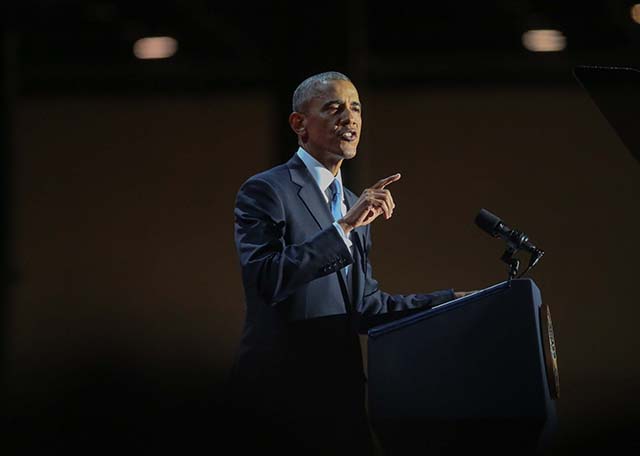
It’s good to be home. My fellow Americans, Michelle and I have been so touched by all the well-wishes we’ve received over the past few weeks. But tonight it’s my turn to say thanks. Whether we’ve seen eye-to-eye or rarely agreed at all, my conversations with you, the American people — in living rooms and schools; at farms and on factory floors; at diners and on distant outposts — are what have kept me honest, kept me inspired, and kept me going. Every day, I learned from you. You made me a better President, and you made me a better man.
I first came to Chicago when I was in my early twenties, still trying to figure out who I was; still searching for a purpose to my life. It was in neighborhoods not far from here where I began working with church groups in the shadows of closed steel mills. It was on these streets where I witnessed the power of faith, and the quiet dignity of working people in the face of struggle and loss. This is where I learned that change only happens when ordinary people get involved, get engaged, and come together to demand it.
After eight years as your President, I still believe that. And it’s not just my belief. It’s the beating heart of our American idea — our bold experiment in self-government.
It’s the conviction that we are all created equal, endowed by our Creator with certain unalienable rights, among them life, liberty, and the pursuit of happiness. It’s the insistence that these rights, while self-evident, have never been self-executing; that We, the People, through the instrument of our democracy, can form a more perfect union.
What a radical idea. A great gift that our Founders gave to us: The freedom to chase our individual dreams through our sweat and toil and imagination, and the imperative to strive together, as well, to achieve a common good, a greater good.
For 240 years, our nation’s call to citizenship has given work and purpose to each new generation. It’s what led patriots to choose republic over tyranny, pioneers to trek west, slaves to brave that makeshift railroad to freedom. It’s what pulled immigrants and refugees across oceans and the Rio Grande. It’s what pushed women to reach for the ballot. It’s what powered workers to organize. It’s why GIs gave their lives at Omaha Beach and Iwo Jima, Iraq and Afghanistan. And why men and women from Selma to Stonewall were prepared to give theirs, as well.
So that’s what we mean when we say America is exceptional — not that our nation has been flawless from the start, but that we have shown the capacity to change and make life better for those who follow. Yes, our progress has been uneven. The work of democracy has always been hard. It’s always been contentious. Sometimes it’s been bloody. For every two steps forward, it often feels we take one step back. But the long sweep of America has been defined by forward motion, a constant widening of our founding creed to embrace all and not just some. (Applause.)
If I had told you eight years ago that America would reverse a great recession, reboot our auto industry, and unleash the longest stretch of job creation in our history…if I had told you that we would open up a new chapter with the Cuban people, shut down Iran’s nuclear weapons program without firing a shot, and take out the mastermind of 9/11…if I had told you that we would win marriage equality, and secure the right to health insurance for another 20 million of our fellow citizens — you might have said our sights were set a little too high.
But that’s what we did. That’s what you did. You were the change. You answered people’s hopes, and because of you, by almost every measure, America is a better, stronger place than it was when we started.
In ten days, the world will witness a hallmark of our democracy: the peaceful transfer of power from one freely-elected president to the next. I committed to President-Elect Trump that my administration would ensure the smoothest possible transition, just as President Bush did for me. Because it’s up to all of us to make sure our government can help us meet the many challenges we still face.
We have what we need to do so. After all, we remain the wealthiest, most powerful, and most respected nation on Earth. Our youth and drive, our diversity and openness, our boundless capacity for risk and reinvention mean that the future should be ours.
But that potential will be realized only if our democracy works. Only if our politics reflects the decency of the our people. Only if all of us, regardless of our party affiliation or particular interest, help restore the sense of common purpose that we so badly need right now.
That’s what I want to focus on tonight — the state of our democracy.
Understand, democracy does not require uniformity. Our founders quarreled and compromised, and expected us to do the same. But they knew that democracy does require a basic sense of solidarity — the idea that for all our outward differences, we are all in this together; that we rise or fall as one.
There have been moments throughout our history that threatened to rupture that solidarity. The beginning of this century has been one of those times. A shrinking world, growing inequality; demographic change and the specter of terrorism — these forces haven’t just tested our security and prosperity, but our democracy as well. And how we meet these challenges to our democracy will determine our ability to educate our kids, and create good jobs, and protect our homeland.
Our democracy won’t work without a sense that everyone has economic opportunity. Today, the economy is growing again; wages, incomes, home values, and retirement accounts are rising again; poverty is falling again. The wealthy are paying a fairer share of taxes even as the stock market shatters records. The unemployment rate is near a ten-year low. The uninsured rate has never, ever been lower. Health care costs are rising at the slowest rate in fifty years. And if anyone can put together a plan that is demonstrably better than the improvements we’ve made to our health care system — that covers as many people at less cost — I will publicly support it.
That, after all, is why we serve — to make people’s lives better, not worse.
But for all the real progress we’ve made, we know it’s not enough. Our economy doesn’t work as well or grow as fast when a few prosper at the expense of a growing middle class. But stark inequality is also corrosive to our democratic principles. While the top one percent has amassed a bigger share of wealth and income, too many families, in inner cities and rural counties, have been left behind — the laid-off factory worker; the waitress and health care worker who struggle to pay the bills — convinced that the game is fixed against them, that their government only serves the interests of the powerful — a recipe for more cynicism and polarization in our politics.
There are no quick fixes to this long-term trend. I agree that our trade should be fair and not just free. But the next wave of economic dislocation won’t come from overseas. It will come from the relentless pace of automation that makes many good, middle-class jobs obsolete.
And so we must forge a new social compact — to guarantee all our kids the education they need; to give workers the power to unionize for better wages; to update the social safety net to reflect the way we live now and make more reforms to the tax code so corporations and individuals who reap the most from the new economy don’t avoid their obligations to the country that’s made their success possible. We can argue about how to best achieve these goals. But we can’t be complacent about the goals themselves. For if we don’t create opportunity for all people, the disaffection and division that has stalled our progress will only sharpen in years to come.
Second Threat
There’s a second threat to our democracy — one as old as our nation itself. After my election, there was talk of a post-racial America. Such a vision, however well-intended, was never realistic. For race remains a potent and often divisive force in our society. I’ve lived long enough to know that race relations are better than they were ten, or twenty, or thirty years ago — you can see it not just in statistics, but in the attitudes of young Americans across the political spectrum.
But we’re not where we need to be. All of us have more work to do. After all, if every economic issue is framed as a struggle between a hardworking white middle class and undeserving minorities, then workers of all shades will be left fighting for scraps while the wealthy withdraw further into their private enclaves. If we decline to invest in the children of immigrants, just because they don’t look like us, we diminish the prospects of our own children — because those brown kids will represent a larger share of America’s workforce. And our economy doesn’t have to be a zero-sum game. Last year, incomes rose for all races, all age groups, for men and for women.
Going forward, we must uphold laws against discrimination — in hiring, in housing, in education and the criminal justice system. That’s what our Constitution and highest ideals require. But laws alone won’t be enough. Hearts must change. If our democracy is to work in this increasingly diverse nation, each one of us must try to heed the advice of one of the great characters in American fiction, Atticus Finch, who said “You never really understand a person until you consider things from his point of view…until you climb into his skin and walk around in it.”
Unite in Struggle
For blacks and other minorities, it means tying our own struggles for justice to the challenges that a lot of people in this country face — the refugee, the immigrant, the rural poor, the transgender American, and also the middle-aged white man who from the outside may seem like he’s got all the advantages, but who’s seen his world upended by economic, cultural, and technological change.
For white Americans, it means acknowledging that the effects of slavery and Jim Crow didn’t suddenly vanish in the ’60s; that when minority groups voice discontent, they’re not just engaging in reverse racism or practicing political correctness; that when they wage peaceful protest, they’re not demanding special treatment, but the equal treatment our Founders promised.
For native-born Americans, it means reminding ourselves that the stereotypes about immigrants today were said, almost word for word, about the Irish, Italians, and Poles. America wasn’t weakened by the presence of these newcomers; they embraced this nation’s creed, and it was strengthened.
Third Threat
So regardless of the station we occupy; we have to try harder; to start with the premise that each of our fellow citizens loves this country just as much as we do; that they value hard work and family like we do; that their children are just as curious and hopeful and worthy of love as our own.
None of this is easy. For too many of us, it’s become safer to retreat into our own bubbles, whether in our neighborhoods or college campuses or places of worship or our social media feeds, surrounded by people who look like us and share the same political outlook and never challenge our assumptions. The rise of naked partisanship, increasing economic and regional stratification, the splintering of our media into a channel for every taste — all this makes this great sorting seem natural, even inevitable. And increasingly, we become so secure in our bubbles that we accept only information, whether true or not, that fits our opinions, instead of basing our opinions on the evidence that’s out there.
This trend represents a third threat to our democracy. Politics is a battle of ideas; in the course of a healthy debate, we’ll prioritize different goals, and the different means of reaching them. But without some common baseline of facts; without a willingness to admit new information, and concede that your opponent is making a fair point, and that science and reason matter, we’ll keep talking past each other, making common ground and compromise impossible.
Isn’t that part of what makes politics so dispiriting? How can elected officials rage about deficits when we propose to spend money on preschool for kids, but not when we’re cutting taxes for corporations? How do we excuse ethical lapses in our own party, but pounce when the other party does the same thing? It’s not just dishonest, this selective sorting of the facts; it’s self-defeating. Because as my mother used to tell me, reality has a way of catching up with you.
Faith in Reason
Take the challenge of climate change. In just eight years, we’ve halved our dependence on foreign oil, doubled our renewable energy, and led the world to an agreement that has the promise to save this planet. But without bolder action, our children won’t have time to debate the existence of climate change; they’ll be busy dealing with its effects: environmental disasters, economic disruptions, and waves of climate refugees seeking sanctuary.
Now, we can and should argue about the best approach to the problem. But to simply deny the problem not only betrays future generations; it betrays the essential spirit of innovation and practical problem-solving that guided our Founders.
It’s that spirit, born of the Enlightenment, that made us an economic powerhouse — the spirit that took flight at Kitty Hawk and Cape Canaveral; the spirit that that cures disease and put a computer in every pocket.
It’s that spirit — a faith in reason, and enterprise, and the primacy of right over might, that allowed us to resist the lure of fascism and tyranny during the Great Depression, and build a post-World War II order with other democracies, an order based not just on military power or national affiliations but on principles — the rule of law, human rights, freedoms of religion, speech, assembly, and an independent press.
That order is now being challenged — first by violent fanatics who claim to speak for Islam; more recently by autocrats in foreign capitals who see free markets, open democracies, and civil society itself as a threat to their power. The peril each poses to our democracy is more far-reaching than a car bomb or a missile. It represents the fear of change; the fear of people who look or speak or pray differently; a contempt for the rule of law that holds leaders accountable; an intolerance of dissent and free thought; a belief that the sword or the gun or the bomb or propaganda machine is the ultimate arbiter of what’s true and what’s right.
Protecting Values
Because of the extraordinary courage of our men and women in uniform, and the intelligence officers, law enforcement, and diplomats who support them, no foreign terrorist organization has successfully planned and executed an attack on our homeland these past eight years; and although Boston and Orlando remind us of how dangerous radicalization can be, our law enforcement agencies are more effective and vigilant than ever. We’ve taken out tens of thousands of terrorists — including Osama bin Laden. The global coalition we’re leading against ISIL has taken out their leaders, and taken away about half their territory. ISIL will be destroyed, and no one who threatens America will ever be safe. To all who serve, it has been the honor of my lifetime to be your Commander-in-Chief.
But protecting our way of life requires more than our military. Democracy can buckle when we give in to fear. So just as we, as citizens, must remain vigilant against external aggression, we must guard against a weakening of the values that make us who we are. That’s why, for the past eight years, I’ve worked to put the fight against terrorism on a firm legal footing. That’s why we’ve ended torture, worked to close Gitmo, and reform our laws governing surveillance to protect privacy and civil liberties. That’s why I reject discrimination against Muslim Americans. That’s why we cannot withdraw from global fights — to expand democracy, and human rights, women’s rights, and LGBT rights — no matter how imperfect our efforts, no matter how expedient ignoring such values may seem. For the fight against extremism and intolerance and sectarianism are of a piece with the fight against authoritarianism and nationalist aggression. If the scope of freedom and respect for the rule of law shrinks around the world, the likelihood of war within and between nations increases, and our own freedoms will eventually be threatened.
Remain Vigilant
So let’s be vigilant, but not afraid. ISIL will try to kill innocent people. But they cannot defeat America unless we betray our Constitution and our principles in the fight. Rivals like Russia or China cannot match our influence around the world — unless we give up what we stand for, and turn ourselves into just another big country that bullies smaller neighbors.
Which brings me to my final point — our democracy is threatened whenever we take it for granted. All of us, regardless of party, should throw ourselves into the task of rebuilding our democratic institutions. When voting rates are some of the lowest among advanced democracies, we should make it easier, not harder, to vote. When trust in our institutions is low, we should reduce the corrosive influence of money in our politics, and insist on the principles of transparency and ethics in public service. When Congress is dysfunctional, we should draw our districts to encourage politicians to cater to common sense and not rigid extremes.
Participation
And all of this depends on our participation; on each of us accepting the responsibility of citizenship, regardless of which way the pendulum of power swings.
Our Constitution is a remarkable, beautiful gift. But it’s really just a piece of parchment. It has no power on its own. We, the people, give it power — with our participation, and the choices we make. Whether or not we stand up for our freedoms. Whether or not we respect and enforce the rule of law. America is no fragile thing. But the gains of our long journey to freedom are not assured.
In his own farewell address, George Washington wrote that self-government is the underpinning of our safety, prosperity, and liberty, but “from different causes and from different quarters much pains will be taken…to weaken in your minds the conviction of this truth;” that we should preserve it with “jealous anxiety;” that we should reject “the first dawning of every attempt to alienate any portion of our country from the rest or to enfeeble the sacred ties” that make us one.
We weaken those ties when we allow our political dialogue to become so corrosive that people of good character are turned off from public service; so coarse with rancor that Americans with whom we disagree are not just misguided, but somehow malevolent. We weaken those ties when we define some of us as more American than others; when we write off the whole system as inevitably corrupt, and blame the leaders we elect without examining our own role in electing them.
It falls to each of us to be those anxious, jealous guardians of our democracy; to embrace the joyous task we’ve been given to continually try to improve this great nation of ours. Because for all our outward differences, we all share the same proud title: Citizen.
Take Action
Ultimately, that’s what our democracy demands. It needs you. Not just when there’s an election, not just when your own narrow interest is at stake, but over the full span of a lifetime. If you’re tired of arguing with strangers on the internet, try to talk with one in real life. If something needs fixing, lace up your shoes and do some organizing. If you’re disappointed by your elected officials, grab a clipboard, get some signatures, and run for office yourself. Show up. Dive in. Persevere. Sometimes you’ll win. Sometimes you’ll lose. Presuming a reservoir of goodness in others can be a risk, and there will be times when the process disappoints you. But for those of us fortunate enough to have been a part of this work, to see it up close, let me tell you, it can energize and inspire. And more often than not, your faith in America — and in Americans — will be confirmed.
Mine sure has been. Over the course of these eight years, I’ve seen the hopeful faces of young graduates and our newest military officers. I’ve mourned with grieving families searching for answers, and found grace in Charleston church. I’ve seen our scientists help a paralyzed man regain his sense of touch, and our wounded warriors walk again. I’ve seen our doctors and volunteers rebuild after earthquakes and stop pandemics in their tracks. I’ve seen the youngest of children remind us of our obligations to care for refugees, to work in peace, and above all to look out for each other.
That faith I placed all those years ago, not far from here, in the power of ordinary Americans to bring about change — that faith has been rewarded in ways I couldn’t possibly have imagined. I hope yours has, too. Some of you here tonight or watching at home were there with us in 2004, in 2008, in 2012 — and maybe you still can’t believe we pulled this whole thing off.
You’re not the only ones. Michelle — for the past twenty-five years, you’ve been not only my wife and mother of my children, but my best friend. You took on a role you didn’t ask for and made it your own with grace and grit and style and good humor. You made the White House a place that belongs to everybody. And a new generation sets its sights higher because it has you as a role model. You’ve made me proud. You’ve made the country proud.
Malia and Sasha, under the strangest of circumstances, you have become two amazing young women, smart and beautiful, but more importantly, kind and thoughtful and full of passion. You wore the burden of years in the spotlight so easily. Of all that I’ve done in my life, I’m most proud to be your dad.
To Joe Biden, the scrappy kid from Scranton who became Delaware’s favorite son: you were the first choice I made as a nominee, and the best. Not just because you have been a great Vice President, but because in the bargain, I gained a brother. We love you and Jill like family, and your friendship has been one of the great joys of our life.
Staff
To my remarkable staff: For eight years — and for some of you, a whole lot more — I’ve drawn from your energy, and tried to reflect back what you displayed every day: heart, and character, and idealism. I’ve watched you grow up, get married, have kids, and start incredible new journeys of your own. Even when times got tough and frustrating, you never let Washington get the better of you. The only thing that makes me prouder than all the good we’ve done is the thought of all the remarkable things you’ll achieve from here.
And to all of you out there — every organizer who moved to an unfamiliar town and kind family who welcomed them in, every volunteer who knocked on doors, every young person who cast a ballot for the first time, every American who lived and breathed the hard work of change — you are the best supporters and organizers anyone could hope for, and I will forever be grateful. Because yes, you changed the world.
That’s why I leave this stage tonight even more optimistic about this country than I was when we started. Because I know our work has not only helped so many Americans; it has inspired so many Americans — especially so many young people out there — to believe you can make a difference; to hitch your wagon to something bigger than yourselves. This generation coming up — unselfish, altruistic, creative, patriotic — I’ve seen you in every corner of the country. You believe in a fair, just, inclusive America; you know that constant change has been America’s hallmark, something not to fear but to embrace, and you are willing to carry this hard work of democracy forward. You’ll soon outnumber any of us, and I believe as a result that the future is in good hands.
My fellow Americans, it has been the honor of my life to serve you. I won’t stop; in fact, I will be right there with you, as a citizen, for all my days that remain. For now, whether you’re young or young at heart, I do have one final ask of you as your President — the same thing I asked when you took a chance on me eight years ago.
I am asking you to believe. Not in my ability to bring about change — but in yours.
I am asking you to hold fast to that faith written into our founding documents; that idea whispered by slaves and abolitionists; that spirit sung by immigrants and homesteaders and those who marched for justice; that creed reaffirmed by those who planted flags from foreign battlefields to the surface of the moon; a creed at the core of every American whose story is not yet written:
Yes We Can.
Yes We Did.
Yes We Can.
Thank you. God bless you. And may God continue to bless the United States of America.
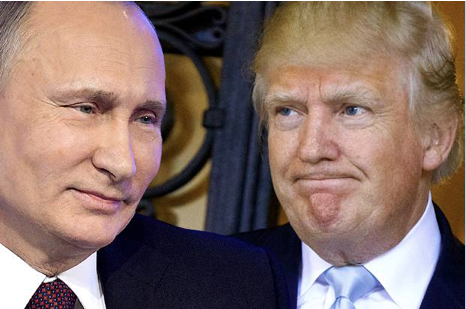
Maybe Trump is Putin’s tool, or is being blackmailed. But isn’t it more likely he’s just an insecure little creep?
If there is any aspect of the just-concluded election more bizarre than the allegations of Russian meddling on behalf of Donald Trump, it is Trump’s continuing resistance to the possibility that the assertions are true.
This is a man, after all, who has never been shy about sharing his beliefs in the most outlandish theories. He has spent the last year and a half throwing out charges without offering evidence, implying by turns that the United States government was intentionally allowing migrants to flood across our southern border, or that Democrats were colluding to steal the election through voter fraud, or that Justice Antonin Scalia might have been assassinated. He first gained notoriety with Republican voters by openly questioning whether President Obama was really born in Hawaii, sucking up all sorts of oxygen to keep attention on that baseless slur.
Nor is this habit of tossing around baseless accusations limited to Trump’s time in politics. In 1989, when five teenagers were accused of gang-raping and nearly killing a jogger, Trump took out a full-page newspaper ad declaring the youths guilty just two weeks after their arrest, long before a trial was even scheduled. This year, despite the fact the men were long ago exonerated, he was still casting doubt on their innocence.
Given all this and so many more examples, it is more than a little jarring to watch Trump turn more cautious than George McClellan, the hesitant general who nearly lost the Civil War, when the question of possible cyberattacks by Russian hackers comes up. Suddenly the president-elect is warning the public that “hacking is very hard to prove.” Suddenly he wants America’s multiple intelligence agencies, who have been seemingly united in their belief that Russia was responsible for hacking the Democratic National Committee and other targets, to be “sure” of their assessment “because it’s a pretty serious charge.” Suddenly his surrogates think it would be “unbelievably irresponsible” to plan a response to Russia, even though the current president has already been sufficiently convinced to take action.