Home Blog Page 770

Our Loss Is The Ancestors’ Gain: Aminisha Black – Gifted Nurturer and Cultural Creative

By Maitefa Angaza

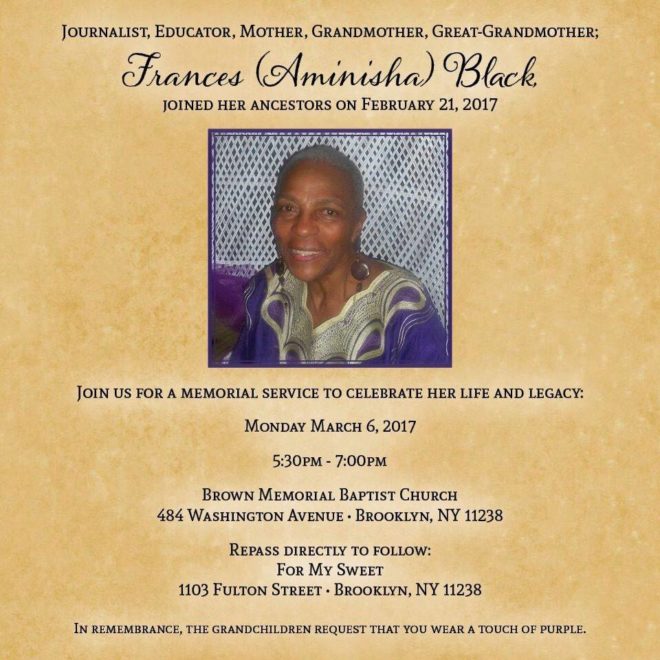
An icon of New York City’s Black cultural community has joined the ancestors. Aminisha Black was one of the founders, in 1969, of The EAST, a groundbreaking cultural and educational organization rooted in the self-determination ethics of Black Cultural Nationalism. Her love/work contributions there – and afterward to the larger community – will long be remembered.

Born Frances Lee in Pendleton, South Carolina in 1940, Aminisha was the only child of Lena and Clarence Lee. She moved to New York City in her early twenties and soon became involved in the cultivation of young minds – an endeavor that would become her lifelong passion. As Brooklyn’s pulse quickened with the currents of Black Power and African heritage, Aminisha bloomed into a kind and committed advocate.

Fikisha Cumbo met her in 1967 when they worked at the same job. After leaving to teach junior high school, Fikisha met Jitu Weusi (Les Campbell) and others involved in the Ocean Hill-Brownsville campaign for community control of schools. “Aminisha said, ‘Invite me to something so I can meet one of those fine brothers you’re hangin’ out with!’“ Cumbo recalls. “So I brought her to a party. She sat in a bay window – Afro cut low, big earrings and a beautiful African dress. Jitu got a look at that woman and sat there talking for the rest of the evening.”

That was the start of a long love and marriage blessed with five children, in addition to Aminisha’s two young boys, Pamoja and Amani Fruster. The couple’s firstborn was Kweli, now a technical writer for a contractor with the MTA; then came Nandi, a New Orleans-based defense attorney; Makini, a high school guidance counselor in Atlanta; Hazina, a criminal justice professor in Birmingham; and son Kojo, an assistant principal at a junior high school in Brooklyn.

Pamoja and Amani are deceased – pain that Aminisha must have channeled into the compassion for which she was known. But her legacy runs deep with 13 grandchildren and one great-grandchild. Although she and Jitu parted some years ago, she was proud that they were able to continue parenting successfully. He joined the ancestors in 2013.

Lolita Standard was one of Aminisha’s oldest friends. Along with Ramona Bhuya, they were, for a time, the only women around during the earliest days of The EAST’s formation, she says. “It taught me what sisterhood was really about. We had each been the only children in our own families. So if Aminisha needed help, Ramona would call me and I had to go – no two ways about it. I was committed because of the bond of the sisterhood.”

That sisterhood became a twin spine of The EAST as it flourished to become “a sample and example” of vision, unity, cooperative economics and creativity. Added to the day care would soon be a Saturday school for secondary students. When The EAST leased a vacant and cavernous local armory, Uhuru Sasa Shule (Freedom Now School) was born, becoming one of the first and most successful independent Black schools on the East Coast.

Fela Barclift, the first teacher for the girls at Uhuru Sasa, remembers when Aminisha came to help with accounting, but quickly became involved in anything to do with nurturing students. “She really did get it that the connection had to be with parents if children were to reach their potential. So she created a parents network with mentoring and enrichment.”

Aminisha’s juggling of multiple roles with kindness, integrity and focus made a lasting impression on Basir Mchawi. “As our political consciousness developed, Aminisha was there in the midst of our struggles. A leadership Council member, she became head of Bookkeeping and Finance. As editor of Black News, I occasionally had to perform financial tricks to keep our publication operational. Aminisha would hold me and all the other EAST department heads accountable.”

MindBuilders Creative Arts Center in the Bronx gained an assist, and director Madaha Kinsey-Lamb gained a true friend when Aminisha arrived to work there. “She started with accounting and bookkeeping, later helped promote the teen theater company and provided a strengths/skills/interest inventory for our young people,” Kinsey-Lamb recalls. “We developed a warm friendship that, for a time, included a weekly phone call, coaching, listening and encouraging each other’s progress with our writing and other goals.”

Adeyemi Bandele felt her early and lasting impact. “Certainly, Aminisha was an integral component of the founding and success of The EAST. Because of her presence, her gentle, loving spirit, she had an effect on us that caused the membership to gel.”

Aminisha’s sense of commitment will always serve as an example to her friend Abimbola Wali. “I remember when Aminisha relocated to Pendleton, South Carolina to care for her aging mother, and that she kept up with Sister Ramona, who is in a long-term nursing facility. And if I wanted to beat her at ‘Words with Friends’, I had to get help from the computer!”

Those who knew her well will tell you Aminisha always had a project in mind or in progress aimed at serving the community. She was a member of the Parents Advocacy Council based at Medgar Evers College, created Word Power League, a vocabulary initiative for third-graders and spoke of a Kwanzaa film festival she wanted to produce in the south. She was active in her block association and organized a regular and popular Scrabble tournament on the block. Her daughter Nandi says Aminisha was a master herself and that it was a family badge of honor if you beat Mama Aminisha at Scrabble.

Her newsletter, “The Parent’s Notebook”, which became a long-running newspaper column in Our Time Press, was a uniquely enlightening and helpful one. It offered not only the expected nuts and bolts of education, agency, health and safety, but also addressed complex social, ethical, political and spiritual issues in an accessible manner. Publisher David Greaves valued the column as an enhancement of the paper’s brand.

“Aminisha’s Parent’s Notebook column gave our readers a deeper understanding of life, with its possibilities and its joys,”” said Greaves.

Block by Block was a project Aminisha envisioned to help achieve incremental but substantive community empowerment. Nandi says Aminisha envisioned it beginning with one block – her own – and being replicated on other blocks in the neighborhood, then in other neighborhoods, boroughs and so on.

Nandi said, “My mother asked, ‘What if adults really knew what was going on with kids?’ She wanted to teach others how to engage people on the block, with adults concerned with and caring for the youth, whether or not they were family”. Aminisha was not able to bring this project to fruition before she became ill, but she has adult children who are educators and grandchildren who love her fiercely, so… you never know.

“The bond she had with her grandchildren was unbelievable!” Kojo said. “She provided a safe space, allowing them to be who they are. They really appreciated that and enjoyed being around her, from the older ones to the younger ones.”

Muslimah Mashariki said of her friend, “Aminisha’s impact on The EAST Sisterhood was that of a very principled and kind worker to look up to, an example of great integrity”. And Aminisha was devoted to the end to that sisterhood, attending as many reunions and vacations as she could and keeping in touch with the women – and also the men, with whom she’d built a meaningful and impactful life.

Makini is grateful for the impact someone had on her mother’s life long ago. “I recently spoke with her high school teacher Mrs. Stevens, who turned 93 years old on Valentine’s Day,” said Makini. “My mom was a teenaged mom and to have someone in the school to encourage and keep you moving is quite significant. My mother would go and visit her whenever she was in the south.”

So it appears that Aminisha’s dedication to young people may have been inspired, in part, by kindness once shown to her. By extension, it served to benefit all who knew her. It’s said in some African traditions that the number 3 signifies an opening of the way. Three of Aminisha’s children share here a significant lesson they learned from their mother. May these serve to open the way to greater understanding for us all:

Makini Campbell

“Her authentic way of seeing community life inspired me. To impart my wisdom and experiences to my students in a way that helps them move forward… it’s a very rich – not material – but meaningful life.

Nandi Campbell

“My mother taught me to learn from history, that things happen for a reason and that we can reform, not repeat, that history. She was very much interested in self-development and had all of her children and some of her grandchildren take the Landmark Forum.”

Kuzaliwa Kojo Campbell

“Being of service and using your time to focus in on your purpose, which is not always immediately evident. That was a major contributor in terms of assisting me to see that it’s an ongoing process to discover who you are and why you’re here.”
HBCU Listening Sessions at White House: ‘Very little listening’ | DiversityInc

“‘They started in church basements, they started in old schoolhouses, they started in people’s homes,’ says Marybeth Gasman, a historian at the University of Pennsylvania who studies HBCUs. ‘[Former enslaved African] were hungry for learning … because of course, education had been kept from them.’”   And in many instances, it still is.

Education Secretary Betsy DeVos demonstrated her lack of knowledge on the history of Historically Black Colleges and Universities after the meeting took place, calling them examples of “school choice.”

Following a meeting with leaders at Historically Black Colleges and Universities (HBCUs), Education Secretary Betsy DeVos released a statement that raised questions about how much listening she did at the session.

DeVos described HBCUs as “real pioneers when it comes to school choice.”

“They are living proof that when more options are provided to students, they are afforded greater access and greater quality,” DeVos said.

But the history of HBCUs was not about “more options” as much as it was about the only option Blacks had for a fair education.

Marybeth Gasman, director of the University of Pennsylvania’s Center for Minority-Serving Institutions, called DeVos’ remarks “inaccurate and a whitewashing of U.S. history.”

Read More: HBCU Listening Sessions at White House: ‘Very little listening’ | DiversityInc

Street Talk: From “Trump Will Destroy Our Schools” to “Trump Will Create Jobs”


By Carolyn Jenkins

This week’s “Street Talk!” question is: “Do you think President Donald Trump’s proposed policies will have any affect on your life?”
A semiretired educator who declined to give his name said: “Trump wants to claim the health care program, instead of Obama. Plus, he’s trying to put a totally unqualified woman to head education. He wants to bust unions, and without unions, there is no strength for the working class. I did what I could do by voting in the last election. I feel the election was rigged.”

This teacher was referring to Betsy DeVos, who was barely confirmed as Secretary of Education. She needed Vice President Mike Pence’s vote to win confirmation by 51-50. The vice president is allowed to cast a vote in case of a tie in the U.S. Senate.

An administrative supervisor for the New York City Police Department (NYPD) who also would not give her name had a different slant on what the Trump Presidency portends. She said: “I was told that Trump had proposed to take away the earned-income credit, and people with children would pay more taxes. This would hurt the middle-income people. This is my biggest fear. As a city worker, I am afraid of the potential for union-busting since I have many years of work left.”

The unions supported Hillary Clinton in the presidential election and this NYPD employee’s concern is understandable. Trump hasn’t yet revealed his tax plans beyond claiming that there will be tax cuts for everybody. He did say corporate taxes will decline to 15% from 35%, which raises the question how government would pay for social programs leading to fears of drastic overboard cuts.

An MTA worker who is a father of an eleven-year-old had this to say about the impact of the Trump Presidency: “I might not see it immediately, but in the future. Like that Education Secretary that he appointed. She appears not to know her thing, and since my daughter is in school, it could have an affect on the way her school is funded. I am quite sure it will have some kind of affect. That’s one thing. The travel ban has been lifted, but it’s still temporary. What affect will that have in the future if it’s reinstated? I definitely see his policies affecting us in a negative way more than anything else and you got to think about the business aspect of it. He’s hiring his business buddies to pretty much run the White House. So yeah, it’s definitely going to affect us, in one way or another – it being taxation – certain budget cuts and social programs. It’s already bad in schools and there are no more music programs – there’s nothing out there, so it will definitely affect us.”

Yet, not everyone is pessimistic about Donald Trump’s plans. A Cuban-born Brooklyn resident, Frederico Scott Pryce supports the Trump agenda: “I have been living in Brooklyn for the past 47 years, and I believe that Trump is a great man and will do great things for America. Most of the jobs in America have left due to the policies of the big corporations, and Trump is trying to bring back the jobs, so that is good for America. What is good for America is good for everybody.

Trump is a businessman, and he is for the money. So, if he can make money for America, I think that’s great. A lot of Blacks don’t support Trump. They say he’s racist, but he ain’t racist. If he can share the stage with Kanye West, Steve Harvey, all those guys – nobody else dragged Blacks up there. He wanted to show the Blacks so we can see what he can do. Chicago has the biggest murder rate. Obama didn’t do anything about it but Trump said, “If you don’t clean up Chicago, I’m going to send in federal troops”. And you say he’s a bad man and a racist – I don’t think so. Like Trump said during his campaign, “With bad schools, poverty and high crime – what do you have to lose?”
Every week reporter Carolyn Jenkins prowls the streets of New York posing a new question to people in the community. Send any comments to contact@guerrillajournalism.co.


A Death in Brooklyn #1

Bernice Elizabeth Green/Our Time AT HOME


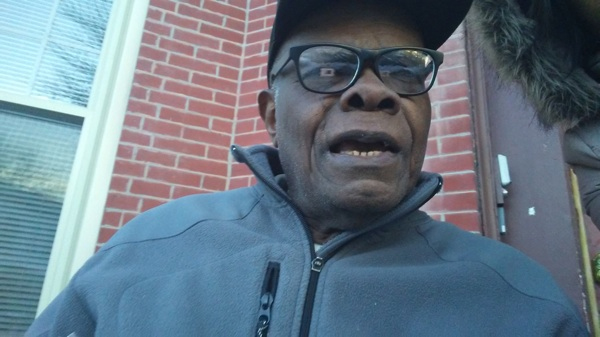
Mr. Kenneth Anderson of 145 Clifton Place Photo: BGreen/Legacy)

Our Time Press expected to meet 82-year-old Mr. Kenneth Anderson of 145 Clifton Place on Thursday, February 23 — after we had closed the door on the issue for that day.


We had confirmed in a phone call, as a favor to a friend, that we would talk to him about his story — another in the continuing reported sagas of theft of property involving mostly families and residents of color as victims; a story about house-thieves using false deeds and legal maneuvers to prey on vulnerable homeowners to steal their homes, legacies and dignity.


Mr. Anderson’s tone was cheerful when the publisher spoke to him by phone, as he had great expectation that a March 7 court date would be the turning point in his life.  A life overshadowed by reverse mortgages he said he never requested on his fully-paid-for property.    This narrative has been continuing for nearly two decades and now an LLC, using his address in their name, has forced his tenants from his dwelling. Mr. Anderson believed that sharing his story would inspire others caught up in a similar nightmare to find inspiration to fight back.

Neighbors on the block described Mr. Anderson as a humble person, and not one to seek media “celebrity.”


On Wednesday, February 22, as we worked on deadline, a phone call informed that Mr. Anderson had passed in his home.  The announcement struck us hard; it almost as though we had known him for years.


Three minutes later we were standing in front of his red-painted house where his body lay, and officers from the 79th did their work. A group of men and one woman stood outside.


Soon after the medical examiner showed up and noted comments from his neighbors.


Lonnie Smith

We met friends who always stood watch at 145: Lonnie Smith – who did Mr. Anderson’s handiwork and repairs; Lonnie Nixon, who checked on him and brought him breakfast and the papers; and Wendell, with whom he also communed and shot the breeze, were caretakers as well as his guard.


We saw Mr. Anderson in the eyes of his friends, who were his caretakers, as well. Even before Smith told us Anderson “died of stress,” we knew we had to keep the appointment set for last Thursday (23) to gather information for Mr. Anderson’s story.


We knew these men would speak for their ace, their brother, their patriarch, and encourage others on the block to do the same.


Speak, they did.  About how Mr. Anderson’s life (and they named names) became entrapped in what he considers a lawless, corrupt underworld ruled by sneak thieves whose livelihood centers on pilfering land, trust, deeds and signatures from the elderly and the innocent.


Lonnie Nixon

But Lonnie Smith is determined not to let death … or its human facilitators … be proud in this moment. With Nixon, he is determined to go the distance Anderson intended to trudge.


Death may have come to their friend naturally.  But it happened during circumstances, they say, that were most unnatural. “Not on my watch,” Smith told us. “I will not let this go down. Not like this.”


Going down like this, said Smith, means that Mr. Anderson will triumph and win his case.


The 79th helped Smith and Nixon contact Mr. Anderson’s direct next of kin, his “beloved” brother Nigel Foster who is flying from his home in Bermuda to New York tomorrow morning, Tuesday, February 28.


Tomorrow evening, Smith, Nixon and others in Mr. Anderson’s Clifton Place crew will attend a performance of August Wilson’s “Jitney” production running through March 10 on Broadway.

Wendell

The play is part of the acclaimed series of Wilson’s powerful theatrical affirmations of the lives of everyday people in different time periods.


Viola Davis, in her Oscar-winning speech last night (for “Fences”), cheered the playwright “who exhumed and exalted the ordinary people.”


Starting our story off through the perspectives of Mr. Smith, Mr. Nixon and Wendell, anchored by the vision and art of Wilson, is a good place to begin. Justice for beleaguered homeowners in gentrifying areas around the nation just may come from ordinary people with extraordinary compassion.


Ultimately, Mr. Anderson’s own story is about the triumph of indomitable love from the point of view of his soulmates who survive him. (More to come.)


Ron Edmonds 113 Students Sharpen Their Dr. King Voices

Submitted by Margo McKenzie, Founder of giftofletters.com

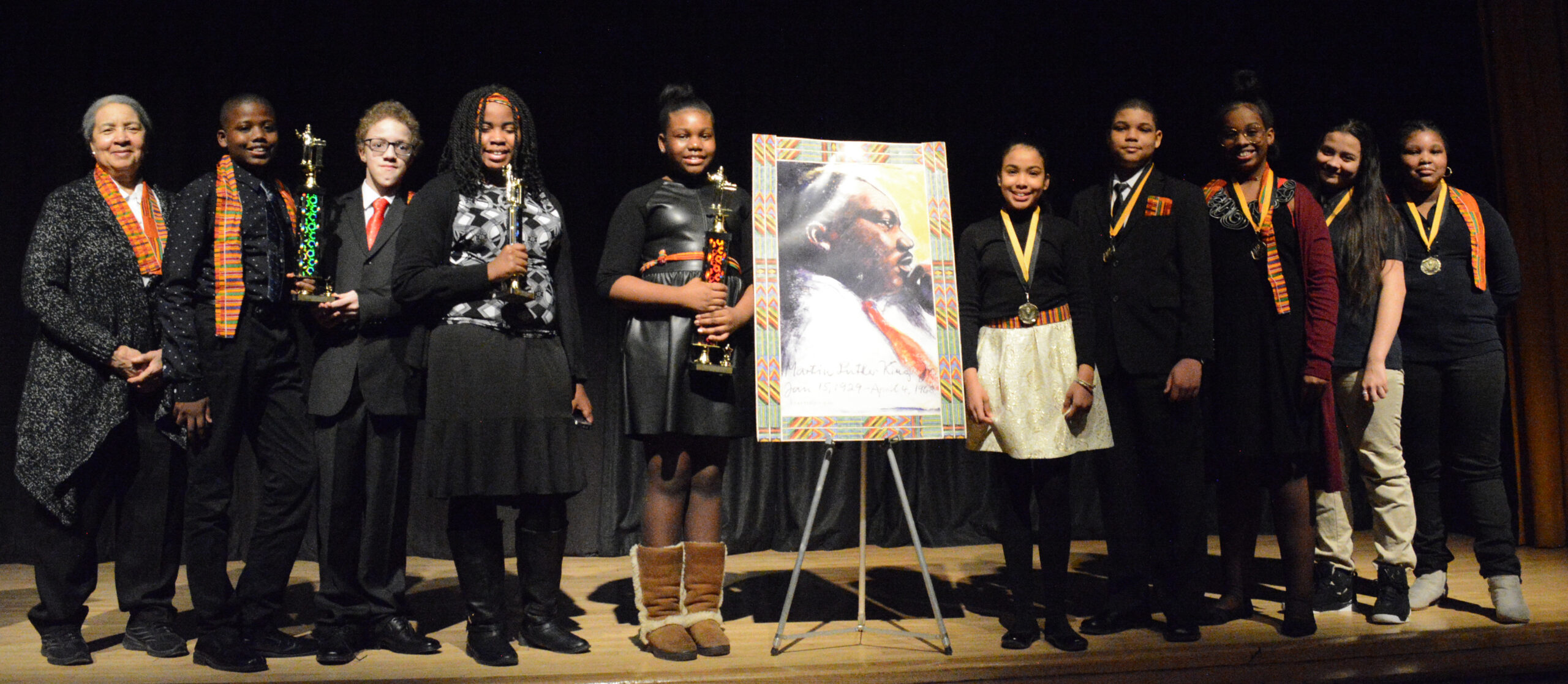
Ten contestants competed in the Martin Luther King, Jr. Oratory Contest at the Ronald Edmonds Learning Center 113 in Fort Greene on Thursday, February 15, 2017. Principal Ms. D. Daughtry welcomed an enthusiastic, expectant audience of students, teachers and parents after which sixth-, seventh- and eighth-graders wielded their way through various speeches Martin Luther King had delivered.

Contrary to last year, early arrival and front-row seating ensured that parent Sandra Prichard would not miss her daughter’s participation in what the principal coined, “This special moment on the school’s calendar.”

Courageous Nashali Arias broke the ice as the first contestant reciting King’s “Speech to Young People” (Part 2).   Eight additional contestants followed her in the following order: Giana Ospina, “The Length of Life”; Anastasia Olive, “I Have a Dream”(Part 1); Jasmine Godfrey, “I Have a Dream” (Part 3); Nicholas Lodge, “I Have a Dream” (Part 4); Nahliyah Willis, “A Drum Major For Justice”; Tyarie Knight, “A Sermon on Peace”; Allen Arias, “Stand Up for Righteousness”; and Amanda Brown, “I’ve Been to the Mountaintop.”

Students watched a video on King’s life and legacy while judges calculated their scores.

(Left of MLK) P. Edwards, Educator; 2nd place winners Tyarie Knight and Nickolaus Lodge; 3rd place Jasmine Godfrey and 1st Place Amanda Brown (R. of MLK, Nashali Arias, Allen Arias, Anastasia Oliver, Giana Ospina, Nahliyah Willis Photo:Mandy Murray (8th-grader, JHS 113)

In addition to commemorating Dr. King and his oratory, public schoolteacher Ms. Priscilla Edwards, founder and advisor to the more-than-thirty-year-old oratory contest at the school, honored Mr. Robert Smalls with a short biography in the program. Smalls freed himself from slavery and was elected to the South Carolina House of Representatives [1868] where he “authorized legislation that created the first free and compulsory public school system in America.”  In an atmosphere where public schools are under attack, Edwards felt compelled to remember a man who fought for public education for all in South Carolina. After all, “presidents, lawyers, doctors, ambassadors and teachers” came through public schools.

Why toil with children to memorize and recite when you have a full teaching load? Observing student growth from the first day of preparation to the day of competition is a satisfying reward. “They all go away more confident.” Seventh-grader Giana Ospina pushed herself to participate because memorizing this speech “builds up my stamina to understand more sophisticated words.”

Do you utilize any specific strategies? Nahliyah Willis said, “We just have to recite the speech as if we are Dr. King ourselves.”

Other oratory contests inspire students in middle school and high school to hone their oratory skills. Martin Luther King, Frederick Douglass, Theodore Roosevelt are a few oratory competitions still open to contestants this year. These contests motivate students to develop one of the most important skills needed for success in life: communication. According to Forbes’ website, Warren Buffett maintains, “Communication will instantly raise a person’s professional value.” Thousands of adults who realize the value of the skill join public speaking organizations.

For the King contest, judges scored each speech using a rubric of five critical public speaking categories: eye contact, confidence, voice, delivery and enunciation—basic requirements for communication on any level. The anxiety of preparation caused a few students to recoil from the challenge. However, if students take advantage of people such as Ms. Edwards, they will not cave into the “emotional pressure” that the competition can create, said eighth-grader Tyarie Knight.

This is the second year 7th-grader Nicholas heard about the contest, but last year he “didn’t feel ready. Some people get a calling. It wasn’t my calling last year. This year, I realized when the opportunity comes, you must take it.” Nicholas rose to the challenge and shared second place with Tyarie.

Four students walked away with trophies but Ms. Edwards honors all participants with dinner. Last year, students opted for Dallas BBQ, followed by a tour of Manhattan. Once Edwards presents three choices, students will exercise their voices, yet again, by casting their votes for the site of this year’s celebration.