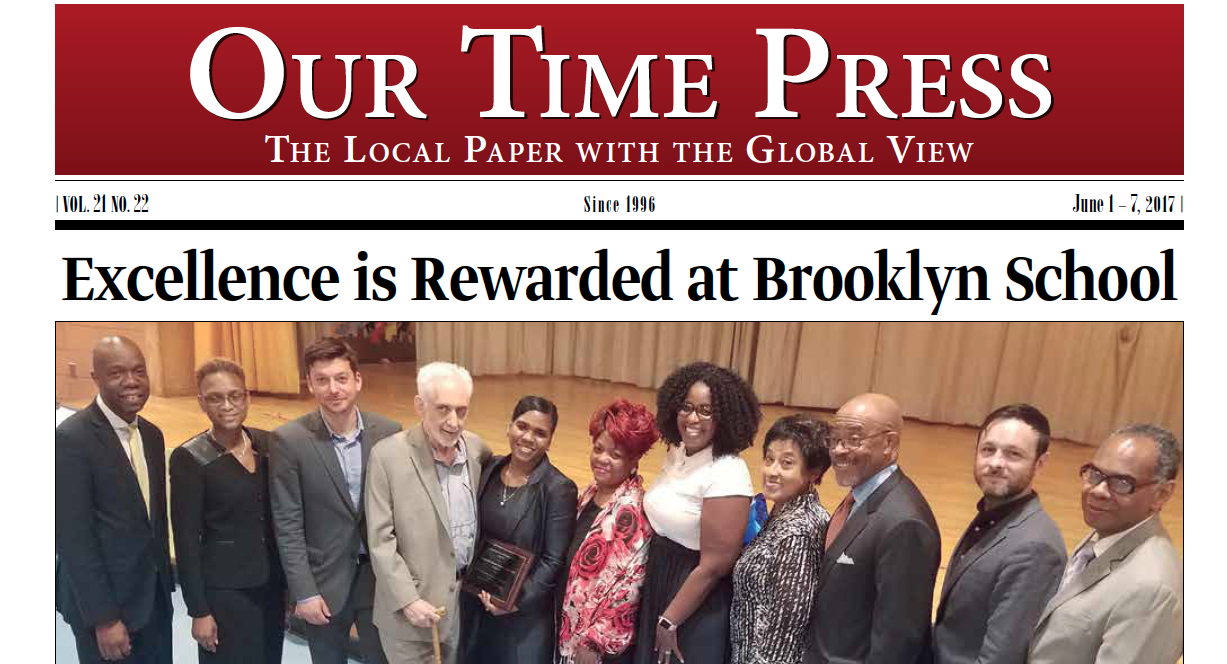
[pdf-embedder url=”http://www.ourtimeathome.com/wp-content/uploads/2017/06/Our-Time-Press-June01-2017.pdf” title=”Our Time Press June01, 2017″]
Retired and Over Fifty-Five, They Find a New Stage to Thrive
By Margo McKenzie
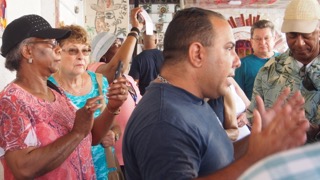
Fannie Smiths had worked with the Department of Education for thirty years as a business teacher. She later rose to guidance department chair and managed the school admissions process, psychosocial issues, preparation for graduation and college. As an extracurricular activity, Smiths directed FBLA (Future Business Leaders of America) organizing school and statewide business and organization leadership activities for youth.
Though a dedicated educator and family member, she longed to see the world. A voice told her, “Just raise your kids and then you will be able to travel around the world.”
Julie Bowers had devoted twenty-nine years to teaching high school English in a variety of high schools, concluding at Thomas Edison High School. She had mastered the art of leading classroom discussions about “Hamlet”, “The Scarlet Letter”, “The Red Badge of Courage”, “Their Eyes Were Watching God” and other literary masterpieces. She prepared students for the English regents and SAT exams, graded essays and research papers.
Every summer after vacation teachers would return to school discussing the various places in the world they had visited. While they swapped stories about Spain, France, Florida or Egypt, Julie had nothing to contribute to the conversation.
This consistent inability to share a travel story created a deep hunger within Julie to see the world. With a husband and two children, five classes to teach and not enough years to retire, Julie’s travel hopes could not come to fruition fast enough.
However, somewhere along the line, Julie became convinced, “God would allow me to live long enough to travel.”
Wilbur Bowers would troubleshoot for solutions to electronic problems in homes and offices. He installed, maintained, repaired telephones lines, voice mail systems, fax lines, security, Internet and wireless systems in hundreds of buildings across the metropolitan area for clients from all walks of life, encountering the very poor or the very wealthy such as residents of the Dakota Apartments where John Lennon lived.
On different days, they each wakened to their last alarm clock; Fannie and Julie taught their final lesson, graded their last test and Wilbur connected his last phone, but for all three, their inspiration to improve the lives of others remained intact.
Very often, retirees enjoy pursuing a life of leisure. Others volunteer in churches or community organizations. But Fannie, Julie and Wilbur wanted to do more.
After raising her children, Fannie founded a business, another venue for her organizational, inspirational and educational inclinations —Funshine Travel–an agency which organizes excursions to ports around the world.
Their children entered adulthood and eventually both Julie and Wilbur retired. Fannie invited Julie to join her travel business, and Wilbur joined also. Some might call it fate, but Julie calls that day divine.
Now fifteen years in operation, Funshine Travel has visited over twenty countries: France, Spain, Italy, Bahamas, Haiti, Greece, Rome, their latest an April trip to Cuba.
Organizing trips for groups is a work of careful juggling, communication and sensitivity, skills all three developed over the years in their first careers.
Their next trip is an October cruise aboard the luxurious Ms. Koningsdam, a new five-star ship, visiting St. Maarten, Guadeloupe, Barbados, Martinique, St. Kitts, Nevis, St. Thomas and Half Moon Cay. Contact: Fann9@aol.com or Jeb@nyc.rr.com if interested.
They shudder to think that just two years ago they led a group to the Champs D’Elysee, the site of a recent terror attack. Though these attacks may cause pause, Fannie, Julie and Wilbur will continue to make their encore performances in life by organizing trips for enthusiastic travelers.
According to Pew Research Report: Working after “Retirement: The Gap Between Expectations and Reality,” 77% of workers expect to engage in some form of work after retirement, but in reality, only 12% find themselves working. Although Funshine Travel is fun, it still qualifies as a business which may serve as a model for others seeking entrepreneurship opportunities.
“With changes underway in the basic financial framework of retirement (fewer people now than in the past work for employers who provide defined benefit pension plans),” the same Pew Research Report suggests that in the future even more retirees may pursue entrepreneurship ventures to meet their financial obligations.
A Night of Honors …
By Bernice Elizabeth Green & Priscilla Mensah
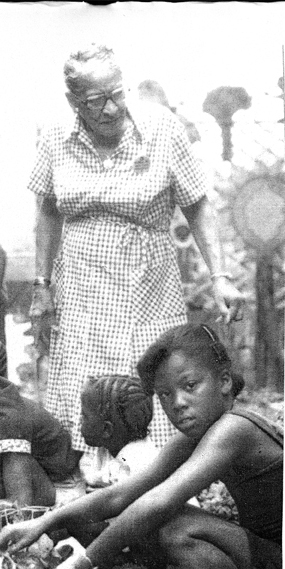
It was a night of honors and more at last Saturday’s fundraiser for the Magnolia Tree Earth Center of Bedford Stuyvesant, as the conjoined spirits of two great women — Hattie Carthan, founder of the Center, and Marcia Goldman, the president emeritus – moved through the event, from idea to planning to development.
The selection of the honorees was not a difficult task. The names of Safiya Bandele, and Evelyn Castro easily came to mind, thanks to administrative assistant Andrea Brathwaite, and they were quickly approved.
There was no debate on who should keynote. For the Chair, David Greaves, and Advisory Board member Bernice Green, there was no other choice than Al Vann – a member (then the youngest) of the famed game-changing Hattie’s Angels circle.
During planning sessions, the Board, in accordance with Ms. Carthan’s expressed grassroots missions for the Center (that it be a site for neighborhood children and families to learn about ecology, environment, the natural sciences and all that relates to them) worked to incorporate a child into the program. They did not need to work hard. Andrea recalled that the Chair’s granddaughter, Chelsea Williams, 10, is a crafter, and had inherited fabrics from the the late Marcia Goldman’s extensive bounty. Miss Williams, mentored by artist/art educator Barry L. Mason in his Mt. Vernon studio, designed the award and layout. The final product comprised Quilt patches made by Ms. Goldman’s own hands; and fallen leaves from the magnificent grandiflora so loved by Ms. Carthan. The spirit of Africa was incorporated at the influence of Miss Williams’ mother through the incorporation of fabric scraps stitched with adinkra symbol details and the use of real Egyptian bark as the mat background.
Mr. Vann’s moving keynote held the audience spellbound. It was generous in painting a picture of the broadstrokes of New York City and national 1960’s history – when extraordinary ideas followed by extraordinary action gave rise to such Black institutions as Hattie Carthan’s Magnolia Tree Earth Center. Known — like his colleague the Hon Annette Robinson, who also attended the event – as an orator who needs no script nor notes, Mr. Vann made the astute connection between majesty of Ms. Carthan and the will of Malcolm X, whose birthday anniversary was that day. “If you want to measure who you are, measure against X,” stated Vann to the audience. “[Malcolm X] told us to stand up. You can’t be ridden if you are standing up.”
He led all in attendance in a “Happy Birthday” shout-out to Malcolm. He lauded the audience for supporting Magnolia’s fundraising effort. He applauded the Magnolia Board for its efforts in keeping alive the legacy of his mentor, Mrs. Carthan. He also exhibited the humility and grace he ascribes to Ms. Carthan and Ms. Goldman, a former close friend by thanking Mr. Greaves and Ms. Green in a special way: “There is a time to be a mover and there is time to move on,” but “the respect that I have for David and Bernice is so profound that it was hard for me to say no.”
It was an evening of giving in the spirit of the times that shaped the need for a place such as Magnolia Tree Earth Center. Quietly, out of view, at the Silent Auction table, a friend of the Goldman family, Mr. Louis McG. Walker, won, at bid, several artworks by such masters as Leroy Clarke, Tom Feelings, James Denmark (a signed poster) and one of Ms. Goldman’s handmade quilts from the family’s extensive collection, and works by Leroy Clarke, Tom Feelings, and others.
Dr, Olivia Cousins, the educator/artist/photographer, assisted tremendously at the Silent Auction table and then bid and won several pieces, including Ms. Green’s copy of the 1969 edition of Ebony with a cover story on Betty Shabazz remembering her husband, Malcolm X and works by such artists as Ernie Banks and Tom Feelings, among others.
Vanika Mock bid and won the super king-sized-plus quilt with pillow items handmade by Ms. Goldman; Curtis Williams, father of Chelsea, won an poster of Marcus Garvey, an original print from The East organization of which the late Jitu Weusi and education pioneer Mr.Vann were organizers.
Future Magnolia Tree Earth Center fundraising events will be announced in Our Time Press.
Priscilla Mensah is an avid reader and scholar whose passions include community development and empowerment. She can be reached at pmensahbrooklyn@gmail.com.
View From Here

By David Mark Greaves
While the Congress, the committees, the special prosecutor and the Fourth Estate looks for the “smoking gun,” Donald Trump and those he has brought to power, who are acting as though they are all Russian agents, promise to wreak havoc on Black and Brown people every which way they can. The only wrinkle is that they wreak havoc on their most fervent believers as well. Unfortunately, it may take a family member having an accident and going bankrupt because of medical bills before they’ll see they’ve been had.
In the meanwhile, the Trump minions will have poisoned the air and water, unleashed microbes in the food supply, increased the collection of heavy metals in animals, fish and people, transferred hundreds of billions of dollars up to the mega-rich, and arrested tens of thousands of Black and Brown people, disrupting families for generations to come. And that’s just here in the States.
In Saudi Arabia, they made him feel so very important with all of the pomp and glitter they could muster to flatter this clownish and ignorant man elected President of the United States. And while he’s killing us slowly here at home, he’s extremely proud of the $110 billion arms sale to the Saudis, allowing this authoritarian, theocratic regime that has outlawed dissent to quicken its own killing.
I am sure he was thoroughly enjoying himself, but maybe not so much fun later in Israel when he tried to hold hands with Melania and she slapped his away. That’s the second time she’s avoided handholding with Trump. She’s given us her opinion of the man before, as in the CNN interview last year when she said, “…I have two boys at home, I have my young son and I have my husband.” Now she’s indicating that not only is he a child, but she agrees he’s an odious one at that. Melania had been so comfortable in New York with the president in Washington and now she’s stuck with him on Air Force One for nine days. It may be starting to get to her – as it would to anyone – but on the plus side, she could be surfing the Net and getting the idea that he doesn’t own her future, she owns his.
African-Americans & Memorial Day
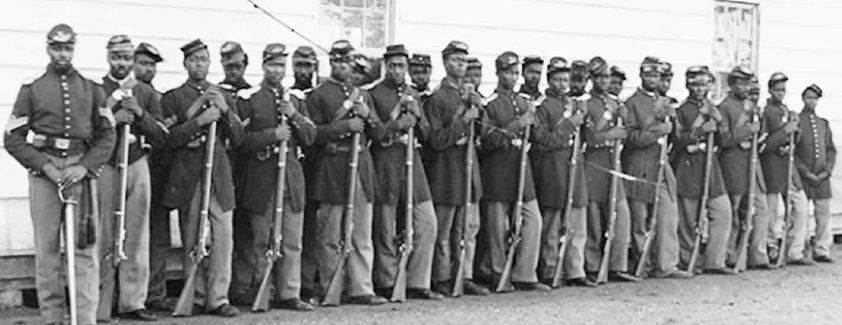
African-Americans may not have invented Memorial Day on May 1, 1865, but the following narrative from the Snopes Fact Checker gives us an opportunity to imagine that time and place.
In his book, Race and Reunion: The Civil War in American Memory, Professor David W. Blight made the case for Charleston, South Carolina as Memorial Day’s birthplace, as that city was the site of an obscure (possibly suppressed) May 1865 event held at a racetrack-turned-war prison, during which freedmen properly reburied hundreds of Union dead found there and then held a ceremony to dedicate the cemetery:
African-Americans founded Decoration Day at the graveyard of 257 Union soldiers labeled “Martyrs of the Race Course”, May 1, 1865, Charleston, South Carolina.
The “First Decoration Day”, as this event came to be recognized in some circles in the North, involved an estimated ten thousand people, most of them Black former slaves. During April, twenty-eight Black men from one of the local churches built a suitable enclosure for the burial ground at the Race Course. In some ten days, they constructed a fence ten feet high, enclosing the burial ground, and landscaped the graves into neat rows. The wooden fence was whitewashed and an archway was built over the gate to the enclosure. On the arch, painted in black letters, the workmen inscribed “Martyrs of the Race Course”.
At nine o’clock in the morning on May 1, the procession to this special cemetery began as three thousand Black schoolchildren (newly enrolled in freedmens’ schools) marched around the Race Course, each with an armload of roses and singing “John Brown’s Body”. The children were followed by three hundred Black women representing the Patriotic Association, a group organized to distribute clothing and other goods among the freedpeople. The women carried baskets of flowers, wreaths and crosses to the burial ground. The Mutual Aid Society, a benevolent association of Black men, next marched in cadence around the track and into the cemetery, followed by large crowds of white and Black citizens.
All of them dropped their spring blossoms on the graves in a scene recorded by a newspaper correspondent: “When all had left, the holy mounds — the tops, the sides and the spaces between them — were one mass of flowers, not a speck of earth could be seen; and as the breeze wafted the sweet perfumes from them, outside and beyond … there were few eyes among those who knew the meaning of the ceremony that were not dim with tears of joy.” While the adults marched around the graves, the children were gathered in a nearby grove where they sang, “America”, “We’ll Rally Around the Flag” and “The Star-Spangled Banner”.
The official dedication ceremony was conducted by the ministers of all the Black churches in Charleston. With prayer, the reading of biblical passages and the singing of spirituals, Black Charlestonians gave birth to an American tradition. In so doing, they declared the meaning of the war in the most public way possible — by their labor, their words, their songs and their solemn parade of roses, lilacs and marching feet on the old planters’ Race Course.
After the dedication, the crowds gathered at the Race Course grandstand to hear some thirty speeches by Union officers, local Black ministers and abolitionist missionaries. Picnics ensued around the grounds, and in the afternoon, a full brigade of Union infantry, including Colored Troops, marched in double column around the martyrs’ graves and held a drill on the infield of the Race Course. The war was over and Memorial Day had been founded by African-Americans in a ritual of remembrance and consecration.
Although contemporaneous accounts from the Charleston Daily Courier describe and document the 1865 ceremony that took place there and the event was one of the earliest-known observances similar to what we would now recognize as Memorial Day, whether it was truly the first such ceremony, and what influence (if any) it might have had on later observances, are still matters of contention. Professor Blight termed it “the first Memorial Day” because it predated most of the other contenders, but he noted he has no evidence that it led to General Logan’s call for a national holiday in 1868: “I’m much more interested in the meaning that’s being conveyed in that incredible ritual than who’s first,” he said.