Home Blog Page 748

Congresswoman Clarke’s Statement on the Army’s Refusal to Remove the Names of Confederate Generals from Streets at Fort Hamilton

Brooklyn, N.Y. – Congresswoman Yvette D. Clarke released the following statement on the refusal of the Department of the Army to consider renaming two streets at Fort Hamilton honoring Confederate generals, General Lee Avenue and Stonewall Jackson Drive. Congresswoman Clarke, joined by Congressman Jerrold Nadler, Congresswoman Nydia Velázquez and Congressman Hakeem Jeffries, formally asked the department to rename the streets in June following the removal of monuments honoring Confederate generals in New Orleans.

“I am disappointed that the Department of the Army will not even consider renaming these streets honoring Confederate generals who waged war against the United States. The department claims that the streets were named ‘in the spirit of reconciliation’. But that ‘reconciliation’ was actually complicity by the North and the South to ignore the interests of African-Americans and enforce white supremacy, effectively denying the result of the Civil War for generations. We are still living with the failure of this nation to fully accept that result, as well as the post-Civil War amendments that were ratified to establish the freedom of women and men who had been held in bondage. The department describes any possible renaming of these streets as potentially ‘controversial’. Nonsense! These monuments are deeply offensive to the hundreds of thousands of Brooklyn residents and members of the armed forces stationed at Fort Hamilton whose ancestors Robert E. Lee and Stonewall Jackson fought to hold in slavery. For too many years, the United States has refused to reckon with that history. I commend the City of New Orleans for initiating this important and often difficult work. I will continue to petition the Department of the Army to contribute to that effort.”


Mayor de Blasio Proposes “Fair Fix” Tax on Wealthiest to Modernize Subways and Buses, Fund Half-Priced MetroCards for Low-Income Riders

NEW YORK—Mayor Bill de Blasio unveiled today a progressive city tax proposal aimed at raising as much as $800 million annually for New York City’s deteriorating subway and bus system. The proposed tax adjustment – levied on fewer than 1% of the city’s wealthiest tax filers – would also allow the city to cut in half subway and bus fares paid by 800,000 low-income New Yorkers.

“Rather than sending the bill to working families and subway and bus riders already feeling the pressure of rising fares and bad service, we are asking the wealthiest in our city to chip in a little extra to help move our transit system into the 21st century,” said Mayor de Blasio. “Instead of searching for a ‘quick fix’ that doesn’t exist, or simply forking over more and more of our tax dollars every year, we have come up with a fair way to finance immediate and long-term transit improvements and to better hold the state accountable for the system’s performance. Our subways and buses are the veins that make life in the greatest city in the world possible. This fair funding source will provide immediate help to straphangers – and it will help New Yorkers get around our city reliably for the next generation and beyond.”

The new tax would increase the city’s highest income tax rate by 0.534%, from 3.876% to 4.41%, on taxable incomes above $500,000 for individuals and above $1 million for couples.

This tax will be paid by an estimated 32,000 New York City tax filers – 0.8% of the city’s filers, about 32,000 people. The tax is projected to raise $700 million in 2018, before rising to $820 million a year by 2022. This new investment will add on to an annual $1.6 billion in city operational support for subways and buses, and a $2.5 billion commitment in 2015 to the long-term needs of the MTA.

The $500 million in revenue dedicated to modernizing our aging subways and buses could support borrowing up to $8 billion for capital upgrades. The mayor believes this funding should be immediately directed toward core infrastructure improvements like signal improvements, new cars and track maintenance, keys to reducing delays and disruptions that have paralyzed the system in recent months.

Half-priced MetroCards for low-income New Yorkers will be financed by an expected $250 million of the revenue raised by this tax. As many as 800,000 New Yorkers are expected to qualify for half-priced MetroCards based on their income levels.


Bad Times

By David Mark Greaves

Bad Times

There are two psychotic world leaders armed with nuclear weapons yelling at each other in evermore threatening rhetoric, such as attack by “fire and fury like the world has never seen before” is one such bellicose phrase. One of these is the president of North Korea, Kim Jong-un, from whom such words are not unusual and over the years have approached comedy, but coming from the mouth of the president of the United States, delivered with arms held tightly across his chest as though in a straightjacket, which unfortunately was not in use at the time, they are bone-chilling and enough to make the military, the Congress and the people hit pause for a moment and think.

The military has to look in the mirror and say they will not obey an unlawful order. The Congress has to confirm to the military and make public to the world that only they can authorize a war and any use of military force must be approved and nuclear weapons are off the table.   The Congress then has to admit that the world can’t wait until 2020 to remove this man from office.

There are 10 million people in Seoul, South Korea and another 160,000 in Guam whose fate are in the hands of someone under criminal investigation and who may place his own family, fortune and vanity above their lives. Fortunately, any military order has to go through the chain of command and would have to go through the Secretary of Defense. However, it does not help that his nickname is “Mad Dog”.

The people have to continue to have their voices heard nationally and as the great abolitionist leader Frederick Douglass said, “Organize, organize, organize,” all to demanding the president’s removal.

Voting

This is a dangerous time for local candidates in the countywide civil court elections. A low voter turnout in our area makes it easy for candidates to garner votes across the borough and move our people out. This next election is particularly unsettled because of the high-profile District Attorney’s race that will bring out voters and a small increase can make a big difference.

In the last election, the vote total of 19,290 represented only 17% of the 109,159 active voters in the 35th.

Once they get in office there is a veneer of inevitability that covers the fact that we have the representatives we do by a thread. As Marlon Rice reminds us in his Thinker’s Notebook, Robert Cornegy won by only 94 votes. And with the neighborhoods changing the way they are, a low voter turnout by African-Americans could cause a sudden change in leadership.

Nationally, the Republican Party and white supremacists are aggressively and nakedly using voter suppression tactics to keep nonwhite people from voting wherever they can. The Department of Justice, under the leadership of Jefferson Beauregard Sessions III, is carrying out that agenda with a laser-like focus, and as more and more judges are appointed, recourse will become even harder to find.

It would be a shame to do their work for them by not having the time to vote for the judges you’re most likely to face or council people who will see that your block gets plowed. Walking past the petition carriers and not having time for community meetings warms the heart of the white supremacist, knowing that in that vacuum their nature can come in quietly and smiling, coiffed and dangerous.

If you don’t come out and vote, we will lose Black representation in the legislatures and in the courts.

Come out and vote! It does not matter who you vote for or even if you know any of the candidates. You will be listed as an Active Voter and in the next election you can be sure all of the candidates will seek out and want to know you.
 

Lawyers’ Committee for Civil Rights Under Law Condemns Latest Justice Department Action Condoning Voter Purge Programs

Justice Department’s 11th-Hour Brief in Critical Voting Rights Case is a Reversal on Civil Rights Division’s Long-Standing Position

Yesterday, in Husted vs. A. Philip Randolph Institute, the U.S. Justice Department filed a brief in a critically important case about whether the National Voter Registration Act (NVRA) prevents certain types of purge programs.  The brief represents a reversal of the Justice Department’s position on the NVRA and opens the door for purge programs across the nation.

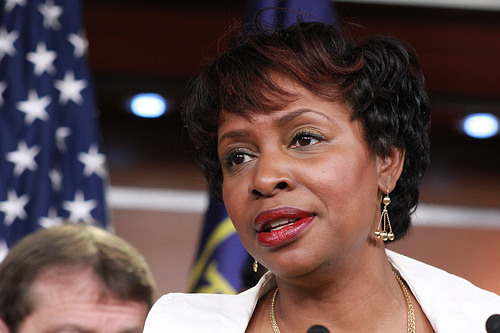
Kristen Clarke, president and executive director of the Lawyers’ Committee for Civil Rights Under Law stated:

“The Department of Justice’s latest reversal of its position in a critical voting rights case represents just the latest example of an agency whose leadership has lost its moral compass.  The law hasn’t changed since the department accurately told the court that Ohio’s voter purge was unlawful.  The facts haven’t changed.  Only the leadership of the department has changed.  The Justice Department’s latest action opens the door for wide-scale unlawful purging of the voter registration rolls across our country.  We fully condemn the Justice Department’s latest move to obstruct voting rights in the U.S.”

The NVRA imposes limits on when state officials can remove voters from the registration rolls because they have moved. In particular, the NVRA states that before officials can remove a voter from the rolls because they’ve moved the voter must notify officials that they have moved, or the official has to send a forwardable notice to the voter and wait two federal elections to see if there is any activity from the voter before taking any adverse action.  While most states will wait until there is some indication that a voter may have moved (i.e., return of a piece of mail or notice from the USPS) before turning to the process set forth in the NVRA, some states including Ohio and Georgia, send the notice based on mere voter inactivity alone.  In yesterday’s filing, the Justice Department indicated that the new administration has reconsidered this question and now sides with Ohio.  In its brief, the Justice Department indicates that it has “now concluded that the NVRA does not prohibit a state from using nonvoting as the basis for sending a Section 20507(d)(2) notice”.

The Lawyers’ Committee for Civil Rights Under Law has been focused on this administration’s efforts to obstruct civil rights enforcement and has condemned repeated actions taken to reverse positions or delay action in active matters handled by the Civil Rights Division.  Since Inauguration Day, the Justice Department has abandoned core claims in a long-standing case challenging Texas’s photo ID law and issued a letter to states concerning their purge policies under the NVRA and the Help America Vote Act (HAVA).  The administration has also launched the so-called Election Integrity Commission, a body that appears aimed at promoting laws and policies that will make it harder for Americans to vote.

About the Lawyers’ Committee for Civil Rights Under Law

The Lawyers’ Committee, a nonpartisan, nonprofit organization, was formed in 1963 at the request of President John F. Kennedy to involve the private bar in providing legal services to address racial discrimination. The Lawyers’ Committee celebrated its 50th Anniversary in 2013 as it continued its quest of “Moving America Toward Justice”. The principal mission of the Lawyers’ Committee is to secure, through the rule of law, equal justice under law, particularly in the areas of fair housing and fair lending, community development, employment, voting, education and environmental justice.


The Thinker’s Notebook: The Voting Paradox

0

by Marlon Rice

Every four years, the entire nation cycles its focus onto picking the next President of the United States. Candidates spend millions of dollars to catch your attention, hoping that the plethora of television and print ads, coupled with satisfactory debate performances and endorsements from your favorite celebrities will be enough to sway your vote in their favor. Social media is always abuzz around Presidential Election time, with folks pontificating on how people died for our right to vote and how important voting is. The Presidential Election cycle is a parade of strategic influence and peer pressure designed to either inspire you or shame you into voting. The marketing dollar is certainly not spent in vain. In 2016, 810,505 residents of Brooklyn went to the polls to choose the next president.

In New York City, the year after the Presidential Election is the year that we vote for our Mayor and City Council members. One can argue that this election means more to the day-to-day life of the residents of New York City than the Presidential Election does. Sure, the president is the leader of the free world. But the City Council makes decisions on all aspects of city life, including budgetary concerns for schools, decisions about land use and development, and even projects to support small businesses. Truthfully, your neighborhood is shaped more by the Mayoral/City Council Election cycle. However, bereft of the pomp and circumstance that goes into the Presidential Election and all of the commercials and the promotions and the talking heads demanding your vote, turnout for our Mayoral/City Council Election cycle is puny compared to the Presidential Election cycle. In 2013, our last Mayoral/City Council Election cycle, only 340,330 residents of Brooklyn came out to vote. That’s less than half of those who came out to vote for Hillary or The Donald.

When your ancestors died for your right to vote, I believe that their intent was for your vote to be heard in every election, not just the ones that are popular.

Smaller turnout numbers mean that every vote is crucial. Entire landscapes can be changed or altered by a few dozen citizens. For example, in 2013 the 36th Council District was decided by just 94 votes. Robert Cornegy, Jr. has done an excellent job in the Council, but just think that if one or two more apartment buildings had come out in support of his opponent we would have never gotten a chance to benefit from his work. This is how important this election cycle is. The city is in flux, with various parts moving in all directions. Neighborhoods are changing, demographics are changing and the voices speaking for your interests can be changed just as quickly.

The truth is that the way Presidential Elections work, states send their electoral votes in for one candidate or another based on the total votes of that state. New York is a decidedly blue state. We’ve only given our electoral votes to the Republican Party three times in the last 50 years. So hypothetically, if you are a Democrat and you happen to not vote in the Presidential Election, unless the Republican candidate has an enormously strong showing in the state, New York will still deliver blue. However, if you don’t vote for your City Council member, because of the low turnout figures your vote would be sorely missed. It could even mean the difference between the right person for the job winning or losing.

The Primaries are approaching on September 12th. There are many hotly contested races in the City Council taking place. One of the hottest is in the 35th Council District, where incumbent Laurie Cumbo is facing Ede Fox. In 2013, Cumbo bested Fox by just 1,825 votes. That margin equates to about one square city block, a narrow margin for sure. Now more than ever, your voice is important. Many tag lines used to incite your vote are simply empty schemes for your attention. Diddy’s Vote or Die T-shirts from 2004, or the I’m With Her posters and the Make America Great Again hats, all of them marketing ploys to tug at your addiction to consumerism in an effort to steer your vote. But that attention is part of a voting paradox because your vote is needed more so now, voting for your judges, your District Attorney and your City Council members, candidates that don’t have cool T-shirts and fancy hats to support them.

Vote because it is one of the most profound civic duties you have as a member of a democracy. Vote every year, for everything you can.