Home Blog Page 720

Now Is the Time to Come Together

By Dee Bailey

We must come together to fight HIV and AIDS and all issues impacting all communities. As we quickly approach World AIDS Day (December 1) 2017 we have yet again found ourselves at a learning moment.  A place in time when reflection on how far we’ve come can help us chart a new course of where we want to go.  It was 60 years ago when Dr. Martin Luther King, Jr. and fellow civil rights leader Bayard Rustin came together in pursuit of freedom and civil rights for African Americans across the country.


While we all know the value of partnership in fighting HIV/AIDS, we also know quite well the challenges we often face in collaborating with fellow organizations who have also taken on the tremendous work associated with educating and reducing barriers to services for those infected and affected by this pandemic in our communities.  Partnerships are the cornerstone of success!  We have seen this before, and we can only eternally thank leaders such as Martin Luther King, Jr.  and Bayard Rustin for the freedoms we have today.


During our struggle for civil rights in America two of our greatest leaders also faced difficulty in their attempts to collaborate for the greater good.  As is often the case, there were well-intended influencers whispering in Dr. King’s ear in an attempt to disparage Bayard Rustin’s tremendous work to demand civil rights for African Americans.


The problem with naysayers is that they are often short sighted.  They only see what is within reaching distance.   What were they saying?  Individuals who found themselves in the company of Dr. King were telling him that Bayard Rustin’s lifestyle as a gay man was not beneficial to the movement.  They cautioned Dr. King that many of Mr. Rustin’s lovers were white men.  This coupled with the fact that Mr. Rustin represented a demographic that many believed did not add to, but only subtracted from Dr. King’s work was reason enough that a collaboration was frowned upon and strongly advised against.


Fortunately Dr. King was a man of vision.  Dr. King was a man steadfast in fighting for the civil rights of the African American community and saw and understood the value of partnerships.  He did not allow minor differences to detract from the ultimate goal of civil rights for all.  While he listened to all the noise that was being raised around collaborating with Mr. Rustin, Dr. King also saw what awaited us over the mountain top.


Today, as community leaders, we find ourselves in a similar place.  We are often advised by those who do not possess our long-term vision but will give you a myriad of reasons why we should not work together. “They’re too this or they’re too that!”  The list of reasons why something can’t or won’t work is endless, but the reasons why we should work are few.


We only need a few good reasons to work together as partners in our civil rights fight against an epidemic that for over 30 years refuses to release its grip on our communities.  On the contrary, its grip is getting stronger, and tighter.  Why?  Because unlike Dr. King and Bayard Rustin, there is still a resistance to long-term partnerships in this line of work.  While we may come together from time to time to collaborate on a stand-alone initiative, there still lacks a cohesive and conscious effort to maintain these partnerships.


Collaborations and partnerships are good for our community in the fight against HIV/AIDS.  On a short-term basis we see the results of our efforts.  Our communities are educated, our leaders are motivated, and we created bridges of comraderies throughout the community.  Looking beyond the short-term and a study of history as so eloquently provided by Dr. King and Bayard Rustin we are living the benefits and results of their partnership in the fight for our civil rights.  I appreciate this every day and thank them for showing us the way.  The mere fact that I can have a drink of water from any public fountain, or the fact that I don’t have to give up my seat or sit in the back of a bus compels me every single day to build partnerships that will fight HIV/AIDS in our community.


Thank you Dr. King!   Thank you Bayard Rustin!  Thank you for showing us through living proof the importance and value of partnership.  I hope that this World AIDS Day will mark the beginning of our partnership example for the next generation of leaders.


Until There’s a Cure…


Dee Bailey

Founder

Watchful Eye
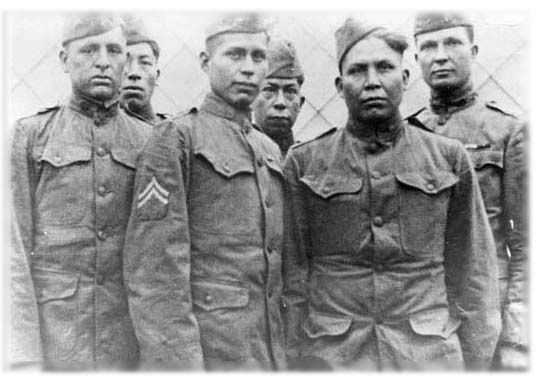
 

Navajo Code Talkers and the Unbreakable Code

From: CIA.GOV

Pfc. Preston Toledo and Pfc. Frank Toledo, Navajo cousins in a Marine artillery regiment in the South Pacific, relay orders over a field radio in their native tongue.

Pfc. Preston Toledo and Pfc. Frank Toledo, Navajo cousins in a Marine artillery regiment in the South Pacific, relay orders over a field radio in their native tongue.

In the heat of battle, it is of the utmost importance that messages are delivered and received as quickly as possible. It is even more crucial that these messages are encoded so the enemy does not know about plans in advance.

During World War II, the Marine Corps used one of the thousands of languages spoken in the world to create an unbreakable code: Navajo.

World War II wasn’t the first time a Native American language was used to create a code.

Choctaw Code Talkers of WWII.

During World War I, the Choctaw language was used in the transmission of secret tactical messages. It was instrumental in a successful surprise attack against the Germans.

Germany and Japan sent students to the United States after World War I to study Native American languages and cultures, such as Cherokee, Choctaw, and Comanche.

Because of this, many members of the U.S. military services were uneasy about continuing to use Code Talkers during World War II. They were afraid the code would be easily cracked, but that was before they learned about the complexity of Navajo.

Philip Johnston’s Brainchild

In 1942, Philip Johnston was reading a newspaper article about an armored division in Louisiana that was attempting to come up with another code using Native American languages. Johnston knew the perfect Native American language to utilize in a new, unbreakable code.

As a child, Johnston spent most of his childhood on a Navajo reservation while his parents served there as missionaries. He grew up learning the Navajo language and customs.

Johnston became so fluent in the Navajo language that he was asked at age 9 to serve as an interpreter for a Navajo delegation sent to Washington, D.C., to lobby for Indian rights.

In spite of concerns about the security of a code based on a Native American language, the U.S. Marine Corps decided to give Johnston’s idea a try. They approved a pilot project with 30 Navajos and allowed Johnston to enlist and participate in the program.

Getting Started

The first 29 recruited Navajos (one dropped out) arrived at Camp Elliott near San Diego in May 1942. One of the first tasks for these recruits was to develop a Navajo code.

The Navajo language seemed to be the perfect option as a code because it is not written and very few people who aren’t of Navajo origin can speak it.

However, the Marine Corps took the code to the next level and made it virtually unbreakable by further encoding the language with word substitution.

During the course of the war, about 400 Navajos participated in the code talker program.

The Code

Word Association

The Navajo recruits began developing the code by taking words from their language and applying to them to implements of war. For example, the names of different birds were used to stand for different kinds of planes.

The initial code consisted of 211 vocabulary terms, which expanded to 411 over the course of the war.

A is for Apple…

In addition, an alphabet system (see below) was also developed by the Code Talkers. It would be used to spell out some of the words not found in Navajo vocabulary.

The first letter of a Navajo word corresponded with one of the 26 letters in the English alphabet. Several different words were chosen to represent the more commonly used letters in order to make the code even more secure.

In Record Time

A skeptical lieutenant decided to test their skills and the code before trusting them to deliver actual combat messages.

The Code Talkers successfully translated, transmitted and re-translated a test message in two and a half minutes. Without using the Navajo code, it could take hours for a soldier to complete the same task.

From then on, the Code Talkers were used in every major operation involving the Marines in the Pacific theater. Their primary job was to transmit tactical information over telephone and radio.

During the invasion of Iwo Jima, six Navajo Code Talkers were operating continuously. They sent more than 800 messages. All of the messages were transmitted without error.

The Navajo Code Talkers were treated with the utmost respect by their fellow marines. Major Howard Connor, who was the signal officer of the Navajos at Iwo Jima, said, “Were it not for the Navajos, the Marines would never have taken Iwo Jima.”

Cpl. Henry Bake, Jr., and Pfc. George H. Kirk, Navajos serving in December 1943 with a Marine Corps signal unit, operate a portable radio set in a clearing that they have hacked in the dense jungle behind the front lines.

Honors

The hard work of the Navajo Code Talkers was not recognized until after the declassification of the operation in 1968.

President Ronald Reagan gave the Code Talkers a Certificate of Recognition and declared August 14 “Navajo Code Talkers Day” in 1982.

In 2000, President Bill Clinton signed a law which awarded the Congressional Gold Medal to the original 29 Code Talkers.

President George W. Bush presented the medals to the four surviving Code Talkers at a ceremony held in the Capitol Rotunda in Washington in July 2001.


Midwood  HS Hurdling Phenom Signs with University of Kentucky

0

By Nathaniel Adams & OTP Staff

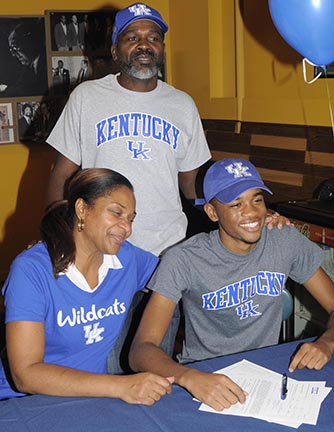
One of the off-track highlights of the PSAL Pilgrim Games this past Sunday was the signing of Midwood High School’s hurdling standout Tai Brown with the University of Kentucky Track and Field team.

The ceremony took place at the venerable 168th Street Armory Track & Field Center on Sunday, November 26, 2017 where a very happy young Mr. Brown said he was excited about going to the University of Kentucky, where he plans to major in sociology.

Coach Charles Weekes of the Ruff Kutz Track Club has been working with Tai since he was 9 years old.  “Tai picked a great college and the coaches there are going to be a big help to him.”

At the signing Tai’s mother, Debby Gittins, said it was “awesome that he was able to find a coach comparable to his youth coach”.

Apparently, the young man had a number of college offers and finding the right fit was a cause for concern.  “It was a collective thing that we did together to find somebody that he is comfortable with,” said Ms. Gittins.   “There is a good feeling when you are comfortable with someone, and he found it.”

Eli’s time passing?

0

Sam Darnold, Josh Rosen, Lamar Jackson, Josh All and Baker Mayfield. Those are the top five quarterbacks who are expected to declare for the 2018 NFL Draft. The question that comes with these quarterbacks is which one of these talented arms will become Eli Manning’s successor when he is ready to hang it up? It is truly amazing how time really flies. It seems like just the other day when the New York Giants swapped quarterbacks with the then-San Diego Chargers with the Giants receiving Eli Manning and the Chargers getting Philip Rivers. For the most part, it is safe to say although both quarterbacks are considered top ten in the NFL today, Manning has the clear edge over Rivers because he has the two Super Bowl Championship rings.

Fast-forward to the present and there has been many whispers and rumors of Eli Manning’s name in trade talks and many sources in belief that his best days are now behind him. It will be sort of unfair to blame Eli for the Giants current 2-8 last-place record. After all, the team has been decimated with injuries to both the offense and defense including season-ending injuries to top wideout Odell Beckham, Jr. and Brandon Marshall. Injuries should not be thrown in as an excuse, but come on, who can really replace a talent like Beckham, Jr.? In his 13-year tenure as the Giants QB, this has probably been his toughest year ever. Manning has thrown for 2,093 yards with a touchdown/interception ratio of 14 to 6. He may not be posting up video game-like numbers, but considering his offensive line has not done the greatest job of protecting him in the pocket and him not having a consistent running game as well as an inexperienced receiving core, Manning is still a quality NFL quarterback.

The downside is the fact that he is 36 years old. With their losing record being as bad as it is at the moment, it is hard to believe that the Giants are not thinking about the future. With this draft class being so quarterback-friendly, how can the “G-men” pass up on one of these quarterbacks? Whether it be to hold a clipboard for a few years and learn from the veteran Manning or the organization coming to the realization of life after Eli. It is sure to be an off-season full of questions surrounding Manning and his future with the Giants.

Sports Notes: (2017 PSAL State Tournament) Playoff matchups (2nd round). #1Erasmus Hall vs. #2 Bayside, #3 Eagle Academy vs. #4 Midwood, #5 Tottenville vs. #6 New Dorp, #7 South Shore vs. #9 Flushing. (NFL Football on Thanksgiving) Vikings vs. Lions @12:30PM, Chargers vs. Cowboys @4:30PM, Giants vs. Redskins @ 8:30PM. On behalf of myself and everyone here at Our Time Press, we’d like to wish everyone a Happy Thanksgiving!


Weeksville: Home to History

Weeksville is the four restored remnant 19th century buildings along the old Huntersfly Road; the families, including our friend Jeanne Hammond’s, who resided in the area in the 20th century; the historians James Hurley, Dewey Harley, Dolores McCullough, Patricia Johnson in the 1960’s, and, in these times, preservationists Joan Maynard (deceased) and Pamela Green, who all worked to bring “the miracle” to life. It is much more than the “no man’s land” or terra incognita depicted in the article below written by a 19th century reporter. It now is a jewel in King’s County’s crown. Next year, we commemorate the sesquicentennial of Weeksville’s founding, the golden anniversary of its resurrection as a global community center for learning and its position in history as a foremost example of the borough’s spirit. Said Ms. Green at the October 29, 2002 groundbreaking to kick-off Weekville’s multi-million restoration project. “Brooklyn’s story is New York’s story and America’s story.” Weeksville is Brooklyn and beyond.

Founding Executive Director of Weeksville Joan Maynard, with students
infront of the Hunterfly Road Houses. Weeksville Historical Society.

 WEEKSVILLE

Brooklyn Eagle Newspaper

Wednesday, July 30, 1873

South of Atlantic Avenue — in that part of the City (of Brooklyn, New York) intersected by Troy, Schenectady, Utica and Rochester Avenues — is a sort of Terra incognitas {sic}.

The inhabitants are principally colored people and its chief products are low groggeries, goats, and mangy, half red and wholly savage curs.

Animate and Inanimate Characteristics

As a place of resort for picnic parties it is not and probably never will be at all popular, but on the contrary it is quite a “Jack in the Box” sort of locality for the police of the tenth sub-precinct. Sergeant Meeks is always in a state of curiosity as to “What will turn up in Weeksville to-night?” Sometimes, it is a disorderly house, a regular witch’s mixture sort of place where whites and blacks and all the intermediate shades mingle, mingle, mingle so freely and get so tight that the evening’s entertainment invariably winds up with a brutal knock down and drag out fight. Then the police have their work cut out for them and Sergeant Meeks is easy in his mind, he knows “What’s up to-night”. A hunt after a suspected purloiner of chickens forms another pleasantly exciting episode in the experience of the policemen of that precinct, but wandering around from house to house asking questions about stray goats with a relish for the bark of the trees on the Avenue, or making inquiries respecting wolfish dogs who have partially lunched off the chubby legs of some mother’s darling are aggravating expeditions. The inhabitants are never able to answer such conundrums, and the policeman returns sadder but not a wiser man.

What Nature has done and what the Contractors Think

Nature has kindly done her best to make the place picturesque. It is all hills and hollows. The hills are the highest and hollows are the deepest of any city. Contractors fail to see anything to admire in the picturesque beauty of those sandhills, studded with boulder and carpeted with {the} scubbiest kind of grass or the hollows filled with stagnant water in which float the rotting carcasses of decayed dogs and cats. They simply see so many lots waiting to be dug down or filled up: That is the impression it makes upon their materialistic minds. The streets are in a state of chaos and general uncertainty. Ruts, stones, garbage, ashes, dust, and all other disagreeable and disgusting things are there in abundance while the houses on either side appear to be debating the question whether they should move off to some safer place or remain just where they are for fear of a worse fate befalling them. Some of the frame and frail tenements are parched on the top of a sand bank, like sparrow houses on a pole, others have their foundations in a sunken lot and the roofs are level with the street. That is what gives the place an air of uncertainty and the casual visitor would not at all be surprised to see the house either tumble down or disappear altogether. Those not built high up or low down are stuck on the side of a hill where they hang like a fly on the wall. Most of the houses have little patches of garden surrounding them and although untidy and shiftless hands attend to them, their products — in the shape of corn, tomatoes, beans, peas and what is called “Truck” — are plentiful and well grown. The livestock consists of chickens, geese, and goats. They are looked after semi-occasionally, counted in the evening and the chickens and geese receive a daily allowance of food in addition to what they pick up while foraging in the street, or scratching a neighboring garden. The goats are always in good condition on a mixed diet of old boots, rags, paper, condemned mattresses, chips, corks, cabbage stalks and other provender picked up during their day’s ramble. It would be unfair to omit all mention of the dogs for they are always not only always heard, but they occasionally make their presence felt. They prowl around every corner, scrape luxurious couches in the dusty streets, or lie panting on the shady side of the fence and snap and snarl, and bark and bite in a manner to remind a Turk of the city which the descendants of Peter the Great so much desire to annex. The progress of improvement is slow in that section for the work to be done is expensive and the majority of the owners of property are not wealthy. If pushed forward rapidly the assessments, instead of being one half the assessed value of the property, would eat it all up and then there would be a large bill for the Auditor to audit and the controller to pay on behalf of the city.

An Ice – House in the Cellar and a fish Pond in the Parlor –

Last winter many of the property owners experienced considerable inconvenience and sustained heavy losses on account of the freshets and in some instance, they had from three to four feet of solid ice in their cellars for more than two months. When the thaw came the result was even worse, as the large pond lying between Utica Avenue and the old Hunterfly Road rose to an unprecedented height. The water made itself at home in several parlors and refused to leave until Spring months had almost passed away. Complaints were loud and numerous, but nothing could be done until the sewer in course of construction along Rochester Avenue was finished, and then Alderman McGroaty offered a resolution that a temporary sewer be built to connect with the pond for the purpose of drawing it. The resolution was adopted of city works. The colored people are anxious to know what Messrs. Palmer and Whiting are going to do about it. The work of filling the pond is in the hands of Mr. Peter Riley and progresses slowly, for reason that the average depth of the ten acres to be filled is about 25 feet. Two and three carloads of dirt dumped into such a hole as that make hardly any perceptible difference in its appearance.

Modern Improvements in the Shape of Sewers and a New Railroad

Last winter the legislature passed a bill authorizing the construction of a railroad along Rochester Avenue to connect with the Broadway line of cars, and on Tuesday morning the first load of timber to be used was dumped on Atlantic Avenue. Work will be commenced immediately, and it is expected that the road will be in running order sometime during the Fall.

For those doing business in the E.D. {Eastern District} or in the upper part of New York it will be a great convenience, as at present they are obliged to walk a long distance before they can get aboard the cars on Broadway.

* Eastern District was a term used in the 19th century for the eastern part of Brooklyn generally including Bushwick, Williamsburg and the northern parts of the Bedford-Stuyvesant sections.

                                              Weeksville Today

Weeksville was a nineteenth century free black community located in what is now the Bedford-Stuyvesant area of Brooklyn, New York.  It is remembered today as a historic site for its community programs, urban employment opportunities, and the promotion of racial respectability. In 1838, only 11 years after slavery ended in New York, Weeksville was formed when Black men purchased a substantial area of land from Henry C. Thompson, another free black man.   Other African Americans were encouraged to settle on the property and lots were sold to newcomers.

Weeksville Today …

A 19th century Halloween party captured by photographer and Weeksville resident Alexander Moore. [Photo: Percy F. Moore Collection, courtesy of the 5th of July Resource Center for Self-Determination & Freedom, Weeksville Heritage Center]