
Grappling with the Opioid Crisis

Opioid use and its addiction have swept through the United States in recent years. This tidal wave of misery has been left unchecked due to the stigma of drug dependency. While social drinking and recreational drug use are common in this country, once someone crosses the addiction line, support and understanding dwindles. In the PBS documentary, “Understanding the Opioid Epidemic,” that aired February 18, 2018, it is revealed that “opioid drug overdose is now the leading cause of death for people under the age of 50.”
The Centers for Disease Control and Prevention stated recently “the opioid epidemic is fueled by prescription pain medication.” To study the crisis from a local vantage point, this reporter contacted hospitals that serve Central Brooklyn. It is the senior medical staff at Interfaith Medical Center that participated in the interview. The two main contributors were Dr. Jason Hershberger, Chairman of Psychiatry at Interfaith Medical Center and Brookdale University Hospital and Medical Center, and Ms. Sharonie Perry, Director of Community Affairs at Interfaith Medical Center, with contributions from Dr. LaRay Brown, CEO of Interfaith Medical Center; Dr. Susan Kleinrock, Deputy Director at NYC Health and Hospitals Corp., and they responded to the following questions in one voice.
- Does Interfaith Medical Center (Interfaith) maintain statistics on patient (outpatient or admitted) opioid dependency? If yes, what do the numbers reveal?
While the Borough of Brooklyn, as a whole, ranks 3rd in the number of deaths due to drug overdose and emergency visits caused by opioids (after Staten Island and the Bronx), the problem of substance abuse is very high in our local neighborhoods. The NYC Department of Health and Mental Hygiene reports that people living in Crown Heights, Prospect Heights and Bedford-Stuyvesant are hospitalized due to alcohol problems at a rate 1.5 times higher than the rest of Brooklyn. Drug-related hospitalizations are double the borough average.
What this means is that safety-net hospitals like Interfaith are working twice as hard to save lives from the ravages of addiction, and our communities are suffering a disproportionate burden of this problem.
2) What are treatment options for opioid addiction?
There are several treatment options and Interfaith has a large number of programs to help. We provide inpatient detoxification services for patients in acute danger of overdose or withdrawal. We provide 14-28-day inpatient rehabilitation to help start patients on the path to recovery. We provide intense outpatient services focused on chemical dependency to help patients avoid relapse. We provide a methadone clinic to help patients with medication to avoid the perils of addiction and to stabilize their lives. We are opening a medication-assisted treatment program integrated into our Bishop Walker Primary Care Clinic to help patients with drug and alcohol problems using cutting-edge treatments like Buprenorphine and Naltrexone.
3) Is there a particular section of the brain that opioids stimulate that makes long-term recovery challenging?
Yes, there are several areas of the human brain that get ensnared in addictions. Our brains are designed to repeat behaviors that are rewarding, and drugs trick the brain into believing that really destructive behavior is good for us. Different drugs impact different parts of our brains, but all of them result in this same problem: the drugs make people feel like everything is great when life is really crashing around them.
4) In the one-hour PBS documentary, “Understanding the Opioid Epidemic,” it is explained that pharmaceutical companies marketed opioids to physicians as “safe, not addictive, and effective for pain management.” Did Interfaith Medical Center receive such marketing? If yes, what was the response?
We haven’t seen this documentary, but there certainly was a period in America when pharmaceutical companies promoted pain management strategies that helped bring about this epidemic. But Interfaith has always put patient care first. That means making responsible medical judgments and helping patients achieve pain relief while steering them away from the risks of addiction. That is why all Interfaith physicians check the pharmacy records of patients before we prescribe potentially addictive substances.
5) What are the alternatives to opioids–eg., hydrocodone and oxycodone–for managing pain? Are there any protocols that do not involve drugs?
There are many alternatives to opioids for pain relief. There are many non-opioid pain medications that can be very effective in some situations. There are also non-pharmacological approaches using physical therapy, massage, acupuncture and biofeedback that have good evidence behind them.
6) Is there evidence that suggests that opioids have surpassed crack cocaine in demand or do these two drugs operate in different social segments?
It depends on your perspective. From a nationwide perspective, opioids have definitely surpassed crack cocaine, but from a local perspective, and the perspective of most inner-city urban centers, crack cocaine remains a major problem. Sadly, the opioid epidemic is hitting us here in our neighborhoods while we are still grappling with the devastation of crack. 7) There are some in society who believe that opioid addiction is “an issue for white people.” Is there any truth to this thinking? No, opioid addiction doesn’t discriminate. It is hitting people of color, undermining our families, just as much as anyone.
8) Given the national epidemic, do you have an idea why there hasn’t been a massive march to decry prescribed opioids and street drugs? Sadly, we do. Fundamentally, it is the stigma our society puts on addictions that dulls the public outcry. If people were dying of the flu at the rates we are seeing people die of drug overdoses, it would be headline news every day. We applaud Our Time Press for picking up this story and pushing for more awareness, more communication, better public policy and more funding to address this scourge. 9) If you have concerns about prescription opioids that aren’t addressed in the above questions, please express your thoughts. Interfaith Medical Center is in the eye of the opioid crisis, one that has affected so many in our community. Interfaith has responded by educating its staff and the community about this important issue and has helped to develop innovative programs like the Anti-bullying Partnership for the Prevention of Violence and Suicide Prevention that has been working in conjunction with the Mayor’s Thrive NYC initiative and the New York City Department of Health and Mental Hygiene. The goal of this partnership is to offer preventive strategies that offer additional tools to local stakeholders, as well as to raise awareness in every sector of the neighborhood, from children to seniors. One such strategy is to provide staff and the community with Mental Health First Aid training. Individuals who complete the six-hour training receive a 3-year certification, as well as a Nasal Naloxone Injection Kit which is used to help revive an overdose victim. The opioid epidemic is a war that cannot be won unless groups and individuals come together to develop campaigns that will make a lasting impact. Interfaith has been in the forefront of forging coalitions throughout the community in order to eliminate this latest crisis. Interfaith is also participating in the Greater New York Hospital Association Opioid Advisory Workgroup. This workgroup is helping hospitals respond to the opioid epidemic by providing training programs for staff, helping staff connect individuals with addiction to treatment and treating chronic pain with individuals in recovery.
The Thinker’s Notebook Presents: Community Chest
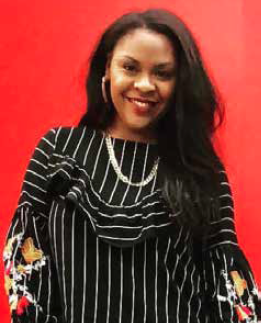
In October 1998, Our Time Press chronicled the passing of Robert Cave, Sr. Cave was a prominent Brooklyn photographer who specialized in capturing events. Mr. Cave passed away on September 8, 1998 of heart failure, leaving behind two children, son Robert, Jr., and daughter Eurila. We chronicled Eurila in that same issue. At the time, she was a 19-year-old with a passion for developing her own photos, a precocious young woman with beautiful bright eyes which seemed to conceal well the sorrow she must have felt, having lost two parents in a three-year period. Sheila James Cave, Eurila’s mom, passed away in 1995. In that issue, we published a photo shot by Eurila in 1996, a rooftop picture amidst a Brooklyn Brownstone community at dusk. When asked about her inspiration back then, Eurila said, “I like taking rooftop pictures because the sky symbolizes heaven, even on its worst day. Being further off of the ground brings me closer to my mother, who passed away. And every time I develop a picture of a sunset or a skyline, I hope to see my mother’s eyes hidden in the scene somewhere.” I first met Eurila in 2010. She was shooting family portraits at a Kwanzaa Bazaar taking place at For My Sweet. She was quirky, sweet and a true professional when it came to photography. We kept in touch through Facebook, and I watched as she began to flourish at her craft, fully unaware of the source of her inspiration. She uses her lens to capture our community in ways that those less familiar, less comfortable and less aware of the terrain would miss. But the woman behind the camera is just as enigmatic as the subjects she chooses to shoot. The married mother of two is a dynamo, spending her days shuttling kids to and from school, and her evenings capturing our history on film. Cali York Creative Visual Media Productions was created in 2011 as a vehicle for Eurila to develop her organically expressive nature. “I started Cali York because I wanted to explore working for myself, and I wanted to do so with a tool that I already had in my arsenal, my camera.” She shoots weddings and events. She does headshots and portraits. She sells prints, and she even teaches workshops on such necessary skills like how to take the perfect selfie. Her work has been on bus stops and on train station advertisements. She’s shot elaborate galas and on red carpets. She even has her own blogshow. Eurila perceives our world through the lens of her camera, and her interpretation is vibrant, deliberate and quite fun.
At 38, Eurila is far removed from the young woman we chronicled back in 1998, but in many ways, she is still the same. That youthful exuberance for seeing the beauty in her surroundings hasn’t changed, and neither has her deep connection to her community. She’s a Brooklyn girl, the maturation of that promise from a generation before, back when children from our neighborhood wore sweatshirts from the 40 Acres and a Mule store, learned who John Coltrane was by watching “Mo’ Betta Blues” and knew nothing about the importance of likes and retweets. She is a product of Old Brooklyn, a place that was eclectic and funky way before gentrification. Most importantly, she’s amazing at what she does for a living. Some of her work was recently published in a new book titled MFON: Women Photographers of the African Diaspora. Her pride for being included in such a project is deserved, and we expect nothing but great things to come for her in the future. Sheila James Cave and Robert Cave would be absolutely pleased with their daughter.
This week opened with many celebrations and bacchanal rituals, especially in countries or states with large Catholic populations like Brazil, Trinidad/Tobago and Louisiana, USA. Mardi Gras in New Orleans; on February 14, Valentine’s Day and Ash Wednesday, the first day of Lent, the fun ends. This week can be compared to the month of March, which comes in like a lion and exits like a lamb.
OUT OF AFRICA
Ellen Johnson SirleafEllen Johnson Sirleaf, former Liberian President, wins $5 million award for achievement in African leadership from the Mo Ibrahim Foundation. The Sudan-born communications billionaire launched the award in 2006 whose beneficiaries would be democratically elected African heads of state who step down after their constitutionally mandated term.
For months, South African President Jacob Zuma has been under pressure to resign, owing mostly to widespread corruption associated with his governance. South Africa’s economy, Africa’s largest, is tanking, political unrest is widespread. All fingers of blame point to Zuma. President since 2009, Zuma is a member of the powerful African National Congress (ANC) Party, which holds a majority in Parliament. He has survived eight “no-confidence” votes and the ANC wants him out! The ANC Party’s national support is eroding. National elections are set for next year. Zuma violates the constitution, awards contracts to cronies and acts like some leaders of a superpower. Under the SA Constitution, the president can be removed by no-confidence votes or impeachment. Does the ANC have the will to impeach President Zuma. Seems like another parallel with a first world power.
BHM: ARTS/CULTURE
Chadwick BosemanFILM: BLACK PANTHER, the film is like some sort of cultural second coming. It is Hollywood’s first blockbuster Marvel Comics Black Superhero story set in darkest Africa in a fictional country, Wakanda, which is the most technologically advanced nation in the world. Film is about a superhero and Black identity. According to forecasters, BLACK PANTHER’s advance ticket sales could make record-breaking grosses, exceeding $152 million during the Presidents’ Day 4-day weekend! Most Black writers in mainstream media concur that the film dispenses with time-worn Black stereotypes and the protagonists are well-educated, all veritable forces of nature.
Read the Time magazine cover story by African-American Jamil Smith, which is the most exhaustively researched essay on BLACK PANTHER. Film topliner is Chadwick Boseman as T’Challa, who is grieving the loss of his father, who was king and is contemplating the challenges he faces in ascending to the Wakandan throne. Directed by African-American Ryan Coogler, BLACK PANTHER includes an assemblage of some of the best African and African-American actors like Michael B. Jordan, Daniel Kaluuya, Lupita Nyong’o, Angela Bassett and Forest Whitaker.
The film’s word of mouth is like a talking drum among African-Americans, who have spent lots of money on advance ticket sales to ensure that young Blacks will get to see the superhero the soonest. I have not seen the film yet. However, I think that I would have to add BLACK PANTHER to my “must-see” list of 28 Black films this month.
CONVERSATIONS: HERITAGE: Bethann Hardison In Conversation with Harriette Cole at the Schomburg Center for Black Culture, located at 515 Malcolm X Boulevard in Harlem on February 22 at 6:30 pm. Hardison, model, entrepreneur, griot and documentarian speaks extensively about the infectious fashion and entertainment worlds and their faultlines re: diversity and beauty standards. Cole is a fashion designer and entrepreneur who founded Dreamleapers, a platform to help people access and activate their dreams.
FINE ART: The Five Myles Gallery’s new exhibit, THE ART LIFE, featuring recent works by Otto Neals and Emmet Wiggleworth, runs through March 11 at 558 St. Johns Place, Crown Heights, Brooklyn. [Call 718.783.4438] Exhibit is curated by Carl Hazlewood and Hanne Tierney.
The Essie Green Galleries’ new exhibit, “HISTORY 365”, features works by masters like Hale Woodruff, Phoebe Beasley and William S. Carter, it opens on February 17 with a reception. Gallery is located at 419A Convent Avenue, 148th Street, Harlem. [Visit EssieGreenGalleries.com or call 212.368.9635]
The Curtiss Jacobs Gallery opens its new exhibit, CEDRICK SMITH FACING HISTORY, on February 18 at 2075 Adam Clayton Powell, Jr. Boulevard, 124th Street, Harlem. Exhibit includes 14 mixed-media works on paper, canvas and wood. [Visit Curtissjacobsgallery.com or call 212.865.2111]
Photo Credit: Andrew H. Walker/The Andrew W. Mellon Foundation (PRNewsfoto/The Andrew W. Mellon Foundation)NEWSMAKERS Elizabeth Alexander was named the Mellon Foundation’s next president effective March 2018, becoming the first African-American woman to helm the organization. Alexander worked at the Ford Foundation as the Director of Creativity and Free Expression, and she co-designed the Art for Justice Fund, a $100 million initiative to transform the criminal justice system. The NY-based Mellon Foundation has an endowment of $6.2 billion and focuses on the humanities – higher ed, arts and culture heritage, diversity, scholarly communications and international higher ed. A household name in modern literature circles, she was a member of the Yale faculty where she was a Professor of English, American Studies and African-American Studies, a department which she chaired. She was a Professor in the Department of English and Comparative Literature. A widely published poet, she is a Cave Canem member. She wrote and recited the poem, “Praise Song for the Day”, at Barack Obama’s first inauguration. Her best-selling memoir, “The Light of the World”, about love and loss, was a nonfiction finalist for a Pulitzer Prize and a National Book Critics Circle Award. Her academic creds include a BA at Yale, MA at Boston University and a PH.D. at the University of Pennsylvania. Apropos of Black History Month, Elizabeth’s family tree is interesting. She is the granddaughter of Dr. Arthur Logan, MD, prominent Harlem physician and power elite in the 50s and 60s. Her father, Clifford Alexander, an attorney/businessman, was the first
Kay Cole JamesAfrican- American Secretary of the Army. Kay Coles James was unanimously elected president of the American Heritage Foundation. Kay Coles James, former Virginia Health Secretary and federal personnel director, becomes the first woman and the first African-American to head, which is arguably the nation’s preeminent, conservative think tank.
PISCES is the 12th and last sign of the zodiac. A mutable water sign, it incorporates all that preceded it, no small undertaking! Birthday shout-outs to Michael Adams, Joan Allen, Milton Allimadi, Flo Anthony, Harry Belafonte, Common, Cheryl Duncan, Dame Pearl Duncan, Dr. Irene Elmore, Anna Maria Horsford, Vonetta Horsford- Jacobs, Rosalind McLymont, Vera Moore, Senator Kevin Parker, Sidney Poitier, Queen Latifah, Rihanna, Smokey Robinson, Karlisa Rodney and SEAL.
A Harlem-based management consultant, Victoria can be reached at Victoria.horsford@gmail.com.

At the Senate Intelligence Committee Hearing on Tuesday, all of the heads of the primary intelligence agencies emphatically agreed that the Russians initiated an aggressive campaign to influence the past presidential election. They also agree that the effort was successful, cost-effective and “we have seen Russian attempts to impact the 2018 elections” and the intelligence chiefs said the Russians will be even better at it going into the midterms. Both by interfering with the voting system itself, and by playing with the minds of the American citizenry, which is the easiest part of all.
Propaganda today is less like a Gatling gun in the Old West, and more like a sniper with a silencer. It is visible only to those whose demographic stats, lifestyle and interests match the algorithm targeting the kind of guy or gal who is susceptible to the particular message that can anger, confuse and direct their opinion. That message is invisible to those who sympathize with Black Lives Matter or #MeToo. They are also given text and images that relate only to them and their peers, again to anger, confuse and retweet.
With this threat to the bedrock institution of the nation, the voting system and how we select our leaders, the intelligence chiefs were asked if the president ever gave a “specific request” to stop Russian interference. They all said no.
Which begs the question, “Why is the president the only person objecting to the notion of Russian interference?” Why does he believe Vladimir Putin when he says, “I didn’t do it?”
After the hearing, Rep. Gerry Connolly, a member of the (D) Foreign Affairs Committee, said that the president not taking the reports seriously, says something “unbelievable and deeply troubling about this President of the United States.” A cynic might be forgiven for thinking that the “something” that is so “deeply troubling” is that the Russians have something on our Commander-in-Chief. And because of the curiously unique nature of the man and the secrets the Russians have proof of, he would rather destroy the nation than have it revealed.
And when people say that’s preposterous, and that the president is only “in denial” because he doesn’t want his election questioned, perhaps its’ because they’re being kind or in denial themselves.
In any event, all of this smoke is just a prelude to the main event — Special Counsel Robert Mueller is the one who will show us whatever fire is there and begin to clear the air.
Meanwhile, the Republican Party, seeing that our national consciousness is being warped and is threatened by both Trump and the Russians, is still following the dictum, “No crisis should be wasted,” and have engineered a theft of the nation’s wealth and natural resources that will hobble the country for generations to come.