Home Blog Page 691

NAACP, Prince George’s County Sue Over Unconstitutional Census Preparations

Understaffing, underfunding, design flaws threaten massive 2020 undercount

BALTIMORE (March 28, 2018) —The National Association for the Advancement of Colored People (NAACP), America’s largest and original legacy civil rights organization, together with Prince George’s County, Maryland, the NAACP Prince George’s County Branch and two county residents, sued the federal government today to combat the imminent threat that the 2020 Census will substantially undercount African-Americans and other people of color in communities throughout the United States causing inequalities in political representation and deficiencies in federal funding of those communities.

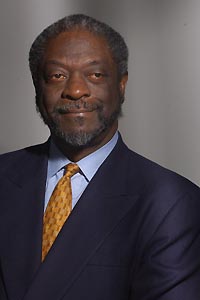
The lawsuit, filed in the U.S. District Court for the District of Maryland, seeks to compel the Bureau of the Census, an agency within the Department of Commerce, to prepare for and conduct a full and fair census in 2020 as the U.S. Constitution expressly requires. “The NAACP is committed to ensuring that the 2020 Census does not systematically undercount communities having large African-American populations, such as inner-city neighborhoods, while substantially overcounting communities that are less racially diverse,” said Derrick Johnson, President and CEO. “The census must not serve as a mechanism for diluting the political power of African-American communities and depriving them of their fair share of federal resources for an entire decade,” he added. “We are prepared to fight against any plan that effectively turns the census into another form of voter suppression and economic disempowerment in our communities.”

The U.S. Constitution requires the federal government to conduct an “actual enumeration” of the U.S. population every ten years. Census results serve as the basis for apportioning congressional seats to each state, redrawing legislative district lines at both the federal and state level and enforcing voting rights laws. The federal government also uses census data to distribute billions of dollars to local, state and tribal governments.

The 2020 Census, however, remains inadequately funded. The Census Bureau is understaffed and is emphasizing processes that will only serve to increase undercounts in communities of color. The bureau has no permanent leadership in place to direct the count, and to make matters worse, the bureau has cancelled crucial pre-census field tests and is rushing to digitize the census without adequate cybersecurity protections, thus undermining public confidence in the privacy of census data and threatening to inflate the undercount.  Further still, the bureau plans to devote insufficient resources to community partnerships, door-to-door canvassing and other processes designed to encourage communities of color to participate in the census.

The issues facing the 2020 Census have already caused the Government Accountability Office to label it a “high-risk program.” Prince George’s County has acutely felt the harmful effects of past census undercounts. The county, which has a majority African-American population, suffered a 2.3 percent net undercount in the 2010 Census—the largest net undercount of any county in Maryland, and one of the largest of any county in the nation.

“An accurate census count is critical to the federal funding, political representation and operations of Prince George’s County,” said Prince George’s County, MD, Executive Rushern L. Baker III. “We must not be undercounted again like we have been over the past 30 years. On behalf of the 900,000 residents of Prince George’s County, I am proud that we are standing and fighting alongside the NAACP to make sure our county gets treated fairly and equally under the law. A vast majority of the residents of Prince George’s County are members of this nation’s historically disenfranchised populations. We cannot let this continue in 2018, 2020 or any year moving forward. This lawsuit will help protect future generations of systemic underresourcing from our federal government.”

Bob Ross, president of the NAACP Prince George’s County Branch and a named plaintiff in the lawsuit, agrees that an ill-prepared census hurts his community in several ways. “When the Census Bureau undercounts my community, we lose political power, and fewer of our federal tax dollars end up coming home to fix our roads, run our schools and fund our federal programs,” said Ross. “We felt these effects in the aftermath of the 2010 Census, and all signs indicate that the 2020 Census will be even worse.”

“The priorities embraced by the Bureau for the 2020 Census threaten to worsen substantially the undercount of communities of color that occurred in the 2000 and 2010 censuses,” said Charlotte Schwartz, a law student intern with Yale Law School’s Rule of Law Clinic which represents the plaintiffs.

This lawsuit is not the first time the NAACP has taken legal action related to the 2020 Census. In October of 2017, the NAACP, NAACP Connecticut Conference and NAACP Boston Branch filed suit under the Freedom of Information Act to compel the Commerce Department to produce documents about preparations for the 2020 Census. That suit is ongoing. The plaintiffs in the new lawsuit are represented by the Rule of Law Clinic at Yale Law School, Jenner & Block, and the NAACP Office of the General Counsel. The Rule of Law Clinic also represents the plaintiffs in the pending Freedom of Information Act case.
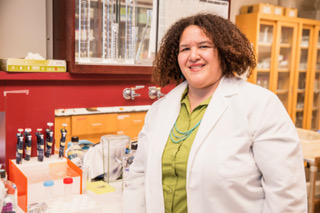

Poet and Scientist Dr. Kathleen Gillespie Brings Art to STEM

Biologist and poet Dr. Kathleen “Kate” Gillespie, Ph.D., is a STEM and STEAM advocate who believes there is poetry in science.

“Inspiration is a key tool in the arts and in the pursuit of scientific discovery,” said Dr. Gillespie.   “The ability to communicate science is best accomplished by telling a story that will bring context and comprehension to a scientific principle.”

For over 10 years, a New Jersey native who earned her doctorate in marine biotechnology from the University of Maryland, has volunteered to engage Maryland students in learning complex principles of biotechnology and microbiology. At Baltimore Underground Science Space, a community science group that supports and mentors students in a iGEM program, she worked with students in solving scientific problems using synthetic biology—including plastic degrading bacteria for cleanup of bottles in Baltimore Harbor. She helped students from third-graders to undergraduates learn about biotechnology through lectures and labs at Towson University’s SciTech program. For A Bridge to Academic Excellence (ABAE) at the University of Maryland, she participated with pharmacy students mentoring high school students.

“Science is influencing the face of our society on a global scale because of the huge scope of the problems humanity faces–from emerging disease to climate change,” she said. “I find that initially children are excited about STEM (science, technology, engineering and mathematics) but quickly become discouraged because they are not having a good grasp of the science and math concepts. Integrating an art component into STEM through STEAM (science, technology, engineering, arts and mathematics) can open new avenues of creative thought and inspiration that will ultimately bring new perspectives to the students learning STEM disciplines.”

For Dr. Gillespie, arts and science have a close bond. During her undergraduate years as a biology major at Rutgers University, she was also engulfed in the literature program and studied with professors like poet Amiri Baraka. “When I was completing my doctoral degree, I used the outlet of creative writing as a stress reliever,” she recalled. The result was etching out a reputation in Baltimore’s literary and theatre community as Kate Gillespie, published poet, short story writer and playwright. Her poetry has been published in Gargoyle Magazine, Silver Blade Magazine, The Baltimore Ekphrasis Project and Syzygy.Journal. Short stories have been published in The Baltimore Urbanite Magazine and Writers and Words. Her plays have been staged at Baltimore’s One-Minute Play Festival at EMP Collective and Glass Mind Theater. In addition, she’s a Writer-in-Residence at Renaissance House Writer’s Retreat in Martha’s Vineyard.

“I have met Black and Hispanic students who have never given any thought as to how science was relevant to them. They got excited over video games and videos but didn’t think they could ever create anything with science themselves,” explained Dr. Gillespie, who even had a class trip to take students to see Black women scientists in the movie Hidden Figures. “As a Black woman in the sciences, I find my personal brand of diversity to be the least seen. Because of this, I have made a point to go out and interact with science-based youth programs to SHOW not tell them that they too can be a player in the world of STEM and STEAM.”

Magnolia Tree Earth Center and Project Green Global Kick-Off “Earth Month” in April with Brooklyn School Tree Plantings

Bedford Stuyvesant’s Magnolia Tree Earth Center has partnered with Project Green Global to celebrate Earth Day and increase community awareness of urban ecology and the environment during April through school tree plantings, family STEM workshops, urban environmentalist Hattie Lomax Carthan art exhibition, developing floral fragrances, the PS 21 Block Party and with several other April events.

Young celebrant at 2010 Project
Green/Magnolia event at Herbert
Von King Park. Credit: Barry L. Mason

Over 25 schools with strong STEM programs in Districts 16, and 14 and 13 will receive magnolia trees from Magnolia Tree Earth Center of Bedford Stuyvesant and Project Green Global. The trees will be delivered by truck from a southern state for the NYC Department of Education’s Earth Day celebration on April 20.

“The response has been overwhelming,” said Bernice Green, founder of Project Green Global, who donated her urban ecology and environmental program services to create April’s Earth Day celebrations for Magnolia Tree Earth Center. “The schools have decided to name their legacy trees after heroes and heroines in the community and engage the children in dedications, tree learnings and other projects.”

To celebrate Earth Day, the Magnolia Tree Earth Center’s Board of Directors directed Project Green Global to take the organization into the schools where STEM programs are alive, thriving and as strong as the famed 45-foot Magnolia Grandiflora tree namesake. The tree is considered New York City’s only living landmark and stands tall outside the organization’s three-complex headquarters in Bed-Stuy.

Project Green Global designs intergenerational urban ecology awareness programs that stimulate the interests of K through 12 students and in ecology, the environment, the community-as-laboratory and their personal interactions with these disciplines. The work is intended to complement STEM studies.

Trees growing in Brooklyn is more than a metaphor. It is a fact, thanks to the legacy of the late Hattie Carthan, founder of the Magnolia Tree Earth Center, who planted the Magnolia Grandiflora tree over 50 years ago. Carthan, considered New York City’s first urban environmentalist, presided over a coalition of 100 Block Associations that planted more than 1,500 ginkgo, sycamore and honey locust tree throughout the community.

Other projects taking place in partnership with neighborhood businesses, schools and individuals for April’s Earth Day, include:


Sunday, April 22, 2018 NATIONAL EARTH DAY

“From These Roots”: an exhibition curated by Tai Allen and Joanna Williams at the historic Macon Library of photographs and documents related to Hattie Lomax Carthan, considered New York City’s first urban environmentalist and also founder of the Magnolia Tree Earth Center. She organized the Neighborhood Tree Corps and, also during the 1960’s, 100 block associations to plant 1500 trees throughout Bedford Stuyvesant. Also, on site: workshops, readings of the nature poetry of Langston Hughes, storytelling, a screening and talks. 

Monday, April 23, 2018

“Capturing the Essence of Nature”: Information sharing at a gathering of Environmental Scientists, engineers, faculty with teachers of elementary, middle school students, parents and community leaders exploring creative ways to teach STEM to youngsters at home. The session, hosted by Marlon Rice and David Greaves, will expand the community-as-lab concept on the evening marking the passing of Hattie Carthan, in 1984. The workshop will center on neighborhood resident Rodney Hughes, creator of the first Magnolia Grandiflora fragrance ever that he created over a year process from the tree’s 2009 flower petals.

Saturday, April 28, 2018

“The Block Party”: The Magnolia Tree Earth Center of Bedford Stuyvesant joins P.S. 21 at its annual block party for a celebration of school, family and neighborhood and to share information about Magnolia Tree’s history and its resources for the community. Magnolia tables will provide board games, arts and crafts, miniature village-building from everyday materials, and a community mural painting. The debut of Brooklyn’s first ecology songs – “Like an Oak Tree” and “Planting My Future” — composed by former NYC Parks and Recreation arts and recreation instructor Larry Banks for the children of Brooklyn — will be performed at a tree dedication to education pioneer Adelaide Sanford.

For more information, contact Project Green Global at: 917-860-8363.

Banking on ‘Literacy’: Grade School Student-Run Bookstore Opens

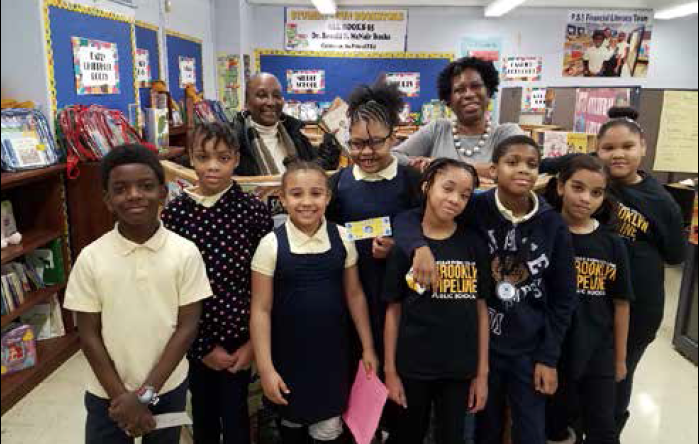
Dr. Ronald E. McNair Public School 5’s Financial Literacy Leadership Team recently hosted a special assembly to launch the opening of their student-run bookstore. The special assembly opened with inspiring words from program participant Olivia Gee.

“As a member of the Financial Literacy Leadership Team, I learned a lot about money,” said Olivia. “I learned about Financial Literacy’s 4 Principles – Saving, Spending, Earning and Giving. Saving, mathematically is adding; Spending, mathematically is subtracting; and Giving, multiplies in the long end.”

Fourth-grade student Serenity Dixon, the creative force behind Slime Surfer – an e-commerce business that produces made-to-order slime – shared, “I learned about identity theft and after the workshop, my rating improved because my customers felt more secure.”
The student-run campus bookstore will allow participating students to share their knowledge with their peers and gain additional experience in customer service and retail management.

No Shortage of Praise at Wake for Pulitzer -winning Journalist Les Payne at Abyssinian Baptist Church

To say that journalist Les Payne was a great man is an understatement as his wake at the historic Harlem Abyssinian Baptist Church in Harlem proved.

In a homegoing viewing attended by journalists, politicians – both former and current – and a slew of other esteemed guests, it was evident that Les Payne lived a life that impacted many.

Payne, who had a column in Newsday for decades, was remembered by his friends, family and former colleagues. Among some of the notable guests were Charles Rangel and David Dinkins.

Former NAACP President Hazel Dukes spoke fondly of her friend. “[Payne] was a man that embodied all that he walked and talked …a race man whose legacy will not be lost.”

She recalled meeting Payne in the 1960s when he covered a story about her moving into a home in Roseland Gardens, NY. What was significant about this story, as Ms. Dukes explained, was that her move into this house made her “the first African-American to move into a home that didn’t allow Blacks to live in.”

In vivid detail, Ms. Dukes recalled, “Payne broke the story. We were both from Alabama, we became good friends. We had our ups and downs as Violet (his wife) knows.”

A minister, Rev. Young recalled Payne “always sitting on the balcony [of the Abyssinian Baptist Church] in the same seat every Sunday,” in addition to his infectious and distinct “laugh.” Rev. Young also reflected on Payne having shared with her that he “interviewed many presidents” and that he was also “always giving her a book or article to read.” She remembered Payne being “calm, kind and firm,” and that he “got his point across in a non-intimidating way.”

A niece of Payne spoke to the humble nature of her uncle. Though most knew Payne to be this remarkable journalist and great man, to her, Payne was just “uncle.” In fact, she recalled, when she, her uncle, and their other family members would go out to eat, for example, Payne would never boast about any of his accolades. Ever. Payne’s son, Jamal Payne, referred to his father as a “hero,” but also revealed that he did not always want to share his dad with the world.

Jamal said he now understands his father’s sacrifice and the seeds he planted would now be harvested by his family members. On a lighter note, Jamal stated that Payne was not from Wakanda, as someone had previously suggested, but instead from his actual hometown of Tuscaloosa, Alabama, but more significant: the meaning of Tuscaloosa is Black Warrior in Choctaw.

Priscilla Mensah covers topics related to improving health, wellness and overall community empowerment. She is also a former Health Reporting Fellow at the CUNY Graduate School of Journalism and can be reached at pmensahbrooklyn@gmail.com.