Home Blog Page 688

Census 2020: Wake Up Call for New York and Black America

By John Louis Flateau, PhD

The Census is an ancient tool of empire. In the Book of Numbers (census!) in the Bible’s Old Testament, there are several head counts of able-bodied males of the tribes of Israel to determine the size of their armies to wage war; and for taxation purposes to finance government operations. In the New Testament, — why was baby Jesus born in Bethlehem? Because his parents, Joseph and Mary, were required by Roman law to return to his stepfather’s ancestral home, Bethlehem, the house of David, Joseph’s lineage, in order to be counted in the Census of Caesar Augustus.

The US Census is the legally mandated national count of all residents in America, as specified in Article I of the US Constitution. The first Census in 1790 was supervised by Thomas Jefferson, and it counted 698,000 Africans, over 90 percent enslaved, and 3.9 million whites in the original 13 states. The US Census has been conducted every ten years, ever since 1790. The Census has several key uses. For one, it determines Congressional Re-Apportionment, that is, how many seats each state will have in the US House Of Representatives (all states have two US Senators each, in the upper House).

Thus, the Census also determines how many votes each state will cast for President in the Electoral College, which determines the US Presidency, — not the popular vote. We learned this in 2016 when Clinton won the popular vote, but Trump won the Electoral College vote. History repeated itself in four previous presidential elections: 1800, 1824, 1876, and 2000 (Bush versus Gore).

Four of the first five (5) US Presidents were slave owners from Virginia: Washington (No. 2, John Adams, was Washington’s Vice President from Massachusetts, and he did not own slaves); Jefferson, Monroe, and Madison. This “Virginia Dynasty” ruled significantly because Virginia was the largest slave-holding state in America, according to the Census; therefore, it had the single largest voting bloc in the equivalent to today’s Electoral College.

Black America went from 698,000 over 90 percent chattel slaves and white owner’s property in the 1790 Census, whose free labor built American agriculture and infrastructure, to 4 million slaves at the dawn of the Civil War in the 1860 Census, 90 percent slave and 90 percent held economic hostages by the Southern Confederate, treasonous Slaveholders. As told by W.E.B. DuBois, Eric Foner, John Hope Franklin, and other renowned historians, Black slaves were the massive, free labor machine of the world’s dominant plantation economy of “King Cotton,” sugar cane and other agricultural production, creating vast wealth for the few, exploding American Capitalism and increasingly dominating the global economy.

Black political and economic freedom didn’t last ten years from the post-Civil War period of Reconstruction to official the Black re-enslavement with the vicious political bi-partisan “Hayes-Tilden” Compromise in the presidential election of 1876. This pernicious political deal ceded to the Confederates, Lincoln’s assassins now reconstituted as the Southern Democratic Party, control over the temporarily freed Black population, state and local politics, economy, and government; and ceded the US Presidency to Lincoln’s Republican Party, which Black people unanimously supported. This political betrayal resulted in a reign of terror in the Black South, resulting in our mass exodus to the North, Midwest, and West Coast. In the largest mass migration in US history, over 7 million Blacks evacuated the South from 1910 to 1970, according to Isabel Wilkerson in her award-winning work, The Warmth Of Other Suns.

A New, Devastating US Citizenship Question on 2020 Census Form!

Today, in 2018, Black America is nearly 50 million strong, according to the US Census Bureau’s latest American Community Survey. After 400 years, we are still struggling to assert our constitutional, civil, and human rights, full US citizenship, and “life, liberty, and the pursuit of happiness.” New York State, with 3.6 million, has the largest Black population of any state in the nation. And New York is at a critical juncture leading up to Census 2020. State and City resources must be put in place now before it is too late.

The Trump administration, on March 26, 2018, just added a question to the 2020 Census Form without legally required pre-testing (last asked in 1950), which will likely trigger a massive Census undercount and have devastating political, economic, and social consequences for Black and other communities of color. To paraphrase, the new question is, — “Are you a US Citizen, yes or no ?”

America’s 50 million Black Diasporan population contains over 11 million Continental African, Caribbean, and Afro-Latino members. Any non-citizen whose papers or relatives’ papers are not yet in order will be highly skeptical about filling out a US census form, including this question, and submitting information to a federal agency, with President Trump’s Immigration raids raging all across America. And even if they don’t fill out the form or the citizenship question, the Census Bureau still knows their address, and Census employees will be sent after them (or Immigration agents?) to complete the form. Under penalty of federal law, fine, and imprisonment, the Census Bureau should not share this information with any other agency. But today, we are living in a new, unpredictable national governmental climate.

A census undercount means fewer congressional, state legislative, and city council seats; fewer federally funded programs and services; and less civil rights enforcement; on top of the political and policy mega-shifts in Washington. Nationally, $675 billion a year in federal funds, services, and programs are allocated using Census data, and $ 7 trillion is locked in by decennial census numbers for the entire decade. $53 billion a year in New York State and $20 billion a year in New York City are in federal funds and programs. A 2020 undercount means major federal cuts on top of Trump Administration federal tax and budget policies, which have killed mortgage interest deductions and other benefits for New Yorkers. Also, civil rights and voting rights enforcement are heavily reliant on census counts to ascertain levels of racial and gender disparities and discrimination. A racial/gender undercount of protected classes will undermine the case for proof of discrimination.

The Trump-Republican-controlled Congress cut the Census 2020 budget in half, from $14 billion in 2010 to $7 billion. It is imperative that New York State and New York City governments, as well as the philanthropic and private sectors, provide substantial Census 2020 education and outreach resources now, or New York is headed for a vast undercount with dire consequences. We are already projected to lose 1-2 more Congressional seats, from our present 27 seats down to 25, and a peak of 45 seats in 1940. New York, the Empire State, once had the largest Congressional delegation in America for 100 years. California passed us in 1970, Texas in 2000, and Florida in 2017. A minority/immigrant-based Census 2020 undercount will mean political power, public services, and civil rights enforcement reductions at precisely the very time when our voices and agenda must be amplified in today’s perilous public policy climate.

The Solution? The good news is that Black America now has a head, some lead time, and 18 months to counteract this massive political and economic attack on its national well-being and sustainability as the “nation within a nation” that we have been and are now. Many groups are beginning to awaken and organize towards Census 2020. We need every New Yorker to be counted in the Census 2020, regardless of race, ethnicity, income, age, religion, gender, mobility, nationality, sexual orientation, and immigration status. Black New Yorkers, among America’s historically most undercounted groups, must do our part. Or, we will lessen our voices in the corridors of power, reduce our fair share of the blessings of liberty, and by our negligence, betray the life chances of our future generations…

uis Flateau, PhD

 The Census is an ancient tool of empire. In the Book of Numbers (census!) in the Bible’s Old Testament, there are several head counts of able bodied males of the tribes of Israel, to determine the size of their armies to wage war; and for taxation purposes to finance government operations. In the New Testament, — why was baby Jesus born in Bethlehem? Because his parents Joseph and Mary were required by Roman law, to return to his step father’s ancestral home, Bethlehem, the house of David, Joseph’s lineage, in order to be counted in the Census of Caesar Augustus.

The US Census is the legally mandated national count of all residents in America, as specified in Article I of the US Constitution. The first Census in 1790 was supervised by Thomas Jefferson, and it counted 698,000 Africans, over 90 percent enslaved; and 3.9 million whites in the original 13 states. The US Census has been conducted every 10 years, ever since 1790. The Census has several key uses. For one, it determines Congressional Re-Apportionment, that is, how many seats each state will have in the US House Of Representatives (all states have two US Senators each, in the upper House).

Thus the Census also determines how many votes each state will cast for President in the Electoral College, which determines the US Presidency, — not the popular vote. We learned this in 2016, when Clinton won the popular vote, but Trump won the Electoral college vote. And history repeated itself in four previous presidential elections: 1800, 1824, 1876 and 2000 (Bush versus Gore).

Four of the first five (5) US Presidents were slave owners from Virginia: Washington, (No. 2, John Adams, was Washington’s Vice President from Massachusetts, and he did not own slaves); Jefferson, Monroe and Madison. This “Virginia Dynasty,” ruled significantly because Virginia was the largest slave holding state in America, according to the Census; and therefore had the single largest voting bloc in the equivalent to today’s Electoral College.

Black America went from 698,000 over 90 percent chattel slaves and white owner’s property, in the 1790 Census, whose free labor built American agriculture and infrastructure; to 4 million slaves at the dawn of the Civil War in the 1860 Census, 90 percent slave and 90 percent held economic hostages by the Southern Confederate, treasonous Slave holders. As told by W.E.B. DuBois, Eric Foner, John Hope Franklin and other renowned historians, Black slaves were the massive, free labor machine of the world dominant plantation economy of “King Cotton,” sugar cane and other agricultural production creating vast wealth for the few, exploding American Capitalism and increasingly dominating the global economy.

Black political, and economic freedom didn’t last 10 years from the post-Civil War period of Reconstruction, to official the Black re-enslavement with the vicious political bi-partisan “Hayes-Tilden” Compromise in the presidential election of 1876. This pernicious political deal, ceded to the Confederates, Lincoln’s assassins now reconstituted as the Southern Democratic Party, control over the temporarily freed Black population, state and local politics, economy and government; and ceded the US Presidency to Lincoln’s Republican Party, which was unanimously supported by Black people. This political betrayal resulted in a reign of terror on the Black South, resulting in our mass exodus to the North, Midwest and West Coast. In the largest mass migration in US history, over 7 million Blacks evacuated the South from 1910 to1970, according to Isabel Wilkerson in her award winning work, The Warmth Of Other Suns.

A New, Devastating US Citizenship Question on 2020 Census Form !

Today in 2018, Black America is nearly 50 million strong, according to the US Census Bureau’s latest American Community Survey. After 400 years, we are still struggling to assert our constitutional, civil and human rights, full US citizenship and “life, liberty and the pursuit of happiness.” New York State with 3.6 million, has the largest Black population of any state in the nation. And New York, is at a critical juncture leading up to Census 2020. State and City resources must be put in place now, before it is too late.

The Trump administration, on March 26, 2018, just added a question to the 2020 Census Form, without legally required pre-testing (last asked in 1950), which will likely trigger a massive Census undercount; and have devastating political, economic and social consequences for Black and other communities of color. To paraphrase, the new question is, — “Are you a US Citizen, yes or no ?”

America’s 50 million Black Diasporan population contains over 11 million Continental African, Caribbean and Afro-Latino members. Any non-citizen whose papers, or relatives’ papers are not yet in order, will be highly skeptical about filling out a US census form, including this question; and submitting information to a federal agency, with President Trump’s Immigration raids raging all across America. And even if they don’t fill it out the form or the citizenship question, the Census Bureau still knows their address; and Census employees will be sent after them (or Immigration agents?) to complete the form. Under penalty of federal law, fine and imprisonment, the Census Bureau should not share this information with any other agency. But today, we are living in a new, unpredictable national governmental climate.

A census undercount means less congressional, state legislative and city council seats; less federally funded programs and services; and less civil rights enforcement; on top of the political and plicy mega-shifts in Washington. Nationally, $675 billion a year in federals funds, services and programs are allocated using Census data, $ 7 trillion locked in by decennial census numbers for the entire decade. $53 billion a year in New York State; and $20 billion a year in New York City are in federal funds and programs. A 2020 undercount means major federal cuts, on top of Trump Administration federal tax and budget policies which have killed mortgage interest deductions and other benefits for New Yorkers. Also, civil rights and voting rights enforcement are heavily reliant on census counts to ascertain levels of racial and gender disparities and discrimination. A racial/gender undercount of protected classes will undermine the case for proof of discrimination.

The Trump-Republican controlled Congress cut the Census 2020 budget in half, from $14 billion in 2010 to $7 billion. It is imperative that New York State and New York City governments, the philanthropic and private sectors, provide substantial Census 2020 education and outreach resources now, or New York is headed for a vast undercount, with dire consequences. We are already projected to lose 1-2 more Congressional seats, from our present 27 seats down to 25; and a peak of 45 seats in 1940. New York, the Empire State, once had the largest Congressional delegation in America for 100 years. California passed us in 1970, Texas in 2000, and Florida in 2017. A minority/immigrant-based Census 2020 undercount, will mean political power, public services and civil rights enforcement reductions, at precisely the very time when our voices and agenda must be amplified, in today’s perilous public policy climate.

The Solution ? The good news is that Black America now has a heads, some lead time, 18 months to counteract this massive political and economic attack on its national well-being and sustainability as the “nation within a nation” that we have been and are now. Many groups are beginning to awaken and organize towards Census 2020. We need every New Yorker to be counted in Census 2020, regardless of race, ethnicity, income, age, religion, gender, mobility, nationality, sexual orientation and immigration status. Black New Yorkers, among America’s historically, most undercounted groups, must do our part. Or, we will lessen our voices in the corridors of power; reduce our fair share of the blessings of liberty; and by our negligence, betray the life chances of our future generations…

______________________

Dr. John Flateau is Professor of Public Administration and Political Science at Medgar Evers College, CUNY; and director of its think tanks, the US Census Information Center and the DuBois Bunche Center For Public Policy. He has decades of executive experience with the US Census, redistricting, voting rights, campaigns and elections; and is a thought leader, author and commentator on public affairs. Email: census2020info@gmail.com.
BK Lawmakers React To 2020 Census Citizenship Question

By:  Kings County Politics

A change to the U.S. Census set for 2020, has many local electeds decrying President Donald Trump’s actions toward immigrants across the country.

Late Monday night, the Commerce Department led by Secretary Wilbur Ross, announced that the upcoming census will include a citizenship question for the first time since 1950. The department officials claim the question will help to enforce the Voting Rights Act.

According to initial reports, Ross decided to add the question to the count after a Department of Justice (DOJ) request based on the desire for better enforcement of the voting law, the U.S. Department of Commerce said in a statement.

The census, which is intended to count the entire population, is crucial for determining how federal funds are distributed and congressional districts drawn.

The controversial announcement has many immigrants worried that the information obtained from the question could be used against them.

Brooklyn Borough President Eric L. Adams denounced the move, claiming the change in policy will cause many undocumented immigrants to not partake in the data collection process.

“We already strongly suspect that urban populations like Brooklyn have been chronically undercounted, and President Trump’s call for a citizenship question in the 2020 US Census will further undercut the accuracy of this critical count by discouraging the participation of immigrant Americans. This decennial process is hard enough without putting additional barriers in place,” said Adams.

Sen. Martin Dilan

State Senator Martin Malavé Dilan (D-Bushwick, East New York, Ocean Hill/Brownsville) echoed the same sentiments calling the move a “farce,” describing the change as a misplaced belief in ethical reasoning.

“Citizenship serves no statistical purpose in the U.S. Census. The census is a head count. It helps guide health policy, allocate resources, representation and governance.Citizenship has nothing to do with voting rights as the Justice Department claims. That is a farce. Think of the Census in terms of occupancy. We need to know how many people are in the room. If half are not citizens, is the room at half occupancy? If you wanted to give them enough chairs to sit in, do you give them enough for half to sit? If they got sick, do you treat half?” said Dilan.

City Councilmember
Jumaane Williams

First generation American and City Councilman Jumaane Williams (D-Flatbush, East Flatbush, Midwood) decried the move, claiming ulterior motives by the Trump Administration.

“It is egregiously clear that the Trump administration’s appalling move to add a citizenship question to the 2020 Census is designed to serve one of two purposes: either the Trump administration and its allies want to collect information on immigrants with the intent of carrying out heinous programs, or they hope to create a pervasive fear that will discourage immigrant populations from participating in the census, and so damaging democracy by denying fair representation in government for diverse communities like the one I represent,” said Williams.

Congressman Dan Donovan

However, Congressman Dan Donovan (R-South Brooklyn, Staten Island) criticized the announcement’s backlash and instead claimed the change in policy would bring accuracy to citizenship data.

“To watch some of the coverage today, you’d think the world is coming to an end because of a minor policy announcement from the Trump Administration. It’s basic common sense for the federal government to get an accurate tally of the citizenship status of people who live in the United States,” said Donovan.

Donovan went on to refute recent claims that the question will deter immigrants from participating in the 2020 Census, claiming that a recent study concluded that “the introduction of legal status questions does not appear to have an appreciable chilling effect on participation.”

According to the Mayor’s Office of Immigrant Affairs, New York City is home to 3.1 million immigrants and an estimated 560,000 undocumented residents. The city is also home to a large lawful permanent resident population, with about 1 million New Yorkers living in mixed-status households, where a household member is undocumented.

March for Our Lives: The Game-Changer Must Honor the Long Game

Last weekend’s “March for Our Lives” mass protest on the Washington, D.C. National Mall has been a game-changer in the gun violence discussion. It is said to be the largest gathering ever on the Washington Mall – though some would disagree given that estimates vary from 500,000 to 800,000 people attending, where estimates for the first Million Man March were 450,000 to 1.1 million. March for Our Lives would be the largest single-day mobilization, however, there was said to be close to 800 sibling protests across the nation and around the world.

An estimated 80,000 people marched in Boston and 200,000 in New York, for example. People marched in Mozambique and in Accra, Ghana; in Canada, Argentina, Australia, Paris, Germany, Spain, in Switzerland, and Parkland shooting survivors spoke in Tel Aviv, Israel. The immensity of the response is heartening, and the supposedly impenetrable armor of the NRA is crumbling as banks, retailers and other big-business players are feeling the heat and severing ties with the organization.

Not lost on Black and brown communities, however, is the magnitude of the disparity – the response when Black students, or Black people of any age, are victims of gun violence, is nowhere near what we are seeing here. The immensity of the empathy and support given to the Parkland students and their cause gives them unprecedented agency. But there have been countless other victims and many protestors and organizers long before them and currently – such as the Black Lives Matter movement.

It has long rankled residents of Black (or formerly Black) neighborhoods to hear that people there are “killing themselves” and failing to focus on this violence instead of on police brutality, for example. Residents disdain these types of comments as ignorant assumption, as they can cite countless “stop the violence” initiatives, marches and activities in their communities for decades. Many of those most impacted live in communities where their Black bodies can make them targets, not only of gangs and criminals, but also victims of gun violence at the hands of the police. But the inattention on the part of government and media has had deadly consequences and community members have been left to advocate and organize on their own. In addition, the lack of support for these initiatives by influential Black people has been demoralizing for young activists.

In a letter to the Parkland student organizers, Barack and Michelle Obama said, “We wanted to let you know how inspired we have been by the resilience, resolve and solidarity that you have all shown in the wake of unspeakable tragedy… Throughout our history, young people like you have led the way in making America better.”

Activist Sean King mentioned this in a talk at the New York Public Library earlier this week.

“It stunned me,” said King, “when I heard Oprah compare the kids from Parkland to the Civil Rights Movement and she said something to the effect of, ‘… at no point had she seen something that so clearly connected student leaders to the sit-in movement.’

“I thought, ‘Damn, you never said that about us!’ We never even got a compliment or an acknowledgement… And I saw a few movement leaders and people on the ground in Ferguson and in Baltimore – it hurt them. It crushed them! Because we (Black Lives Matter activists) were dying for you to just say, ‘I believe in them, I support them.’ ‘‘And there were times when I thought, ‘Okay, maybe Sandra and Oprah will say something, maybe she’ll speak out here.’ But…” Our Time Press spoke with some veteran anti-gun violence organizers and community leaders to get their impressions of the March for Our Lives.

Andre T. Mitchell is the founder and executive director of the hugely successful East New York organization MAN UP! He feels this new addition to the movement is wonderful, but must be cooperative.

“As it relates,” said Mitchell, “to those of us who have been actually on the ground and doing the work for many years in what I call, ‘the war on violence’ – what we offer is known as the Cure Violence model that comes out of Chicago. It’s a public health approach to public safety, and in New York City, we have taken that model and added wraparound services as well. “Taking nothing away from what has taken place in Florida, Black and brown communities in urban centers across the country have been impacted by this disease far too long, and we feel strongly that this is an opportunity for us to get our message out there. They [March for Our Lives organizers] have to work in conjunction with us. And we have to be able to share best practices, share resources, share funding, you know? We have now coined the phrase, ‘ the March for our Black and Brown Lives,’ and we are pushing that messaging around organizations, neighborhoods and communities where the issue is rampant.”

Esmeralda Simmons, founder and director of the Center for Law and Social Justice, was encouraged by the march and wants to see the momentum continue.

“First, let me say that it’s extremely, extraordinarily heartening to see young people in New York City, in the nation’s capital and elsewhere, standing up and expressing themselves vocally and using their constitutional freedom of speech to tell government that they deserve to be safe in their schools and their homes and in their communities, without fear of massive gun violence affecting themselves, their families and their loved ones.

Youth have always been the true leaders of any major societal change and the fact that so many people understand clearly the role that guns are playing in our community, and the fact that it only takes one or two deranged and extremely selfish people to murder masses – this is hopefully a turning point. When they chant things like, ‘Vote ‘em out!’ the message is very clear to elected officials that the people want action on gun control, and they won’t wait another year for it.

There also has to be a serious move to stop the trafficking of weaponry, which goes on unabated even as we pass gun control laws.”

Rev. Taharka Robinson, a founder of the Brooklyn Anti-Violence Coalition, speaks from a perspective gained from commitment to this issue for over a decade.

“We have been marching for our lives for some time now,” said Robinson. “Over the course of the last 10 years, or maybe more, there have been individuals who begin to move to work against the issue of gun violence in communities across the city. Individuals and organizations like Erica Ford and Life Camp, the Trucked-Out SUV Club, the James E. Davis Stop Violence Foundation, Man Up! And, of course, the Brooklyn Anti-Violence Coalition.”

Robinson welcomes the new advocates, as there remains so much to be done.

“That’s good, that the capacity has been raised to national attention. We look forward, as advocates and activists, to remove the scourge of gun violence in our communities through a legislative agenda. We can march, we can protest, we can rally – we must continue to keep the pressure on at the legislative buildings [across the nation]. This is not an issue that affects one group of people. This is a national crisis, this is a national epidemic, and we must do everything we can to stop it.”

Mark Winston Griffith, founder and director of the Brooklyn Movement Center, reflects on the underlying issues that characterize this long-standing crisis.

“The recent Parkland-inspired demonstrations prompt us to remember that violence is a deeply internalized feature of American culture,” said Griffith. “Shrouded in claims around the need for self-defense, the maintenance of settler culture, and the fetishization of the second amendment, America’s obsession with guns reflects our terrorist past and recklessly projects our national aggression upon one another and the rest of the world. The disarming of our streets and communities has to be accompanied by the demilitarization of the state and the advancement of a regenerative, non-oppressive social order. In Central Brooklyn, we stand in solidarity with all those who are working to build that future.”

Black Female Judges Converge in Bed-Stuy

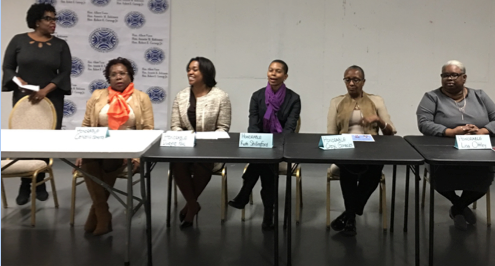
A panel of six African-American female Brooklyn judges convened on Saturday, March 24 at the Quincy Street Senior Citizens Residence to discuss their roles, responsibilities and advice. As part of the meeting of the Vanguard Independent Democrats Association (VIDA), this Women’s History Month exhibit of “Advancing Equality through the Judiciary” drew additional judges, politicians, community members and residents to the community room.

The agenda highlight was when VIDA V.P. Honorable Annette Robinson invited the community “to interact [with judges] in a positive way and know what to do when you go before them.”

Judge Lisa Ottley

Hon. Lisa S. Ottley. A former supervising judge is currently Acting Justice of the Supreme Court (Guardianship Part). “If you put your affairs in order beforehand, such as health care proxy, a living will and a power-of-attorney, you probably, in all likelihood, will not have to be in my court.” Ottley decides whether people are incapacitated and need someone to govern their person or their property from jewelry to real estate. She advises that wishes be in writing so loved ones know what to do. (She is up for reelection.)


Judge Cheryl Gonzales

Hon. Cheryl J. Gonzales. Supervising judge of fifteen judges in Brooklyn Housing Court’s three parts: #1 Resolution Part where landlords and tenants resolve disputes; #2 Trial Part; #3 Housing Part (H.P.) where tenants bring landlords to court for repairs or for harassment. She also emphasized two exciting developments: Universal Right to Counsel (now active in 3 zip codes: 11207, 11225, 11221); eligible tenants receive attorney advice or representation. There have been far fewer orders to “show cause” and more tenants asking for more time. As a result, this initiative will spread to other zip codes in the future. In addition, plans are underway for a new housing court with a construction completion date of 2021 or 2022.

Hon. Ruth Shillingford. President of Judicial Friends Assoc. of African-American Judges to ensure diversity in the system. She presides over Supreme Court/Criminal Court, all felony matters with the exception of homicides and racketeering. She hopes to see more families and friends in attendance during proceedings. “A family’s presence impacts bail and ensures justice is carried out.” She is also optimistic about increased diversity but currently in Brooklyn Supreme Court Criminal Term, “Not a single Black male judge presides.”

Judge Deweynie E. Paul

Hon. Deweynie E. Paul. In family court, she presides over custody, visitation and family offense cases (orders of protection). In addition, her court hears issues pertaining to guardianships for minors, certification for US visas for immigrant victims of domestic violence and abandoned child immigrants. She also decides cases involving private adoptions and juvenile delinquency.

Judge Cenceria Edwards

Hon. Cenceria Edwards. After spending two years in criminal court, she now presides over civil court cases involving consumer debt, student loans, auto loans, post-eviction debt and personal family issues. She also hears cases involving utility debt and name changes. She advises defendants to take advantage of all the programs the courts offer.


Below are a few of the questions panelists answered:

Question: What is the difference between appointments and elections?

Gonzales:   After submitting an application, undergoing six interviews, the mayor appoints judges in criminal court and family court after successfully undergoing six interviews over the course of a year. Housing court judges must be appointed by an administrative judge and undergo six interviews. The governor also appoints judges who serve in the city. They serve for ten years.

Edwards: A candidate must practice ten years of law, submit petitions and be active in the community.

Question. What basic documents we must have so family is not in your court fighting over our assets?

Ottley: Health care proxy which indicates measures hospital should take to keep you alive (take the form with you from the hospital), a living will and power-of-attorney to handle all of your affairs.

Question: When can we come visit your court?

Answer: Anytime. Courts are public places, except for family court where judges exercise their personal discretion about admitting spectators. In general, the public is invited.

Question: What do you wish African-American families knew when they entered your court?

Sheares: “I wish they would come to more forums like this, so they are less nervous.”

Edwards: Pay attention to the procedures, how the judge reacts, and you learn something that will help your case. There are so many self-help desks to take advantage of.

Ford: You should know you have a right to counsel. Ask the judge for an adjournment if you are not prepared. You may even be entitled to free counsel.

Shillingford: Don’t be afraid to ask your attorney about what will happen during the process and what’s going on with your case. If your attorney is not willing to answer your questions, make a request for new assignment of counsel.

Gonzales: Be prepared. Bring your documents to back up what you say.

Ottley: Know what you’re going to say to the judge. If you’re not prepared, ask for an adjournment.


Question: Why do cases languish so long in landlord-tenant court?

Answer: We have only fifteen judges. The trial judges sometimes cover for the resolution judges when they’re out or on vacation. I have over 200 cases in trial court right now and not enough judges.


Question: Have you seen an increase in the number of cases in housing court?

Answer: We handled 70,000 cases and that’s a decrease. Practice is changing. People are not settling cases like they used to. There are trials.

Question: If the courts have limited resources, how can they afford to make resources available for tenants to avoid eviction?

Answer: Homelessness is not something we want to contribute to. We try to keep people in their homes, so we don’t contribute to homelessness.


Question: How can I discharge student loan debt?

.

Answer: Don’t hide the papers when you receive them. Answer the papers. There is a wave of plaintiffs bringing requests for relief of student loan debt and the question before the court is who owns the debt. You must litigate the case to find out if the debt is signed. Is there a note? Sometimes agencies are willing to settle for a percentage of the debt.


Question: How do you resolve mold issues in the home?

Answer:   Come to the courts and start an HP action for $45 or ask for fee waiver.

Question: Is leniency toward tenants perceived or on the books?

Answer: Depending on where you stand, you may see the court as biased, especially if they don’t rule in your favor, but every judge tries to maintain a balance, so no one is hurt.

Question: What if you find your lawyer is not representing you well?

Answer: Go to the Character and Fitness Committee. Bring an action in a civil court to get recovery money. If the issue is legal or ethical, take the issue to a Grievance Committee.


Question: Is there more fairness in the judicial system now that Black women are there?


“We all take an oath to carry out justice fairly for everyone.”

“As a Black judge, I understand the culture, so I do make a difference.”

“Diversity on the bench is important. . . for the broader community of judges who can educate their peers.”

“When people walk into my courtroom and see a Black judge, people feel reassured.”

“There is implicit bias. . . in family court, we have training and workshops about perception.”

“When I see disparities in offers made to defendants, I question why.”

I know judges who have changed their names to sound like the prevailing culture. Someone who campaigned in our community did not put her face on her flyer but used red, black and green colors. People play the race card all the time. You don’t always know exactly who’s on the ballot, but you have to make it your business to find out.

“Diversity applies to the jury box also. We have to be in the room to explain our culture to jurors who may not be familiar with it. Their ignorance can put someone in jail.”

At the conclusion, the room responded with applause in appreciation for an informative exchange. As Joan Brown, Chaplain of the Tenants’ Quincy Senior Residence said, “You have to come out for these things and find out what’s going on, so you can grow and make life better for yourself or for someone else.”

The Art of Imperialism, The Imperialism of Art

This week, the Brooklyn Museum appointed two new curators. Kristen Windmuller-Luna was appointed the Sills Family Consulting Curator of African Art, and Drew Sawyer was appointed the Phillip Leonian and Edith Rosenbaum Curator of Photography. As soon as the news hit social media, the choices were met by scrutiny and questions, specifically Windmuller-Luna’s appointment, because both appointees are white. On Facebook, people commented with the obligatory stance on the perception of white people appropriating all things Black. Couldn’t they find a suitable Black candidate? Do Blacks curate Euro-American art? Kristen Windmuller-Luna received her B.A. in the History of Art from Yale University, and her M.A. and Ph.D. in Art and Archeology from Princeton University. She met all of the qualifications as listed in the job posting found on the Call for Curators – minimum three years museum experience, well-versed in historical African Art, a Ph.D. in Art or Anthropology. Her main responsibility, according to the job posting, will be to “assess and rethink the museum’s extensive holdings of African Art and organize an innovative, freshly conceived temporary installation highlighting major works, to showcase the breadth and depth of the collection and encourage public engagement.” Doesn’t sound too hard, right? Move some pieces around, choose a theme and create a buzz necessary to ignite attention. I’ve handled similar responsibilities as a party promoter. Surely, they could have found a Black person to do this, right?

In 2015, according to the National Science Foundation, 54,909 people received Doctorate degrees. Of that number, 2,773 were Black people. That places us fourth, behind whites, Asians and Hispanics. Of all Doctorates completed in 2015, less than 10% of them were for Art or Anthropology, the Doctorate necessary to qualify for this position. And so, if the ratios hold true, that would mean that roughly 250 Black people received their Doctorates in Art or Anthropology three years ago, and if every one of them spent the last three years since receiving their Doctorate working in a museum, then that would mean that there were at least 250 qualified Black candidates for the job. There are currently 35,000 museums in America. Roughly 1% of them have an African or African-American art collection. That’s 350 museums.

Useless numbers aside, the concept of collecting and displaying African Art began in the late 19th century when Western expansion into Africa yielded many stolen artifacts which were taken to Europe and displayed. This wasn’t a case of African artists getting recognized for their great creations. This was European soldiers and explorers invading African territories and usurping these territories of anything that looked interesting. This was the spoils of colonial conquest. King Leopold II, known for chopping off the hands of tens of thousands of Congolese, created The Royal Museum of Central Africa in Belgium in 1897 as a place to hold and display all of the great works of art his soldiers had stolen from the Congo. And yes, he did display a few chopped-off hands. Not long after the success of The Royal Museum of Central Africa made the entire museum industry stand at attention, a man named Stewart Culin became the founding curator of the Department of Ethnology at the Museum of the Brooklyn Institute of Arts and Sciences, now known as The Brooklyn Museum. He built the foundation for collecting and displaying African Art in the museum. He is known for being one of the first curators to display ethnological collections as art objects and not just specimens. His most well-known exhibition? It was called Primitive Negro Art, Chiefly from the Belgian Congo. My point? I’ve rambled so much, but I guess I have a few. I’ll start with this. Any anger or disappointment directed towards The Brooklyn Museum for appointing Ms. Windmuller-Luna as their curator of African Art is simply misdirected. She is obviously qualified for the position. However, if you wish to direct your ire at anything, there are plenty of places to direct it. Start with working on building up our children to achieve Doctorates in their educational journey. We need more Black Ph.D.s. Then you can begin to do some research about the origins of displaying African Art in museums. That should get you mad enough. Finally, appreciate the fact that even though removed through force, stolen without remorse and taken to a foreign place for the benefit of others, African Art, much like African culture, has influenced and continues to influence the entire world.