Home Blog Page 530

Judge Betty Staton Speaks: Part 1 of 3

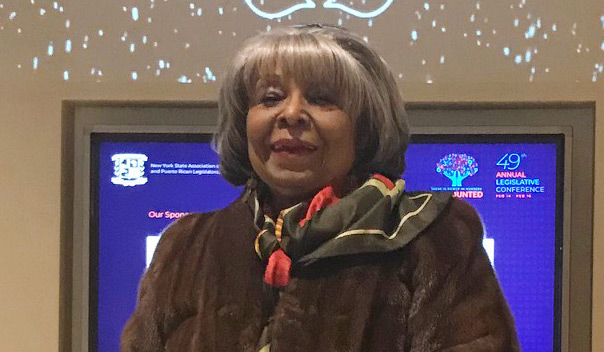
At last week’s annual meeting of the New York State Association of Black and Puerto Rican Legislators in Albany, Our Time Press was fortunate to encounter Judge Betty Staton and arrange the following interview.
Here Judge Staton, President of Legal Services, Brooklyn Legal Services, discusses the importance of this year’s Census.

David Mark Greaves, OTP: What panel was most compelling for you?

Staton: This year, one of the main focuses of the (Iowa) Caucus was the Census. Although it’s not legally based, it is certainly community based and my organization does a lot of community workshops and outreach in the community.

OTP: What are the important elements of the Census? Why is it so important that people keep emphasizing it?
Staton: It’s important because it controls everything about what happens in our communities.; how much money we get for our school systems, for our hospitals, how many people are representing us. Now, it’s more than half of what we used to have and we’re in danger of losing 2 more if the people don’t register, which means that we don’t have people in Washington representing us and advocating for us and the communities. It funds the police; it funds everything, and we lose millions and millions of dollars when people don’t register. It’s very critical but also very scary for a number of the people this year, especially immigrants.
A lot of people don’t know that there’s not a question about your immigrant status anymore. They don’t understand the confidentiality of the Census–meaning that whatever you put on it will not be revealed to ICE or any of the other government agencies. They’re frightened. So, we have to try to educate the public to let them know that they don’t have to be afraid.
In Bed-Stuy and all around, they have these large buildings going up, but people are not living in them now, but in the next 10 years they will be in those buildings and have to be provided with all of the services, but if only say 60% of our people register at the Census, we’re getting 60% instead of 100% of the resources we should be getting for police and education and hospitals and all when those buildings fill up.
They will have to share that same 60%. So, it gets worse as you project onto the next 10 years because this is the Census that won’t be taken for the next 10 years. So, whatever resources–whether it’s 40, 50, 60, whatever percent of people register and whatever percent of people register and whatever percent of the resources that we get–will be shared with the 100% of the people who live in these communities.
So, when you look at it, bit by bit, you can see how important it is and people have to understand. People can go to 2020census.gov that explains everything you need to know about the Census. There are only 10 questions. Only 10 questions. You can do it if you do it by April 1st. You can do it via the Internet, the phone or the mail. So, people are now afraid. If you’re an immigrant, somebody knocks on your door you don’t know they’re a Census taker. You might think it’s ICE. So, you’ll be afraid to even open your door, but you don’t have to open your door if you do it over the Internet or over the phone or by mail. All of this can be explained to them if they go on the Census website. You don’t really have to open your door because people are afraid.
I’ve been looking at it because even though you know my organization, which has to be my booker of legal services, because we get federal funding, we cannot do a lot of stuff. We can’t represent immigrants. But we can educate people about the Census because it’s so important to our constituencies, our low-income people and to the whole of New York.
The Black and Puerto Rican Caucus Weekend educates people throughout New York State.
Black, Puerto Rican People Power on The Hill

Part One of Two Parts

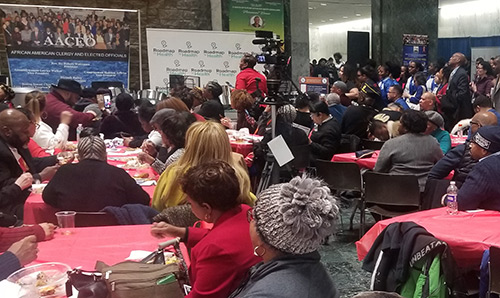
It was a productive weekend loaded with exchanges of impactful information and resources, and rededication to objectives in the service of the people. The New York State Black and Puerto Rican Association of Legislators gathered with colleagues and constituents for their annual meeting at the Legislative Office building in Albany.

An expansive list of issues were discussed at plenaries and workshops on Friday and Saturday. Prime among the topics discussed were voter rights and participation, the 2020 Census, and the burgeoning cannabis-related industries. Attendees took advantage of the opportunity to speak with elected officials or to network with peers.

And while an impressive amount of business was taken care of, those in attendance also made time to have fun and celebrate the retiring of the iconic State Senator Velmanette Montgomery.

Georgia Governor Kemp Loses Vote Purge Suit Brought by Reporter Greg Palast

A Major Win in the Battle Against Voter Suppression

By Nicole Powers
for the Palast Investigative Fund

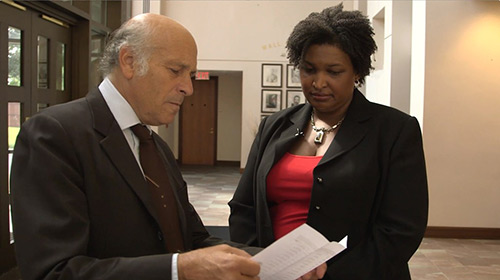
In an extraordinary and unexpected move, Federal Judge Eleanor Ross has declared Gov. Brian Kemp the loser in a lawsuit brought by investigative journalist Greg Palast for the State of Georgia to open up its complete files on the mass purge of over half-a-million voters from the rolls. Surprising all parties, the judge ruled that Kemp’s defense was so weak that no trial is needed. The judge acted “sua sponte”—on her own initiative, unrequested by Palast’s attorneys.
Palast has been fighting Kemp to release his hidden purge lists and methods for six years for Rolling Stone, al-Jazeera, Salon, Democracy Now! and currently The Guardian.
Palast said, “Kemp and the new Secretary of State of Georgia want to keep the lid on their methods for removing literally hundreds of thousands of low-income, young and minority voters on the basis of false information. They cannot hide anymore. This is a huge win and precedent for reporters trying to pry information from the hands of guilty officials.”
A key issue at stake are the “Interstate Crosscheck” purge lists secretly provided to Georgia by the Kansas Secretary of State in 2015 and 2017. Kemp had turned over Georgia’s voter rolls to Kansas official Kris Kobach, who worked closely with Donald Trump, and is known for his racially biased vote suppression techniques.
Palast’s co-plaintiff, Helen Butler, is the Executive Director of the Georgia Coalition for the Peoples Agenda, a nonpartisan group founded by civil rights legend Rev. Joseph Lowery. She said: “Kemp tried to hide the Crosscheck lists which he got from his crony Kobach. The lists are at least 99.9% wrong. Kemp’s office claimed he did not use the lists to purge voters, an assertion contradicted by his GOP predecessor. Moreover, Zach D. Roberts of the Palast investigative team obtained the Georgia 2013 purge list provided by Kobach through (legal) investigative techniques—so we know, and the judge knows, he has more squirreled away.
“Kemp finally turned over evidence that he purged 106,000 voters, overwhelmingly voters of color that were on the Crosscheck list.  But that’s just the tip of the purge-berg.” Rev. Lowery, commenting on the Crosscheck purge system, told Palast, “It’s Jim Crow all over again.”
Oddly, one of Kemp’s defenses was that he turned over Georgia’s confidential voter information to Kobach so it could be used to purge voters in 29 other states, but not Georgia. Kobach’s list showed thousands of Michigan voters supposedly also registered or voted in Georgia. Michigan removed tens of thousands of voters with names like “James Brown” and “Mohammed Mohammed”—almost all with mismatched middle names.
The Michigan purge of Georgia voters was key to Trump’s official victory margin of 10,700 in Michigan, putting Trump over the top in the electoral college. While Palast says, “The evidence is overwhelming that Kemp used the Crosscheck list in some way to purge Georgians — 106,000 is not a ‘coincidence’— I do want to find out why Kemp was using Georgia voter rolls to remove voters in other states.” 
The Crosscheck list identifies over half-a-million Georgians — including one in seven African-Americans in the state — as having moved out of Georgia, according to an investigative report on Kemp and Kobach published by Palast in Rolling Stone in 2016.
“My job as an investigative journalist is not to change laws or affect elections, but to expose official shenanigans. I thank my lawyers Brian Spears of Atlanta and Jeanne Mirer of New York for taking this case pro bono to rip the cover off Kemp’s and the state of Georgia’s racially poisonous undermining of democracy.”
The Palast team is providing investigative reports to The Guardian’s “Fight for the Vote” series and is completing work on its short film of how exactly Brian Kemp illegally eliminated 340,134 voters from the rolls, stealing the election from Stacey Abrams. The Palast film then takes us to Wisconsin where the “Kemp” techniques are the center of a push-block of 247,000 voters, mostly Democrats and thereby keeping Wisconsin, “the swing state of swing states,” in the Trump column.

Southern U’s Move on CBD Market Is Good Sense

0

By Marlon Rice

Last week, the largest historically Black university in Louisiana, Southern University, launched its own CBD line. It’s called Alafia, from the Yoruba word that means “inner peace.” This is a monumental feat on many levels, but in order for you to understand this, I think we need to start at the beginning.


CBD stands for Cannabidiol. Cannabidiol is one of 113 cannabinoids found in the cannabis plant, the plant more commonly referred to as “marijuana”. The term cannabinoid refers to any of the chemical compounds found in the cannabis plant. CBD accounts for 40% of the plant’s extract. In 2018, the Food and Drug Administration approved the use of CBD to treat certain forms of epilepsy, but there are many benefits of the use of CBD, including: anxiety, inflammation, depression, pain management, to reduce acne, to benefit heart health and even to reduce the symptoms of diabetes.


When discussing the plant we call marijuana, most people talk about the effects of the THC in the plant. THC stands for Tetrahydrocannabinol. THC is the primary psychoactive cannabinoid of the plant. In short, THC is what gets you high. THC does have medicinal uses as well, such as in the treatment of multiple sclerosis. However, when people talk about the feeling of being “high” from marijuana, they are talking about the effects of THC. THC is what gets you high. CBD does not.
Marijuana is currently legal for recreational use in 11 states, and available for medical use in 33 states. Here in New York, medical marijuana is legal. Although marijuana isn’t yet available for recreational use in New York State, the state is offering the opportunity to file for a dispensary license. The fees and start-up costs associated with the license is as follows: There is a $10,000 nonrefundable application fee. And then there is a $200,000 registration fee that will be refunded to those who aren’t approved for the license. So, if you want to apply for a license, you have to have at least $210,000 in cash, just to register. You do not need any license to sell CBD products in New York State as long as the oil is sourced from industrial hemp and the THC content is below 0.3%.


In 2019, the State of Washington generated $319 million in revenue from the sale of marijuana. California generated $300 million. Colorado generated $267 million. This marijuana market that these states have chosen to capitalize on was created and maintained for decades by Black and Brown people. It was Black and Brown people working as mules, bringing the marijuana across the border from Mexico. It was Black and Brown people that sold the marijuana in the inner cities and metropolitan areas. There have been lives maintained by the marijuana trade, regular people that have risked freedom selling an illegal substance to make enough money to support their families. They made the market, keeping marijuana available for people to purchase and embody. But the legalization of marijuana effectively separates the common dealer from the market.

Dispensaries offer more variety at comparable rates. They are safe spaces with a bunch of different products derived from marijuana that engage the customer in a way that buying dime bags on the corner could never compare. So, the economic boom, anchored by the market made by Black and Brown people, is now controlled by corporations and privately owned entities that are, by and large, not Black and Brown people. I don’t know any weed dealers that could cough up that $210,000 application fee to become a dispensary owner in New York State.
So, how can Black and Brown people find plateaus of economic empowerment in this brave new world of legalization? One way is through the use and sale of CBD products. Enter Southern University.

The move to launch an entire line of CBD products is bigger than just the products themselves. By entering into the cannabis industry, Southern University has effectively created an institutional pipeline for students interested in the field of cannabis. Students can go to the school, learn in-depth about the plant, and then work at Alafia if they wish, or even venture out into other job opportunities in the industry. This is a direct answer to the back-door income disparity which is inevitable in Black and Brown communities where weed is legalized and dispensaries begin taking all of the business away from the dealers who made and maintained the market.


I hope this business model takes hold at other HBCUs. Eddie Kane from The Five Heartbeats said that crossing over ain’t nothing but a double-cross. The legalization of weed may seem like a great idea to tokers, but the underside of that crossover is really a double-cross for many in the Black community. Southern University has introduced an option to fight against that. Good for them.

New Black History: Louisiana’s Largest HBCU Launches Own CBD Line, Becoming First to Ever Do So

By Brooklyn Baldwin,
www.theroot.com

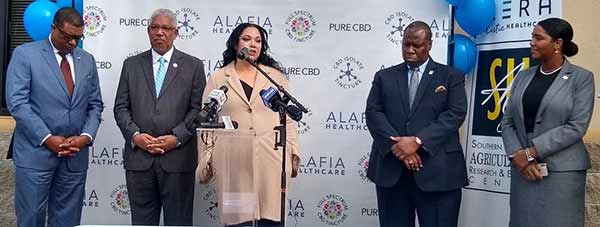
The Southern University and A&M College has launched its own hemp-derived CBD product line named Alafia. Considered the largest Historically Black University in Louisiana, the Baton Rouge-based school’s Agricultural Research and Extension Center—along with partner Ilera Holistic Health Care—unveiled the lab-tested and pesticide-free products during a press conference and ribbon-cutting at H&W Drug Store Dispensary in New Orleans. According to a news release, Southern is the first HBCU to launch a hemp product line. Alafia means “inner peace” in the Yoruba language.


The makers promised the brand will be available for over-the-counter purchase across the nation by the end of the month—in compliance with the 2018 Farm Bill (also known as Agriculture Improvement Act of 2018), which mandates that hemp-derived CBD is legal for sale in all 50 states. Alafia products currently on the market are two formulated PURE CBD tinctures: Isolate CBD with 500mg ($40) and 1000mg ($80), and Full Spectrum CBD with 500mg ($40) and 1000mg ($80).


“This is an exciting time for health care and business here in the state of Louisiana, and Southern University is honored to be a part of it all,” Southern University System President Ray L. Belton said. “Southern has been a leader in agriculture and the sciences for 140 years while staying true to its mission of access. This CBD venture with Ilera encompasses all of that. We look forward to advancing this vision and serving as a model for other universities.”


Chanda Macias, Ilera Holistic Health Care’s CEO, said the vision for Alafia has always been about being patient-access and affordability.


“It was imperative for us to bring high-quality products that support health and wellness. Patients now have the ability to purchase Alafia over-the-counter without a prescription anywhere it is available,” she said.