Home Blog Page 519

Black Communities Nationwide Hit Disproportionately Hard by Coronavirus

Editors Note: the absolute best local coverage of the coronavirus in New York is at www.gothamist.com. Read and donate!

By Jake Offenhartz and
Gwynne Hogan, Gothamist, WNYC

Data is emerging showing major racial disparities in coronavirus death rates across the country. In Chicago, 70% of COVID-19 fatalities have been Black residents, despite making up less than 30% of the population. In New York City, coronavirus patients from the Bronx, which has large Black and Latinx populations, are twice as likely to die from the infection as elsewhere in the city. City and public health officials say the disproportionately higher rate is due to a greater number of underlying health conditions, such as diabetes and asthma, lack of access to testing and healthcare, and poor conditions in public housing that promote the spread of the disease. New Orleans, a majority-Black city, now has the highest coronavirus death rate in the entire country.
 New York City may soon be forced to bury bodies in temporary mass graves on public land, as the number of COVID-19 fatalities exceeds the available capacity of local funeral homes and cemeteries.
City Councilman Mark Levine detailed the “gruesome reality” in a series of tweets on Monday, explaining that even the refrigeration trucks deployed by the Office of the Medical Examiner would soon be out of space. As a result, the city was looking at “temporary interment” sites, where bodies could be buried in trenches ten in a row.
“There are going to be thousands of more people who will die, and we need the resources to manage that in a dignified and orderly way,” Levine told Gothamist. The “ultimate goal,” he added, was to avoid the tragic circumstances seen in Italy, where scores of caskets were left awaiting burials in local churches and halls.
A spokesperson for the Mayor’s Office later clarified that this would not be done at local parks, as Levine initially indicated.
We are NOT currently planning to use local parks as burial grounds. We are exploring using Hart Island for temporary burials, if the need grows.
During a press conference on Monday morning, Mayor Bill de Blasio acknowledged that the city was exploring temporary burials for victims of COVID-19. He declined to go into details about the plan, beyond noting that Hart Island, a Bronx location previously used a burial site for the city’s indigent dead, was “the place we have used historically.”
Governor Andrew Cuomo also declined to elaborate on the plans, calling the idea of mass graves in city parks a “wild rumor.”
A 2008 report from the Chief Medical Examiner about managing an influenza pandemic references the possibility of “temporary interment” on Hart Island in the Bronx for up to 19,200 people. The city has reportedly offered to pay detainees on Rikers Island to dig the mass graves on the island.
 The planning comes as the city’s morgues, funeral homes and cemeteries buckle under the rising death toll from the virus, which reached 2,475 on Monday morning. The makeshift morgue trucks deployed to city hospitals, known as “Body Containment Points,” are “mostly full,” Levine said.
A spokesperson for the Office of Emergency management said that 80 refrigerated trucks had been dispatched to hospitals across the city and they were monitoring morgue capacity, but declined to give specifics.
Speaking to Gothamist, Levine said the plans for temporary graves was more than just a hypothetical. “I think [people] have not wanted to talk about the system for bodies because it’s very hard to talk about,” he said. 
Residents Give Hand and Heart

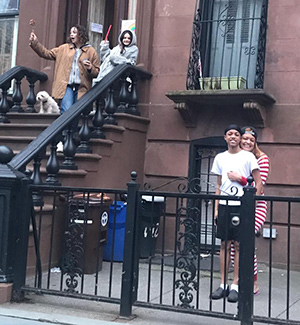
For the past week some Clinton Hill residents have been leaving their homes to cheer those First Responders who are battling an unseen enemy while trying to save lives. They came together to “bang the drum” and break the silence with whoops, bells and whistles.
They were neighbors Keth Rice and her son Kody, Linda Vital, Mrs. Harrell and Karina, with her artist daughter Anaisa of Greene Avenue at the intersection of Cambridge, and Lillian Brooks, considered the Mayor of Cambridge Place.

Linda Maurice Vital, who is a lifelong resident of and historic figure in Clinton Hill history.


     On Monday, Our Time Press heard the exuberant cheering. It started at around 7pm and ended two minutes later. 
Tuesday, we joined them. The freedom to escape the cooping and coping of being at home was welcome. A release.  A way to exhale.     
We naively expected to see a queue of masked medics, weary, but appreciative, rolling down the street from the wars. They were not there.
     “We do this to be part of the world,” said Ms. Brooks referring to the applause being heard ‘round the world for emergency providers.  “We come together to smile and laugh and clap to show we care about the people on the frontlines as much as they show they care about saving lives at the expense of their own.”
     And “after all,” Ms. Vital reminded us, “We have First Responders in our own families. I have three,” she added proudly, speaking of her adult children, all law enforcement professionals.
We quickly calculated that this group of neighbors – by blood or by acquaintance – are associated with about a dozen First Responders in a range of occupations, including emergency care, elder care, medicine, and more.  It may not be by accident that the Clinton Hill cul-de-sac of Greene Avenue’s transverse at Cambridge easily resembles a Cross.
     “They cry. They break down. But they keep working. They are dealing with stress and pressure. They are protecting us.  The least we can do is give them a hand,” Ms. Vital told us. 
  At the end of the two minutes, a round of applause rippled the air: the neighbors had just received word that residents two blocks east
had decided to join in the evening tributes.            

– Bernice Elizabeth Green

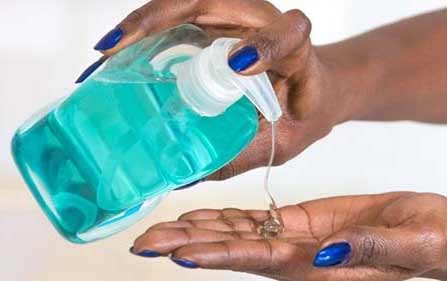
How to Make Your Own Natural Hand Sanitizer at Home

BY AAGD STAFF
(African American Golf Digest)

The worldwide pandemic of COVID-19 has paralyzed many cities across America and the hoarding of household and personal hygiene products has been at an all-time high.  If you can’t find sanitizer on the shelves and don’t want to overpay on the black market, you might want to consider making your own.
Over the last several weeks, our entire world has been shaken by COVID-19 so, it’s smart to stop freaking out and start taking control to protect yourself and your family.
We’ve been advised by the World Health Organization (WHO) to stay clean by frequently washing our hands for at least 20-seconds under running water. This advice is said to help reduce and stop the spread of viruses, as well as preserve our own health.  An alternative to hand-washing is the use of a hand sanitizer that you can carry around to protect yourself, but unfortunately, the little bottles of antibacterial liquid are nowhere to be found.
The good news? All it takes is three ingredients to make your own hand sanitizer at home. Read on to find out how.

A word of warning
Hand sanitizer recipes, including the one below, are intended for use by professionals with the necessary expertise and resources for safe creation and proper utilization.
Only use homemade hand sanitizers in extreme situations when handwashing isn’t available for the foreseeable future.
Don’t use homemade hand sanitizers on children’s skin as they may be more prone to use them improperly, leading to a greater risk of injury.

What ingredients do you need?
Making your own hand sanitizer is easy to do and only requires a few ingredients:
How do you make your own hand sanitizer?
Dr. Rishi Desai works as the chief medical officer of Osmosis, and a former epidemic intelligence service officer in the division of viral diseases at the Centers for Disease Control (CDC). Dr. Desai has professional experience with public disease control efforts and says that the hand sanitizer recipe below will kill 99.9 percent of germs after 60 seconds.  Consider making a batch of your own to keep handy for use at home and while active outdoors.

Hand sanitizer recipe
What you’ll need:
Jagdish Khubchandani, Ph.D., associate professor of health science at Ball State University, shared a similar formula.His hand sanitizer formula combines:
two parts isopropyl alcohol or ethanol (91 percent to 99 percent alcohol)
one part aloe vera
a few drops of clove, eucalyptus, peppermint, or other essential oil.

Directions:
Pour all ingredients into a bowl, ideally one with a pouring spout like a glass measuring container.
Mix with a spoon and then beat with a whisk to turn the sanitizer into a gel.
Pour the ingredients into an empty bottle for easy use, and label it “hand sanitizer.”
If you are making hand sanitizer at home, Khubchandani says to adhere to these tips:
Make the hand sanitizer in a clean space. Wipe down countertops with a diluted bleach solution beforehand.
Wash your hands thoroughly before making the hand sanitizer.
To mix, use a clean spoon and whisk. Wash these items thoroughly before using them.
Make sure the alcohol used for the hand sanitizer is not diluted.
Mix all the ingredients thoroughly until they are well blended.
Do not touch the mixture with your hands until it is ready for use.

For a larger batch of hand sanitizer, the World Health Organization (WHO)Trusted Source has a formula for a hand sanitizer that uses:
isopropyl alcohol or ethanol
hydrogen peroxide
glycerol
sterile distilled or boiled cold water

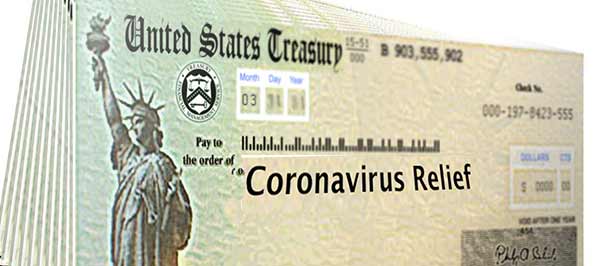
Congress Approved The $2 Trillion Relief Package. When Can I Expect My Check?

VANESSA ROMO
Via Twitter

The $2.2 trillion coronavirus relief package marks the largest rescue package in American history. President Trump announced Wednesday that it includes $300 million in direct payments to individuals to alleviate at least a little of the financial pain caused by the deliberate near-standstill of the U.S. economy.

But despite promises from Trump and Treasury Secretary Steven Mnuchin that the one-time funds will be distributed “within the next three weeks,” it will likely be months before the stimulus relief hits people’s bank accounts according to experts.

Under the plan, single people earning incomes below $75,000 will receive as much as $1,200. Married couples would get $2,400, and parents would receive $500 for each child under age 17. Payments would be phased out beyond those income limits, and people making more than $99,000 will not be eligible at all.

How soon can I expect my check?
“It really depends on what information the IRS has on you,” Kyle Pomerleau, a resident fellow at the American Enterprise Institute, told NPR.
That’s because the infusion of cash will be distributed by the IRS, so those who have previously received tax refunds via direct deposit will be first in line for the rebate checks. Pomerleau estimates the earliest those payments will go out is 3 to 4 weeks after the package is approved.
Alternatively, those who receive tax refunds through the mail will have to hold out much longer.
“I don’t think physical checks will be in the mail for another 3 to 4 months,” Pomerleau said, citing delays in the system in 2008 when the government last issued national stimulus payments under the George W. Bush administration.
Back then the financial relief package was signed into law in February but the delivery date for people whose checks were sent through the mail was somewhere between May and July.
There’s another group who may have an even longer wait: Those who receive tax refunds in the mail and have moved since filing 2018 taxes.
“So far there’s no information on how [the IRS is] going to handle that,” Pomerleau said.

What if I didn’t file 2018 taxes?
Pomerleau says nonfilers, including recent college graduates, and those who didn’t file 2018 taxes because they had no obligation, “would be left out unless they hurry up and file a return for 2019.”
For Americans receiving Social Security benefits their funds will be based on information the government has on them for a direct deposit or check through the mail.

What if I made more than $99,000 in 2018 or 2019?
Those who earned more than $99,000 are not totally shut out from the massive relief package if they expect to make less than that sum in the coming year.
The IRS will allow tax filers to qualify for the relief aid next year, when filing 2020 taxes.
“That of course is no good for someone who needs to pay their bills today,” Pomerleau said, “but all is not lost.”

Because Reading is Still Fundamental

How to keep your child interested in reading and thinking about what she/he has read might be one challenge you’ve encountered these last two weeks. If you’re running out of books, we offer a solution: a list of websites which provide free access to books of all kinds.

In addition to reading, encourage your child to keep a reading response log. This will provide tangible evidence of reading done and thoughts considered which your child can marvel over years later. One log model includes the following columns: Book Title, Author, Pages Read, Summary, My Response (feelings, questions, concerns, connections to self, other books, or other people).

Include your child in the final book selection and gauge how long she/he can stay focused on reading. For some children, it may be ten minutes for others much longer. Reading time will vary, sometimes from day to day. Start small and build up for as long as your child can sit and stay focused.

You will find African-Americans are poorly represented on these online resources now. A major reason centers around copyright laws. The only books available for free access are those books published before 1924. Books published between 1925 and 1978 are protected for 95 years. That means books published in 1925 will lose their copyright protections this year. The third tier of books, protect authors for 70 years after death, if their work was printed in 1978 and later. Gradually, more books will attain free domain accessibility.

The education of African-Americans is two-fold. We must read literature in the African diasporic literary canon, but we must also read the works of those outside our communities. Just remember, reading should be enjoyable and cover a wide range of authors, themes cultures and ideas. These sites should help.

  1. New York Public Library. Get remote access to books, tutoring, and a wide range of other resources. Get a library card at Simply E:
  2. Fiction.us. If you’re looking for children’s books with illustrations. From pre-K to college, find books which won various awards. Very few African-Americans are represented here.
  3. Project Gutenberg.
    provides access to books written before 1924. Works by W.E.B Dubois, Frederick Douglas, Paul Laurence Dunbar are a few of the African American writers whose work is posted.
  4. Read Print. Get access to thousands of the old classics. Same as Gutenberg with more a more colorful platform.
  5. The Literature Network. In addition to access to the old classics, this site provides author background, a forum for discussion, quizzes and a vibrantly colored platform.
  6. Classic Bookshelf. Another colorful platform for classic literature. Offers readers the option of selecting: font, color, and brightness.
  7. Chest of Books. This platform provides a limited number of books on just about every subject: art, business, cooking, gardening, religion, sports, etc. No listing for basketball though.

(In what other way can OTP support you at this time? Contact: education@OTP.gmail.com)