Home Blog Page 50

Now is the Time for a Focus on Things Haitian

By Jeffery Kazembe Batts
IG: @kazbatts

“Haitians are eating the pets, cats, and dogs,” he claimed while campaigning for a return to the White House, having previously declared Haiti to be a “shithole country” along with the continent of Africa. With such undeniably negative comments from the American president, many were not surprised when the Trump administration reduced the Temporary Protective Status extension to 12 months, with an expiration date of August 3, 2025.

That date has passed. Mercifully, a District Court ruling blocked his TPS termination date, extending it back to February 3, 2026. With this six-month reprieve, Haitians and all Black people, since we look alike, must prepare for what is being planned regarding people born on or descended from the first truly free republic in the Western Hemisphere. In 1804, Jean-Jaques Dessalines declared all people free in the Haitian constitution while the United States was still extending the “peculiar institution.”


The “Big Beautiful (Ugly) Bill” allocates over $165 billion to immigration and border enforcement over the next decade. This includes significant funding for border wall construction, immigration detention facilities, and increased staffing for Immigration and Customs Enforcement (ICE) and Customs and Border Protection (CBP). Border czar Tom Homan threatened, “We’re going to be in New York City, and President Trump said, we’re gonna double down, triple down on sanctuary cities.

I’ve said it before, we’ll flood the zone with sanctuary cities. If they don’t let us arrest a bad guy in the county jail, they’re going to arrest them in the community, we’re going to arrest them at a work site”. Most people snatched by ICE and Homeland Security have not been “bad guys” or criminals. Adding Haiti to the list of travel ban countries is another example of Haiti being disrespected. Brooklyn is the home of “Little Haiti” and needs to prepare for Trump, Homan, and ICE running wild in the streets.


Haiti is currently engulfed with widespread gang violence in Port-Au-Prince, a collapsing public health system nationwide, and a food crisis with millions in need of assistance. The U.S. Department of State advises against all travel to Haiti. Flights to the western third of Hispaniola (Haiti) are rare. A humane American foreign policy would not deport people to a place where they are advised not to travel.

Respect is due. Savannah, Georgia, has a Haitian Monument in Franklin Square that honors the largest unit of men of African ancestry, who were recruited from Saint-Domingue, which became Haiti, and helped the future United States win the American Revolutionary War against the British Empire in1779. Nonetheless, America has never respected Haiti. Not recognizing its sovereignty for 60 years until after the American Civil War, occupying the nation from 1915 – 1934, and using willing stooges and shenanigans to undermine development for decades in sync with France.


Florida is the only place outside of the NYC area that has more people of Haitian ancestry residing. Earlier this year, from Jan. 24 to 26, the Aventura resort in Miami became a Who’s Who of national and local politics regarding Haiti.

The National Haitian American Elected Officials Network (NHAEON) hosted the largest network of Haitian American leaders at its annual summit. Florida’s Haitian leaders are being assertive in getting Haitian issues prioritized. Related to the gang takeover is the illegal trafficking of guns.

In April, Cherfilus-McCormick, the only Haitian-American in Congress, introduced the Caribbean Anti-Smuggling of Trafficked Arms Act. Recently, she and more than 30 congressional colleagues signed a letter with their recommendations to Secretary of State Marco Rubio and Secretary of Homeland Security Kristi Noem.

Cherfilus-McCormick said Haiti “has seen a staggering influx of illicit U.S.-origin weapons — primarily funneled through South Florida.” She and the other lawmakers say 90% of illegal Caribbean-bound firearms shipments originated in Florida, including through the Miami River and Port Everglades.


This is the same Everglades area where Florida Governor Ron DeSantis has built Alligator Alcatraz to confine people rounded up by ICE agents, with the funding from the Big Ugly Bill. Could it be time for the New York City Council, the Borough Presidents, the Mayor, the New York State legislature, and NYS Governor Kathy Hochul to like the Florida officials, to convene meetings that focus on what is best for Haitians living in New York State and create mechanisms to protect our fellow New Yorkers when ICE comes looking? The nation of Haiti and the Haitian people have earned the right to be respected. February 3, 2026, is fast approaching. What are we going to do?

Running Out of Time

0

By Eddie Castro
For the most part, it is safe to say the New York Yankees were one of the teams that came out as winners during last week’s trade deadline. General Manager Brian Cashman has the huge task of upgrading a roster that has three major needs. One being bringing in depth and right-handed hitters to match up against opposing left-handed pitchers, acquiring relief pitchers, and possibly a starting pitcher. Before the July 31st deadline, Cashman was able to check two out of three.


The team acquired relief pitchers David Bednar, Jake Bird, and Camilo Duval. The Yankees also added some much-needed bench depth in Amed Rosario, Austin Slater, and Jose Caballero. Slater and Rosario have good numbers against left-handed pitching, and the acquisition of Caballero not only provides speed (leads the league in stolen bases with 35) but can give a rest here and there for shortstop Anthony Volpe.

With a revamped bullpen and a deeper bench, the Yankees are set up for another playoff run. The question is, can the Yankees find a way to even get in the playoffs?


Since the trade deadline, the Yankees are 0-4 with all four games within reach of a Yankees victory. The team has had some bad luck the past week, losing two of the last four games, having the lead in the late innings of the game.

What was the biggest weakness for the Yankees before the deadline is the exact reason they have lost these heart-wrenching games. The lack of consistency from the starting and relief pitching, and the offense. Since July 1st, Yankees starters have pitched to an ERA of 5.62, which ranks 27th in the league. The relievers have been worse with an ERA of 6.13 (29th in MLB). The Yankees’ offense has a 114 WRC+(weighted runs created), which ranks 4th in MLB.


The Yankees’ chance of making the playoffs could be slipping. As we go to press, the Bronx Bombers are 5.5 games behind the Toronto Blue Jays for first place in the American League East division, and they have dropped to the No.2 slot in the AL Wild Card standings.

It has not even been two weeks, and already the Yankees have optioned Jake Bird to AAA after two bad outings. With just 47 games left in the regular season, Manager Aaron Boone must find a way to get the best out of this current roster.

Help could be on the way as slugger Aaron Judge is back after missing the last 10 games with a right elbow flexor strain. A team in desperate need of some offense will now be able to insert its best player back in the lineup. Judge will be the team’s designated hitter moving forward until the team feels comfortable throwing him back in the outfield.

All the Yankees have to find a way to score runs early and, most importantly, put the right combination of relievers to hold on for the win. August could very well be the make-or-break month for the team in 2025.


Sports Notes: (Football) Yes, ladies and gentlemen, football is indeed around the corner, with pre-season for both the Jets and Giants kicking off this weekend! Tune in to an All-New episode of Sports Talk With Eddie tonight at 5 p.m. on the Our Time Press YouTube channel.

Plan to Cut HUD by 44% will Impact NYC

By Mary Alice Miller
“We are already living in poverty-stricken conditions, said Lisa Kenner, President of NYCHA Van Dyke Houses. “If he cuts housing funding, what is that supposed to do to us? Can we come and live in the White House?”


Kenner was referring to the Trump administration’s 2026 budget proposal, which would cut approximately 44% from the Housing and Urban Development (HUD) budget, a $26.7 billion reduction in funding for rental assistance programs, including public housing and housing voucher programs like NYCHA. HUD would also face a 26% cut in federal employees.


“It would have a tremendous impact because we all are just barely keeping our heads above water to pay our rent and our bills,” said Arlene, who lives in a Section 8 building. “The worst thing that could possibly happen would be for the subsidy to be cut or reduced. It would be a tremendous struggle.”

Lisa Kenner, President, NYCHA Van Dyke Houses


The HUD proposal would limit the amount of time people can get federal rental subsidies to two years and add work requirements as a condition of funding. In addition, states would receive a block grant to distribute the housing funding at a time when housing is already in short supply.


“Rather than promoting self-sufficiency, proposals like time limits and work requirements impose unnecessary bureaucratic barriers to obtaining and maintaining housing assistance, said Renee Willis, president and CEO of the National Low Income Housing Coalition. “Most people who receive assistance are working but are not paid enough to afford rent.”


The National Low Income Housing Coalition has found a shortage of 7.1 million affordable and available homes nationwide, and only 1 in 4 households that qualify for HUD assistance receive it.


“It would have a devastating impact on families,” said Deborah Thrope, deputy director at the National Housing Law Project, millions of whom already face unaffordable rent.
The NYC Department of Housing Preservation and Development (HPD) gets 54 percent – almost $1 billion – of its operating budget from federal funding to provide housing vouchers, code enforcement, and emergency repair programs.


NYCHA, the nation’s largest and oldest public housing authority, is home to over 300,000 people across 244 developments. Its budget receives over 75 percent federal funding, with the balance mostly coming from tenants’ rental payments. That funding is largely used to support renovations and reconstruction of dangerous and aging buildings.


The funding cuts would be “a doomsday scenario for NYCHA, or for public housing,” said Public Housing Committee Chair and Council member Chris Banks.


According to a report from the NYC Comptroller’s Office, NYCHA’s latest budget, adopted in December 2023, includes $1.3 billion in federal operating subsidies (out of total revenues of $4.96 billion) for 2024 and $4.5 billion in federal capital funding through 2028 (more than half of the housing authority’s total capital budget of $8.2 billion).

The lack of funding would directly affect Section 9 housing, which is controlled solely by NYCHA with money from outside the city’s budget, according to a recent report by the city comptroller.


This past Spring, the Trump administration held back at least $60 million in funding mainly intended for affordable housing developments nationwide. That funding was intended to go to small community development nonprofits in small grants to be used as seed funding for affordable housing projects.

At a time when new housing is desperately needed, the cuts have put developers in a quandary, making it harder to maintain and pay debt on new properties.


NYC administers the largest Section 8 program in the country. Since the enactment of the Housing and Community Development Act of 1978, Section 8 has provided housing assistance and vouchers to low—and moderate-income families renting in the private market.
According to a report from the Center on Budget and Policy Priorities (CBPP), 3 million people, including 1.5 million children, could lose housing support.


“We are facing a dire housing shortage paired with an affordability crisis, and the federal government is committed to making it even worse,” said Christine Quinn, President & Chief Executive Officer of WIN, the largest provider of family shelter and supportive housing in New York City.


“Last year, we witnessed the highest number of individuals experiencing homelessness, and the administration proposes to abandon effective, evidence-based strategies in favor of approaches that will precipitate a catastrophic surge in homelessness,” said Donald Whitehead, the Executive Director of the National Coalition for the Homeless.


Latesha, who rents an apartment in a Section 8 building with her children, said, “It would impact me a lot because it is hard for me already to pay my rent plus live, buy food, and everything else. That would be putting me and my children at risk for housing because where would I go and what would I do if I can barely afford housing now?”


The 2026 budget proposal must still pass through Congress. There will likely be proposed amendments and negotiations over funding levels taking place during the next few months.
The public is urged to contact their representatives and raise concerns about the potential impact on vulnerable populations, including the poor, working poor, disabled, veterans and homeless.

Restoration Plaza – “Too big to fail?”

0

By Nayaba Arinde
Editor at Large

When some folks rolled up to Bed Stuy’s Restoration Plaza this week, they were surprised to see all doors locked, bright red chairs removed, signage taken down, and a notice stating “End of Our Lease” on the doors of Applebee’s.


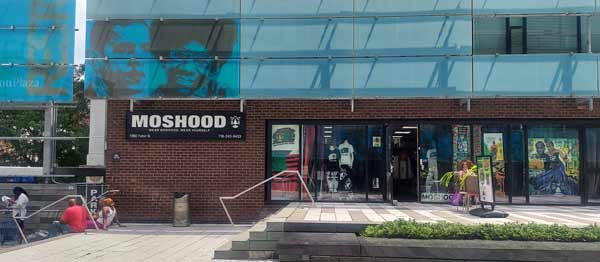
The rumor mill went into overdrive. Is the Post Office closing? Will Moshood’s Creations fashion store remain? What about Carver Bank and Foodtown?
Chase was their anchor tenant, but left last year, replaced eventually by the Brooklyn Cooperative Credit Union.


This, just a couple of years after news first broke that the whole Plaza was going to be torn down, and rebuilt into two multi-million-dollar multi-story commercial, art, business and tech hubs.


“Recently, we have received inquiries pertaining to the closure of Applebee’s at Restoration Plaza and questions around other potential tenant vacancies,” Renée D. Jenkins, Chief Advancement Officer of Bedford Stuyvesant Restoration Corporation, told Our Time Press.

“Restoration respects the decision of all its tenants who may elect not to renew their lease and appreciates the years-long partnerships with these businesses, which have helped the local economy and created jobs for many local residents.”


While there are no signs of large-scale moving or deconstruction, in 2023, Restoration revealed developers’ plans to renovate the Fulton Street/Harriet Ross Tubman Avenue space into the “Restoration Innovation Campus, a global hub dedicated to closing Brooklyn’s racial wealth gap.”

Designer Moshood Afariogun said, “We have not been told too much at all, but we are staying.” Photo Nayaba Arinde


This past Saturday, Restoration Plaza-located Moshood Afariogun held his mega 31st annual fashion show. In attendance with his family, Public Advocate Jumaane Williams told Our Time Press, “We need Restoration to remain this community-centered space. It was the first Community Development Corporation in the country, and there is still very much a need for it.

It is a central part of this neighborhood. I hope that whatever the plans are for this historic space, it remains one that the community has access to, and stays the vibrant venue that has hosted so many great events. And we will definitely look into it to ensure that the community is kept informed about the future of Restoration Plaza.”


Always a man of few words, Moshood himself told the paper, “We have not been told too much at all, but we are staying.”
A worker behind the counter at the Post Office assured Our Time Press, “We are not going anywhere. There are no plans to close this location.”


“Renovating or reimagining, we need to make sure we keep the Restoration Plaza. It is the first Community Development Corporation in the country,” Assemblywoman Stefani Zinnerman told Our Time Press. “And while everyone keeps going on about Robert Kennedy, John Lindsay, and Jacob Javits, I must mention Elsie Richardson–the community activist who advocated to bring this about, and the fantastic programming that we continue to have here.


“Restoration is too big to fail,” continued the Bed Stuy Assemblywoman. “It cannot be replaced. There are so many investors, like myself, who are waiting to invest in this space. I have very solid plans for the community.”


Created in 1967 through solid grassroots activism and the bipartisan alliance of Senators Kennedy and Javits, Restoration said their mission is, “To close the racial wealth gap in Central Brooklyn’s lower income neighborhoods through an economic mobility platform designed to help people become financially literate and independent.”


In 2023 Restoration announced that they were planning to use the mixed-use 840,000-square-foot space to “enable Restoration to meet the needs of the community.”


While currently on vacation, Restoration Corporation president and CEO Blondel Pinnock said that to maximize the current space, the plan was to build a 16-story, 245-foot-high building, a 195-foot, 13-story building, and a four-story building. These would guarantee spots for existing tenants and commercial space for new entities and organizations, including cultural spaces, dance studios, and art galleries.


For 5 decades, they say that every year they serve more than 60,000 people. Pinnock said on the website, “Restoration has helped lift thousands of local residents out of poverty and created countless opportunities right here in our community.

Now, the nation’s staggering racial wealth gap requires a bold, new approach—to harness Brooklyn’s economic growth to support wealth creation for our neighbors, particularly longtime residents and people of color. We look forward to working with local elected leaders and the residents we’ve proudly served for generations to realize this critical vision.”


“They are going through such a tumultuous time,” a source close to Restoration Plaza told Our Time Press, preferring to remain anonymous. “They are tearing everything down and moving the office to New York Avenue. Everything else, and the stores at 1368, will have to go.

This was a plan from 15 years ago, when they met with the community and with the architect. But everything is a secret now. They don’t understand that they have had a responsibility to the community for over 50 years, and now you’re not telling anyone?”


Heavily gentrified now, in what used to be one of the nation’s biggest African American communities, yet, do-or-die Bed Stuy still manages to maintain that overall Black Brooklyn energy.
The beloved gathering place for the community, Restoration, has helped maintain that defiant character.


It used to be a milk bottling plant, but Restoration opened in 1972 to become a busy business, education, and cultural event space, a meeting hall, an education and edutainment locale, an outside movie theater, jazz, hip hop, calypso and soul spot, and an interactive art locale – with both the Skylight, and director Eric Edwards’ Cultural Museum of African Art.

The community hub also hosts Carver and Citibank, Nichols, Foodtown supermarket, and once the New York Daily Challenge, Con Edison, Duane Reade, and the College of New Rochelle satellite campus.


Restoration proudly proclaims its: $650M neighborhood investment, and 27K clients placed in employment through its job creation and job services. With owning masses of property Restoration touts, “Safe, stable housing is fundamental.”

Their Brooklyn Business Center “provides pathways to wealth creation by helping businesses to start up, grow and scale.”
Restoration has said that they are a “direct service provider with a focus on the predominantly Black, brown, and low-income communities of Central Brooklyn.”


They have stated, “Black households in the U.S. have a median net worth of $24,000 compared to $188,000 for white households. In Brooklyn, the racial wealth gap is between $40 and $50 billion—and widening amid a pandemic that was devastating to Black and brown businesses and neighborhoods.”


Within the rapid gentrification, there are new types of stores, schools, dozens of condos, and increased rents and home prices. There is a concern that a renovated Restoration Plaza may become a reflection of this.


They said that their mission “is to relentlessly pursue strategies to close gaps in family and community wealth to ensure all families in Central Brooklyn are prosperous and healthy.”
Chief Advancement Officer Jenkins assured, “At this time, plans are underway to update the Bed-Stuy community about the Restoration Innovation Campus and will be shared at a later date.”

Historic Partnership Announced Between Black Faith Leaders and Black Media

Nashville, TN — July 25, 2025: In a historic announcement, a coalition of leading Black faith organizations and the National Newspaper Publishers Association (NNPA) unveiled a strategic partnership and plan aimed at confronting systemic disparities impacting African American communities nationwide.


Dr. Boise Kimber, President of the National Baptist Convention, USA, Inc.; Bishop J. Drew Sheard, Pre- siding Bishop of the Church of God in Christ (COGIC); Dr. Samuel Tolbert, President of the National Baptist Convention of America; and Dr. Benjamin F. Chavis Jr., veteran civil rights leader and President of the NNPA, are leading this collaboration between the Black church and Black Media.


“There is strength in unity. There is power in our collective voice. There is hope in our actions” said Dr. Boise Kimber.
For generations, African American communities have endured deep rooted inequities in healthcare, education, criminal justice, economic opportunity, and access to capital. These challenges are not new. The coalition intends to put an end to fragmented responses and speak with one clear, concise and consolidated voice.


The Black Church and Black Media, two institutions that have long anchored and uplifted Black America are now coming together with renewed focus and purpose.
This partnership is grounded in shared values, spiritual conviction, cultural empowerment, and an unwavering commitment to truth, justice, and progress.


The coalition will focus on five core initiatives:
-Shaping a unified national narrative that challenges harmful stereotypes and amplifies stories of Black resilience, excellence, and innovation
-Mobilizing faith-based and media networks to address community disparities through solutions-focused advocacy and outreach
-Holding corporate America accountable by demanding responsible reinvestment in Black communities through sustainable partnerships, economic equity, and community-led development
-Empowering the next generation by reclaiming our narratives and creating new pathways for education, leadership, and entrepreneurship
-Holding elected officials accountable by spotlighting those whose policies do not align with the interests of the Black community. To earn our votes, they must heed our voices


“This is more than a symbolic gesture it is a strategic and spiritual alignment.” When the Black Church and Black Media speak as one, we can ignite a movement. When we organize as one, we can shift the narrative. When we act as one, we cannot be ignored or denied,” the coalition stated.


The coalition invites all stakeholders, faith leaders, media professionals, community organizers, educa tors, business leaders, and concerned citizens to join this movement for unity, justice, and progress.

Coalition Leaders
Dr. Boise Kimber, President
National Baptist Convention USA, Inc.

J. Drew Sheard, Presiding Bishop
Church of God in Christ

Dr. Samuel C. Tolbert, President
National Baptist Convention of America

“This is more than a symbolic gesture it is a strategic and spiritual alignment.” When the Black Church and Black Media speak as one, we can ignite a movement. When we organize as one, we can shift the narrative. When we act as one, we cannot be ignored or denied,” the coalition stated.