She had no symptoms prior to getting her test result
Gerren Keith Gaynor www.thegrio.com
Keisha Lance Bottoms has tested positive for COVID-19, the Atlanta mayor announced Monday on Twitter. “COVID-19 has literally hit home. I have had NO symptoms and have tested positive,” Bottoms tweeted. Bottoms, who is in the running to be Democratic presidential presumptive nominee Joe Biden‘s running mate, has been an early standout among city leaders praised for their response to the coronavirus pandemic since the nation went into lockdown in March. Read More
COVID19 UPDATES The states, eager to re-open after the COVID19 Pause, face insurmountable public health and economic challenges like virus surges and the concomitant public health expenditures. States like Texas, Florida, Arizona, Georgia have large infections and their hospital systems are all close to capacity. While infections and hospitalization rates rage, they are not experiencing the high death rates that devastated states like NY and NJ. Medics in current surge states learned lessons from the northeast COVID crises and are better able to treat infected people. They benefit from meds like remdesivir, which were not used during the early phase of the health crisis and which is a de rigueur today. Governors in the surge states are rescinding some re-open practices and are stipulating COVID19 precautions like social distancing and face masks. Atlanta Mayor Keisha Lance Bottoms, a Joe Biden VEEP short lister, tested COVID positive this week.
The US will pay Maryland-based drug manufacturer, Novavax, $1.6 billion to develop 100 million doses of a coronavirus vaccine by early 2021. This company has never brought a product to market. The commitment falls under a federal initiative, Operation Warp Seed, created to get a coronavirus vaccine ASAP.
Last week, the US Senate and Congress voted to extend of the PPP (Payment Protection Program) application date to August 8. This enables small to medium sized US businesses to apply for PPP’s forgivable loans. The program is part of the $2 trillion CARES Act aimed at small businesses affected by the coronavirus lockdowns. There’s still $130 billion in unused funds under the PPP.
On July 6, Senate Majority Leader Mitch McConnell talked about another round of direct-payment stimulus checks for low income Americans, those earning $40,000 or less. He warned that the next round of stimulus spending would be the last. Does his 2020 US Senate race influence his thinking? The US House of Representatives already proposed a $3 trillion stimulus package last month, which McConnell said that would be DOA. Rent subsidies should accompany the next stimulus package to allay fears of eviction for the unemployed and to accelerate the US economy’s recovery.
ARTS/CULTURE Dana Canedy, 55, named new publisher of Simon and Schuster, major American book emporium, of CBSViacom, on July 27. She is the first Black woman to head S&S as publisher, and the first African American to head a major imprint. A former NY Times writer and Pulitzer Prize administrator, Canedy succeeds Jonathan Karp who was promoted to S&S President/CEO. Current Simon & Schuster titles are the #1 bestseller “The Room Where It Happened”, a Trump tell-all by former National Security Advisor John Bolton, and “Too Much and Never Enough: How My Family Created the World’s Most Dangerous Man,” written about President Trump by his niece, clinical psychologist, Dr. Mary Trump (in stores July 14).
Two magazine articles are must read items: The NY Times Magazine essay, “America’s Enduring Caste System; Our Founding ideals promise liberty and equality for all” by Isabel Wilkerson, who wrote the highly acclaimed bestseller book, “The Warmth of Other Suns,” about the great Black migration from the South circa 1915. The NYT essay “A Conflicted Cultural Force: What It’s Like to Be Black in Publishing,” starring Linda Duggins, Errol McDonald, Cherise Fisher, Janifer Wilson, Kerri K. Greenidge, and Ebony LaDette, and Tracey Sherrod. Their titles cover the waterfront, from author to literary agent, marketer, publicist, editor and to bookseller.
BOOK NOTES: The following are some newly published nonfiction book titles about Blacks, race, and racism, all great for summer reading and beyond. Writer Karu Daniels, back to the NY Daily, recommends the following books: 1) How To Be An Antiracist by Ibram X Kendi; 2) Our Time Is Now by Stacey Abrams, who is on Biden’s short list for VEEP; 3) Me And White Supremacy by Layla F Saas; 4) My Vanishing Country, by Denmark, South Carolina’s Bakari Sellers, which is “part memoir, part history, and cultural analysis… (of ) The South’s past, present and future”; 5) Becoming by Michelle Obama; 6) When We Free The World by NY social and political activist, Kevin Powell, a “collection of essays about America yesterday, today, and the future;” and “I’m Still Here: Black Dignity in A World Made For Whiteness” by Austin Channing Brown.
For the insatiable reader, still undecided about his/her 2020 Presidential choice, get a copy of “The Room Where It Happened” by former White House official John Bolton, but if your tastes lean more towards family dirt and disclosure, read “Too Much and Never Enough” by Dr. Mary Trump, the President’s niece.
Princeton Professor Eddie Glaude’s book, “BEGIN AGAIN: James Baldwin’s “America and Its Urgent Lessons for Our Own” will dominate bestseller lists this summer. Invoking his literary/intellectual muse, Glaude’s work is “equal parts biography, literary analysis, memoir and pieces of American history,” says the Kirkus Book review. A Harlem-based brand/media consultant, Victoria is reachable at Victoria.horsford@gmail.com
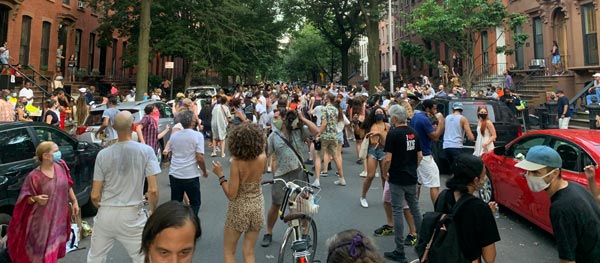
I need to preface this article with the following statements. First, and most importantly I consider myself a friend to the St James Block Association and to Ms. Gail and Mr. Jo. I think that they are both valuable assets to our neighborhood and I believe wholeheartedly that the block party that they have curated was designed from a space of love and appreciation. Secondly, for full disclosure, my own mother and sister Keth were one of the first neighbors to join in with St. James Place in celebrating the essential workers. They continue to support the block party and can always be found at 7pm either on our stoop around the corner on Greene Avenue, or sitting on the stoop of friends on St. James Place. Lastly, this column isn’t written from a position of malice, but of concern for my neighbors and to offer a more sobering perspective of the block party in the hopes that conversations take place. Far too often, I’ve watched as my neighborhood has been made into a novelty by new neighbors or visitors. At this time in our lives, we can’t afford to risk our lives for the sake of novelty. With all of that being said, we can now begin: The St. James Place block parties are irresponsible.
When the idea to applaud the essential workers at 7pm every night began, my neighborhood took to it with zeal. I’m the son of a retired cop. Our neighbors across the street are retired from Transit. We have retired firemen, retired postal workers and current and retired doctors that all live in this neighborhood. My dentist, Dr. Grannum has his office on St. James Place. We are a neighborhood that values essential workers. So, our neighborhood took pride in representing that. Nightly, you could find my mother and sister on our stoop ringing sleigh bells and banging pots. Others were doing the same. At the time, our city was in the throes of battling Covid-19. We were seeing hundreds of deaths and thousands of new cases every day. So, even as they celebrated, they kept the focus on social distancing. Once Mr. Jo brought his speakers out, the applause pivoted into a celebration of life. Again, that’s understandable given our circumstances. 86 days sheltering-in-place, all while friends and family and strangers were dying of Covid-19. We needed a chance to celebrate. We needed a chance to be free of the stress and anxiety. Music soothes, and so when he brought his speakers out the neighbors danced. FIrst, on their stoops. Then, in their front yards. And then, in the streets in front of their homes.
I took a trip out of town a couple weeks back. When I returned, the scene on St. James Place had changed for the worse. One day last week, I sat on my stoop and watched as people pulled up in cars and parked Revel scooters in front of my house so that they could go party around the corner on St. James Place. Out of curiosity, I questioned a group of women who had gotten out of an Uber right in front of my house. When I asked them where they were from, they said Queens. The Block Party was no longer a neighborhood thing. Now, it was an actual party. I watched people leave St. James Place to go buy adult beverages at Tarachi or at Peaches Shrimp and Crab, only to return to the block to continue to party. This thing had grown out of control and I waited for someone, either the organizers or other neighbors to realize it had gone too far.
But, there was nothing.
On the day that this column was written, it was reported that Covid -19 cases in NYC were on a slight rise. This was only days after this city experienced Covid-19 numbers lower than they were prior to quarantine. Compared to the surges that other states are experiencing, our surge is minimal. But, it is a surge nonetheless. We know for sure that an increase in social interactions causes an increase in new Covid-19 cases. Gov. Cuomo put a halt on the opening of indoor dining, in part, because of this. Allowing people into close quarters with one another increases the risk of contracting the virus, even if you’re wearing a mask.
Let’s say you are Covid-19 positive and do not know. And, let’s say that on your way to the bar you aren’t wearing a mask in your car. Say you cough and use your hand to cover your mouth and then minutes later when you arrive at the bar, you put your mask on. At the bar, you see a friend and you slap him five or even give him a fist bump. If that friend doesn’t sanitize his hands before touching his face, he can contract Covid-19, even if you both were wearing masks when you saw one another. This is the reason why indoor dining has been postponed. And this is also the reason why having hundreds of people from all over the city converge onto St James Place every night is a disaster waiting to happen.
This week, the Block Party IG page (yes, the block party has its own IG page) reported that the parties would be scaled back from every night to only on Friday through Sunday. While this is good news, what I’d love to see that page report on is the guidelines for people entering my neighborhood to party on the block adjacent to where my 80 year old father lives. These guidelines might want to include the following: Limit the gatherings on the block during the party to the stoops and front yards of residents. Create Hand Sanitizer stations at each end of the block, and mandate that anyone coming into the block party sanitize their hands.
Because having socially responsible rules of engagement is paramount to keeping people healthy and free of Covid-19. I implore the St James Block Association to consider drafting such rules, as it will ensure that people who come to the block to celebrate are doing so safely, and it will show those of us that live on the surrounding blocks that the organizers of the St. James Place block parties are committed to being good neighbors.
Stolen Land, Stolen Labor: The Case for Reparations Part 2 (Edited and amended)
The Black Lives Matter movement highlighting police brutality has caused an awakening of White America to the systemic racial injustice perpetrated against African Americans. However, this awakening cannot be limited to the toppling of statues, renaming of military bases and removal of confederate flags.
There has to also be an awakening to the financial brutality that Black people have been subjected to, starting with the institution of slavery and the part it played in laying down the foundation of this nation. Those who say they did not benefit from slavery because it ended in 1865 and now in 2020, they’ve worked for everything they have. These folks are either ignorant of the role enslaved Africans played in building the nation’s foundation or are willfully ignoring how the nation’s basic infrastructure and wealth was made possible. Below is a reprint of Part 2 of Stolen Land Stolen Labor: The Case for Reparations, Part One of which was awarded 2nd Place for in-depth reporting by the New York Association of Black Journalists in 1998. Here in Part 2 we learn that during the Industrial Revolution, when the nation was being built from the ground up, Black lives not only mattered, they were indispensable to the nation and the world. The work that was done was never paid for. That bill is still outstanding, and it does not include the Post Traumatic Slavery Syndrome that is a factor in the gun violence we’re seeing around the country and is part of the answer to: “Why do they do it?”
We see companies today traveling around the world seeking the most slave-like conditions they can find. Whether it’s 23-cents-an-hour in Haiti or a dollar-a-day in Malaysia, by buying labor so low and selling the output so high multinational corporations like Nike and Disney are market phenomena and widely admired in the financial communities. So, if paying low wages is good, then paying no wages is better. The combination of stolen land and stolen labor at the coming industrial age made the United States the greatest ground-floor opportunity of all time, a ground floor that was constructed and financed by the labor of Africans brutalized to work as slaves.
Historians talk about the Industrial Revolution starting in 18th century England, when the bank profits from cotton imported and made possible by slave labor supported their industrial growth, and the computer/information Age of today. Not acknowledged is the Slave Age, that period of the dark days of the golden age of white supremacy. This was the time when the United States, an emerging nation at the time, dealt most efficiently with a formidable problem: the supply and cost of manual labor to extract the value from the land stolen from the indigenous people.
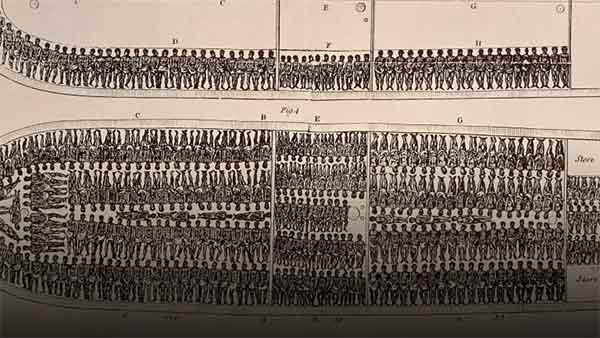
This estimate of national wealth undercounts slaves and undervalues them by $400. The value of slaves “prime field hands” in 1805 was $600 “per head” as the above chart demonstrates.
A headline in the New York Times dated Tuesday, January 13, 1998, reads, “Software Jobs Go Begging, Threatening Technology Boom”. The Times points out “As America relies more heavily on computer software than ever before, the demand for people who can develop and use the tools of the modern age has vastly outstripped the existing supply.” “If the talent drought continues, the entire national economy may feel the effect of lost wages and slowed innovation… ‘This is like running out of iron ore in the middle of the Industrial Revolution,’ said Harris N. Miller, president of the Information Technology Association of America.” Mr. Miller is in error with his analogy. Running out of silicone in the Technology Boom, would be like running out of iron ore in the Industrial Revolution. Running out of computer programmers (the workers) in the technology industry, would be like running out of slaves during the Industrial Revolution.
In 1850 The New York Times headline would have read, “Manual Labor Jobs Go Begging, Threatening Industrial Boom.” African-American slaves were the critical workers of the Industrial Age in the United States. In the same way that programmers transform computer code into products, so the labor of slaves transformed raw materials and land into products that would allow the Industrial Age to flourish. Information technology has grown into one of the nation’s largest industry over the last thirty years. Slavery was the largest industry from the time such things were first measured in 1805, until African-Americans were freed to be paid labor in 1865.
At $865 billion a year, information technology represented about 12% of the 1997 Gross Domestic Product of $7,214 billion. In 1805 slave labor represented as much as 20% of the national wealth. By the 1850’s- ‘60’s that figure rose to as high as 40%. If a 12% industry like information technology can affect the entire nation, how much impact does a 20-40% industry have? Let’s take a look at the 1850’s and the effect of slave labor on the economy. According to J.D.B. DeBow, writing in the Seventh Census 1850 Statistical View, Compendium published in 1856, “The total number of families holding slaves by the census of 1850, was 347,525. (See U.S. Census Table XC below). On the average of 5.7 to a family there are about 2,000,000 persons in the relation of slave-owners or about one-third of the whole white population of the slave States; in South Carolina, Alabama, Mississippi and Louisiana, excluding the largest cities, one half of the whole population.” In his work, History of American Business & Industry, Alex Groner observes, “In the sense that they were large and complex producing units, the big plantations were the South’s factories. The hundreds of slaves included large numbers of production workers -the field hands- as well as such specialists and skilled artisans as carpenters, drovers, watchmen, coopers, tailors, millers, butchers, shipwrights, engineers, dentists, and nurses…Because virtually entire families could be put to work in the fields for most of the year, the slave economy proved ideal for cotton culture. The price of a good field hand, about $300 before Whitney’s invention, doubled in twenty years. Poor whites, who could afford neither slaves nor land at the higher prices, moved west in mounting numbers and soon dominated the Southwest……It was not only the plantations of the South but also the factories, shipping merchants, and banks of the North whose economies became tied more and more closely to cotton. What north and south had in common was the prosperity resulting from the growth of cotton production. The size of the crop climbed steadily, from 80 million pounds in 1815 to 460 million, or more than half the world’s output, by 1834, and to more than a billion pounds by 1850…..From 1830 until the Civil War, cotton provided approximately half of the nation’s total exports.” At an average of 400-man hours per 400 pounds of ginned bales of cotton, (based on census averages), these billion pounds required a billion hours of unpaid labor. These were supplied by African-American men, women and children, working as slave labor, under threat of torture and death. Thus produced, the cotton crop traded hands on exchanges like the largest one in New York. Longevity counts in business, and many banking institutions trace their founding origins back to that time, including Bank of Boston -1784, Brown Brothers Harriman 1818, Chase – 1799, First Maryland Bancorp – 1808, Fleet Financial Group, Inc. 1791, J.P. Morgan, Co. Inc. 1838, to name a few. U.S. Trust of New York in 1853 was only a gleam in some banker’s eye at the time, and Price Waterhouse, the famous accounting firm had just gotten its start in 1849. These banks and other businesses participated in cotton transactions that were all handled as they usually are, for a fee. And so, the brokers, traders, lenders, etc. all profited first. Then came the employees of the firms, the landlords, the washerwomen, the street vendors, messengers, haberdashers, milliners, and all of their families, and mortgage holders and service-providers, in an ever-widening circle.
SLAVE CROPS TOTAL MORE THAN 60% OF THE NATION’S EXPORTS Now traded, the cotton found its way to 25 of the 35 states and territories for manufacturing. We don’t have to assume how the product was distributed, we can look at the 1850 list of cotton manufacturers. (See U.S. Census Table CXCVI) Here we see there were 1,064 businesses directly employing over 92,000 people across the country. Leading the way is Massachusetts, using 223,607 bales of cotton while employing over 29,000 people. It is also interesting to note that the export of slave-crops cotton, tobacco, and rice, totaled over 60% of all the nations’ exports. This meant that the shipping industry, the dock workers, and the factories on both sides of the Atlantic, all made a living from the peculiar institution of African-Americans working as slaves. It was possible for people throughout Europe, to work in cotton factories or peripheral industries in their home countries, save their money, and book passage to America. Here, the newly arrived immigrant could get off the boat, and work selling apples on Wall Street to the employees of the Cotton Exchange. A seamstress from English cotton mills, could come and find work making dresses for the wives and mending the coats of the men who worked in the financial district. Maybe you’ve heard stories like these before, told proudly by people pointing to their ancestors arriving with nothing and building a new life. When an industry produces over 60% of the national exports, it reaches farther than can be seen from the docks or from the fields. And there were other crops as well. There were 2,681 sugar plantations, and 8,327 hemp planters. In 1850 there were over 20 million bushels of sweet potatoes, 3 million bushels of Irish potatoes, 7 million bushels of peas and beans, and 8 million pounds of wool, all produced in slave-holding states. The African-Americans that Europeans called nere-do-well, clothed and fed this nation when the Europeans couldn’t.
GOVERNMENT PROFITS MOST The government profited most of all. The export of slave-produced crops allowed this emerging nation to import, from the more industrialized countries (with tariffs applied), without incurring a trade deficit. Also, slave-intensive industries such as agriculture, manufacturing and transportation comprised over 60% of the total private production income at the time. In one way or another, this money was taxed. The slaves themselves were taxable as property beginning in 1815. The Federal Government profited by first placing a tax on the slave as a unit of property, and again when taxes were paid on the land the slaves improved. Taxing authorities, whether federal or local, made their money at some point in the trading of cotton and again when salaries found their way into taxable areas.
The government uses a myriad of ways to raise the money it needs to do what it has to do – to build the infrastructure of the nation. To build the roads, forts and pay the calvary and the federal marshals. This was done, in a large part, with slave dollars flowing like an irrigating stream, watering national, state and local governments at various stops along the way. And now today, the United States stands as a money pump with $7 trillion worth of pressure, creating jobs for Joe Blow in Idaho, and millionaires and billionaires with fortunes that span the globe. But it is a pump that was primed with the blood of African and Indigenous people. This is a fact that must be faced and recognized, and white Americans must recognize it first of all.
The paying of reparations is not new to the United States. In the Civil Liberties Act of 1988, the United States apologized to 82,000 Japanese Americans unduly imprisoned during World War II and paid them $20,000 each to compensate for their suffering. The Jewish community demanded that Swiss banks which received deposits of money and valuables confiscated from Jews by the Germans, repay the principal of those deposits with interest. They received Congressional support, had a respectful hearing, and the Swiss banks complied and totaled the accounts. The Jewish Holocaust ended in 1945 with the surrender of Germany. The Slavery period of the African Holocaust, ended only 80 years earlier in 1865 with the surrender of the confederate states. As we say, that bill is still due and the question is how should it be paid.
What form could reparations take. Cash payment to people is not something that is going to happen, and I don’t believe it would work. What can be done is use programs already in place and fund them as a national emergency. For example, in education have eight students per class in economically deprived areas, increase Head Start and Title 1 programs for disadvantaged students. In health have health care for all, in business development, greatly increase government-related set asides for African American businesses and increase their business development. Increase anti-voter suppression efforts and social security. Many of these programs would also help low-income whites as well to make them palatable and passable in congress.
How to pay for it? Not hard at all. Reforming the tax code so that corporations have to pay fair taxes and maybe hedge fund operators have to do with less than a hundred million or a billion a year in income. The money is there, all that’s needed is the political will to pay the bill. In recognition of the wrong done, Congressman John Conyers has sponsored a reparations bill in every legislative session from 1989 to 2017. the bill is H.R.40: “A bill to acknowledge the fundamental injustice, cruelty, brutality, and inhumanity of slavery in the United States and the 13 American colonies between 1619 and 1865 and to establish a commission to examine the institution of slavery, subsequent de jure and de facto racial and economic discrimination against African Americans, and the impact of these forces on living African Americans, to make recommendations to the Congress on appropriate remedies, and for other purposes.” And in the Senate, A reparations bill (S.1083) led by U.S. Senator Cory Booker (D-NJ), a member of the Senate Judiciary Committee, has reached 12 cosponsors in the Senate. “This bill would establish a commission to study the impact of slavery and continuing discrimination against African-Americans and make recommendations on reparation proposals for the descendants of slaves.”
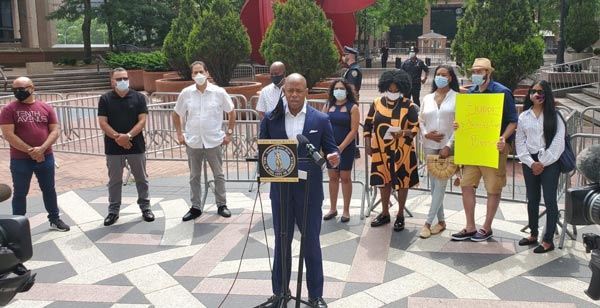
July 3 in front of One Police Plaza in Manhattan, Brooklyn Borough President Eric Adams announced his support of struggling Black and Brown businesses facing economic calamity and possible closure due to the ongoing COVD-19 pandemic. Adams’ effort is part of the continuing One Brooklyn multicultural campaign designed to grow a sustainable, more empowered Brooklyn.
Upon learning of the BP’s campaign and rally on behalf of New York City’s small ethnic businesses through a press release, Our Time Press drew parallels to the work of Earl G. Graves, Jr., the late Brooklyn-born and raised business leader who founded Black Enterprise Magazine, which celebrates its 50th anniversary next month.
BE’s Advisory Board included: political leaders Shirley Chisholm, John Lewis, Julian Bond, Edward Brooke; business leaders William Hudgins, Henry G. Parks, Jr., and Mr. Evers; NY Times journalist Thomas Johnson, and Mr. Graves, then age 35. The opening words of Graves’ very first publisher’s statement in BE’s premier issue resonate one-half century later, and could have been Adams own words at the rally: Graves wrote, “The health– indeed the survival — of this nation will depend upon the extent to which our ethnic minorities will participate and profit from its economic system. The Black businessman, and entrepreneurs from other minorities, have for the most part been systematically excluded from any meaningful participation in the economic mainstream. They have been the ‘missing link’ in the chain of benefits which have sprung from the American enterprises that have built our ever-increasing gross national product. Black sweat, black muscles and black brains have contributed greatly to that gross national product, but at the same time black entrepreneurs have not profited — neither fully nor fairly — in its rewards. “Lacking capital, managerial and technical knowledge and crippled y prejudice, the minority businessman has been effectively kept out of the profitable corner of the American marketplace. We want to help change this.
“We do not expect that all minority businessmen, new or experienced, will succeed. They will not. Some will fail. “But we do believe that all should have the opportunity to compete.” (In a future issue, Our Time Press observes BE’s 50th in remembrances from Graves’ first team members, including Judy Beardsall, photographer LeRoy Henderson and, for transparency, this writer, who was BE’s assistant editor.)