Home Blog Page 363

Georgia Republicans Purge Black Democrats From County Election Boards


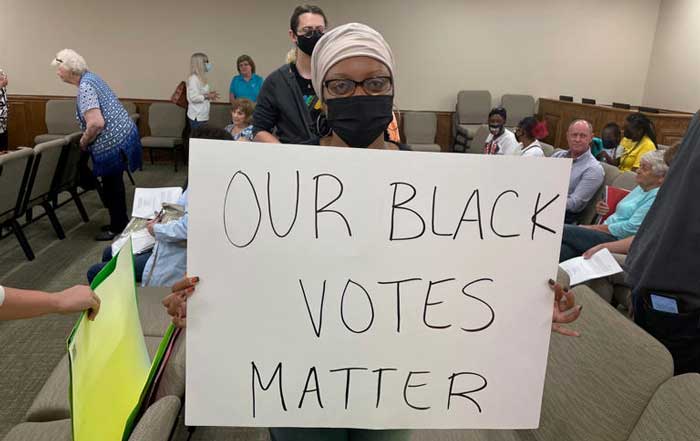
GRIFFIN, Georgia (Reuters) – Protesters filled the meeting room of the Spalding County Board of Elections in October, upset that the board had disallowed early voting on Sundays for the Nov. 2 municipal election. A year ago, Sunday voting had been instrumental in boosting turnout of Black voters.


But this was an entirely different five-member board than had overseen the last election. The Democratic majority of three Black women was gone. So was the Black elections supervisor.


Now a faction of three white Republicans controlled the board – thanks to a bill passed by the Republican-led Georgia legislature earlier this year. The Spalding board’s new chairman has endorsed former president Donald Trump’s false stolen-election claims on social media.The panel in Spalding, a rural patch south of Atlanta, is one of six county boards that Republicans have quietly reorganized in recent months through similar county-specific state legislation. The changes expanded the party’s power over choosing members of local election boards ahead of the crucial midterm Congressional elections in November 2022.


The unusual rash of restructurings follows the state’s passage of Senate Bill 202, which restricted ballot access statewide and allowed the Republican-controlled State Election Board to assume control of county boards it deems underperforming. The board immediately launched a performance review of the Democratic-leaning Fulton County board, which oversees part of Atlanta.


The Georgia restructurings are part of a national Republican effort to expand control over election administration in the wake of Trump’s false voter-fraud claims. Republican-led states such as Florida, Texas and Arizona have enacted new curbs on voter access this year. Backers of Trump’s false stolen-election claims are running campaigns for secretary of state – the top election official – in battleground states. And some Republicans in Wisconsin are seeking to eliminate the state’s bipartisan election commission and threatening its members with prosecution.


The stakes are high in Georgia, which last year backed a Democrat for president for the first time since 1992. Its first-term Democratic Senator Raphael Warnock will be up for reelection in 2022, a contest that could prove pivotal to which party controls Congress. The governor’s race next year pits incumbent Republican Brian Kemp against Trump-endorsed candidate David Perdue in a primary. The winner will likely face Democrat Stacey Abrams, a voting rights advocate. Both Warnock and Abrams are Black.


The county board restructurings and statewide voting restrictions, Democrats and voting-rights groups say, represent the most sweeping changes in decades to Georgia’s electoral system. Until 2013, Georgia elections operated under federal oversight to ensure fair participation for Black voters in this once-segregated Southern state.
Democrats say Republicans are trying to expand their control over election administration functions that should be nonpartisan. That could result in suppression of votes, they said, and could give Republicans control over certification of results, along with recounts and audits of contested elections.


“We are talking about a normalization of Republican takeovers of local functions,” says Saira Draper, director of voter protection for the Georgia Democratic Party.
Republicans say the changes aim to restore public trust in elections after many problems during the 2020 elections.
“What we want to make sure is that we have election integrity,” said Butch Miller, the No. 2 Republican in the Georgia Senate, a leading advocate for Senate Bill 202 and a sponsor of the bill to reconstitute the Lincoln County election board.


In five of the Georgia counties that restructured election boards – Troup, Morgan, Pickens, Stephens and Lincoln – the legislature shifted the power to appoint some or all election board members to local county commissions, all of which are currently controlled by Republicans. Previously, the appointments had been split evenly between the local Democratic and Republican parties, sometimes with other local entities controlling some appointments. The intent of the old system: To ensure a politically balanced or nonpartisan board.


In the sixth county, Spalding, the parties still choose two members each, but the fifth member is now chosen by local judges. (It used to be decided by a coin flip.) Those judges tend to be politically conservative; they appointed a white Republican to replace a Black Democrat on the election board, giving Republicans a 3-2 majority.
In Morgan County, the majority-Republican county commission reconstituted its election board, ousting two outspoken Black Democrats. In Troup County, a Black Democratic member claims the board shake-up was aimed at ousting her after she fought to increase voting access.


Reuters could not determine the exact split of Democrats and Republicans in the five counties that handed control to county commissions before and after their restructurings. That’s because board members’ party affiliation is not public information in Georgia, and board representatives declined to identify their allegiances.

RESTRICTING ACCESS
The county election boards have broad authority over voter access, such as polling locations and early-voting procedures. They also have considerable sway over post-election provisional-ballot tallies, audits and recounts.
Reconstituted boards in two of the six counties have already moved to restrict voting access. In addition to Spalding’s termination of Sunday voting, Lincoln County has proposed consolidating its seven precincts into one voting center, which critics say would discourage voting by people traveling from remote areas. Proponents say it would make voting more efficient and secure. The proposal is set for a vote on Thursday.


In Lincoln County, the new law removes appointments by political parties and gives the Republican-led county commission discretion to appoint the board’s three-member majority. County Republicans say the changes are meant to comply with a 2018 state Supreme Court ruling, which dictated that private entities cannot appoint members to government bodies. That decision, however, involved boards of ethics, not elections, and many other Georgia counties continue to allow political-party appointments to election boards.


The changes come in the wake of Trump’s false claims of election fraud. Trump won Spalding County with 60% of the 2020 vote. But his margin of victory declined by 4 percentage points from 2016 as turnout among Black voters jumped 20% in a county where the population is 35% black.


Trump supporters rifled through the dumpsters behind Spalding’s election office, looking for tossed ballots. None were found. Others demanded to watch the vote-counting. Sheriff’s deputies had to escort election workers to their cars. In Georgia and nationwide, some Trump supporters have threatened election officials with violence.
With conservative judges now choosing the county election board’s fifth member, the previous fifth member, Vera McIntosh, a Black Democrat, has been ousted. She was replaced by James Newland, who is also vice-chair of the county Republican Party. In September, he voted to end Sunday voting.


The board’s new chair is Ben Johnson, a former official of the county Republican party. Johnson declined to comment on his social media posts endorsing Trump’s false voter-fraud claims. He would not answer questions about whether he acknowledged that Biden won the 2020 election fairly.


McIntosh, the ousted Democrat, called the changes a “power grab” by local Republicans who wanted to “go back and prove the ‘Big Lie’ was real,” referring to Trump’s election-fraud claims.
“They wanted control,” she said. “They got control.”
The law restructuring Spalding’s board also required the elections supervisor to live in the county, a change that forced out the incumbent supervisor, Marcia Ridley. Two other Black Democrats on the board quit: Margaret Bentley and Glenda Henley, who cited objections to the law and harassment from Trump supporters.
Henley said the board’s meetings were increasingly attended by Trump supporters crying fraud. She called the tensions “exhausting” and said: “I have never been afraid in this town, but I am now.”


The restructured board still includes two Democrats, one of whom is Black.
Republican state representative David Knight from Spalding, who co-sponsored a bill to reconstitute the board, said the changes had nothing to do with race or partisanship. They aimed, he said, “to restore the integrity of our election board and voter confidence.”


On Election Day in 2020, voting machines malfunctioned in all 18 precincts, resulting in long waits. Republican Secretary of State Brad Raffensperger called for Ridley’s resignation, and the Republican-controlled State Election Board referred her handling of the problems to the state attorney general, who has to date not taken any action.
Ridley denies any mismanagement, saying her staff “worked hard to ensure that no voter got disenfranchised and all were able to vote.”

FREE AND FAIR?
In western Georgia’s Troup County, the Republican-controlled county commission now appoints all election board members, a power previously shared by three cities and the two political parties.
Lonnie Hollis, one of two Black female members, will leave the board at year-end. Hollis, who has served since 2013, said the restructuring was aimed at unseating her because she fought to increase voter access. Her efforts included advocating for the first voting location in a predominantly Black church in the county, which she said has multiple precincts in predominantly white churches.


Patrick Crews, the Republican chairman of Troup County commissioners, denied Hollis was targeted for removal.
“Our goal is to be inclusive and appoint members who are concerned about having fair and honest elections,” Crews said.


In Morgan County, two Black Democrats on the board, Helen Butler and Avery Jackson, were removed after the new law eliminated political-party appointments and handed appointment power to the Republican-dominated commission. Butler and Jackson sought reappointments but were denied.
The commission chair, Philipp von Hanstein, did not respond to a comment request.
Butler has long advocated for voting rights and social justice. Testifying before a special U.S. Senate subcommittee in July, she said she was ousted for fighting the closure of polling locations and advocating for ballot drop boxes.
Butler warned that the restructurings could “enable members of the majority party to overturn election results they do not like.”


(Reporting by James Oliphant and Nathan Layne; editing by Soyoung Kim and Brian Thevenot)
Keerchant Sewell Tapped as NYPD Commissioner

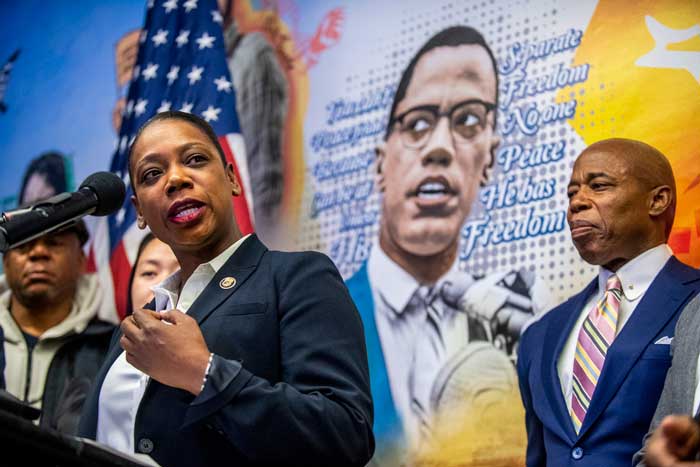
Today, Mayor-elect Eric Adams announced his appointment of Keechant Sewell as the 45th New York City Police Department (NYPD) Commissioner at an event at Queensbridge Houses in Long Island City. 


Sewell, whose first home was Queensbridge Houses, will be the first woman to serve as Commissioner of the NYPD in its 176-year history. A 25-year veteran of the Nassau County Police Department, she has worked as an undercover officer, protected students in schools, led hostage negotiations, spearheaded initiatives to get guns and drugs off the streets, and been a member of the federal terrosism task force. She also led Nassau’s Major Case Bureau and its Professional Standards Bureau. Sewell currently serves as Chief of Detectives, the first Black woman to serve in that position. 


“As someone who wore a bulletproof vest for 22 years protecting the children and families of this city, today is a very meaningful day. I believe in New York’s Finest, because I have seen and been part of some of our proudest and most tragic moments – from 9/11 to the tragic assassinations of Officers Rafael Ramos and Wenjian Liu. And I also have been a clear and consistent voice for accountability throughout my law enforcement career, because I know that when an officer violates their oath to protect and serve, it undermines the nobility of public protection. 


“To lead this department into the next chapter of our shared history, I conducted a nationwide search of some of this country’s brightest talents. I am thankful to every candidate who was interested in this important assignment, but am particularly proud of the historic choice we have made. Chief Keechant Sewell is the right woman to lead New York’s Finest at this critical moment in our city’s history. She not only has the experience to step into the role of Commissioner – she also has the emotional intelligence that is necessary for healing the divides between police and communities. I look forward to working with her to deliver the safety all New Yorkers need, and the justice they deserve,” said Mayor-elect Adams.


“For the past 25 years, I have immersed myself in the work of policing. My wide breadth of experience has shown me what works in law enforcement, and what doesn’t,” said Chief Sewell. “We are at a pivotal moment for New York, as our city faces the twin challenges of public safety and police accountability. My job as Commissioner will be to carry out the vision Mayor-Elect Adams has articulated. To do that, we must engage with our entire ecosystem of public safety, including our Crisis Management System, clergy leaders, and other groups on the ground. The NYPD has an important role to play in making our communities safer, but we cannot do it alone. 


“I am deeply humbled by the historic nature of this announcement. As the first woman and only the third Black person to lead this department in its 176-year history, I will bring a different perspective to the NYPD. I am firmly committed to making sure the department looks more like the city it serves, and elevating women and Black and Brown officers into leadership roles. The NYPD is the best of the best—and it’s about to get better. My shoes are laced up. I’m ready to get to work.”

Black Leadership Matters to Brooklyn and the City

(This story was originally published by Chalkbeat. Sign up for their newsletters at ckbe.at/newsletters.)
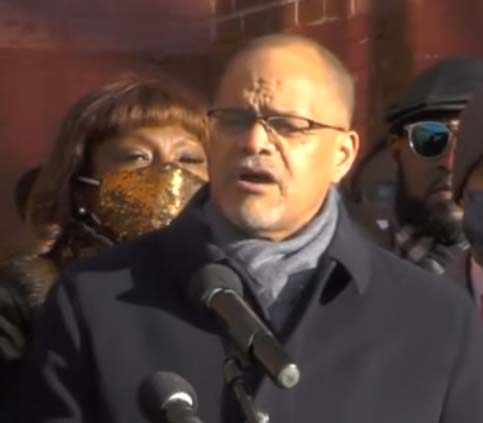
Mayor-elect Eric Adams and his newly announced schools Chancellor David Banks vowed Thursday to upend New York City’s education department, offering pointed criticisms of the city’s vast education bureaucracy and promising to better serve its most vulnerable students.


Outside of P.S. 161 in Brooklyn, which Banks attended through the fifth grade, the pair repeatedly noted that roughly 65% of students of color are not considered proficient in reading or math and argued the education department’s $38 billion budget is not producing the results it should.


“If 65% of white children were not reaching proficiency in the city, they would burn the city down,” Adams said.
Although they did not offer many specifics about how they plan to boost achievement for the highest-need students, Banks and Adams — who both attended the city’s public schools — began to outline some priorities.
They emphasized early childhood programming, a plan to launch universal screening to identify students with dyslexia, improving students’ access to healthy food, and ensuring that more students are exposed to career options before they graduate.


Adams also indicated that he wants to replicate schools that have found successful models, including traditional public schools, charters, and even religious schools. “Wherever we find excellence, we’re going to duplicate that,” Adams said.

That approach is reminiscent of the “portfolio model” of school management that some cities have embraced, which involves expanding the schools seen as effective and closing those that don’t measure up. (Banks hasn’t said whether he would close schools.)
In some of his most fiery comments, Banks said the city’s students have enormous promise but are stymied by a system that often doesn’t serve them well.
“Every young person who attends our schools across the city is filled with brilliance, potential promise, and gifts,” he said. “They exist in a school system which is fundamentally flawed.”


Banks vowed to shake up the education department’s bureaucracy itself, indicating that administrators who work in the department’s headquarters may be redeployed to work closer to schools.
“Here’s the question that will be asked of everybody who works throughout this department: If you left, and your job disappeared tomorrow, would that change anything that’s going on in any of our schools?” Banks said. “There needs to be a transformation and it will start at the top.”

Incoming Chancellor David Banks holds up a photo of himself as a fourth grader outside P.S. 161 in Brooklyn, where he attended elementary school. Alex Zimmerman / Chalkbeat


Banks indicated he would involve parents, students, and educators in key decisions as chancellor — saying he would never make a major announcement without their input.


“The answers to how we re-engineer the system exists in the hearts and the minds of the teachers, the principals, the children, and their families,” Banks said. “If we want to create an innovative school system, you cannot do that without engaging the community.” He noted that he plans to elevate students’ voices by ensuring there is a student government at every school.


In some ways, Banks and Adams’ comments represented a direct repudiation of the prior administration, though neither have yet articulated exactly how they will approach education policy, or even staked out a signature goal such as Mayor Bill de Blasio’s successful push for universal pre-kindergarten. At the same time, Adams has praised some approaches that mirror de Blasio’s, including providing schools with resources such as eyeglasses and washing machines so students’ basic needs are met.


Adams, who did not consider many other candidates to lead the nation’s largest school system, said that he has been in conversation with Banks for years and did not feel a need to conduct a broad search, noting that he wasn’t looking for someone with Ivy League credentials or complicated philosophies of education.
“I didn’t have to do a national search to find someone that don’t understand our city,” Adams said to cheers from the dozens of supporters that assembled for the announcement.


At the press conference, Banks emphasized his own roots in New York City, holding up a photo of himself when he was a fourth grader and another photo of a cherished teacher who taught him about Black history at P.S. 161.
Banks also has a long track record in schools — even working for a year as a school safety agent. His teaching career began in Brooklyn in 1986 and he eventually became the founding principal of a school in the Bronx in 1997.
In 2004, he helped launch the Eagle Academy, which was designed to serve boys of color and has now grown to a network of six schools, one in each borough and another in Newark. (At Thursday’s press conference officially announcing his appointment as chancellor, Banks was surrounded by Eagle Academy educators and students as well as his parents and other relatives.)


Launching Eagle Academy has given Banks an intimate sense of the city’s education landscape, though he has never held a high-level administrative job within the department or run a large organization. Banks’ current role is the head of a foundation that helps support the Eagle Academy schools, which are operated and supervised by the city’s education department.


Banks takes the reins at a tumultuous moment, as the city’s schools continue to be disrupted by the coronavirus pandemic for a third school year. But he also has an influx of resources at his disposal, including billions in federal relief money and substantial funding increases from the state. Among the most critical decisions he’ll face is how to spend it.
The incoming chancellor has also begun to assemble his cabinet. He has tapped Dan Weisberg — who runs an organization focused on teacher quality and handled labor issues under Mayor Michael Bloomberg — to be his top deputy. That move is likely to raise eyebrows with the city’s teachers union, which has previously clashed with Weisberg.


Michael Mulgrew, head of the teachers union, did not attend Thursday’s press conference but put out a supportive statement about Banks’ appointment. (The principals union chief attended the event in person.)
Banks was less eager to address some of the hot-button issues he’ll soon have to tackle.
“Don’t ask me about gifted and talented today,” Banks said, referring to de Blasio’s proposed overhaul of the program.
“Don’t ask me about specialized high schools today. We will have answers for all of that. But today is the day to celebrate.

“Chalkbeat (chalkbeat.org) is a nonprofit news organization covering public education.”

USA: The Threat of an Authoritarian State

View From Here

By David Mark Greaves

Let’s see, there’s a real threat of an authoritarian takeover of the United States: we have the Omicron Covid variant to deal with, the real threat of an authoritarian takeover of the United States, climate change is wreaking havoc across the country and around the world, the real threat of an authoritarian takeover of the United States, the oceans are holding more and more plastic endangering all life there, and there’s a real threat of an authoritarian takeover of the United States of America.

This is spooky stuff and we never thought we’d be here, looking into an impossibly dark future.  How do we change the course?  Fight back more effectively that the Democrats are doing now.  It feels as though the Democrats are following Marquise of Queensbury Rules and the Republicans are fighting with brass knuckles, Kay-Bar knives, and flame throwers. 

They are gerrymandering districts to ensure their dominance, suppressing the vote in every conceivable way.  They are installing election officials who will make decisions to their liking and enacting legislation to give legislators the power to name the winner of their state, no matter what the vote count is.

The Select Committee investigating the January 6th insurrection will be holding open hearing early next year, and the indications are that the gloves will be coming off, the extent of the conspiracy will be revealed and the question to be answered will be how most voters will take in the information, reject the conspiracy, and punish the Republican party for it.  Right now, it’s not looking good without voting rights legislation.

If the Republicans take back the House of Representatives, the Select Committee will be disbanded, and the path will be cleared for Donald Trump to regain the presidency, mete out his vengeance on the constituencies that voted against him, and pave the way for the next authoritarian to continue his legacy and the destruction of the American Promise.

How do we fight that battle here in Brooklyn?  Send money to Democratic candidates like Stacey Abrams running for Georgia governor and US Senator Raphael Warnock fighting to keep the Georgia seat he just won.  Once you do that, trust me, you’ll be hearing from candidates across the country who are in the trenches and already in the hand-to-hand combat that will be the election next year and in 2024.

We must get in this fight.  If we don’t, the risk increases that there will be a dictatorial takeover of the United States and we will be in a world we never imagined.

A Breath of Fresh Air: “Undesign the Redline” Exhibition & Symposium

By Maitefa Angaza

There is hope—both on the horizon and here in hand—for some measure of justice and redress concerning the egregious effects that redlining has had on our communities. Students and faculty, environmental, community and political activists, historians and other scholars, technology experts, etc., were treated to a captivating keynote speech given by environmental activist Peggy Shepard, founder of WE ACT for Environmental Justice, the legendary West Harlem based organization. Attendees were gathered late last month for the Undesign the Redline two-day symposium at Barnard College in Manhattan, convened and hosted by Barnard Library & Academic Information Services on the Columbia University campus.

We await the release of the official video recording of the symposium, which covered not just the environmental, but the housing, economic, social justice and other impacts of the practice of redlining. In the meantime, Our Time Press shares here some of Shepard’s keynote remarks. The history she told was unflinchingly honest, but she was also inspiring and empowering. First, a blit about the background framing this event.

The symposium was organized around an eye-opening exhibition at the library examining the history and effects of redlining in the Upper West Side neighborhood in which Columbia University and its Barnard College are located. “Undesign the Redline” has traveled across the nation to numerous colleges, universities, private institutions, community organizations, and other hosts. It was last in NYC hosted by a venue in Gowanus in 2019 and New York City Health and Hospitals has featured the exhibition here as well. The current exhibition is on display at Zora Neale Hurston’s alma mater  until May, 2022. Free tours are conducted on Friday afternoons to allow visitors to experience it.

April De Simone of Designing the WE, a Manhattan social and civic justice organization, created the foundational model for the Undesign the Redline exhibitions. The organization works closely with host teams in communities and institutions, helping them to input their neighborhood specifics, making the exhibitions their own. (At Barnard she worked alongside Miriam Neptune of the Barnard Center for Research on Women and Mary Rocco of Barnard Urban Studies, and others team members as well.) The result is something people involved in each local installation, as well as residents and former residents of the surrounding area, can clearly see—the roots of structural racism and inequity in their local histories. In many cases, the conveners’ own roles in this history are revealed in undeniable clarity.

So, as to be expected, Columbia University had lots to confront, having displaced countless residents for decades in what was widely considered to be a profiteering land-grab. In discussions at the Barnard event people unfamiliar with the term “redlining”— though they’d lived through it—interacted with those who’d studied it and attended in order to understand it fully. The fundamental definition and impact realities offered for consideration by Designing the We, include statements like this: 

“Redlining demonstrates how the explicit racism of the Jim Crow era was designed into the structural racism that continues to plague cities across the nation. Massive post-war era programs would go on to reinforce these divisions, such as the Federal Housing Administration’s requirement to only insure loans made in “racially homogenous areas” and the targeting of Urban Renewal programs in redlined neighborhoods, which disproportionately displaced communities of color. The devaluation of many communities through redlining resulted in the deepening of segregation and wealth inequality throughout the United States. This is a legacy we are still grappling with today.” 

Shepard has, for decades, shared with fellow advocates, the community and legal and government representatives, the human health, and environmental aspects of the unjust practice of redlining. In her keynote address at the symposium she explained how she got into this field of endeavor.

“I valued that all people have the right to clean air, clean water and a toxic-free future,” said Shepard. “And there’s just compelling evidence that we’re all exposed—whether it’s at home, in schools or in our communities—to toxic allergens that have lifelong and intergenerational effects on our public health, our reproductive outcomes, human development and the sustainability of the planet.”

Shepard, originally working at her dream job of magazine editor, entered politics, becoming a Democratic district leader. But she felt that some of the community’s critical needs were unmet by the people and organizations positioned to make the biggest difference. Eventually, it was a few ordinary citizens who lit her fire.

“I interacted with key leaders around the state… and it was a trio of elder women who provided my insurgency and my leadership position with a real energized surge of support. And they really became my political-based community mentors. They told me it was my generational turn to take over the organizing and community action that was necessary to improve West Harlem’s quality of life.

“And that effort to grow new, progressive leadership in West Harlem became the foundation of the struggle for environmental justice in Northern Manhattan. And so through strong organizing efforts, we got the City to commit $55 million to fix the North River Plant, which was spewing odious emissions that were making people sick. …And 18 years of advocacy (you’ve gotta be in this for the long haul, folks) has made the MTA diesel-fuel bus line one of the cleanest in the nation.“

Shepard also mentioned a critical factor in the ways inequity shows up in the real estate-development process.

“Communities need legal support and technical support to analyze and respond to, say a thousand-page environmental impact statement in 30-45 days, because that’s the way large environmental impact projects are rolled out… thousands of pages produced over a year’s time by engineers and suddenly a community has 30-45 days to assess and analyze that. These communities need the same sort of access to regulators as industry has, instead of getting three minutes to testify at a public hearing — even if one is held! Even when we understand the permanent process, regulators are biased and they assume community members are exaggerating the conditions.”

As mentioned, these excerpts from Shepard’s keynote address represent the depth and breadth of the Undesign the Redline two-day symposium. Clearly Our Time Press won’t be able to mine all the riches, but for next week, we’ll select some information to share with readers and will include the link to the full (edited) symposium as well.