Home Blog Page 353

Coffee, Community and Voting

We’ve often passed the Playground Coffee shop while biking down Bedford Avenue, but only learned of their impact in the community when an article in Brooklyn Patch reported on the over $50,000-plus the company has received in an outpouring of community support.
In the article seen below, Published on October 18, 2020 by softpowervote, we understand how that support was earned.
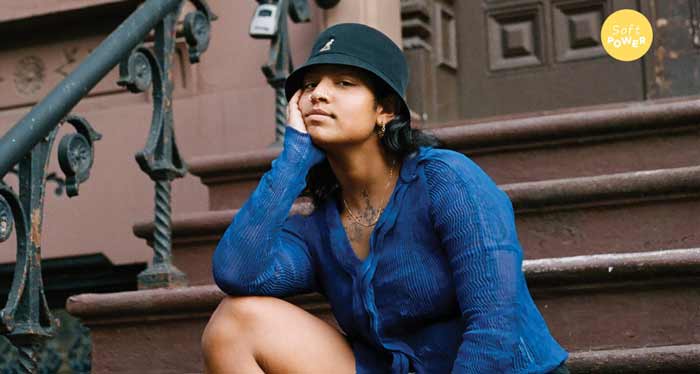
Zenat Begum is a first generation Bengali-American born and raised in Brooklyn. She opened Playground Coffee days after Trump was elected President, motivating Begum to create a safe, creative, and community-oriented space. What was her father’s hardware store for two decades, Begum has wielded this space into a movement that serves community youth, collaborates with non-profit art organizations, and in the times of COVID-19, pivoted to launch a full on community fridge program to feed her neighbors. Over the summer of 2020, Begum and the Playground Coffee Shop community debuted a free lending library composed only of BIPOC and queer authors. Playground has become a model for community-oriented business, and Zenat exemplifies what is to be expected of the next generation of young business owners.


When did voting become important to you?
I think voting is really important and I voted for Obama in his second term, which I was really stoked about. It became evident that I needed to vote when my mom began working at the poll sites. Seeing an immigrant woman who doesn’t know how to communicate that well in English, going to a poll site to teach Americans how to vote, white Americans, was enough for me to say, okay, I’m going to start voting—I’m going to start helping my mom. My mom has worked every single election, and we have worked polling sites since I was eighteen. 
Seeing someone in my age bracket helping at the polling sites was interesting. Polling machines always crash, and need a lot of support. If young people can be there and help with the technology that there, this shit flow a lot easier for everyone. 
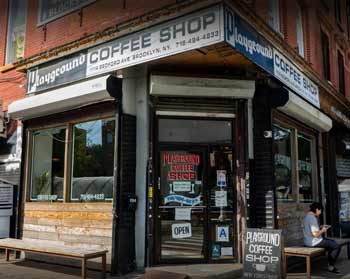
Playground Coffee Shop in Bedford-Stuyvesant


What do you tell your friends who are hesitant to vote? 
Being able to express our concerns for freedoms that we need in our lifetime is important. You can help our future and our children’s future. Women couldn’t vote until 1920, but that was only white women. In thinking about women of color—we were not born free, we had to fight to have our ideas be represented in Congress and the Senate, and that is powerful. Now we have the right [to vote] and some frivolously toss it around like it’s nothing—there’s not going to be change if we don’t vote. White people are voting, why are we not going to vote? This is why we have people like Trump in office. I really wish I could tell people of color and Black folks how important it is to vote.
On the other hand, it’s lazy activism to assume that voting is the thing that saves the world. But when we do show up, and vote in elected officials, like AOC, who is from New York and now sits at Capital Hill—that is change.
For all the times that we’ve had to keep our mouth shut, this is a time for you to speak up. If it means that we have to work a little harder to get this done, let’s do it, because Republicans know how to campaign a little harder than us.

They are not shy about playing the game or for changing the game to benefit them. What method did you vote in the Primary?
I went into a polling site, day of. For anybody mailing their ballot in, always get it out of the way, and send it early, because if it’s not postmarked and it doesn’t arrive on time it won’t count. There are so many loopholes. It’s really important to do your research and make sure you know exactly what to do for this election. There’s so much information and graphics on Instagram, so let’s take the time and absorb this burst of information, and learn how to do that new dance afterwards.

What’s at stake this November and why should young people vote? 
Everything: housing, food, equity, healthcare, space. How business owners are going to be able to pay for all of this. Just everything.
It will have an impact on our whole daily lives. Ever since Trump was elected, every time something weird happened, it affected someone I know, myself, or my parents or their family members. Being tight with my community is the most important thing, because if all else fails, I have y’all, and they have me.


What do you listen to in the mornings? 
I listen to NPR every morning. I drive a lot, running around between all the fridges aside from getting donations. I also listen to The Daily just to make sure that I’m good. I also love satirical politics and love to watch John Oliver here and there. Sharing stuff between my friends has been really pivotal in the morning, and reading articles on Twitter, but I try make sure that I’m reading real things which is a constant struggle, because I’ve seen a lot of people share things that are incorrect 
Did you always think business was synonymous with community and mutual aide work?
We’ve always held space for other organizations; I met you through 8 Ball [Community] and gave them space to do their thing, because it’s all about opportunity. Prior to Playground, no one gave me a chance, no one saw me as an integral part of a movement, and I carry that with me. When you feel lost, and you want to feel carried; what do you do? You create your own spaces, you create your own platforms and you put yourself on. That’s essentially what I had to do. 
We’re in a global pandemic where there are a lot of restrictions on us gathering socially, but you have all the tools. People want to do community work, but do you talk to people around you? Do you say “Hi” to your neighbors? To the passer-bys in your life who are part of your community? We are the ones that have to be extroverted and reach out to people to make them feel comfortable. You have to make it a lifestyle or it’s going to feel like a job. 
For the first time in my life, people are trusting me with this vision. I’ll continue this kind of work—like the tree branches that spread apart—I want people to know that this is as easy as you want it to be, and as functional as you want it to be.
As they say: when you do what you love, it’s no longer work.
Every day that we sell coffee, we fill the fridge, we’ve embedded this into our process. It’s easier to do daily than to think, “how much am I going to spend on feminism this month?” It has to become an everyday checklist—I brushed my teeth, I donated, I did this. It’s an individualistic idea that we’ve had to kind of institute into our own lives. 

Playground used to be your dad’s hardware store. What’s been your family’s response to Playground’s success? 
You know, [my father] hasn’t told me he’s proud of me, but I think that is really hard for immigrant parents to admit that they are proud of their children for doing something that isn’t tangible, like earning a PhD. At the end of the day, my ideas have come from being surrounded by my parents and seeing how charitable they’ve been. They are the family that moved to this country, and as a result, they send funds back to sustain the lives of many back home. When my dad opened his hardware store, it was a huge accomplishment for him, as an immigrant to open a business in America—especially in New York, which feels like the epicenter of the world. My dad helped me build Playground from the ground up, and I feel so honored to be able to work with a visionary like him, who has always done things on his own. 
(https://softpower.vote/2020/10/zenat/)
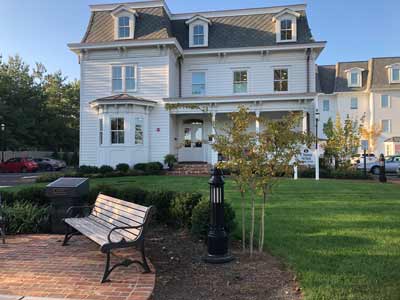
Our Time At Home: On Location
Victorian Gilded Age Has Continuous Connections
From Brooklyn to Red Bank, NJ; Manhattan,Troy, NY and Back

0

While the City of Troy is featured prominently throughout ‘The Gilded Age,” HBO’s new ten-episode 1880s historical drama series, other areas in the northeast have roles behind the scenes although they are not actually seen in show.  They include Brooklyn, New York; Red Bank, New Jersey, and Manhattan, through the re-enactment of an icon in African American media history — T. Thomas Fortune (1856-1928), publisher, editor, journalist, and businessman.
Sullivan Jones of “Harlem” fame, the actor who portrays Mr. Fortune in three episodes of the series, is a resident of Brooklyn, where the Black journalism legend lived before moving to Red Bank in 1901.  Fortune’s historic newspaper, The New York Age, was printed in Manhattan.  In this first part of our two-part series written by Fern E. Gillespie, Our Time Press journeys through time starting at the site of the actual Fortune family Victorian mansion, now one of New Jersey’s cultural centerpieces. It’s where Mr. Jones traveled for inspiration and research on this iconic figure. (Part 1 of 2)

  • by Fern E. Gillespie

Gilda Rogers, a co-founder, and executive director of the T. Thomas Fortune Cultural Center in Red Bank was at the forefront of lobbying government and businesses for years to save the home of legendary 19th and 20th century journalist and civil rights activist T. Thomas Fortune (1856-1928). From the 1880s to the 1920s, he was editor-in chief of America’s largest Black newspapers, The New York Globe, The New York Age and Marcus Garvey’s Negro World. He was a colleague of W.E.B. DuBois, Ida B. Wells and Booker T. Washington.

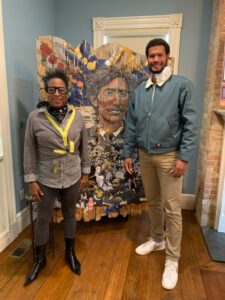
Gilda led actor Sullivan Jones — who plays T. Thomas Fortune in episodes of HBO’s “The Gilded Age” — on a tour
of the Center where he found “inspiration” for his portrayal.

In 1901, Fortune moved his family from Brooklyn to a stately Victorian mansion in Red Bank, NJ’s prominent Jersey Shore Black community. He named the home Maple Hall and lived there until 1911. Although it was designated a National Landmark in 1976, preservationists pursued saving the decomposing building that the new owners wanted to sell.
In 2013, Gilda was a leading advocate in securing an agreement with developer Roger Mumford, who restored the Victorian and built a Victorian apartment complex surrounding the building. When the T. Thomas Fortune Cultural Center opened in 2018, it became a leading institution on Jersey Shore promoting and preserving Black culture. Our Time Press talked with Gilda about the Afrofuturism-Victorian design of the center.

OTP – You headed the design vision of the T. Thomas Fortune Cultural Center. You are known as a journalist (a reporter for the Asbury Park Press and managing editor of City News, which was New Jersey’s largest Black weekly), and community affairs director of Two River Theatre in Red Bank. What is your design background?

ROGERS – Prior to becoming a journalist, I studied Fashion & Visual Merchandising and Interior Design and graduated from Roberts Walsh Business School, a long time ago, it no longer exists. I also took a few classes at FIT.  I then worked for 15 years as a window dresser for major department stores and specialty stores.   A lot of the display work I was doing was also connected to interior design, particularly in department stores that had simulated bedrooms, living room settings during that time. 

OTP– What was your interior design vision of The Fortune House? How did you coordinate and layout the antique furnishings?

ROGERS – One of our Board members, Robin Blair donated some of the chairs that dictate a particular time period, and we thought it would be a novel concept to have them reupholstered in African designed fabric to bring the two cultures together.  We actually had reached out to a reputable interior decorator to work with us. However, her vision was much different from ours.  She didn’t see what we did.  We wanted the home to reflect Black culture from the time you walked in the door.  We parted ways with her quickly.  I relied on my own interior design experience, and we went from there. A few of us traveled to Montclair, where we purchased a slew of African inspired fabrics and motifs. Of course, several people wanted to donate items to us.  They seemed to think if it were something old then we should have it.  However, we were very selective about what pieces of furnishings we chose to accept for the decor of the home.  The T. Thomas Fortune Room has a big poster-sized sign that welcomes you to “ A Cultural Textile Experience,”   Fortune’s room reflects and showcases an Afro-futurist design that is appealing and appreciated by all who visit the home. My co-decorators were Birgit Mondesir, Robin Blair and Kathy MacAuley, all of whom are Board Members.  

OTP – Why was it unique that the Fortune House organizers collaborated with developer Roger Mumford, who restored the house and created Victorian apartment complex?

ROGERS – Roger Mumford was the building developer and financier of the T. Thomas Fortune Cultural Center.  He deeded the home back to the T. Thomas Fortune Foundation for $1 to run as a Cultural Center, to bring people together to eradicate the injustices that prevail in our society.  If we can start to understand one another and form relationships that engage and promote different perspectives, as opposed to one point of view, perhaps we can start to build trust and understanding between the races.  It’s a challenge, however, I am grateful to Roger Mumford for being someone who cares about humankind and what that should represent.  
 
OTP – What are the special spaces in the T. Thomas Fortune Cultural Center?

ROGERS – Adjacent to the Fortune Room is the Ida B. Wells Gallery, which houses our current exhibit, “A Love Letter to Count Basie: From The Great Migration to The Harlem Renaissance.”  I am currently working on an exhibit upstairs which is in honor of the Parker Family. Ancestral Ascension is the title of this exhibit, which honors a family of Black medical doctors, educators, and leaders in the community.  It is due to open late March.  And there’s the Carrie Smiley Fortune Research Library that is dedicated to Carrie Fortune, the wife of T. Thomas Fortune and one of the founding members of the National Urban League.  

The T. Thomas Fortune Cultural Center is open to the public on Saturdays and Sundays from 1:00pm – 5:00pm. For more information on events and programs: www.tthomasfortuneculturalcenter.org

Fortune House and Memories Preserved

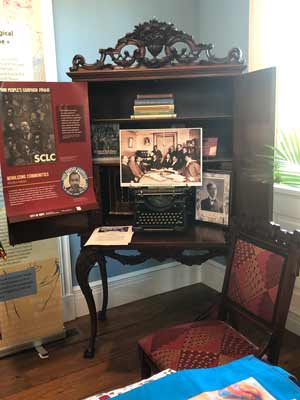
Preservationists, among them Gilda Rogers led a successful effort to save The T. Thomas Fortune House in Red Bank, N.J. from destruction.  In 1901, Fortune and his family moved from Brooklyn to Red Bank. Antique furniture, not the originals, were refurbished in contemporary African fabrics by Gilda and other designers, in honor of the publisher’s civil rights activism. Born a slave and freed after the Civil War, Fortune rose to become journalist, editor and publisher of the first nationally syndicated African American owned newspaper. Fortune also founded the organization which later became the NAACP.  He was a colleague of the most influential leaders of the day, among them Booker T. Washington, WEB DuBois, Ida B. Wells, and Marcus Garvey. Fortune wrote for The Amsterdam News. He also served as an editor of Marcus Garvey’s Negro World.  (Photo Credit: Fern E. Gillespie)

Bryce Nicholson: An Artist Born

For Bryce Nicholson, art is not what he does. It’s in his DNA.
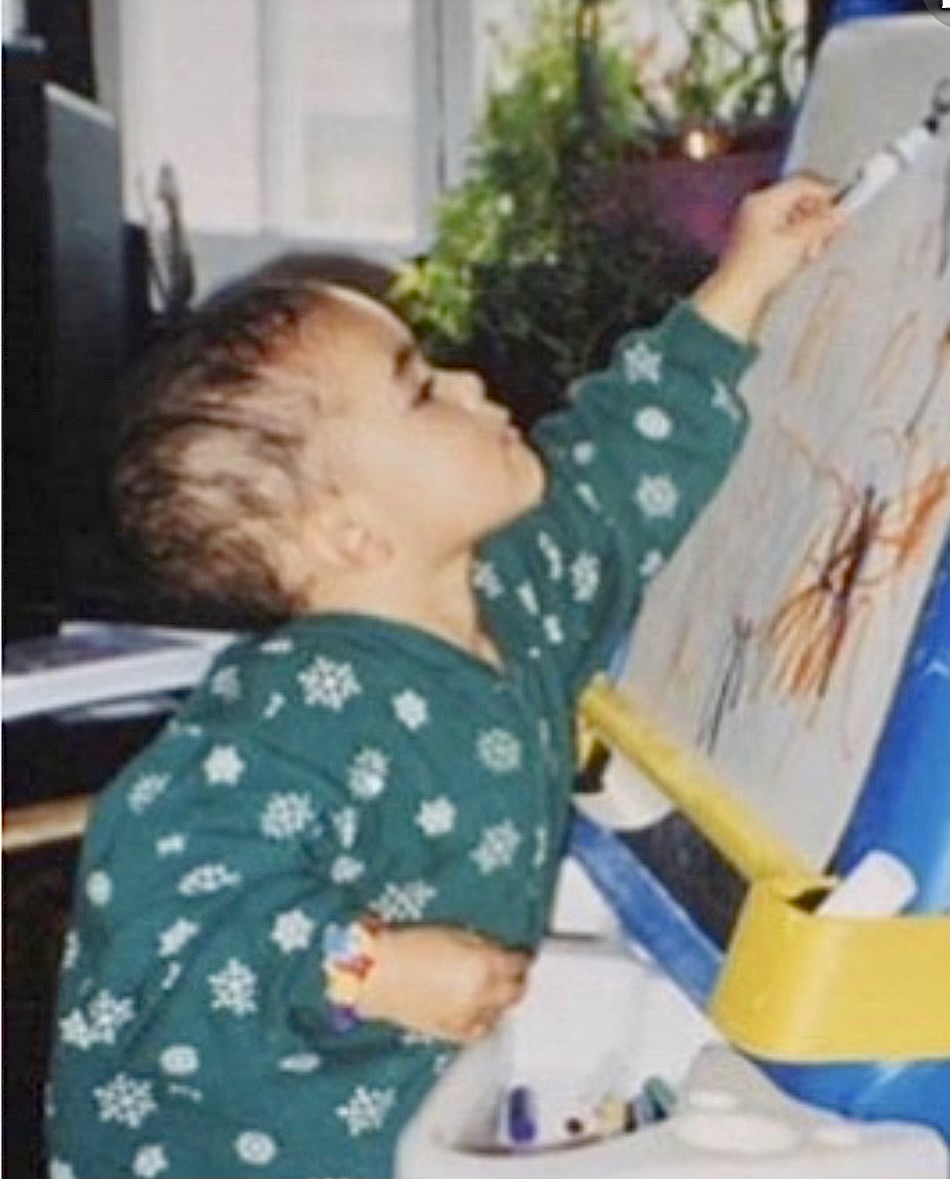
“I’ve been doing this for as long as I can remember,” says the talented 25-year old Black artist from Toronto and Miami. Proof in point: this picture of him painting at an easel when he was just two years old. “There is no one moment when I knew I was an artist. It’s hard-wired into me,” he smiles, adding that when he got into trouble and was told to go to his room, it was more of a reward. “Art helped me thrive, especially when we moved to a small town in fifth grade where there was some animosity and some racism,” he recalls. Nonetheless, his creativity has helped him to reframe racism as “ignorance and bad influence from past generations.”

“Pathos Portraits” a series of 13 physical pieces and 100 digital NFT’s (non-fungible tokens) opens the way for him to express his fundamental belief that art speaks to something universal in each of us. Although it is an expression of his life as a young Black artist, “Pathos Portraits” invites us to discover something about the intangible core of ourselves. His message is hitting home with hundreds of visitors, art connoisseurs and collectors from all over the world who were introduced to his work at last month’s world-famous Art Basel festival in Miami. The collection, done in jetso, acrylic, charcoal, oil pastel, oil and spray paint was inspired by a period of introspection during the pandemic when the artist was struggling with self-doubt. “What Lies Inside” reveals the depth of his struggle at the time. “I love it the most because it came out of the woodwork at a time when I was really doubting myself.”

The key to Pathos is seeing how every portrait shows the same person at a different point in time. “The image of a godlike creature who has no shape and form means it is up to us to delve in and discover parts of ourselves that are in these pieces,” he says, adding that his goal is to create art that will appeal to people of all races and all walks of life. “I wanted ‘Pathos’ to exhibit every emotion in the past, present and future. Any meaning based on my Blackness is just coming from my experience in general. I just want people to identify with it on their own terms and hopefully they will discover things in “Pathos” that I never saw.”
You can find his work at www.brycenicholsonart.com and on Instagram @brycenicholsonart

What’s Going On – 1/27

POLITICS/ USA

Last week, African American Sheila Cherfilus-McCormick, a Howard University grad, was sworn in as the newest member of Congress after winning a special election in Florida with a 79% vote. She succeeds the late Alcee Hastings (D), who died last year. Her victory gives the Dems a 222 to 212 advantage over House Republicans. While she won by a landslide, her White male Republican opponent Jason Mariner refuses to concede and is suing her.

Brooklyn-born Cherfilus-McCormick was also raised in Queens. At age 13, her parents from Haiti relocated their family from New York to Florida. She later earned degrees from Howard University (BS) and St. Thomas University School of Law (JD).
Congresswoman Cherfilus-McCormick and her attorney husband are parents of two.

Congrats also to African American Latoya Cantrell who was sworn in for a second term as New Orleans Mayor.

Fresh from the November election season, New Yorkers are getting ready for the 2022 primary season for NYS Governor, Attorney General, NYS Legislators and Congress.
A few special elections will be called to replace electeds who got “kicked upstairs.” NYS Assembly lost members to NYC Council and Governor Hochul’s office. East Harlem Assembly member Robert Rodriguez is new NY Secretary of State. Special election for his successor was held last week. African American Eddie Gibbs won Rodriguez’s seat in a predominantly Latino majority district. Election should be called to replace former Assembly member Diana Richardson, newly appointed Deputy Brooklyn Boro President.

ARTS AND CULTURE

MEDIA: Black World Media Network, BWMN, a new comprehensive, multimedia platform to serve the Global Black community, debuts on February 3, during Black History Month 2022 cycle. A multimedia digital platform, BWMN connects the Black World through news, information, and culture from African Diaspora capitals in the USA, Canada, African, the Caribbean, Central and South America, Great Britain and beyond.
The BWMN will produce and distribute original programs and podcasts hosted by prominent scholars, activists, journalists, policy and system analysts, et al. Black World Radio, a 24-hour audio streaming service that features news, commentaries, spoken world, Black music and public service announcements, is the centerpiece of BWMN. Video Services and free mobile apps will also be available via www.blackworldmedia.net on You Tube, Facebook, Twitter, LinkedIn and Instagram. Some early contributors to BWMN include Professor/journalist Herb Boyd; Milton Allimadi, BlackStarNews.com; Rev. Dennis Dillon, NY Christian Times; Journalist Bev Smith; Dr. Julius Garvey, MD; George Fraser; and Sir Hilary Beckles, UWI.

The BWMN is the brainchild of Don Rojas, Communications Director for the Institute of the Black World 21st Century, founded by Dr. Ron Daniels in 2002

FOOD: EATER NY ranked two Harlem restaurants on its top 40 most affordable restaurants. list. They are: Senegalese Pierre Thiam’s popular, TERANGA, housed in the Africa Center on Fifth Avenue on 110 Street, which specializes in West African cuisine, culture and décor; and Sideon Steward’s JERK HOUSE, featuring Jamaican cuisine, located on Adam Clayton Powell Boulevard near 127 Street.

FASHION: Harlem Fashion Week, HFW, will celebrate NY Fashion Week and Black History Month, February 5-10, at the Kente Royal Gallery in Harlem. HFW is the center of gravity during New York’s Fashion Week seasons, including fashion shows, talks and related activities employing multiple venues. This year, COVID dictates that HFW must be fashion safe, observing all COVID protocols. HFW will incorporate the Black Experience in Fashion with a special exhibit honoring the legacy of fashion and style historian Andre Leon Talley. Visit HarlemFW.com

NEWSMAKERS

RIP: Lani Guinier, 71, died on January7, from Alzheimer’s-related complications. New York born trailblazing legal scholar, Guinier was named the first tenured woman of color at Harvard’s Law School in 1998. A graduate of Radcliffe College and Yale Law School, she came to national prominence in 1993 when President Bill Clinton pulled the plug on the nomination for her to become Assistant AG for Civil Rights, US Justice Department.
Her dad and his dad were lawyers and Guinier wanted to be a lawyer during her tween years. Her perennial interests were voting rights and racial equity. Her work credits include the NAACP’s Legal Defense Fund, the US Justice Department and the University of Pennsylvania Law School. A prolific writer, her book titles are: “Lift Every Voice: Turning A Civil Rights Setback Into A New Vision of Social Justice” about her Justice Department nomination; “The Tyranny of the Majority: Fundamental Fairness in Representative Democracy” and “The Tyranny of the Meritocracy.” She is survived by her husband Nolan Bowie, Harvard legal scholar and their son, Nikolas, a Harvard Law Professor.

RIP: Coy Maurice LaSister died on 11/31. New York born and bred, he was a former NYC Assistant Commissioner with the Department of Ports and Trade and with the Department of Business Services before launching his own real estate development firms, LaSoeur Management and Development and LaSoeur Brownstones, LLC. His brother Charles Knox LaSister is a real estate lawyer. The Coy LaSister memorial service will be held at Harlem’s Abyssinian Baptist Church, located at 132 West 138 Street, on Friday, January 28 at 3 pm.

RIP: Cheryl Hickmon, National President and Chair of the National Board of Directors of Delta Sigma Theta Sorority, a Black Greek organization, transitioned on January 20 after a recent illness. Ms. Hickmon has been a Delta since 1982.

A Harlem based management consultant, Victoria can be reached at victoria.horsford@gmail.com

Mayor Adams on Solving NYC’s Crime Problem

“Dam the Rivers Feeding Sea of Violence”

(From a CNN interview Tuesday, January 15, 2022)
On Plain clothed Response Units on the Street
The message I’m sending to New Yorkers and America is that we’re dealing with a sea of violence and there are many rivers that are feeding that sea. One of them is using the proper police tactics that build on that aspect of it.
I know how unfair and abusive that unit was because I testified in federal court, and the judge’s ruling acknowledged my testimony, New York City vs Floyd, to rule against the behavior and practices of the police department. Using that knowledge, we’re going to reinstitute an antigun unit, where police officers will have a modified version of police uniform apparel, they’re going to be better trained, we’re going to use technologies, with cameras to video every interaction. And I’m going to make sure the right officers are assigned there with precision policing, to go after those who are in dangerous gangs and carrying guns in my city.

On Police Withdrawal from the Community
“That’s a river we must deal with. We must deal with the city, and cities, where we’re telling police officers that people can walk in stores, steal items off the shelves and no one is going to prosecute them. When you can do fare evasion in the city and no one is going to prosecute. When you can pour water over the head of a police officer and the person who did that is not going to be held accountable for that
So we ask officer to do their job. Officers are doing their job. We removed 6,000 guns of the streets in the City of New York last year and over 300 since I’ve taken office. We’re asking them to do their job, but let’s look at the other aspects of public safety. Mental health, prosecutors, laws. We must make sure we don’t put dangerous people back on the streets and continue the flow of guns into our cities.
I’m going to get my cops to do their job, I need [those in] the rest of the country in positions of authority to do their job.

On Manhattan District Attorney Alvin Bragg’s proposal not to prosecute small robberies, fare evasion, etc.
“The DA has his job to do, and he has the authority. I don’t have the authority to tell him how to do his job. What I will do is have conversations with him, like I’ve had, and we’re going to partner together to deal with violence in our city. And my job is to do exactly what we’re doing now. Show the public and those who are a part of this apparatus, how do we dam all those rivers that are feeding the sea of violence.

On How Police Officers Reconcile Manhattan DA’s message and the Mayor’s
The Nye York City police department is made up of professionals. We saw two professional officers, officer Mora and Rivera, walk inside a room and were shot, targeted to be shot at. I know how well officers do their job, and they will continue to do so. I tell my officers all the time, don’t be caught up with social media, don’t be caught up in the politics, stay focused on keeping New York City safe, and they’re doing that. We are doing our job and they’re going to continue to do their job and they’re going to have a mayor that is going to give them the support, resources, and equipment to keep New York City safe.