Home Blog Page 340

NY Board of Regents Re-Elects Dr. Lester Young Jr. as Chancellor and Josephine Victoria Finn as Vice Chancellor

Dr. Lester W. Young, Jr. and Josephine Victoria Finn were unanimously re-elected to the posts of Chancellor and Vice Chancellor to the New York Board of Regents, announced Commissioner Betty A. Rosa.


The New York Board of Regents’ Chancellor and Vice Chancellor are the two elective officers of the University of the State of New York, each serving a three-year term. Under the leadership of Chancellor Young, Vice Chancellor Finn, and Commissioner Rosa, the Board and Department follow two guiding principles. The first is a commitment to creating equity for all students to prepare for college, careers, and civic engagement – regardless of background, zip code, first language, or ability. The second strategic priority is to fundamentally change how the Department approaches its mission, shifting focus to a service-oriented approach as part of the statewide teaching and learning community. 


“I am humbled and honored to be re-elected to serve the children, educators, and communities of our state as the Chancellor of the New York State Board of Regents,” said Chancellor Lester W. Young, Jr. “Despite the challenges of a global pandemic, we have made significant progress. With the leadership of Commissioner Rosa and our dedicated SED staff, together with district and school leaders, teachers, staff, school boards, parents, and our students, New York State schools were able to reopen safely. Additionally, we have advanced the values and beliefs necessary to create school and district environments where all NYS students have the opportunities to go as far as their hopes, dreams, and hard work will take them.”


During his 50-year career in public service, Chancellor Young has focused on creating opportunities “where every student can be successful.” Dr. Young received his doctorate in education from Fordham University and his masters from Brooklyn College.  He has co-chaired the P-12 Education Committee and the Regents Workgroup on Early Learning and Early Childhood Education. He also chaired the Regents Workgroup to Improve Outcomes for Boys and Young Men of Color. His leadership led to the establishment of the New York State My Brother’s Keeper initiative. New York State is the only state to have the My Brother’s Keeper initiative enacted into a state law.


“The enduring trust that Chancellor Young and my fellow Board members have placed in me enables me to continue to serve New Yorkers as Vice Chancellor of the Board of Regents,” said Vice Chancellor Finn. “I am so grateful for this opportunity. Working with the Board, Commissioner Rosa, and Department staff, I believe we are better positioned than ever to support our schools and empower students from all backgrounds to be successful.”


Chancellor Finn was first elected as Vice Chancellor of the Board of Regents in 2021 and appointed to represent the Third Judicial District for a five-year term in 2014 and again in 2019. Practicing law for 35 years, she holds a B.A. in psychology and Black Studies from SUNY Oneonta and a law degree from the University of Buffalo. Trained in mediation, she has served as Assistant County Attorney for Sullivan County and Assistant Town Attorney and Town Attorney for Thompson. Chancellor Finn is a former Justice for the Village of Monticello.


Established in 1784, the New York Board of Regents is the oldest, continuous state education entity in the United States. The Regents, who serve without pay, are responsible for the general oversight of all educational activities within the state, presiding over the University of the State of New York and the State Education Department.

Zelensky to US lawmakers: ‘We need you right now’ as he invokes Pearl Harbor and 9/11

(CNN) Ukrainian President Volodymyr Zelensky appealed to Congress for help on Wednesday in a historic speech, telling US lawmakers “we need you right now” as he invoked tragedies in American history like the attack on Pearl Harbor and the September 11 terrorist attack.
The speech, which was given as a virtual address to members of Congress, came as the United States is under pressure from Ukraine to supply more military assistance to the embattled country as it fights back against Russia’s deadly attack.


At the conclusion of his remarks, Zelensky had an impassioned message for President Joe Biden, saying, “You are the leader of your great nation. I wish you to be the leader of the world. Being the leader of the world means to be the leader of peace.”


Biden later pledged ongoing US aid to Ukraine and announced an additional $800 million in security assistance as he condemned Russia’s attacks in a speech of his own.


“America is leading this effort, together with our allies and partners, providing enormous levels of security and humanitarian assistance that we’re adding to today and we’re going to continue to do more in the days and weeks ahead,” Biden said.


In his address to Congress, the Ukrainian President expressed gratitude to Biden for aid the US has delivered so far, but he argued that more assistance is desperately needed. Zelensky specifically reiterated calls for the US to help enforce a no-fly zone in Ukraine to protect civilians and provide fighter aircraft that the Ukrainians can use to defend themselves, requests that have met with resistance.


The speech featured a short video with harrowing scenes from the war-torn country graphically depicting the brutal and deadly toll of the Russian invasion. At the end, the screen read: “close the sky over Ukraine.”
Zelensky paid tribute to tragic moments in American history as he made his appeal.


“Friends, Americans, in your great history, you have pages that would allow you to understand Ukrainians, understand us now, when we need you right now,” he said through a translator at the start of his speech, though at the end of his remarks, he spoke in English.


“Remember Pearl Harbor, terrible morning of December 7, 1941, when your sky was black from the planes attacking you,” Zelensky said. “Just remember it, remember, September the 11th, a terrible day in 2001 when evil tried to turn US cities into battlefields, when innocent people were attacked from air, just like nobody else expected it and you could not stop it. Our country experiences the same, every day, right now at this moment.”


The speech has sparked renewed debate among lawmakers over what more the US can do to aid the country as it fights back against Russia.
While there is widespread bipartisan support for aid to Ukraine, many US lawmakers also believe the US should be careful not to be drawn into any kind of direct, armed conflict with Russia.


Members on both sides of the aisle praised Zelensky after the speech concluded and many agreed the US has more work to do to ensure the safety of Ukraine, but most stopped short of endorsing the call for a no-fly zone.


A number of Democrats pointed to what the Biden administration has already done to deliver aid. House Speaker Nancy Pelosi called the speech “quite remarkable.”


“(We’re) grateful that he was grateful to United States for all that we have done and what President Biden has done,” she said.
As he left the address, Senate Minority Leader Mitch McConnell called it an “incredibly effective speech” but said “the message to President Biden is that he needs to step up his game.”
In his speech, Zelensky implored lawmakers to do more.


“Russia has turned the Ukrainian sky into a source of death for thousands of people,” he said as he described the use of missiles, bombs and drones by Russian troops to inflict brutal and deadly attacks on his country. “We are asking for a reply to this terror from the whole world.”


“To create a no-fly zone over Ukraine to save people, is this too much to ask?” he said. Zelensky went on to say, “You know how much depends on the battlefield, on the ability to use aircraft, powerful strong aviation to protect our people, our freedom, our land, aircraft that can help Ukraine, help Europe. You know they exist and you have them, but they are on Earth not in the Ukrainian sky.”
“I need to protect our sky,” he said.


Lawmakers of both parties say they are wary of a no-fly zone at this time because they think it could pit the US directly against Russia in the skies over Ukraine.


Republicans have generally been more hawkish about giving Ukraine jets, but some Democrats — and the White House — are concerned Russia could consider such a move an escalation and potentially draw America into war.


There is a push by some lawmakers in Congress to add provisions for providing Ukraine with fighter jets to legislation targeting Russia’s energy imports and trade status, but it is not yet clear what the fate of that effort will be.


The US and its allies have taken a wide range of actions in recent weeks intended to punish Moscow for its invasion, including the rollout of harsh sanctions and export controls and a $350 million security assistance package. In addition, Congress recently passed a $13.6 billion emergency package to supply defensive, humanitarian and economic aid to Ukraine, and the Biden administration announced a $200 million assistance package this past weekend.


As Biden announced an additional $800 million in security assistance for Ukraine on Wednesday, the President outlined a series of anti-aircraft and anti-armor systems, small arms and ammunition, and drones the administration was surging to the region to fend off Russian attacks.
On a no-fly zone, Psaki said Biden “has to look at decisions that are made through the prism of what is in our national security interests and global security interests, and he continues to believe that a no-fly zone would be escalatory, could prompt a war with Russia.”
This story and headline have been updated with additional developments Wednesday.


CNN’s Ted Barrett, Ali Zaslav, Lauren Fox, Annie Grayer, Daniella Diaz, Kristin Wilson, Melanie Zanona, Jeremy Herb, Donald Judd and Kate Sullivan contributed to this report.

Call For Gun Violence Curriculum

A Letter to the Chancellor

Dear Chancellor David C. Banks,
The Bedford-Stuyvesant Community has seen a severe increase in gun violence that is tearing the fabric of our society and directly targeting the lives of our children and young people, with the most recent incident yesterday involving a 14 year-old boy who attends school in District 16. The wealth of the culture and history of Bedford-Stuyvesant is marred by violence and bullets storm our neighborhood day and night, indiscriminately affecting all of our lives. It is necessary to engage in an immediate conversation about the issues that our community faces and how we can further support our children to learn about gun violence and provide the resources that are necessary to ensure that education – without the fear of another violent incident involving guns – is at the forefront.


Gun violence is an issue that has affected me very closely, with the loss of four family members at the hands of this infectious malady. In 1996, my uncle and cousin were killed by gun violence at the ages of 24 and 16, respectively, in the Van Dyke Houses in Bronwsville. In 2016, my brother, 29, was killed in front of 666 Hancock Street between Malcom X Boulevard and Patchen Avenue. In 2020, I lost my nephew at 159 Chauncey Street, at the corner of Malcom X Boulevard, at the age of 22.


After the death of my nephew, on November 12, 2020 we held a press conference regarding gun violence in District 16. A parent, who is also a criminal journalist, posed an important question that had no real answer at the time. He asked, “what is the Department of Education doing around educating students in gun violence?” Over the past year, bordering the last two academic years, we have had conversations with the Office of the Congress Member Hakeem Jeffries, Senator Jabari Brisport, and Assemblywoman Stefani Zinerman, to devise ways in which we can set the course to bring educative discussions about gun violence into our schools. As essential as math, English, science, and arts, educating our students in gun violence, as has started to happen in some of our schools, creates life changing learning that they can benefit from now and through which they can live to continue to benefit in the future.


We cannot watch idly as gun violence robs our families of peace and expose our children to serious risk each day. That is why, the District 16 Community would like to have a conversation with you to talk about the steps that you foresee taking to continue to combat gun violence in our schools. With the sense of urgency that this situation merits, I respectfully request a virtual meeting with you and members of the Community of District 16 who have been working to address and uproot gun violence, to discuss the connection between gun violence and education in our community. This crisis needs to stop and now is the time to start the conversation that will achieve an end to it.


Please email CEC16@schools.nyc.gov with the dates and times that would be most convenient for you to meet with our community, or with any questions that you may have.
In Partnership,
NeQuan C. McLean President, CEC 16

Women on the Move

VP Kamala Harris: ‘We will not let setbacks stop us’ – Is this, finally, Kamala Harris’ moment?

Analysis by
Chris Cillizza, CNN
Editor-at-large

It’s been a rough first year as vice president for Kamala Harris.
Beset by staff departures and lingering questions about how good a fit she is for the job, Harris has struggled to find her political footing. (Worth noting: That’s not terribly unique. Being vice president is a notoriously difficult and, at times, thankless, job.)


But with Harris jetting to Europe on Wednesday – amid the ongoing Russian invasion into Ukraine – the possibility exists that she is about to meet her moment.


As CNN’s Kevin Liptak noted Wednesday morning, Harris is traveling to Poland and Romania at a decidedly fraught time:
“The Polish government announced Tuesday that it was putting its fleet of MiG jets at American disposal to supply to Ukraine, an idea the US rejected out of hand. The White House was completely caught off guard by the Polish offer, according to people familiar with the matter, despite officials saying in the preceding days they’d been discussing options with their counterparts.


“Harris will be tasked with smoothing over the situation as she arrives there late Wednesday on a mission to reassure one of NATO’s easternmost allies the United States remains committed to its security amid fresh worries about Russia’s intentions. The trip is the second time in a month that Harris has been dispatched to Europe as the Biden administration seeks to rally international support behind its efforts to isolate and punish Russia for the war in Ukraine.”


This sort of tricky international diplomacy at a moment of crisis for Europe and the world is when (and how) leaders are made. If Harris can find a way through the this fraught period with Poland, as well as the ongoing push by Ukraine for a no-fly zone, it would amount to a major win – not just for the Biden administration, but for Harris in particular.
And the simple fact is that, to date, Harris has had very few of those during her time as vice president.


As CNN’s Edward-Isaac Dovere and Jasmine Wright wrote last November:
“Worn out by what they see as entrenched dysfunction and lack of focus, key West Wing aides have largely thrown up their hands at Vice President Kamala Harris and her staff – deciding there simply isn’t time to deal with them right now, especially at a moment when President Joe Biden faces quickly multiplying legislative and political concerns.”


That was one of a slew of stories around that time that painted Harris – and Biden – as frustrated with the vice president’s office. It didn’t help that Harris also lost several senior members of her communications staff around the same time – although the White House insisted that those departures were planned and were not evidence of chaos within the her office. (Harris didn’t help her cause when, in an interview last December, she refused to answer whether she would have done anything differently during her first year in office.)
Harris’ poll numbers have also suffered recently.


A Fox poll in January showed that while 43% of registered voters approved of the job she was doing, 54% disapproved. An NBC survey around that same time showed that a near-majority (49%) of Americans held a negative view of Harris, compared to 32% who viewed her positively and 14% who were neutral on her.


So far in 2022, Harris has kept a lower profile, aside from a diplomatic trip to Munich in February. Her missions to Europe over the last month are, without question, her biggest moments of the year – and very probably – her vice presidency to date
Diplomacy and foreign policy tend to be, primarily, the mandate of the executive branch. This is not the sort of mission with which a House member or a senator is tasked. This is uniquely a job for a president or a vice president.


That matters – because when talking about Harris (and her performance in office), it’s impossible not to mention her own future presidential prospects, whether in 2024 if Biden decides not to run again or in 2028. The world stage is where politicians prove their mettle, and persuade voters as to whether they have what it takes to represent the entire United States as its leader.


Harris badly needs a moment to show that she could step into the top job. Those moments don’t come along very often, but this week’s trip is very much one of them.

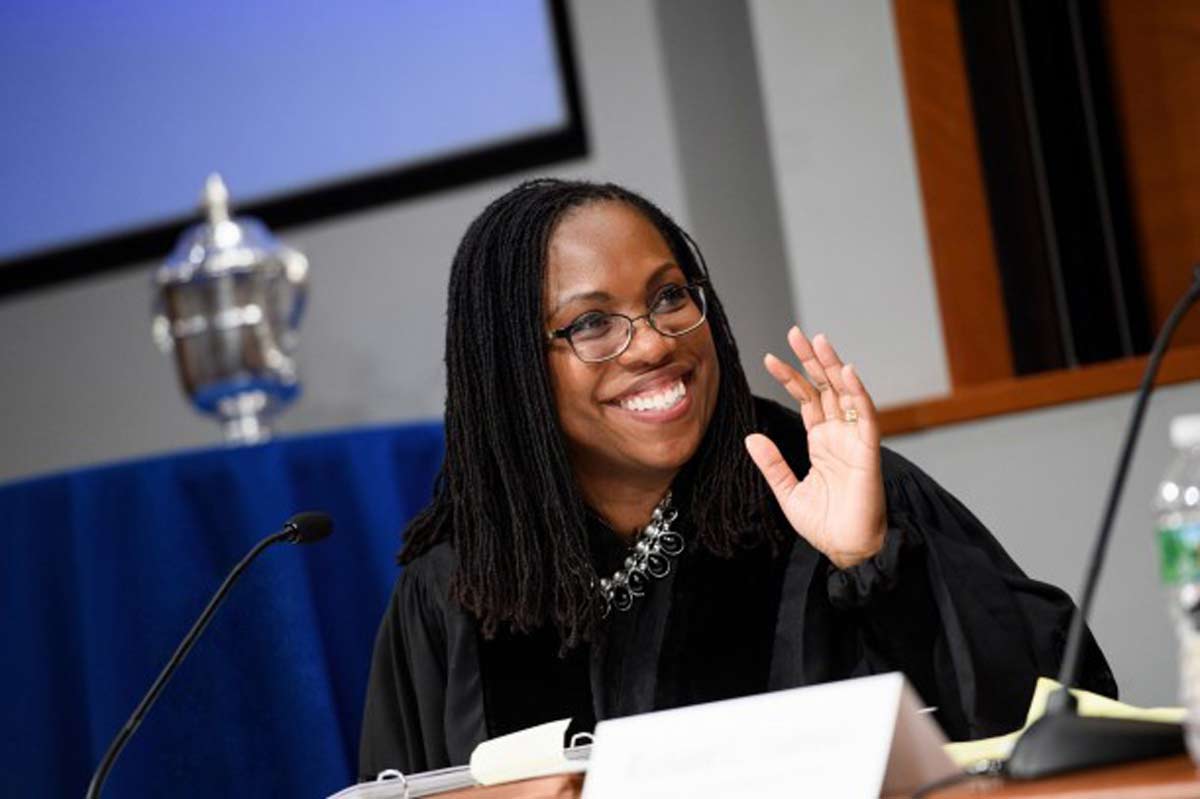
‘The Moment’ and Judge Ketanji Brown Jackson

Black Women Legal Experts Deliberate on Supreme Court Nomination at Howard Law Panel

By Nyah Marshall Howard,
University News Service

It was a historical moment for the nation and a monumental one for many Black Americans, as President Joe Biden publicly introduced Judge Ketanji Brown Jackson last Friday as his nominee for the U.S. Supreme Court. Legal experts recognized this moment, its significance and the emotions it evoked during a panel hosted by the Howard University School of Law on Tuesday.


“It means a lot for the history of Black women in this country,” Howard law professor Tiffany Wright said. “We have been so deeply affected, in many times, in many cases disproportionately, by the decisions of the Supreme Court but have never had a voice in that process.”  


Wright joined other Howard law professors, Tuneen Chisolm and Lisa Crooms-Robinson, on this virtual panel of Black women moderated by Dean Danielle Holley-Walker. 
“What really stands out for me is the hope,” Chisolm began. “This is real hope for an extended effect, more so even than the election of President Obama, because the president has four years and then maybe another four.”


An audience of over 140 people listened as panelists spoke on Jackson’s nomination and touched on topics like her background, the confirmation process, the potential change she can make within the court and redefining the typical background of a Supreme Court justice. The Senate Judiciary Committee announced that confirmation hearings will start on March 21.
Since Jackson’s nomination, more and more information has been coming forth about her background, personal life and judicial history. During Jackson’s initial introduction at the White House, President Biden spoke of her extraordinary qualifications, while Jackson thanked and spoke of her family — including aspects that aren’t as flawless. 
“You may have read that I have one uncle who got caught up in the drug trade and received a life sentence. That is true,” Jackson said.


“But law enforcement also runs in my family. In addition to my brother, I had two uncles who served decades as police officers, one of whom became the police chief in my hometown of Miami, Florida.”


Crooms-Robinson appreciated “the way that she told that story” with transparency and candor. “It wasn’t about stigma or shame for anybody,” she said. “It was just the fact.” 
“In a particular kind of way, it was really touching,” Crooms-Robinson continued. “No matter who our relatives are, by and large, we love them, regardless of what it is that they do or where they might find themselves.”


Chisolm adds that Jackson is the daughter of an attorney and an educator, demonstrating that she’s a “women equipped to reason and reason with the best of them.”
Jackson is also a “double Ivy,” having graduated from Harvard University and Harvard law school. “So that tells me that she’s got grit and tenacity and that she has learned how to develop relationships with people who are not like her, because she was in a minority situation there for seven years,” Chisolm said.


Career-wise, Wright explained, it’s evident that Jackson is committed to public interest, as she has spent much of her time as a federal public defender. “She has the empathy for people who are navigating that system, which is often deeply unjust and unfair to people who look like us.”  


In terms of the real change that Jackson can make on the Supreme Court and how fast that change can occur, the panelists had a range of opinions. However, it is certain that Jackson’s background as a Black woman and mother will provide a new perspective and challenge or add to those of other justices who may share similar experiences. 
As Wright contends, Jackson has the perspective to counterweight Justice Clarence Thomas on matters about race, and she would also be the only other mother on the court to counterweight Justice Amy Coney Barrett.


Although Jackson is well equipped, she may not be walking into an easy situation, said Wright, who previously clerked for Justice Sonia Sotomayor.
“I’ve seen how difficult it has been for Justice Sotomayor, for example, to be in the minority and to feel like on so many issues that you deeply care about, you just don’t have the votes,” Wright explained.
“There is very little that a minority of three can do.”
On the other hand, Chisolm says Jackson may be able to see her own impact on the court. However, Crooms-Robinson thinks she may plant seeds “that she may not, in fact, ever see sprout.” 


“But they are seeds that could, in fact, be sown later on in a way that is similar to what happened just after Reconstruction,” Crooms-Robinson noted. 
Jackson is already redefining what a typical justice looks like as a Black woman and former public defender. Though the Constitution does not specify qualifications for justices such as age, education or profession, certain aspects can make one an extremely qualified candidate. At the same time, Jackson checks all the traditional boxes with her Ivy League background and history as a clerk for former Justice Breyer.  


The panelists proposed different ways the traditional qualifications can be redefined in hopes of having a future of diverse justices. One is to reframe who the justices select as clerks.
Being chosen to clerk at the Supreme Court is considered the most prestigious job a law graduate can land — only 36 clerkships are offered each year. Clerkships remain highly dominated by white men. The National Law Journal published a study of clerks from 2005 to 2017; 85% of all clerks were white, only 20 of the 487 hired were Black and nine were Hispanic. 


While the late Justice Thurgood Marshall was an alumnus of Howard’s law school, almost all justices are Ivy League graduates, specifically graduates of Harvard and Yale. This sets a precedent that this is the education required to clerk for or become a justice. 
“Building the clerkship pipeline is important,” Chisolm said. “As we place HBCU students, grads out in the world doing different things, claiming their pedigree, right, we make it more apparent to people that you don’t have to come from a Harvard or Yale to achieve.” 
Echoing what many audience members mentioned in the chat, Holley-Walker pointed out that Howard has the ability to “help hold the justices accountable, because we have a substantial pipeline of Howard University School of Law graduates who are going on to appellate clerkships.”


The dean noted that Judge Robert L. Wilkins, who serves on the U.S. Court of Appeals for the District of Columbia Circuit, has made offers to two Howard law graduates. 
“We have the same power when it comes to other judges and including Justice Jackson,” she added. “We will be looking forward to her hiring one or more Howard law clerks — hopefully one every year — and we will be waiting, watching in anticipation with all of the outstanding Howard law students and graduates that we have and we know are supremely qualified to clerk on the Supreme Court.”


Nyah Marshall is a reporter and regional bureau chief for HUNewsService.com. She has been covering Judge Ketanji Brown Jackson’s nomination as an associate justice for the U.S. Supreme Court.