Home Blog Page 326

BPHA Caucus Demands Passage of New York Health Act, and End Medical Debt Bills

(ALBANY, NY) Lawmakers with the Black, Puerto Rican, Hispanic & Asian Legislative Caucus and Campaign for New York Health held a press conference today to announce the release of a new report on healthcare and racial equity and to call the Legislature to pass and implement the End Medical Debt bills, and the New York Health Act (A6058/S5474) before the close of the 2022 session. 


The report, titled Healthcare and Racial Justice: Systemic Change Is Needed for a More Equitable Health System, compiles national and New York State level data to illustrate that healthcare access is a critical racial equity issue and how systemic solutions like a universal, single-payer health plan will significantly improve healthcare access and health outcomes for all. The report found that Black, Indigenous and People of Color (BIPOC) were disproportionately harmed by COVID-19 due to an unequal ability to access quality, affordable healthcare and, long before the start of the pandemic, were more likely than white people to be uninsured and to struggle with medical costs. 


“The New York State Constitution directs me as an elected official to work to protect and promote the health of our state’s residents. That is why I am a proud cosponsor of the New York Health Act. As the Chair of the Black, Puerto Rican, Hispanic, and Asian Legislative Caucus, I know that it is imperative we pass this piece of legislation that will ensure that the most vulnerable New Yorker’s are given access to healthcare services which will provide substantial support to children and families, especially in Black, Latino, Asian, and Indeginous communities.” said Assemblymember Michaelle Solages, Chair of NYS BPHA Legislative Caucus.

The full Black, Puerto Rican, Hispanic & Asian Legislative Caucus at the state office building.


“If we are to effectively address the racial inequities prevalent throughout our healthcare system, we must radically change the way we deliver healthcare to New Yorkers,” said State Senator Gustavo Rivera. “As the Campaign for New York Health’s new report further highlights, it is critical that we pass the New York Health Act to guarantee comprehensive healthcare coverage to all New Yorkers and in that way, move the needle forward to eliminate our de facto two tier system of care and truly improve our State’s health outcomes as a whole.” 
Senator Luis Sepúlveda said, “We have to pass the New York Health Act. It’s a social justice issue, we clearly see how disadvantaged communities are the ones who pay the highest costs of inequality. Latinos, Blacks, women, it is always the same groups of people who have to bear the burden of needs and lack of services. In this case we are talking about a basic right: health. Study after study we see how prevention and health coverage has a positive effect in our communities and in the life of any human being. However, we also have to see how study after study it is the vulnerable communities that suffer the most for not being covered, not being able to pay for health insurance and in the specific case of the studies that concern us here, they are the ones that have the most economic debt for the mere fact of wanting to take care of their health. I support this initiative and I will be mobilizing myself to achieve the passage of the New York Health Act” 


“As the newly released report from the Campaign for New York Health makes clear, our state’s health care system needs to prioritize BIPOC individuals who disproportionately lack access to essential services. By providing comprehensive health coverage for all New Yorkers, the New York Health Act will improve health outcomes across all communities. I am proud to support this legislation and advocate for equitable solutions to systemic health care issues this session. Without fundamental changes in our health care insurance system, we cannot provide health care as a right to every New Yorker,” said Senator Jeremy Cooney. 


“With the impending overruling of Roe Vs. Wade, New York must be an access and haven state for all who need healthcare and need to see a provider here. This makes passing the New York Health Act and getting to single-payer healthcare more crucial than ever because it is communities of color that will most disproportionately suffer these consequences. I’m proud to stand with my colleagues in the Black, Puerto Rican, Hispanic, and Asian Caucus to clearly state that single payer healthcare is a racial justice imperative and we must pass it this session,” said Assemblymember Jessica González-Rojas.


 “As a Black mother, I am too familiar with the obstacles so many women like me face, particularly around maternal healthcare in this state, and broadly this country. BIPOC communities battle our medicare system daily to obtain basic care. It is imperative that we end medical debt and call upon the state to institute universal healthcare. It is truly an injustice that so many people of color, economically challenged families and immigrant populations suffer from insufficient healthcare due to lack of insurance and medical care debt. It’s beyond time to bring humanity to the healthcare policies in our system and absolve medical debt today. Healthcare is a human right.” said Assemblymember Stefani Zinerman.

Selections from Will Calhoun’s Rhythm Art/AZA Collection on View at National Museum of Mathematics, ongoing through July

What does science, math and fine art have to do with music?
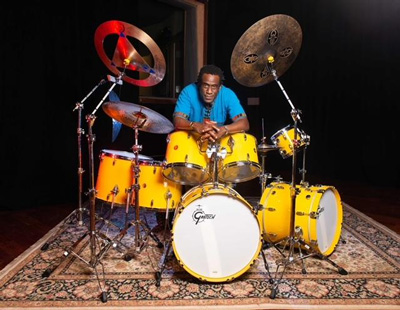
Plenty says Grammy Award-winning drummer Will Calhoun whose performance-art-work combines his love for sound and science at an exhibition of selections from his revolutionary Rhythm Art/AZA collection at Manhattan’s  National Museum of Mathematics (MoMath), ongoing through July 31.  (The Museum is open seven days a week from 10:00 am – 5:00 pm..
When OTP heard of Calhoun’s new “gig” at MoMath, we wanted to learn more. So, we thought we would ask also for the guardians of cell-phone absorbed Tik-Tok followers. Question: the basic relationship between math and music is apparent to young beat lovers, but how do you get them to feel as inspired about learning math in the same way they are inspired by the call of a new dance movement, a beat or song.


Calhoun, a graduate of the Berklee School of Music, with a BA in Music Production and Engineering, responded through email:
“A student can feel metrics and numbers many ways. Dancing to a drum beat is the first example that comes to mind. As you hear each beat, you take a step or make a movement. Then you sway or move your arms to counter beats based off the original beat. Your feet can physically play 1, 2, 3, 4. Your arms may only move on beat 2 and 4.

Last month, Sistas Place musical director Ahmed Abdullah, top row, far left, and Grammy Award-winning drummer Will Calhoun, bottom row, far left, took a break between sets with Calhoun’s quintet musicians, clockwise from top row, left, pianist Hector Martingon; saxophonist Jay Rodriguez; bass Rachiim Ausar-Sahu; and Trumpeter J.S. Williams. “Incredible performance,” Bro. Abdullah told OTP. “The Will Calhoun Quintet definitely will be coming back.” For more information: sistasplace.org or call 718.398.1766.


“This process can also be called a subdivision. Both arms and feet are reacting to the same time signature — however the arms only move in half of the actual time. Together they create a rhythmic pattern of 4 beats. Alternating beats between your left and right limbs also help balance your patterns. Example: 1,2,3,4…Left, Right, Left, Right.”


To fully understand where Calhoun’s coming from, it’s probably best to travel to see visual/photo interpretations of the artist/teacher performing: at MoMath (11 East 26th Street between Fifth and Madison Avenues, across from Madison Square Park) or live and in-person, this fall (dates TBA), at Sistas’ Place (456 Nostrand Avenue, at the corner of Jefferson Avenue & Frederick Douglass Square) in Brooklyn.


About his exhibition at MoMath, the Brooklyn-born, Bronx-raised drummer revealed in a press release, “I was thinking about visual versus sound, versus an immersive experience. So, in my drum solos, I took the African loops off, jumped back on the drumkit, turned the lights off in the venue and then used lightened drumsticks. The people not only heard the African-type drum solos … they also saw the streaks of light.” 


Calhoun took his concept to SceneFour, Inc., a Los Angeles-based, visual arts company. They photographed him drumming with cameras with slow apertures, and translated his powerful, polyrhythms into multicolored abstract art. “They removed me, the [Studio lights], the drumsticks and the drum set from the photograph,” Calhoun says, “and they had these streaks, which were roadmaps of my hand movements. That’s where the concept came from, and that’s what got the attention of the museum.”


 Christening his audiovisual concept Rhythm Art and naming his collection AZA – which means “powerful” in Swahili – Calhoun’s selections at MoMath reveal the relationship between improvisation and mathematical shapes. “I’m playing different time signatures,” Calhoun says. “My arms are moving in geometrical shapes like a triangle, a square or a hexagon, and the tracking of my arm movements creates the mathematical angles and shapes.”


Calhoun developed his audiovisual concept five years ago, playing with Living Colour, and wanted to create a visual experience with his drum solos by combining African-inspired dance, history, culture and rhythms with cutting-edge visual technology.


Will Calhoun hopes his inventive and groundbreaking artwork will inspire others to come up with their own musical mathematical designs. “I hope musicians will be inspired to visually look at improvisation as this physical movement that creates lines and shapes and angles.”
As a founding member of Living Colour, Calhoun won two Grammys with the group: one for Best Hard Rock Performance by a Group for the song “Cult of Personality” in 1989, and another for Best Hard Rock Performance by a Group in 1990. Calhoun recorded and/or performed with Miles Davis, Harry Belafonte, Pharoah Sanders, Wayne Shorter, McCoy Tyner, Santi DeBriano, Herb Alpert, Mos Def, Oumou Sangaré and Charnett Moffett. His six albums as a leader, released from 1995 to 2016, include Housework, Drumwave, Live at the Blue Note, Life in this World and Celebrating Elvin Jones. 


He has lectured at Brown University’s Watson Institute, Columbia Teachers College, Berklee College of Music, Haverford College, New York University, The Brooklyn Academy of Music, The New School, Head-Royce School in Oakland, and the Sup’imax Institute in Dakar, Senegal. He also has studied with folkloric drummers in Australia, Mali, Morocco, Senegal, Belize, and Northern Brazil.

For more information about the MoMath exhibit, visit www.momath.org or contact (212) 542-0566.

How this brochure sparked the movement for reproductive freedom

Black women and the fight for abortion rights:

By Natelegé Whaley
NBC News

Faye Wattleton, the first black woman to serve as president of Planned Parenthood, stood on the steps of the Supreme Court in the summer of 1989 to condemn its decision on the abortion rights case Webster v. Reproductive Health Services. The high court had ruled that states had the right to limit abortion access.


‘’This Supreme Court decision once more slaps poor women in the face and says you do not have constitutional protections if your state sees fit to restrict them, and you do not have the resources to circumvent those restrictions,’’ Wattleton said, according to a New York Times report from August 1989. ‘’The court says certain fundamental protections that are part of your human dignity and part of being a respected and decent human being are not yours.’’
The Webster decision upheld a Missouri law that restricted state funded abortions at public facilities and public employees from conducting abortions, prohibited counseling in support of abortion, and stated doctors were to conduct viability tests for the fetus when a woman was 20 weeks pregnant or longer. Opponents of the ruling saw this as a threat to the 1973 landmark decision in Roe v. Wade, which affirmed that access to safe and legal abortions is a constitutional right.


Wattleton and other black activists, lawmakers and civil rights icons were fed up with the new debate about women’s right to choose. Largely, the voices of black women had been left out of the conversation around abortion access.
Until the summer of 1989.


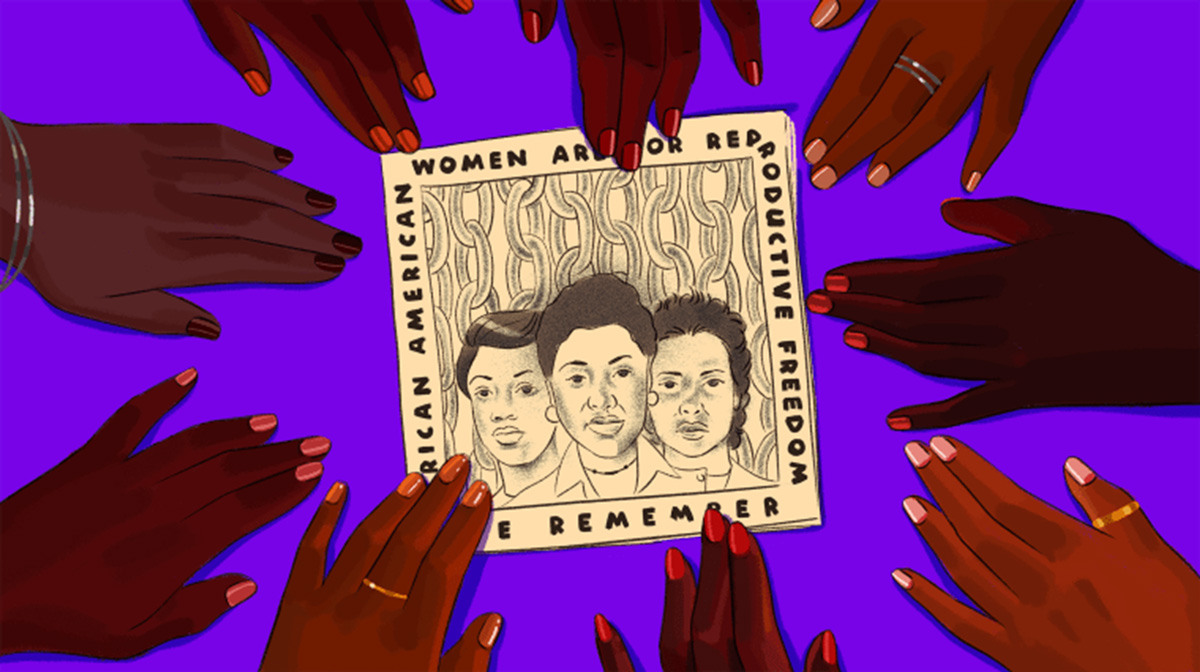
That year, 16 black women made history by publishing the first collective statement advocating for equal access to abortion, “We Remember: African-American Women are for Reproductive Freedom.” Retired U.S. Rep. Shirley Chisholm, soon-to-be-elected U.S. Rep. Maxine Waters and civil rights activist Dorothy Height were among the notable names who signed the unprecedented brochure. Many points in the pamphlet amplified some of Wattleton’s statements that day in front of the Supreme Court.


“Now once again somebody is trying to say that we can’t handle the freedom of choice,” the document said. “Only this time they’re saying African-American women can’t think for themselves and, therefore, can’t be allowed to make serious decisions. Somebody’s saying that we should not have the freedom to take charge of our personal lives and protect our health, that we only have limited rights over our bodies.”


September marks 30 years since the statement was first distributed, at anti-apartheid demonstrations, anti-rape rallies and other public venues. In commemorating this public statement, there are some parallels to the state of abortion access in today’s America. Under the Trump administration, reproductive health advocates say Roe v. Wade could be overturned which, experts say, could have devastating effects for low-income women of color. As of 2014, black women are 28 percent of those who sought abortions, compared to 36 percent of white women and 25 percent of Hispanic women, according to the Guttmacher Institute. Meanwhile, 60 percent of black American adults say abortions should be legal in all or most cases, according to a Pew Center Research report in 2018.


It was against a similar backdrop that black women banded together to create the “We Remember” brochures. Ordinary black women who felt ashamed to discuss their abortions publicly now had the support of some of the most powerful black women in the country. The brochure supported their rights to have complete ownership over their bodies and addressed how racism and poverty also impacted those decisions.


“We, black women, who have been very active in reproductive politics for a long time felt like we were leaders without a constituency,” said Loretta Ross, a professor at Arizona State University in Phoenix, an organizer of the brochure and co-founder of the reproductive justice movement in 1994. “We represented the black women who walked into the clinics, but no one had given them permission to own up to what they were doing. They were speaking with their feet rather than with their mouth.”


Following the Supreme Court ruling, Donna Brazile, a founding member and organizer with the National Political Congress of Black Women, arranged a conference call with prominent black women including Ross, then-director of the women of color program at the National Organization for Women, and Byllye Avery, founder of the National Black Women’s Health Project, which is now the Black Women’s Health Imperative.


The National Political Congress of Black Women and the National Coalition of 100 Black Women were among the few black women’s organizations who spoke out proactively on abortion rights, according to Ross.


“A number of them spoke out, but you had to persuade them because they were afraid of alienating what they perceived as their religious membership,” the activist said. There was also the stigma that supporting the right to abortion meant supporting black genocide. Not everyone who was on the call signed the document, Ross explained.


Avery, who Ross described as having the strongest standing in the reproductive freedom movement in the black community, suggested the group write a pamphlet, the most common form of distributing new ideas in the public forum in the era before political hashtags spread the word about campaigns. The pamphlet would act as a permission slip to speak out about abortion access, Avery argued, as many leaders were afraid to be punished by their constituencies for supporting the right to choose.


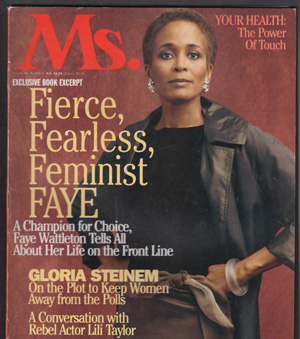
Faye Wattleton was the first African American and the youngest president ever elected of Planned Parenthood Federation of America, and the first woman since Margaret Sanger to hold the position. She is best known for her contributions to family planning, reproductive health, and pro-choice activism. As a nursing student at Columbia University, Wattleton saw a woman die of a botched abortion. She came to understand that the fight for safe and legal abortions was also about the fight against racism, sexism and poverty.  According to an article in the Baltimore Sun (1990), “In 1989, after the Webster vs. Reproductive Health Services decision handing states the right to limit abortions, Wattleton told a crowd on the Supreme Court steps, ‘This decision once more slaps poor women in the face and says you do not have constitutional protections if your state sees fit to restrict them and you do not have the resources to circumvent those restrictions.’ “
The Baltimore Sun reporter wrote, the United States must re-educate itself before it can correct its confusion about sex (a recent national survey reported widespread ignorance on basic questions about sexuality), the crises of sexually transmitted diseases, and a soaring birthrate among poor, young women, Wattleton says. “That means a very radical change in the way we see ourselves, but also in the way we see our children and their sexual development. The lack of comfort with sexual matters on the one hand, the spread of explicitly sexual materials and ideas at the same time we repress knowledge and information, I’m sure, from some one’s point of view of looking at us from afar, is peculiar indeed,” Wattleton says. “But I think it really does reflect the vestiges of our puritanical traditions, which were by the way, pretty hypocritical even back then . . . We have a tragic record to show for it.”

What’s Going On – 4/6

SPRING 2022 IN AMERICA
NYS: Governor Kathy Hochul appoints Congressman Antonio Delgado, 45, as Lieutenant Governor, replacing Brian Benjamin who recently resigned. Delgado’s name will be on the June 23 Primary ballot on the Lieutenant Governor line. Hochul got Albany lawmakers to create a bill changing the election law. TV news said that Representative Delgado is Black Hispanic. A Congressman since 2019, Delgado is a Rhodes Scholar, who graduated from Colgate University and Harvard Law School graduate, he is an attorney and member of Congress since 2019. His ancestors are African American and Cape Verdean.

The NY electorate and electees are in limbo, not knowing what the Senate and Congressional Districts will look like. Courts rejected NY redistricting maps evaluating them unconstitutional, with a strong Democratic twist. There will be an August 23 Primary for Congress and Senators.

NYC: Last week, Mayor Eric Adams presented his $100 billion budget plan. It compares with no other because we have never encountered multi crises generated by the coronavirus. This will be the first budget in two years sans Federal stimulus funds. His priorities are public safety, jobs, housing, streets with less vehicles…….and the revenue flow. Economic recovery is slow! City Council must approve the budget. Its members want more monies for homelessness, sanitation, and youth programs.

THE NATION
Politico dropped the May 2 bomb. The US Supreme Court drafted an opinion to overturn Roe v. Wade, the 1973 landmark law making abortion legal nationally. Hours later, the US Supreme Court did not deny the claim, only said that the draft is not final. Who is running the nation? The Supreme Court? That action supported by Conservative Republicans in and out of government could affect the November elections. More than 70% of Americans favor the law. This midterm will be just as important as the 2020 American election.

While the nation is divided and lawmakers hold majorities in Congress by one or two seats, who made the US Supreme Court the new conservative arbiter of the American government? Well, the conservatives have won. The Democrats must keep their majority in the House and Senate. Also, the Supreme Court must be expanded. The John Roberts Court will be remembered for dismantling major civil rights laws like Voting Rights and Abortion Rights. When the states began enacting voting restrictions laws in 2021, the Supreme Court made it clear that it would not hear cases opposing new restrictive voting laws. Americans must stop this sharp turn to the right if we are to work towards a more perfect nation.
The Supreme Court could deliver major Democratic victories, in congress and statehouses, this year after it overturns Roe v. Wade.

BUSINESS MATTERS
Congrats to Guy Wood, Sharene Wood, Guy Wood Jr, Louis Johnson, Ashley Muhammed and Kells Barnett, founders of the upscale Harlem Haberdashery, located at 245 Lenox Avenue, which celebrates its 10th Anniversary at that location, on May 7. Harlem Haberdashery is the studio/boutique of 5001 Flavors, a Black-owned custom-made apparel company which created looks for celebs, recording artists, and sports figures such as Jay-Z, LeBron James, Fat Joe and Will Smith. Fashionistas across many professions shop at Harlem Haberdashery, for all needs from ready-to-wear to haute couture.

The Black News Channel, a Tallahassee-based cable TV platform, catering to African Americans, recently filed for Chapter 11 bankruptcy protection for $50 million debt. Bankruptcy Judge allowed BNC to borrow $1.5 million to avoid a total shutdown while paying off some creditors and scaling back air time while looking for a buyer.

EDUCATION
The Transnational Association of Christian Colleges and Schools restored full accreditation to Atlanta-based MORRIS BROWN COLLEGE, an HBCU, after it was revoked 20 years ago. Founded in 1881 by the African Methodist Episcopalian church, MORRIS BROWN COLLEGE is eligible for Federal education grants.

Eleven NYC High Schools made the US News and World Report List of Top 100 national schools, including Kew Gardens HS, 11; Queens HS for the Sciences; Stuyvesant HS; Bronx HS of Science; Brooklyn Tech, 46; Staten Island Technical; HS of American Studies at Lehman Studies; Brooklyn Latin School, 79; HS for Dual Language and Asian Studies; and Baccalaureate School for Global Education. More NY schools will make the top 100 once NYC Chancellor David Banks expands the Gifted and Talented Program.

Jonelle Procope, Apollo Theater President/CEO, will be awarded an honorary Doctor of Humane Letters by Howard University at its 154th Commencement ceremony on May 7.

ART/CULTURE
FINE ART: The Skoto Gallery’s new show, George Afedze Hughes, “Moments In Time: Tangents,” 23 works that highlight “parallels between the violence of colonialism and contemporary global encounters,” opens May 5 through June 11, with an opening reception. Ghana-born performance and fine artist, Hughes is a Professor at the State University of Buffalo, NY. Located at Chelsea fine arts district, SKOTO is located at 529 West 20 Street, Manhattan. Call 212 352 8058 or visit skotogallery.com
The Dorsey Gallery’s next show, “OTTO NEALS: Inspirational Moment” opens on May 15. Gallery is located at 533 Rogers Avenue in Brooklyn. Call 718.771.3803


The Metropolitan Black Bar Association, NY, hosts its 38th Annual Anniversary Awards Gala, “Leap into Excellence: The Return of the Black Bar,” Friday, May 20, at Pier 60, Chelsea Piers, Manhattan. Gala honorees are distinguished attorneys, including Cynthia Bookhart Adams, Jefferies LLC; Shannon J. Hales, Citigroup Global Markets; Edwina G. Mendelsohn, NYS Unified Court Systems; Tracy Richelle High, Sullivan & Cromwell LLP; and Alvin Braggs, NY County District Attorney. Award-winning TV anchor, NY1’s Cheryl Wills (In Focus and NY1 Live at Ten) will host the black-tie Benefit.

NEWSMAKERS
ENGAGEMENT: Congrats to NYC Cultural Affairs Commissioner, Laurie Cumbo, former City Councilmember who got a proposal from her fellow of a few years Bobby Didi Olisa, on the red carpet at the Met Gala. A vision in a white and gold down, Cumbo accepted.

RIP: Andre Leon Talley’s funeral was held at the Abyssinian Baptist Church on April 29. Don’t know if service was spread through Black community. NY Post ran pictures of attendees, including Anna Wintour, Naomi Campbell, Marc Jacobs, Gayle King, Martha Stewart, Kimora Lee Simmons, and Diane Von Furstenberg.

A Harlem-based media consultant, Victoria can be reached at victoria.horsford@gmail.com

The Women’s Health Protection Act (WHPA)
Federal Legislation to Protect the Right to Access Abortion Care

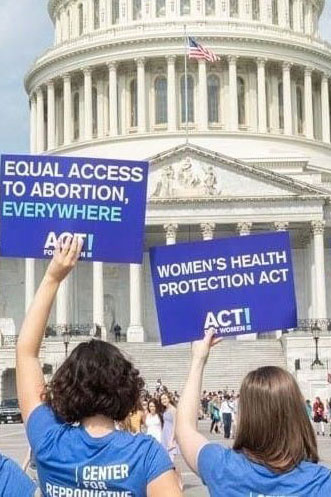
On February 28, 2022, the U.S. Senate voted on the Women’s Health Protection Act (WHPA) in the first-ever Senate vote on proactive legislation to enshrine the right to abortion in federal law. The bill—which is supported by a majority of voters in the U.S and was passed by the U.S. House in a historic vote in September—did not receive the 60 votes needed to overcome the filibuster. 
If enacted, WHPA would protect abortion access nationwide by creating a statutory right for health care providers to provide, and a corresponding right for their patients to receive, abortion care—free from restrictions and bans.
Below are excerpts from the House debate before it passed WHPA:

Summary
Equal access to abortion care is essential for social and economic equality, reproductive autonomy, and the right to determine our own lives. But, in many places, accessing abortion care is extremely difficult, and for many people nearly impossible, because of state-level laws that restrict and ban access to abortion.
The Women’s Health Protection Act (WHPA) is federal legislation that creates a new legal protection for the right to provide and access abortion care, free from medically unnecessary restrictions and bans on abortion, including forced waiting periods, biased counseling, and pre-viability bans like the one in Texas.
What does the Women’s Health Protection Act do?
WHPA establishes a statutory right for health care professionals to provide abortion care and the right for their patients to receive care, free from medically unnecessary restrictions that single out abortion care.

Why is WHPA needed now?
Politicians have passed nearly 500 state laws restricting abortion access over the past decade. These restrictions have eliminated access to abortion care in large swaths of the United States. Nearly 90 percent of U.S. counties are without a single abortion provider and five states are down to their last clinic. The people hurt most by abortion restrictions are those who already face barriers to accessing health care—including Black, Indigenous and People of Color (BIPOC), women, those working to make ends meet, members of the LGBTQI+ community, immigrants, young people, those living in rural communities, and people with disabilities.

Does WHPA have support in Congress?
Yes, the Women’s Health Protection Act has strong support in Congress. WHPA was reintroduced in the 117th Congress by lead sponsors Representatives Judy Chu (D-CA), Lois Frankel (D-FL), Ayanna Pressley (D-MA), and Veronica Escobar (D-TX) and Senators Richard Blumenthal (D-CT) and Tammy Baldwin (D-WI). The bill was introduced on June 8, 2021 with 176 original co-sponsors in the House and 48 supporters in the Senate, record-high support for the bill at introduction.
The Center for Reproductive Rights has actively supported WHPA since its first introduction in 2013. In February 2020, Center president and CEO Nancy Northup testified before Congress in support of the bill, stating: “The Women’s Health Protection Act protects the provision of and access to essential reproductive health care and the constitutional rights of all people, no matter where they happen to live.”

Taking action to support WHPA
The Center for Reproductive Rights is spearheading a national campaign to pass the Women’s Health Protection Act. Visit the campaign’s website to learn more and find out how you can join in the effort to make WHPA the law of the land. Also, call your Senator to support WHPA.