Home Blog Page 321

Coalitions Formed for Gun Violence Awareness

Yesterday, June 1 marked the first day of Gun Violence Awareness Month.
But for people of color, Gun Violence awareness is a daily occurrence. On average, 30 African Americans are killed daily by guns, and more than 100 suffer injuries. It is reported that 68% of homicide victims in large urban cities are Black Americans.


Brooklyn is an epicenter for many ills, and gun violence is near the top of the list.
One community, East New York, Brooklyn has found support and positive messages from the powerful MAN UP! organization, a visible force for family and public safety in its neighborhood for nearly 20 years.


The group, founded and directed by A.T. Mitchell, is branching out to other areas, most recently North Bedford Stuyvesant at the corner of Marcus Garvey Blvd. and Kosciusko Street.


The organization’s history, on the storefront window, tells the story of the impetus for its existence: “the unfortunate death of the 8-year-old angel, Daesean Hill, in 2003. After the release of the shocking Black male unemployment report in February 2004, an emergency meeting of like-minded men was organized to discuss and create immediate solution that would combat both of these community problems, senseless violence and racial discrimination.” The group meetings were popularized as Man Up! discussion sessions leading to its official formation in 2004.


The inscription continues: “We serve communities through afterschool, summer day, employment readiness, mentorship, athletics, anti-gun violence and advocacy programs.”
MAN UP’s Bed-Stuy affiliate will open its doors at the site a few days before Marcus Garvey’s birthday in August.


Yesterday, June 1, the first day of National Gun Violence Awareness Month, the organization’s doors were opened in response to local residents and business owners’ request for help in planning how to save a nearby community garden.
As MAN UP! commenced plans for the event and opening the site on Kosciusko, here in New York City, mayors from throughout New York State came together to discuss ways to fight the epidemic of gun violence in their areas.


Mayor Eric Adams and six other mayors formed a coalition to partner with faith leaders and anti-violence advocates on finding solutions to the problem.
Today, June 2, beginning at 10am, there is a Citywide Gun Violence Awareness Movement March over the Brooklyn Bridge to City Hall.
Tomorrow, Friday, June 3 is the start of “Wear Orange for Gun Violence Awareness” weekend in a month-long effort to show support for banning assault weapons, life-saving gun safety measures and safe and protected schools.


In addition to the marches and rallies, communities nationally are mourning with Buffalo and Uvalde, Texas, mass shootings and other forms of violence. Also, religious leaders in New York will deliver sermons this weekend in a “Weekend of Faith.”


As Our Time Press goes to press, AP reports, “Even as Democrats and some Republicans in Washington work to forge a consensus on modest gun control measures following last week’s school shooting in Uvalde, Texas, state legislatures across the country are continuing to undo existing regulations.”


MAN UP! and other organizations across the country have a lot of work to do.
(BG)
Mayor Adams Objects to Mayoral Accountability Legislation

How you mandate smaller class sizes with no money attached is odd on the face of it. Classes are not like punch. You can’t just add more water.  
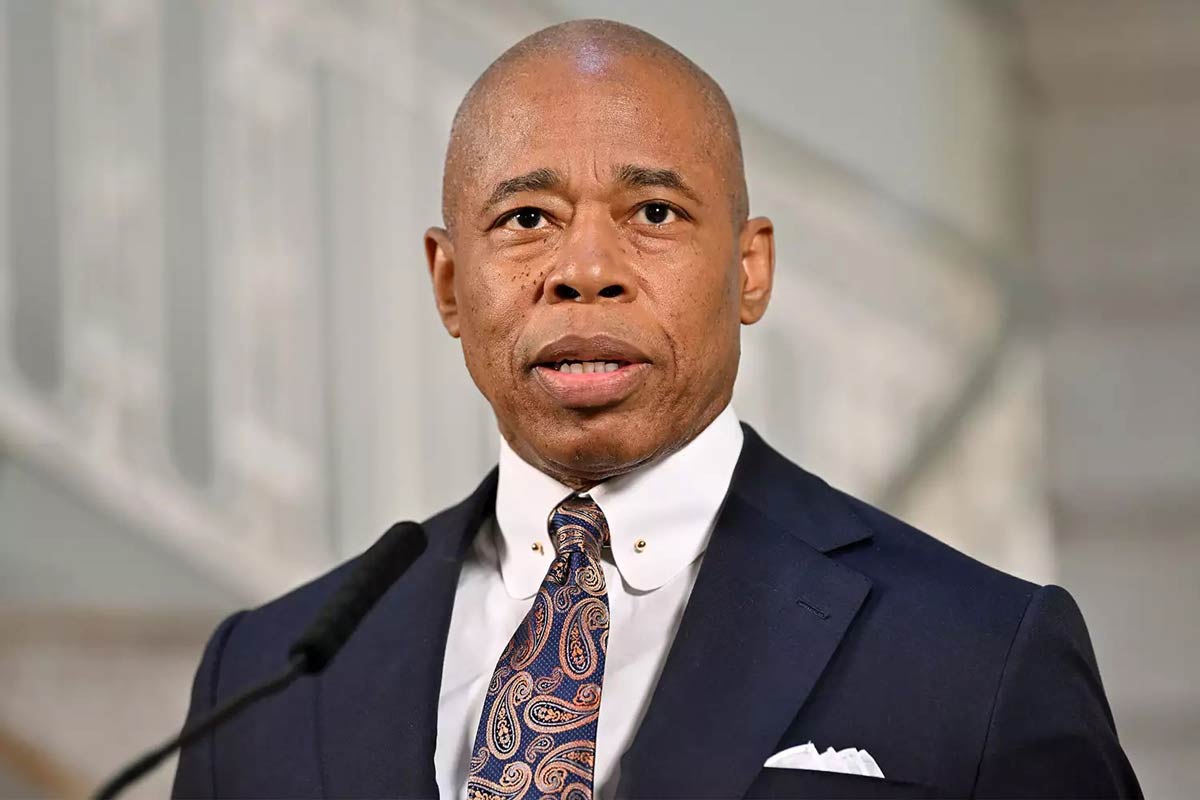
NEW YORK – Following the introduction of legislation to extend mayoral accountability for two years with the reduction of class sizes, New York City Mayor Adams released the following statement:
 “While we believe all parties are operating in good faith, we also believe the legislation as currently written is not the best we can do for New York City students, and we look forward to addressing these concerns in the coming days. For example, while my administration strongly supports lower class sizes, unless there is guaranteed funding attached to those mandates we will see cuts elsewhere in the system that would harm our most vulnerable students in our highest need communities — including the loss of counselor positions, social workers, art programs, school trips, after-school tutoring, dyslexia screenings, and paraprofessionals. There must also be a mechanism for altering or delaying the plan to reduce class sizes if the mandate is shown to severely adversely impact racial equity and the city’s fiscal health.


 “As we finalize a potentially historic agreement for public schools, I expect the Legislature to follow through on its promise to improve the educational outcomes of students of color and to help the struggling families who need Albany to make responsible, equitable decisions on behalf of our children, now more than ever. I look forward to working with my colleagues to get this done.”

John R. Lewis Voting Rights Act of New York

Center for Law and Social Justice
As Black and Brown voters across the country face the greatest assault on their rights since the Jim Crow era, we need New York to set the standard for state-level voting rights by adopting the John R. Lewis Voting Rights Act of New York (“NYVRA”). That’s why we were thrilled when the NY State Senate voted to approve the John R. Lewis Voting Rights Act of New York (NYVRA) yesterday! We now continue to call for the Assembly to do the same – BEFORE THE 6/2/22 END OF SESSION – so that Black voters and voters of color will once again be protected from voter discrimination.
The NYVRA’s critical protections include:

  • Launching a “preclearance” program that requires local governments with records of discrimination to prove that proposed voting changes will not harm voters of color before they can go into effect.
  • Providing new legal tools to fight discriminatory voting provisions in court.
  • Expanding language assistance for voters with limited English proficiency.
  • Creating strong protections against voter intimidation, deception, or obstruction.
  • Instructing state judges to interpret election laws in a pro-voter way whenever possible, so that close questions of legal interpretation are resolved in favor of the rights of qualified voters.
  • Establishing, through companion legislation, a central hub for election data and demographic information that will empower officials and community members to ensure accessible elections.

But the Assembly must follow the Senate’s lead and pass this bill – and they must act immediately as the legislative session ends on June 2.
If you believe that Black voters and voters of color deserve to be protected by a robust NY State Voting Rights Act, contact your State Assembly members to let them know how you feel. Click this link to find the contact information for your Assembly member and give them a call, send them an email or tag them on social media (or all of the above!) to demand that they vote to pass the NYVRA so that Black communities and communities of color are protected when we make our voices heard at the ballot box.

Irreplaceable Treasures,
Lost & Found on Willoughby

by Bernice Elizabeth Green

The landscape of Central Brooklyn is changing so rapidly one can hardly see the trees for the forest of developers’ tower lifts, scaffolding and industrial tarp protective barriers. 

Architectural masterpieces, here today are vanished in favor of tik-tok lux, the next. 

Even long-time residents of the north area may not have noticed the disappearance of one of Brooklyn’s tallest magnolias.  The “other one” that stood majestically in the courtyard of the now-defunct CABS Nursing Home at the south west corner of Dekalb & Nostrand– not the Lafayette Avenue Grandiflora of international fame.

Some neighbors call it the way they see it, preferring words like gentrification, erasure, displacement, vanishing and even replacement to the bland “change”.
  
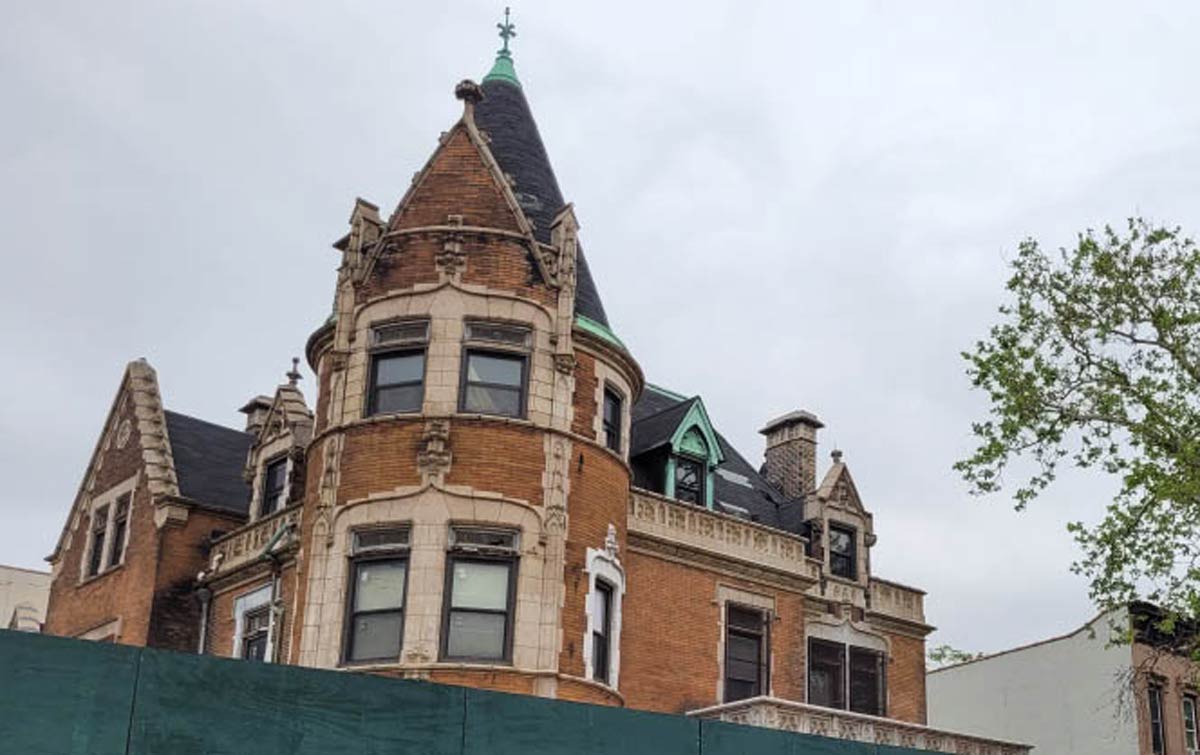
Two blocks at the northeast corner of Nostrand & Willoughby (441 Willoughby Avenue), there’s more evidence of an evolution of sorts in real time. The “Masonic Temple on Willoughby” may be headed straight to something other than its function and away from its original form.

Construction on The Jacob Dangler House began in 1870 and was completed in 1902.  The Oriental Grand Chapter of the Eastern Star, an African American woman-led masonic group founded in 1850, purchased the building from descendants of the Dangler family, in 1967.

For many years, the mansion served the owner’s desire to be an event space for social functions, baby showers, birthdays, weddings, rites-of-passage celebrations, dances, award ceremonies.

Over the past several months local media outlets have followed the story of developers efforts to turn the building into condos, and the nearby community’s fierce fight to protect the French-Gothic limestone structure itself by having it landmarked. That way, its architectural integrity, its intended service to the community as an event space home away from home, and its history would be preserved.
While they “stave off developers,” the community is awaiting the decision from NYC Landmarks, residents also, it was reported last week, directed attention “ to saving as many parts of the property” as possible, and whatever valuable that’s left inside. Like copper roofing and blue stone.   

Meanwhile, the “Brooklyn 360” developers are moving swiftly. Their petition for pre-demolition approval has passed approval, setting the stage for a “greenlighting” for further work.

Our Time Press’ visit to the site yesterday reveals that whatever’s valuable may not be inside anymore; and what’s salvageable already is what’s already saved:  memories of another space, in another time. 

A kind site worker, putting up protective wood barriers on the building’s Willoughby entrance, told us there was nothing to photograph inside the building.  “Nothing. It’s an empty space. Nothing to take pictures of.”  We were totally fine to photograph the insides of what only can be called a cavern, based on his brief description. But for safety reasons, we didn’t force the issue, standing back to observe the “debris” clean-out. 

As of yesterday, at 2:00pm, the original Order of the Eastern Star entrance sign is still intact.

But when we left Willoughby to head north down Nostrand to Myrtle, we found two other “things”: an iron gate painted — Basquiat-like — with names and tags of passersby or visitors.

We also intercepted a heavy wood cross headed to the trash heap.
If there is meaning to the discovery of a crucifix on its way to the trash heap as debris, it could be associated with the spirit of community advocacy in the 1200 petitioners advocating for the preservation of a mecca. The history of the mansion at 441 Willoughby is told exquisitely by the writer Suzanne Spellen at brownstoner.com. It is where a family lived for three generations, and where in the late 1960’s an organization born from African American entrepreneurial women ancestors (possibly some formerly enslaved) created a space for social exchange for a neighborhood.

Our Time Press intends to donate the relic to The Macon Public Library with the hopes that it is dedicated to the Order and the neighborhood who sought NYC Landmark designation to protect its architectural and cultural significance while preserving its unique history.

So, the significance of this effort is that if historic landmarking is approved for the building, it will not be torn down whatever the developers’ purposes. It will not become nothing more.
 
For more information, please visit, bkreader.com and PATCH.com. For a precise history of the building, Our Time Press recommends you read writer Suzanne Spellen’s column at: www.brownstoner.com/history/walkabout-the-jacob-dangler-house-on-willoughby-avenue.

Summer Vacation, Reconsidered

By Julianne Malveaux
(TriceEdneyWire.com) – Students everywhere are anticipating, or already experiencing, their summer vacation. It means freedom from daily classes and the opportunity to break, “chill,” and perhaps attend a summer program for many. We know, however, that there is knowledge erosion over the summer, especially for students who don’t continue to read or learn. Race matters here. Lower-income parents often can’t afford summer programs. In other cases, they count on older children to be caretakers for their younger siblings, which means they may have to forego opportunities for continued learning.


There are year-round learning or staggered learning opportunities in a few school districts. However, students are “off” from late May or early June to August or September. Some parents aggressively seek summer programs to keep their children intellectually engaged. Others face significant barriers to keeping their children involved in the learning process.


Parents must be encouraged to find summer learning experiences for their children. More importantly, we need to reconsider this notion of summer without learning. Some schools assign summer reading lists, but to the extent that learning is interactive, reading in a vacuum may not be optimal for enhancing education. It’s better than nothing, but why such a low bar? Why aren’t school districts more forcefully providing summer opportunities?


The achievement gap is real, and it starts before children are enrolled in school and continues through higher education. Upon preschool enrollment, data (sometimes disputed) suggest that young white children are exposed to 30 million more words than young Black students. Other exposure gaps are cultural (who goes to museums, cultural performances, or libraries), physical (involvement in sports), and social. These gaps show up when students take standardized tests or are measured against prevailing cultural “norms.”


Learning has to be both year-round and life-long. This isn’t just about students but also about the adults who guide them. When was the last time you read a book, checked out a museum, or expanded your horizons? You can’t encourage your children to be lifelong learners unless you are one yourself.


Still, it is time for us to think about these summer vacations. The notion of having summer off comes from an agricultural model where young people had the summer off to help their parents harvest crops. With the number of family farms plummeting, children aren’t needed to work in agriculture. From my perspective, they are needed to be in classrooms, libraries, and museums.


Rethinking education means spending money, though, and as our national student body has become more diverse, there seems to be less interest in spending money on education. Higher-income parents can pay for the supplemental education programs that their children need. Lower-income parents scramble for opportunities and have to balance their economic situation with their children’s learning needs.


There are lots of objections to reconsidering summer vacations. Parents with several students worry about coordinating schedules if calendars are changed, and different children are off at different times. Teachers, who savor their summers off, wonder about the financial implications of a more extended school year. And culturally, we are all used to the model of “summer off,” and it will take some adjustment to change that.


Other countries do more with education and achieve better results. Nearly everyone (98 percent) 15-24 years old in Costa Rica can read. That country spends 8 percent of its GDP on education, compared to 6.4 percent in the United States. Worldwide, students spend between 175 and 220 days a year in school, with the United States hovering at the lower end, with about 180 days a year. Our K-12 education is often lacking, especially for students of color. Why aren’t more people speaking up more forcefully about educational access?


The hybrid education introduced by COVID could be a model for summer education. At the very minimum, it provides us with some of the alternatives we need to consider if our nation is educationally competitive. The traditional model isn’t working, and it exacerbates the achievement gap. If we genuinely believe that “children are our future,” we must reconsider the concept of a two or three-month summer vacation and implement year-round learning.


Dr. Julianne Malveaux is an economist, author, and Dean of the College of Ethnic Studies at Cal State LA. Juliannemalveaux.com