Home Blog Page 318

Therapeutic Model

The following is Part III of a series based on the lectures of Joy DeGruy (Nee Leary), M.S.W., that first ran in Our Time Press in January of 1999. With the ending of Mental Health Month in May, and the reliving of the massacre in Tulsa, Oklahoma 100 years ago, we thought it appropriate to remind of the ongoing trauma African Americans have endured over the centuries.
It took aerial bombings to destroy Black Wall Street in Tulsa, but the minds of a people can be subject to ongoing violence by forgotten forces as deadly as fire and bullets.
Here, Dr. DeGruy walks us through that process.

Here’s what I realized in terms of the therapeutic model. When families come in for therapy, whatever the issue is, I already know I’m looking for post traumatic slave syndrome. I know it’s there, I just don’t know how it impacted this family. The way I find out how it impacted this family, I do the geno-gram. I’m going to find out who momma is, who daddy was, right down to the client. I will also find out how his family survived and sustained through slavery. And we can always know that.

There was only four ways how we did it. First was the church. Everybody in the family a pastor or minister. The other way, we’re going to educate our way out. The other was entrepreneurs. Setting up barbershops, and small businesses. During segregation they did quite well. Better than we’ve ever done because we had to depend on each other. Then you have the criminal. Or a combination of them. In my family it was education and criminal. Based on that I understand what the integrity of our family was. In this criminal world also, what came out of it was drugs and alcohol. We know what that did to our families. Alcoholism because we had to cope. We look at that mixture, and I begin to understand the level of post traumatic slave syndrome, and how it introduced itself into your family, and how you coped. So now I can begin to understand what the therapeutic process should be. I understand how you arrived at your character and how your mother arrived at hers. “You know my grandmother, bless her heart, but she used to be so mean. She was always angry. She’d beat us.” You know, she was suffering from post-traumatic slave syndrome. Then I begin to understand how it broke down for you. The level of resilience of this family. The strengths of this family. The needs of this family.


Black History

Post Traumatic Slave Syndrome
Anger, Self-Hatred and the Twisting of the Human Spirit

The following is part two of a series based upon
the lectures of Joy Degruy (Nee Leary), M.S.W., that first ran in Our Time Press in January of 1999.
With the ending of Mental Health Month in May, and the reliving of the massacre in Tulsa, Oklahoma 100 years ago, we thought it appropriate to remind of the ongoing trauma African Americans have endured over the centuries.
It took aerial bombings to destroy Black Wall Street in Tulsa, but the minds of a people can be subject to ongoing violence by forgotten forces as deadly as fire and bullets. Here, Dr. Degruy walks us through that process.

I had to take a look at African American behaviors and my focus was African American males. We know that African American males have the highest homicide rate. European males have the highest suicide rate. Let me explain to you what that means clinically. People who commit suicide are depressed about something. What does depression look like. They’re sad, loss of appetite, withdrawn, people start giving stuff away, sleep a lot, that’s a depressed person. They come into therapy, you’ve got to try and help them. Now you have a person who’s homicidal. He comes into therapy. Now why would a person be homicidal? Well they say here’s an anti-social personality, they act out, they’re compulsive. Eventually they’re labeled a sociopath. Guess what? You can’t cure a sociopath. So what can you do with them? You lock them up, it’s really simple. Prisons are a booming business and we’ve got the folks to put in there. Because they’re sociopaths, you can’t cure them, so you put them into institutions. When they go into therapy, they go to a white therapist, he says, “Homicidal? Got to go straight to the institution.” Whereas other youth who have these behaviors, they first go to treatment facilities where everybody is trying to help them. But the Black one with the same symptoms goes to a correction institution…

Afraid to Live
They’re misdiagnosing the whole thing. Here’s a true situation. Two young brothers are out in front of a high school. One is 19 and one is 16. The one that is 19 has pulled a gun on the one that is 16. The crowd thins out. The guy points the gun, pulls the trigger and it jams. To me, that’s the time for the other kid to run. Instead, the kid stands there and throws his hands back. So the guy hits the gun and pulls the trigger and it jams a second time. The 16 year old starts laughing. The 19-year-old tries it a third time and the gun jams again. The 16-year old said, “You think I’m afraid to die? I’m not afraid to die, I’m afraid to live.” The kid tried it a fourth time and the gun went off. To understand that behavior, I have to get into the psyche of a sixteen-year-old boy. How can it be that at 16 years old, he no longer wants to live? He can’t see a place in the world for himself and I’ll tell you why. We’re a man-object oriented system that says that you are what you are based on what you have. You are measured by your things. That’s why you have brothers walking around don’t have a home, don’t have a car, but they’ve got 50 gold chains. They’re thinking, “I’ve got to wear some worth, because I don’t have any worth.” So when you look at that what they’re saying is that I have to measure myself by things and then you tell me I can’t have them. You’ve barred every way that I have to get them and you tell me I’m nobody if I don’t have them. That’s what our society does to Black men. These young men don’t see a way. They can’t find a place to be somebody. To maintain a sense of dignity and worth. When I looked at that I realized that’s Post Traumatic Slave Syndrome. What I’m saying is that the injury of slavery was trans-generational in its transmission. We learned it. it’s knee-jerk, we figure it out. And every generation we give it to them because we pass on everything to the children. And the children begin to live out those things. It’s unconscious, I realize that it’s unconscious. And when I look at the brothers, I understand it’s a very, very different thing going on than what they believe. It’s one of the symptom of Post Traumatic Slave Syndrome.

Post Traumatic Slave Syndrome
The fact that slavery went on for hundreds of years suggest the end result is not Post Traumatic Stress Disorder, it’s Post Traumatic Slave Syndrome. Socially learned and trans generationally impacted. So now what are some of those things? I had to look at this stuff. I had to figure out what it really was, what it looked like. We’ve all seen it by the way. When I come up with these things, it’s not going to be confusing, I just put a name on it. the first place to go is to the mirror. That’s the first place because I know Joy’s got it. Let me tell you what we go through and people don’t give us recognition for. There’s something called the Beck Anxiety Inventory. That’s is a stressor scale. When you move, there’s a stressor. When you get married, there’s a stressor. There are stressors for many things. They ought to put Black on it. Nobody has measured the stress of being Black. There is a stressor in America involved with being Black.

Racial Attitude Inventory
I want somebody to measure what happens to the blood chemistry and heart rhythm of a brother when a police car pulls up behind him. No one has measured that stressor. No one understands what that feels like. I’ve been in a car with a brother when that happens, and I’ve seen his entire body change. Everything changes. What is that stressor? Let’s look at anger. There is a process, it’s called the stages of Negressence. African Americans developed this scale. Racial attitude inventory. All of those things have been done. You haven’t heard about those things and neither have I. When I started doing my research, I started looking for scales that measured stuff about Black folks. I couldn’t find them anywhere. Not in any of the referee journals. Nowhere could I find any. But it was done years ago, but they couldn’t publish in journals. Our psychiatrists, psychologists, scientists, couldn’t publish because they were Black. So, they had to publish where they could, in obscure Black journals. I found the creators of the scales and they said it’s been here for years. Never been used as tool. The establishment says, “What is this, to help Black people? We don’t need that.” So, these scales were created. What they did was show the stages of our acculturation. In other words, there is something that happens to child when they realize they’re Black. There is a time when kids are walking around, they don’t know what’s going on, and then suddenly they get aware that they’re Black.


Strength of Positive Feedback
I’m going to end with a story about something that happened when I was teaching. I was in a program, and they would call me in when anything looked strange. They said “Joy there’s a little girl in the second grade we need you to look at. We don’t know if she’s Special Ed or what.” She’d come in the classroom, shed’ be dirty, she’d be unkempt, she wouldn’t talk to any of the kids. She’d come in, put her coat over her head and put her head on the desk all day. The teacher, a towering male, asked me what to do. I told him to do the first standard, a smile and a handshake. Insist when she come in the class to give you a smile and a handshake. She’d do it, then go to her desk and put her coat over her head. A couple of months went by. After a while she started looking forward to that at the door. We have a rally every quarter and we give awards to the kids. Now in the PTA we had only a 5% representation of parents. But at the rally we get 75-90% of the parents. Parents come, grandmothers, everybody would come because their children, for the first time, were awarded. I told her teacher that for her class he should give her the most improved student award, because she gets to the door and shakes your hand. He said okay, but that’s not enough. So he told his wife about the little girl and his wife made a beautiful life-sized Black rag doll.


At this rally, we also have a parent component. There are parent coordinators who go into the home when we had a child with issues, because you cannot separate the child from the family. So we’re dealing with the momma and the daddy. Guess what? Momma’s was on crack, so the first thing the parent coordinator does is get her into treatment. Momma gets cleaned up. Momma then starts a halfway house for women, running it now. She got most improved parent award. Gave her an award too. Now comes the rally. Little girls comes in cleaned up with bows in her hair, because momma’s cleaned up. They’re sitting in the back, and they announce the award for this little girl. From the stage they say, “Most improved student award” and he unwraps this life-sized ragdoll. Each child was to walk up to the stage, but she couldn’t get out of her seat. I have to stop because I’ve got to tell you, this is so hard for me. What I feel when I see this little girl…he walked down with the doll. The whole audience turns to look at this little girl. Her mother and her are nervous and she’s beaming and he hands her the doll. She smiles and she pulls the coat over her head. That little girl later on was standing up and reading aloud in front of the class. Now, tell me if I care that she went from an F to a D. I don’t care if she did because we cannot get to the D if she doesn’t raise her head. She has to raise her head, and that’s a victory. So that is the healing, the healing is right here with us. I end as I end with all my training, it was best said in “The Color Purple”, “everything just wants to be loved.” Thank you very much.
Caretakers of Westchester Black History

David Thomas Speaks

Our Time Press first learned of the existence of Rye’s historic African American Cemetery from Alfred Peterson Jr. AKA Baabasurya. The site on North Street, now a National Historic landmark, is where Peterson family members — notably Baaba’s mother and grandparents — are among the interred 300 individuals.  It opened officially in 1860, although it was a burial ground for people of color for many, many years before then. 

“There are fifteen Civil War Veterans, one Spanish American War Veteran, five World War I Veterans and two World War II Veterans that we know of.  Each time we met at the site, another descendant would approach me with new information. It was these descendants, town employees and local officials, who were the first Friends of the African American Cemetery.
“Each year, I try to present research on those at this burial ground:The stories of everyday people and families, their lives and their deaths, what they meant to our community and the organizations they belonged to.  


“ Over the years, we have discovered stories of wealth, poverty, disease, honor, sacrifice, love and family.  Many of those interred belonged to local churches, namely the Barry Avenue AME Zion Church in Mamaroneck and the Saint Frances AME Zion Church in Port Chester. The founder of Barry Avenue, Robert Purdy his wife and two of his children are interred at the site. Their descendants, Robinette Robinson and Surya Peterson, are current Friends. Through the years, they have provided stories and histories of other ancestors buried at the African American Cemetery.


“The goal of the Friends is to preserve the site, research the lives of those buried, and promote the educational value of the site. Over the years, several scouting projects have improved each aspect of our goal.  Daniel Vitagliano’s Eagle Scout project and Anna-Kay Smickle’s Silver Star project have documented the names and stories of some of the people. Brendan Ramos’ Eagle Star project cleaned every headstone at the site.  Each project has contributed to both new knowledge and maintenance.”
Learn more about the Friends on their Facebook: https://www.facebook.com/FOAAC/

DuBois Freedom Center, First in North America, Named in Great Barrington, Mass.

DuBois Freedom Center, First in North America, Named in Great Barrington, Mass.
Housed in DuBois Boyhood Church, Center to Honor Berkshire County’s
Native Son and Regional Black Heritage/Legacies

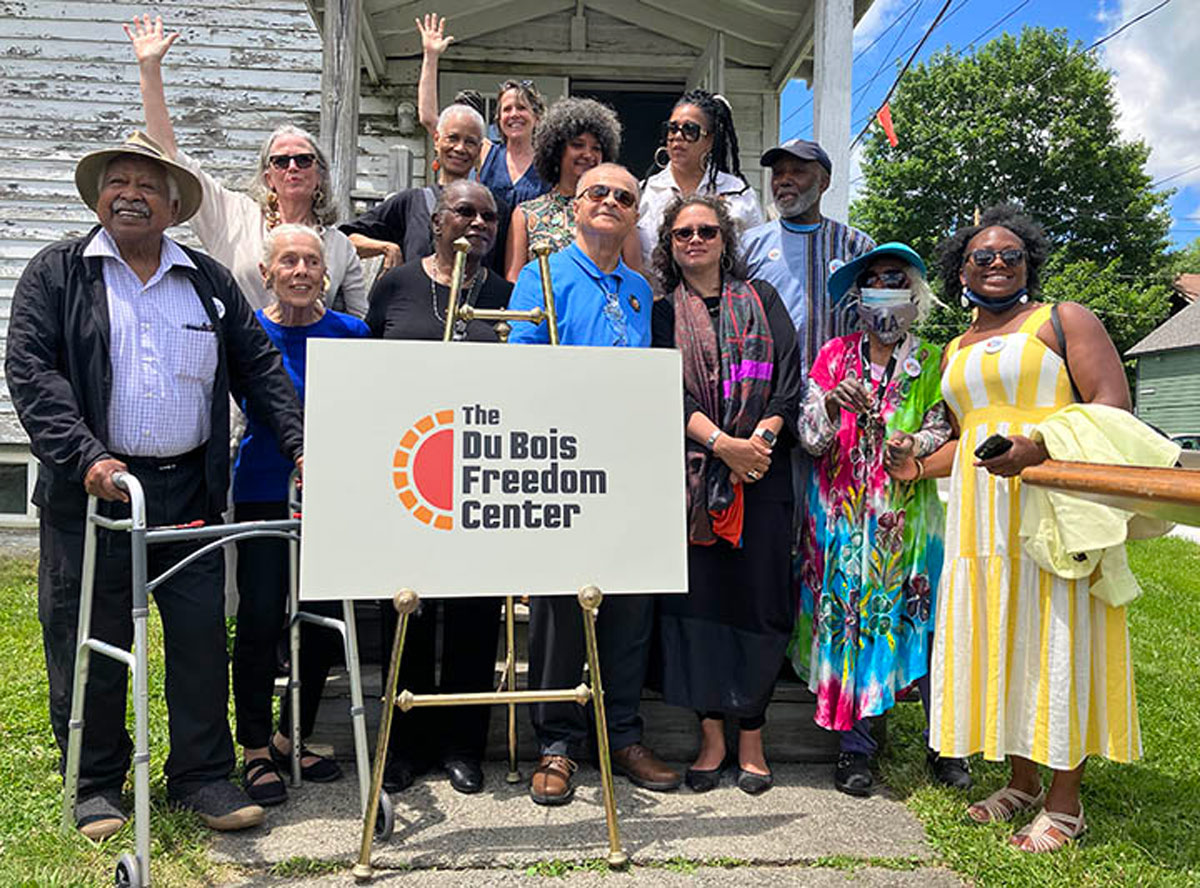
On Friday, June 10, members and friends of the Great Barrington, Mass. community, renowned scholars, authors, and other distinguished guests converged to celebrate the naming of the W. E. B. Du Bois Center for Freedom and Democracy.  Amidst a wave of tributes to the great scholar throughout Berkshire County, this acknowledgment is reportedly the first of its kind in the nation.


The mission of the Du Bois Freedom Center, as it will be known, is to educate the public about the life and legacy of civil rights pioneer W. E. B. Du Bois and the rich African American heritage of the Berkshires. Located in the former Clinton A. M. E. Zion Church in Great Barrington, where Du Bois was born and raised, this vibrant center of Black thought and remembrance constitutes the first museum and living memorial in North America dedicated to his life and legacy.


Formed in the late 1860s as the A. M. E. Zion Society, the Clinton Church was the first Black institution of Du Bois’ life. Although he left Great Barrington at age 17, Du Bois returned for visits throughout his life and spoke at the church on Elm Court in 1894. The Clinton Church Restoration also is restoring the historic site for adaptive reuse as an African American heritage site dedicated to educating the public about the Berkshires’ rich African American history. The former church served as the spiritual, cultural, and political hub of African American life in the southern Berkshire community for nearly 130 years.

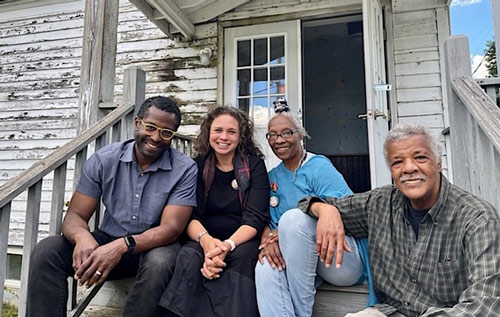
Wives and Husbands: At the Du Bois Freedom Center dedication were Khary Jones, winner of a film making grant from Firelight Media’s William Greaves Research and Development Fund; Kendra Field, Historian in Residence, Bernice Green and David Greaves, co-founders of Our Time Press. Photo: Eugenie Sills


“This is an historic announcement for our project and our town,” said Du Bois Freedom Center president Wray Gunn, Sr., whose father, David Gunn, was one of the Memorial Committee’s original incorporators. Gunn, who attended the Clinton A. M. E. Zion Church for more than 70 years and was a longtime trustee, is not only carrying on the work of his father but that of the late Rev. Esther Dozier, who worked tirelessly to promote Du Bois’ legacy. “W. E. B. Du Bois was one of the country’s foremost intellectuals and certainly the most consequential person to be born and raised in Great Barrington, yet his contributions have never been fully recognized. We hope we can count on continued support.”  


“We could not have picked a better name that represents history and will automatically speak history just by the naming,” said Dennis Powell, president of the NAACP Berkshire County Chapter, to the Berkshire Eagle newspaper. Du Bois was one of the founders of the NAACP in 1909 and the founding editor of the Crisis Magazine, which heralded the Harlem Renaissance.
Over 75 people celebrated on the lawn of the building. One speaker was historian David Levering Lewis, whose two-volume Du Bois biography earned him two Pulitzer Prizes. Lewis, who serves as honorary chair of the Freedom Center’s National Advisory Council, noted that a Du Bois renaissance  is sweeping the area. “The Freedom Center presents a singular opportunity to reclaim and extend in Du Bois’ hometown, the Black intellectual, artistic traditions, and social movements to which he dedicated his life’s work,” Levering Lewis said in an earlier statement.


“An appropriate appreciation of Du Bois is long overdue, both nationally and locally,” added Dr. Lewis. While the Du Bois Freedom Center is a new entity, the project’s lineage dates to 1967 when Dr. Edmund W. Gordon and Walter White purchased Du Bois’ boyhood homesite on the outskirts of town. The following year, on Du Bois’ 100th birthday, they formed the W. E. B. Du Bois Memorial Committee “to honor his memory and to perpetuate and extend his work.” The site was dedicated as a memorial park in 1969 and is now a National Historic Landmark stewarded by UMass Amherst. Dr. Gordon, now 101, has endorsed the new Du Bois Freedom Center and pledged his support for the project.


Clinton Church Restoration has been awarded a $117,000 capital grant from MassDevelopment and the Mass Cultural Council, part of a round of Cultural Facilities Fund grants that were announced yesterday. The funds will be used to help complete architectural and engineering plans for the African American cultural heritage center the nonprofit is creating in downtown Great Barrington.


Community support and key partnerships — with the W. E. B. Du Bois Center at UMass Amherst, Housatonic Heritage and the Upper Housatonic Valley African American Heritage Trail, and now the African American Trail Project at Tufts University — have contributed to the project’s success to date. The organization has raised more than $2 million, completed an initial phase of stabilization work, and developed an interpretive plan and schematic-level designs for the Center, which is expected to take several more years to complete.


 According to Eugenie Sills, the project’s interim executive director, the Cultural Facilities Fund grant is one of six grants the project has received in as many months. In March, the American Historical Association provided a $75,000 grant to support a one-year historian-in-residence position, research assistant, and public history programming.
Kendra Field, the Du Bois Freedom Center’s Historian-in-Residence, is an associate professor of history at Tufts University. She noted the gravity of what the Freedom Center means for understanding past and present in the Berkshires and beyond.


Field pointed out that the Berkshires and Great Barrington had historically been a site for Black refuge, culture and intellectual engagement. “Here we have the extraordinary opportunity to see up close the local roots of a national and indeed global story of Black life, culture and resistance.”

More information about the new Center is available at duboisfreedomcenter.org, which was launched on Friday, June 10th.   

What’s Going On – 6/17

SUMMER IN AMERICA
NY, NY: The June 28 NYS Primary for governor, Lt. Governor, assembly members, judges and committee people is being challenged by groups who argue that NYS Assembly districts were drawn by an unconstitutional process. State’s highest court, the Appeals Court, ruled that two primaries will be held.


NYC City Council (44-6 vote) and NYC Mayor Eric Adams arrived at $101.1 billion budget agreement. Hizzoner and Council Speaker Adrienne Adams, hugged and kissed. The NYPD budget is $5.5 billion. In NY more than 1000 NYPD personnel retired and resigned this year. Is it burnout, the culture, COVID or a series of unfathomable circumstances?
Primary fever dominates spring/summer in NY and beyond. Heated Democratic and Republican gubernatorial debates continue. Harlem Assemblymember Inez Dickens, recovering from a kidney transplant surgery last month, is diligent on the campaign trail, albeit virtual, lending endorsements to judges and Democratic State committee members. She recently came out for a photo op with Lieutenant Governor Antonio Delgado, candidate for NYS LG.

THE NATION: The January 6 Committee has gone public with excerpts from its hearings, related to that dark day of insurrection on Capitol Hill. Eyewitness reports by filmmakers and talks with Capitol police about the unfolding chaos that day are scary. Disclosures by Trump’s daughter Ivanka and by AG William Barr verify that Trump was aware that the 2020 election was not stolen from him. The vote was fair. Trump was interested in the January 6 insurrection attempt and invalidating the election results. These televised tapes, the Supreme Court striking down Roe v Wade, a woman’s right to an abortion, rampant misbehaviors among the Trump faithful, and relentless gun violence everywhere are recipes for Republican disaster at the polls this year, methinks. Let’s see what happens with inflation, the Democrats and the nation’s short memory.

NYC/ JUNETEENTH
June 18, 11am to 6 pm: MASJID Malcolm Shabazz hosts its 29th Juneteenth Parade and Street Fair on West 116 Street, from Adam Clayton Powell Blvd to Fifth Avenue.
The Juneteenth Celebration, commemorating the United States of America’s true independence, will be held at Carnegie Hall on June 19 at 7 pm. Juneteenth is the day that all members of the newly reunited nation were finally declared free after the American Civil War. Rev. Dr. James Forbes Jr will lead the celebration
Benefit Concert: SWEET HONEY AND THE ROCK and Nona Hendryx, Juneteenth 2022: The Struggle Continues on June 19 at Ethical Culture, 2 West 64 Street in Manhattan.
CARIBBEAN AMERICAN MONTH
The following is a brief list of Caribbean American notables!

MUSIC: Sonny Rollins, Rihanna, Cardi B; Nikki Minaj; LL Cool J; Nile Rogers ASAP Rocky. WRITERS/JOURNALISTS: Karine Jean-Pierre, White House Press Secretary; novelist Marlon James; Hilton Als; Dame Pearl Duncan; Audrey Edwards; Joy Elliott; Sunny Hostin, “The View; ” T.J. Holmes, ABC News; Ruschell Boone and Errol Louis, NY1; Earl Lovelace; Roland Martin; Rosalind McLymont, TNJ; Joy Reid, MSNBC; Jean Wells, Positive Community; playwright Lynn Nottage; Patricia Hinds; Faye, Karlissa and Karl Rodney of NY Carib News; Bernice Green and David Greaves of Our Time Press; Raymond Joseph, Haiti L’Observateur; Sheryl Salomon, City State NY; Sylvia Wong Lewis, Paper Li publisher: VISUAL ARTS: Eric Girault; Peter Wayne Lewis; Yolene Legrand, Bette Byer; Ramona Candy

HEALTH/WELLNESS: Samuel Daniel, MD; Edgar Mandeville, MD; John Mitchell, MD: Cheryl Smith, MD: Roslyn Woods Cabbagestalk, RN; Jocelyn Valentine, Nutritionist; Leon Merrick, DDS; Enrique Riggs, DDS.

THEATER/FILM/TV: Anna Maria Horsford, Queen Latifah, Nia Long, Jada Pinkett Smith, Jackee, Kim Weston Moran, Voza Rivers; Sundra Williams, Vy Higginsen, Grace Blake.

FINANCE: Ambassador Harold Doley, Jr; Harold Doley III, investment banker; Bill Thompson.

ENTREPRENEURS: Real Estate: Al Cunningham; Robert Horsford, Lee Brathwaite, Apex Builders; Meredith Marshall, BRP Companies; Eddie Poteat, Carthage Real Estate; Russell Grey, Ramona Grey Harris, Aden Seraile, Edward Sisters Realty; Kenyatta Punter; Beatrice Sibbles, BOS Development; Alyah Horsford Sidberry, Cove Lounge; Daymond John, “Shark Tank;” Laurent Delly, IDEACOIL technology; Roy Miller; and Yvonne Stafford, Real Estate and Health;

EDUCATION: Wayne A.I. Frederick, MD, Howard University President; Dr. Juanita Merrill; Brenda Clark; Wanda Ballard Wingfield; Fern Khan, Dean Emerita, Bank Street; Givaid Khan; Dr. Nafees Khan; Dr. Yinka Stanford; Kenneth Thompson; Dr. Keith Taylor; Dr. David R. Williams, Harvard.

POLITICS: US Vice President Kamala Harris; NYS Senate: Andrea Stewart-Cousins; Cordell Cleare; Leroy Cowrie; Jabari Brisport; Zellnor Myrie; NYS Assembly: Carl Heastie, Michael Blake, Deputy Chair, Democratic National Committee and Rodneyse Bichotte; Ydanis Rodriguez, NYC Commissioner; Congress members Yvette Clarke, Adriano Espaillat; Ritchie Torres, and Alexandria Ocasio-Cortez; Antonio Reynoso, Brooklyn Boro Prexy: Diana Richardson, Deputy Brooklyn Boro Prexy; Keith Wright, NY County Democratic Leader; Sheena Wright, Deputy NYC Mayor; Anne Williams Isom, NYC Deputy Mayor; Ingrid Lewis-Martin, Chief Adviser to Mayor Eric Adams; Keisha Sutton-James, Deputy Manhattan Boro Prexy.

LAW: Ernst Perodin, Fabiana Pierre- Louis, NJ Supreme Court Judge; Judge Sylvia Hinds-Radix, NYC Corporation Counsel; Judge Michele Rodney; Damian Williams, US Prosecutor, NY; Nathanael Wright, GA.

NONPROFITS: Roy Paul, Cents Ability: Elizabeth Alexander, Mellon Foundation; Melanie Edwards, Rosamond Johnson Foundation; Lloyd Williams, Greater Harlem Chamber of Commerce; Stanley McIntosh, Neighborhood United W. 132 Street Block Association; Colvin Grannum, Bedford Stuyvesant Restoration Corp; Dr. Malcolm Punter, HCCI.

FAITH COMMUNITY: AJ Bernard, Christian Cultural Center; Rev. Dennis Dillon; Jacques DeGraff. Canaan Baptist; Rev. Dr. Walrond, First Corinthian Baptist.

NEWSMAKERS
Birthday greetings to Cancer the Crab natives: Dr. Betty Holmes Anthony, Will Anthony; Joe Bethune; Goldie Watkins Bryant; Harlem Preservationist Valerie Bradley; Harold Doley III, investment banker; Omar Epps; Danny Glover; Ernie Green; Kevin Hart; Desa Horsford, Desa Unique, lifestyle entrepreneur; twins Lillian and Karen Horsford; Aubrey Jacobs; Sandy Livingston: Wendy Williams; writer Ramona Wraggs Wall; Ricky Wingate; Mike Tyson; Alyah Horsford Sidberry; Assembly member Inez Dickens; Harriet Michel; actress Barbara Montgomery.

A Harlem-based management consultant, Victoria can be contacted at victoria.horsford@gmail.com

New York City Public School Small Class Bill Faces Problems

By Fern E. Gillespie

The classrooms in New York City public schools have been infamously known as being the most overcrowded classrooms in New York State.

This month, the State Legislature passed a bill that mandates caps on class size to be phased in over five years in all New York City public schools. The caps are 20 students per class in kindergarten through grade three; 23 students per class in grades four through eight; and 25 students per class in high school academic subjects. The new law, which has to be signed by the governor, requires caps in all schools rather than averages and adds enforcement mechanisms to ensure New York City public school compliance.

“It’s about time that New York City really embraces the planning to reduce class sizes so students can get the individualized instruction needed to thrive in their schools,” Jasmine Gripper, Executive Director for the Alliance for Quality Education, a parent and educator advocacy organization told Our Time Press. “When we have large class sizes, we see students being promoted who are not quite yet mastering the skills they need at each grade level and no one having enough time to help those students.”

“If this law is enacted, it will transform New York City schools by finally ensuring smaller classes in all grades,” announced Leonie Haimson, Executive Director of Class Size Matters. “For too long, city students have struggled in classes that are 15 to 30 percent larger than those in the rest of the state. These excessive class sizes have deprived them of the close feedback and support of their teachers that they need to succeed, a glaring inequity. While all students benefit from smaller classes, the research shows that those who benefit the most are children of color, who make up the majority of students in the NYC public schools.”

Unfortunately, Mayor Eric Adams has announced approximately $215 million in school budget cuts, which might make it impossible to afford smaller class sizes next year.

This year, enrollment at New York City public schools declined by 4%. Since the COVID pandemic, the number of students attending the city’s public schools has been decreasing. To pay for reduced class sizes, Adams said the bill would lead to further cuts in school budgets for social workers, counselors, dyslexia screenings, trips and after-school programs.

Kindergarten through third-grade classes has averaged around 21.2 students this school year, compared to 23.8 students before the pandemic, according to data compiled Class Size Matters. The averages in grades four through eight have also fallen to 23.8 in 2021-22 from 26.5 in 2019-20; and 24.7 in high school from 26.4 students.

“They’re going to have to excess staff. If you have significantly fewer students, you need significantly fewer teachers,” Mark Cannizzaro, president of the Council of School Supervisors and Administrators, told the Gothamist.

The small class bill was shepherded to passage in Albany State Legislature by Speaker Carl Heastie and Majority Leader Andrew Stewart Cousins; Chair of the Assembly Education Committee Michael Benedetto; Chair of the New York and City Senate Education Committee John Liu. The bill awaits the signature of Governor Kathy Hochul to go into effect.

“At this point, the majority of the children in New York City public schools are children of color. If the mayor and the chancellor prioritize Black and brown children the way they do, they will prioritize our children in their budget,” said Gripper. The research shows that smaller classes are beneficial to our children.”