Home Blog Page 102

Black History Month Paused??

Pentagon intelligence agency pauses events, and activities related to MLK Day, Black History Month

By Will Steakin
Matt Seyler,
abcnews.go.com

The pause comes after Trump targeted DEI initiatives in executive orders.
In response to President Donald Trump’s executive order banning diversity, equity and inclusion initiatives, the Pentagon’s intelligence agency has paused special event programs and related events, including for Juneteenth, Martin Luther King Jr. Day, Black History Month, Holocaust Days of Remembrance and Pride Month, according to a memo obtained by ABC News.


Despite being on the list of the Defense Intelligence Agency’s paused events and activities, the memo clarified that Martin Luther King Jr. Day and Juneteenth will remain federal holidays.


“The Defense Intelligence Agency is working with the Department of Defense to fully implement all Executive Orders and Administration guidance in a timely manner,” Lt. Cmdr. Seth Clarke, DIA spokesman, told ABC News in a statement when asked about the memo. “As we receive additional guidance, we will continue to update our internal guidance.”


A copy of the memo began circulating on social media Wednesday morning.
The affected events, per the memo, which is dated Jan. 28, 2025, include: Martin Luther King, Jr. Birthday, Black History Month, Women’s History Month, Holocaust Day and Days of Remembrance, Asian American Pacific Islander Heritage Month, Pride, Juneteenth, Women’s Equality Day, National Hispanic Heritage Month, National Disability Employment Awareness Month and National American Indian Heritage Month.


The pause comes as Black History Month is set to begin on Saturday, Feb. 1.
Trump has targeted DEI initiatives in a series of executive orders in his first week in office, with the White House saying that “DEI creates and then amplifies prejudicial hostility and exacerbates interpersonal conflict.”


The memo also noted that the DIA would “pause Agency Resource Groups, Affinity Groups, and Employee Networking Groups, effective immediately and until further notice.”

Trump Tests Separation of Powers and Constitution

By Mary Alice Miller
When Donald Trump said he would be a dictator on his first day in office, apparently, he wasn’t joking. Among the scores of executive orders he signed on Inauguration Day were challenges to the U.S. Constitution and legislation passed by both Houses of Congress and signed into law.


Trump is testing the limits of his presidential authority. With an eye to the conservative majority Supreme Court, Trump might believe that any lawsuits challenging his executive orders would be decided in his favor.


The 14th Amendment, which granted birthright citizenship to former chattel slaves and their descendants and all people born in the U.S., invalidated the 1857 Dred Scott decision, which ruled that Black people, enslaved or free, were not citizens of the United States and, therefore could not sue in federal courts.


Trump’s executive order invalidating birthright citizenship related to undocumented immigrants comes dangerously close to erasing the outcome of the Civil War for African American citizens, too.


Trump signed an executive order extending a ban on TikTok for 75 days to give his administration time to address the app’s national security concerns. Bipartisan legislation remains in place that would fine companies like Apple and Google if they help users access the app.


Pursuant to Trump’s anti-DEI executive orders, in an internal memo from the Office of Management and Budget ordered a pause on all grants and loans disbursed by the federal government.

The pause meant to align federal funding to Trump’s agenda of “ending DEI, the Green New Deal, and funding nongovernmental organizations that undermine the national interest.”


The impact was immediate, sparking mass confusion. New York was among many states locked out of the Medicaid reimbursement funding system. NYS receives over $55 billion in Medicaid and about $400 billion in overall federal funding annually.


The White House assured the country that the spending pause would not impact direct funds to individuals, including SNAP, social security, and student loans.
It was unclear how the OMB directive would impact other federal funding, such as shelters, housing subsidies, transit, and health and social programs. It would have defunded the police.


NYS Attorney General Letitia James led a multi-state coalition challenging Trump’s order in federal court. “We are seeking a temporary restraining order and then a preliminary injunction against this illegal act. It exceeds the authority of the president of the United States. It is a violation of the spending clause. The United States Congress has control over the purse,” said James. “This president of the United States cannot disrespect the co-equal branch of government with a stroke of a pen.”


A federal judge has issued a temporary restraining order on Trump’s pause on federal funding until Monday Feb. 3.
On Wednesday, the OMB withdrew its pause on federal funding.
In December 2024, Congress passed, and Biden signed a bill to temporarily extend funding for the federal government to avert a government shutdown. The agreement extends federal funding until March 14, 2025, and includes disaster relief funding. It did not include an extension to the debt ceiling.


The Trump executive order banning diversity, equity, inclusion, and accessibility initiatives on the federal level put all federal employees in DEI positions on paid leave and required all federal agencies to submit a written plan to shut the programs down. Federal workers received an email that threatened consequences for any employee who did not report on co-workers who worked in DEI roles, which may go undetected by the federal government.


Trump’s attack on DEI disproportionately impacts Black and Brown federal employees. But the attack on accessibility is a direct attack on the Americans with Disabilities Act, signed into law in 1990 by President George H. W. Bush.
On a related note, a group of Republican attorneys general sent a letter to Costco demanding that the retailer drop its DEI policy days after Costco’s board rejected a resolution from the conservative think tank National Center for Public Policy Research at its annual shareholder meeting.


Other companies, including Apple, JP Morgan Chase, Pinterest, Microsoft, Goldman Sachs, Cisco, Delta, and Salesforce, have publicly defended their DEI policies.


Trump signed executive orders banning DEI in the federal government and the private sector, claiming the policies are preferential and identity-based and diminish “the importance of individual merit, aptitude, hard work, and determination.” Trump ordered “all agencies to enforce our long-standing civil rights laws and combat illegal private sector DEI preferences, mandates, policies, programs, and activities.”


Trump seems to equate DEI with affirmative action, which was struck down by the Supreme Court in 2023 after a group of Asian students sued Harvard.
“We have no choice but to fight,” said African American Policy Forum Executive Director Kimberle Crenshaw. “They are coming for the entire infrastructure created from Civil Rights.

We cannot have a DEI practice that is not grounded in an analysis of why we need DEI in the first place, which is why they go after our history, why they go after intersectionality, and why they go after our framework. You can’t fix a problem that you cannot name.”


Trump has ordered each Homeland Security region to detain 75 people per day for deportation. This week ICE took 20 people into custody in the Bronx.
The Heritage Foundation’s 180-Day Playbook has become a daily Operation Chaos from the White House.

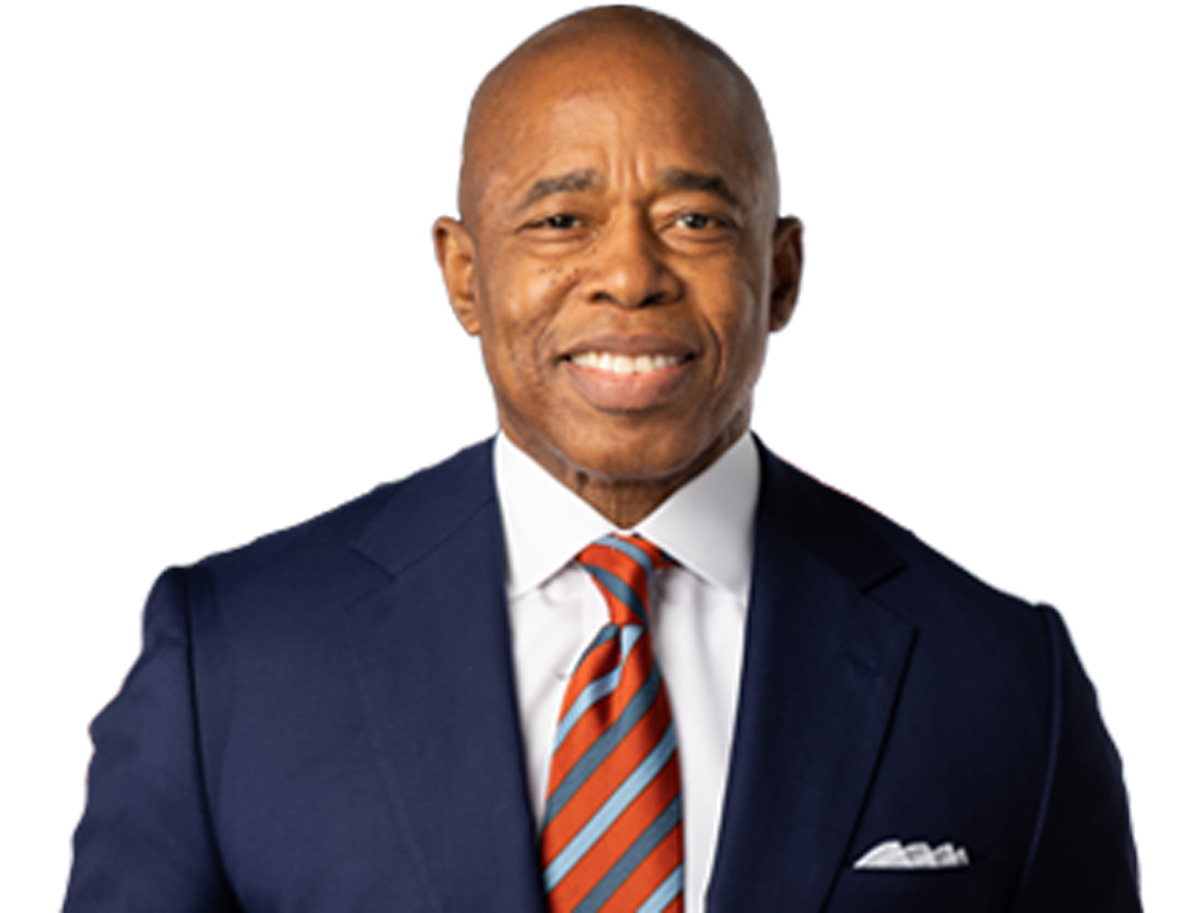
Mayor Eric Adams at Gracie Mansion

By David Mark Greaves
January 30, 2025

We had an opportunity to interview Mayor Eric Adams at Gracie Mansion last week. We met in a small meeting room at a table covered with a forest green cloth, and asked him first about his response to the raft of Executive Orders that have been flying out the Oval Office like bats out of a cave. This was not the first time he’s gotten that request.


“We’re on Day Four or Five, the ink is not even dry yet, and people are looking for comprehensive responses and analysis on these reports;” said Adams. “I think out of emotions and not out of really reading through them and finding out, ‘What does this all mean and what are the actions taken?’ And if we don’t respond in a kneejerk way, people are saying, ‘You’re trying to harm immigrants. No, I’m trying to do my job.”


“This is the largest city in America,” said the mayor and former columnist at Our Time Press, “and anything that comes of Washington, DC, we should thoroughly look at.”


“Not only on immigration, what are we doing with the various grants that we receive from the administration? What does this mean? What does ‘Reapplying mean?’ Do we present the same proposals? And so, we need to go into the crevices of all of these EOs, and I have my team doing that.”


It is rightly said that “The devil is in the details,” and one can only imagine the policy surprises lurking in this particular paperwork.
“My Corp Consul, my Chief Council, all the legal teams at the various agencies that are impacted are also doing that, and once we get a full understanding, then we can sit down and say, ‘Okay, this is how it’s going to impact New York.’ I say all that to say, ‘We don’t know.’”


With deportations of migrants and the new questions posed by the administration about what constitutes a citizen, and now raids in other cities, how does New York’s status as a Sanctuary City fit into the equation?


“Many people don’t understand what a Sanctuary City is and conflate Sanctuary City with asylum seekers,” said the mayor. “Being a Sanctuary City does not mean if you’re an undocumented person, we’re going to harbor you and get in the way of federal authorities.”


“What Sanctuary City states is while you are in the City of New York, when you buy this bottle of water, you’re paying taxes, and those taxes pay for the services of the State, and people paying taxes” should be able to and are encouraged to, use those services.

“Children must go to school. If you’re sick, use our medical facilities; if you’re a victim of a crime, call the police. Don’t be afraid. If you go to these services, we’re not turning you over to federal authorities merely because you’re applying for services.

Immigration status does not figure into the city’s delivery of services to people who live here. You are protected to get those services without us turning you in.”


We noted that a December report from Comptroller Brad Landers had highlighted what he called an increase in evictions at NYCHA housing. Given that there are tens of thousands of NYCHA residents in our distribution area, we asked the mayor to respond, and he did with a ‘Yeah, let’s talk about NYCHA’ attitude, starting with how, as Brooklyn Borough President, he saw that NYCHA residents did not have highspeed broadband. “The parents could not do telemedicine; children could not do remote learning. Now every NYCHA resident receives free high-speed broadband.”


The mayor said he headed the formation of the NYCHA Land Trust, which residents voted on and approved. “That frees up billions of dollars for repairs.” In this case, it is $8 billion dollars to NYCHA.” This is against the ugly fact that NYCHA “Has an over $80 billion capital problem,” including repairs, lead removal, paint removal, and “our budget is only $114 billion.”


“Unlike what Brad says, the number of evictions is not going through the roof.” “His report failed to show how we fix NYCHA for those residents who are paying their rent.”


“Brad ignored that altogether with his superficial approach.”
Repairs have to be paid for said the mayor, and “what do we do with those residents who are paying their rent every month? They deserve a standard of service.” Even if some tenants don’t pay rent, things like heat and hot water, as well as repairs, still have to be paid for. And yet the mayor says, “The $7 billion infused under PACT (Permanent Affordability Commitment Together) is substantial to help with the needed repairs, and when you add the NYCHA Land Trust, we’re moving in the right direction.


We’re very focused on NYCHA, and I disagree with them totally. It’s just a political report to make it seem like people are being evicted at high rates, and they’re not.”
With artificial intelligence now being integrated into every facet of our lives, in schools, and in city management, what about the president’s $500 billion AI initiative and its potential effect on the city?
Adams said he anticipates some of that funding will be for schools and city government.


“People are looking at what they don’t like about what this administration is doing, how about looking at what we like? I don’t want to spend all my energy on what we disagree on; I want to look at how we elevate the things we agree on.” One of those things is educating New York children to be ready to face the competition coming into the city from around the world.

“We have to build a pipeline for Artificial Intelligence in our young people, if not, they’re going to be left behind.”
While he was at the inauguration, Adams had the opportunity to meet Sam Altman, the founder of OpenAI. “He and I were talking about how do we look at internships, working with our schools, and other ways for our children to be introduced to AI.”


I asked the mayor what his message would be to a group I knew he would be familiar with, the monthly meeting of the African American Clergy and Elected Officials (AACEO) at Antioch Baptist Church in Brooklyn.


“Yes, I know Reverend Waterman and the AACEO. I came up through those groups, living blocks from there on Lafayette Avenue. We should all be proud of what we have accomplished against all odds.

When we came into the office, we were dealing with COVID-19; then add on Black unemployment was high, NYCHA did not have broadband, small businesses were hurting, crime was high, and people were not back on the subway.


“We’ve moved 20,000 guns off the streets. People talk about crime in our subway system, we move 4.1 million riders a day and have only six felonies a day.”
There may be only six felonies, but it is the perception that becomes the reality. New York City’s daily subway ridership would replace Oklahoma (population 4,095,393) as the 28th most populated state, with people not spread out over tens of thousands of square miles but on 665 miles of mostly underground track in 6712 jostling, crowded, wheel-screeching subway cars.

Still, high-profile crimes, such as a woman burned to death and three people killed by being pushed in front of trains, can cause a general feeling of fear, and the presence of the mentally ill can be very uncomfortable.


“We know the perception has overshadowed our success. Having said that, we’re not ignoring how people are feeling. But if you were to talk with the average commuter and ask if anything had happened to them, they’d say no. Although they would tell you what they’ve read.


“This week, we rolled out an initiative to put two police officers on every train between 9:00 pm and 5:00 am. The best way to reduce the perception of crime is to have a visible presence in a police uniform.


“What I ran on, we did. Our students are outpacing the state in reading and math, outpacing the state. We changed the reading curriculum, we changed the math curriculum, and then we diversified government.

There has never been a government with a top-end more diverse than what we have now. What people hoped we would accomplish, we have. Look at the record I ran on and what we have accomplished in three years.


We have broken records in affordable housing and voucher programs for subsidized housing, and we have broken record after record. Every New Yorker, people of faith, should look at it all and say, ‘Our mayor has lived up to and did what he said he was going to do.’”


In terms of the diversity of his administration, Adams ticked off the firsts: First South Asian to become a deputy mayor, first Filipino deputy mayor, first Trinidadian deputy mayor, first Dominican to be a deputy mayor, first African American to be first deputy mayor, first woman to be a first deputy mayor, second woman to be chief of staff, first dreamer to be head of the mayor’s office of immigrant affairs.

First woman police commissioner twice, first Spanish-speaking police commissioner, “We made the city leadership look like the city”
(You and the Law and The Law and You, are the columns Mayor Adams wrote for Our Time Press in the early 2000s. Available at www.ourtimepress.com)

Black Agenda 25:Assemblywoman Stefani Zinerman encourages Trump-era community building

0

By Nayaba Arinde
Editor at Large
@NayabaArinde1

With President Donald Trump’s slim margin in the house, mid-terms in two years may be both the brake and the motivation.
As the new administration begins with threats to health care, social services, and benefits, Brooklyn Assemblywoman Stefani Zinerman urged people to “Harness that fear and trauma, and move forward with it.”


With a 2-year window, Trump is ramming through hundreds of executive orders. He is attempting to make good on his campaign immigration deportation promise, with nationwide ICE raids arresting and deporting hundreds of undocumented residents targeting big cities like New York, Newark, and Chicago. Trump is looking to fire hundreds of federal workers.

He dismissed 18 inspectors general overnight, saying that they did not “align” with what he wanted to do with his administration.
The 47th President is pushing for higher tariffs on imported goods, but his promise to lower grocery costs on day one sits on the shelf.

Meanwhile, a Seattle judge temporarily halted Trump’s proposed policy of banning birthright citizenship.
As Trump disbanded the Diversity, Equity (DEI) and Inclusion policy, Target and Walmart were among the national chains that did the same.


Politico reports that Trump has ordered a “sweeping freeze of federal aid,” quoting that the Office of Management and Budget announced that “federal agencies would be forced to suspend payments–with the exception of Social Security and Medicare.” Would Medicaid, FAFSA, and other social welfare agencies be cut too? All this as Trump tries to finagle a third term for himself.

Motivation for resistance?
“I think there’s a mixed bag because there’s a lot of people who voted for him,” Assemblywoman Zinerman told Our Time Press. “I think some of them are realizing and having an epiphany that ‘Oh, he meant me too.’ They were thinking that he was only going after one group of people, but now they’re seeing how it’s going to impact them.”


The 56th District rep and longtime civil rights and justice advocate said, “We know that Project 25 is in play, and for Black people, it has been in play since we were enslaved. I think at this moment, what we need to remember is that strife and struggle and overcoming – that is our superpower.

There’s no other explanation as to why we’ve been able to survive this onslaught of terror and trauma we have dealt with in this country. As our parents used to say, ‘Believe people when they show you who they are,’ and we knew that in the first Trump administration. So, there should be no surprise to anybody that he is keeping his word to repay the people whom he respects and who share his values.

Their values don’t include equity and justice especially when it comes to people like us. So last year, we began dissecting Project 2025 at a meeting that started in August, and we continue those conversations.”


But she said, “We quickly pivoted from Project 2025 to Our Agenda 2025 – not so much focusing on what he’s going to do, but how we plan on living and protecting ourselves and continue to progress.”


So they looked at “What is it that Black folks need to do in coalition? And do the work that our forefathers and foremothers told us to do. We are not taking care of families, we are in broken fellowship with members of the community, and now is the time for us to bring that back together.”


The Brooklynite determined, “We have some key people in place. We have some strategies for progress and protection, and people need to come outside so that we can go into the woodshed and have those conversations.”


There is hope, though, Assemblywoman Zinerman told Our Time Press.
“It’s two years until the mid-terms. We always look to the presidency, but if we don’t do what we have to do now, it will be worse in 4 years because, in 2 years, there are some people in the federal government that need to be replaced.

So people need to look at their own municipalities and state government, and see who needs to be replaced state-by-state. Look at the states who voted for him, Who’s in position in those states to take those seats back, so that we can get some modicum of control. Right now, he is in complete control of the government because he has the majority of both houses.”

ALL POLITICS IS LOCAL
“I am an elected official, but I’m going to tell you that we can’t solve this problem alone,” said Assemblywoman Zinerman. “We need our community-based institutions, and that’s everybody fighting for the family, to our healthcare apparatus, to our schools, to the organizations that we actually fund to do this justice work.

Everybody’s got to be clear about what the agenda is and ignore the fact that he is getting rid of DEI and all the other things because they’re gone. We survived without them before. We didn’t necessarily need somebody in Human Resources telling us that they should follow the law. The law exists. You can’t discriminate, but it still happens despite those programs.

So what do we now tell those CEOs and those government agencies that are getting rid of those programs? What are they going to do with that money? We need to demand that they ensure that folk can still be educated that look like us, have the protection that the law gives us to go ask everybody from worst landlords, [to challenge] the banks that won’t lend people money so that they can fix their homes, or they can fix their business so they can continue to thrive. That’s the work ahead.”


The Trump-effect trauma is real but not debilitating.
“I won’t tell people to get over it. They need to harness the feeling, whether it is fear, disgust, or outrage– harness that into a positive movement forward. They need to identify the thing that they feel most passionate about and use that trauma to push past this.

The problem now is people are too comfortable. They’ve lost their fight and their sense of survival. Sometimes you gotta be put in a position that’s going to stomp you out of your inertia and propel you forward–and I think this is the task.”


Political pundits and regular activists cite that Trump’s policies are upending basic needs and resources of the nation.
For example, the Bed Stuy/Crown Heights elected told Our Time Press, “People think that food is expensive now, let him go forth with mass deportations. We are the nation’s food basket. The truth be told, Black folks were replaced by immigrants, and they do that work right now.”
She added, though, “Will our district be fine? Yes, because we have 15 schools growing food hydroponically. We live in a borough where we’ve got 26 community farms and gardens. Our investments, my investments over the last four years in offices, have been in those spaces, and so whether it is a man-made disaster like the one in the White House or a natural disaster, we need to be self-sufficient in the way that we know how to be.”
The Assemblywoman said that every fourth Saturday at Bed Stuy’s Restoration Plaza, she hosts a Community Action Network meeting where people can get information “to combat what is going on right now. If we do not have a list of things that we are charged to do in this moment, then we are part of the problem. We need discipline. We’ve been in places like this before. We’ve got to [move away] from places that are supporting policies that don’t support our community.”

New State Leadership
-Speaker: Carl E. Heastie
-Majority Whip:
Rodneyse Bichotte Hermelyn
-Majority Leader:
Crystal D. Peoples-Stokes
-Deputy Majority Whip:
Stefani Zinerman
-Standing Committee, Election Law
Chair, Latrice M. Walker
-Task Force and Legislative Divisions
Chair, New Americans
Phara Souffrant Forrest

At Brooklyn Org, Dr. Jocelynne Rainey Nurtures Brooklyn’s Racial Justice Nonprofits

0

Fern Gillespie
While this new presidential administration is determined to deconstruct racial justice gains in America, Brooklyn Org, a philanthropic foundation, continues to embrace social and racial justice as a mission to empower Brooklynites through nonprofit grants and mentoring programs dealing with racial justice.


Brooklyn Org, formerly known as Brooklyn Community Foundation, supports Brooklyn communities through grants to nonprofits that focus on families, youth, immigrants, older adults, civil rights, justice reform, workforce, and environmental justice.


“We are here to make sure that Brooklyn has a platform where all of Brooklyn can support other Brooklynites in so many different ways,” Dr. Jocelynne Rainey, Ed.D, President & CEO of Brooklyn Org told Our Time Press.

“This foundation for me is a model for how a foundation can get away from telling people how to do work and how to do programming, but becoming more inclusive and listening to the people who live in the community and who are impacted by the community and creating programming to support them.”


Under Dr. Rainey’s leadership, Brooklyn Org has surpassed $100 million in total giving. “I decided I wanted to run a nonprofit that was focused on racial equity. I wanted to be a visionary,” she said.

“I wanted to do it in Brooklyn because I love Brooklyn. I grew up in Brooklyn. I love the people.” Dr. Rainey is a lifelong Brooklynite. She grew up in Flatbush, lived in Park Slope and for 26 years has been raising her family in Bedford Stuyvesant.


Since 2021, Dr. Rainey has headed Brooklyn Org. Previously, she was CEO and President of Getting Out and Staying Out (GOSO), working with youth involved in the justice system. For several years, she was Executive Vice President and Chief Administrative Officer for the Brooklyn Navy Yard Development Corporation.

Her career began in human resources and workforce development at several major retail corporations. She holds a BA from Southern Connecticut State University, masters from Metropolitan College and a doctorate in Leadership from St. John Fisher College.


Brooklyn Org’s major grant, the Sparks Prize, honoring Brooklyn nonprofits committed to advancing racial and social justice for all Brooklynites, will be presented at the Sparks Prize Breakfast on February 25 at the Barclays Center. This year’s winners are: Book Bodega, Brownsville Community Culinary Center, Community Help in Park Slope, Good Call legal services and Technology for Families in Need.

“These five nonprofits get $100,000 each which they can use for whatever they want,” said Dr. Rainey. “It gives them a chance to really be able to dream about how they serve their participants.” In addition, 20 finalists for the Brooklyn Org Spark Prize also receive up to $5,000 in matching funds through Brooklyn Org’s Brooklyn Gives on Giving Tuesday campaign.


For three years, in partnership with the Joe and Clara Tsai Social Justice Foundation in Brooklyn, Brooklyn Org has awarded a special grant to individuals making an impact on racial justice outreach in Brooklyn. “We give five individual Brooklynites, who are doing social justice work in Brooklyn, $20,000 each.

They can do with that money whatever they want to do,” she said. “These are individuals and they don’t have to run nonprofits. Many of them do, but it’s not the criteria. This is for them being social justice warriors.”


To give more opportunities to racial justice nonprofits in Brooklyn, Dr. Rainey is establishing micro grants “One of the things that I’ve realized in the last few years is that we have limited funding. But, there are so many nonprofits that are doing amazing work across Brooklyn that can really do a lot with smaller grants that will help us start a relationship with them,” she said.

“This will allow them to maybe execute a program that they’ve been wanting to execute. We did a small pilot of the micro grant program with another organization. But next year, we will have a full-blown micro grant program where we will be giving $5,000 to $10,000 grants. We’re not going to be telling them what to do with that grant money. But we will get to know them.”


Brooklyn has entered a new era in nonprofit leadership. Major nonprofits like Brooklyn Academy of Music, Prospect Park, Brooklyn Arts Council, Brooklyn Children’s Museum, 651 Arts, BRIC, Weeksville and Bed Stuy Restoration (first woman president) are being headed by Black executives.

“It’s amazing that some of the most iconic, Brooklyn nonprofits and cultural institutions are now being led by Black leaders. Many who are from Brooklyn. I am so impressed with that group of leaders and what they’ve been doing to get together.

Instead of fighting for dollars separately they have been working together to try to make sure that they are able to serve our communities,” Dr. Rainey said. “So, I have started a group with those particular leaders. I’ve been hosting lunches with them. To hear from them about what’s going on and how we can support them. Also, how we can elevate their issues to the powers that be. I’m learning so much from them.”


There are a range of opportunities for nonprofits at Brooklyn Org. There are workshops on administration, grant writing, funding, board of director management and networking.

This includes the Leadership Salon series. To get involved in being a philanthropy funder, there is a Donor Advised Fund program that advises individuals, families and businesses on charitable giving.


“We are not able to fund everyone with a grant, but we are definitely able to support so many more Brooklynites and Brooklyn nonprofits through our very diverse programming,” said Dr. Rainey. “That includes capacity building, round tables, and briefings. We connect people to people.”
For more information,
check out brooklyn.org