

From Exclusion to Leadership: Black Women Lawyers and the Legal Organizations they Established
By Hon. Rhonda Tomlinson, Kings County Supreme Court
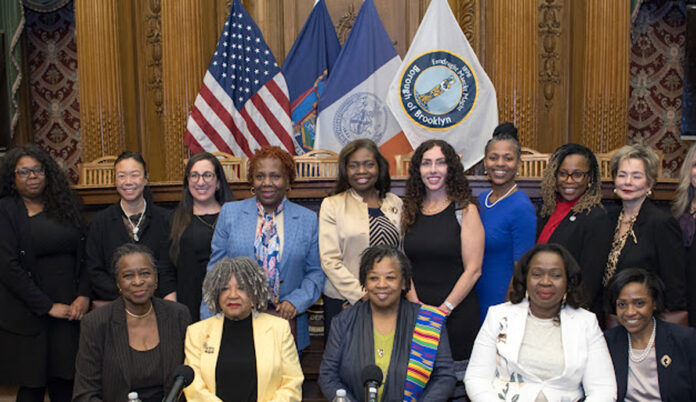
The Brooklyn Women’s Bar Association, the Caribbean American Lawyers Association and Brooklyn Borough President, Antonio Reynoso, co-sponsored a centennial celebration of Black History Month. The celebration was hosted at Brooklyn Borough Hall on April 8, 2026, with Deputy Borough President Kim Council serving as master of ceremonies.
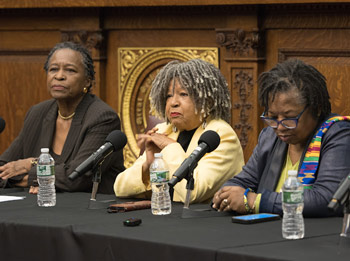
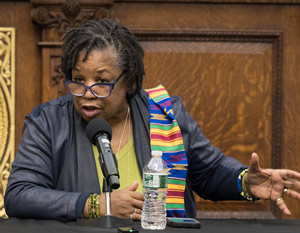
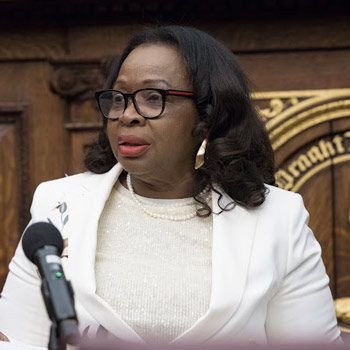
The panel featured Hon. L. Priscilla Hall (Ret.), Hon. Yvonne Lewis (Ret.), and Esmeralda Simmons, Esq., with the discussion moderated by Hon. Sylvia Hinds-Radix (Ret.), President of the Caribbean American Lawyers Association (CALA), and Hon. Rhonda Tomlinson.
The history of Black women lawyers in the United States is not simply a story of individual achievement. It is a story of collective advancement—built through institutions created in response to exclusion. From Reconstruction to the present, Black women have entered the legal profession by confronting two overlapping barriers: racism and sexism. Their progress has depended not only on individual perseverance, but on the strength of organizations that created pathways where none existed.
In the late nineteenth century, pioneers like Charlotte E. Ray—who became the first Black woman to earn a law degree in 1872 from Howard University School of Law—and Mary Ann Shadd Cary, who earned her law degree eleven years later in 1883, entered a profession that largely refused to recognize them. Both were educators who used their training to serve their communities. By 1900, fewer than ten Black women lawyers existed in the United States.
When denied access to courtrooms, they advanced justice through suffrage, education, and community organizing, laying the foundation for future generations.
A major institutional turning point came in 1925 with the founding of the National Bar Association (NBA), the first Black bar association in the United States. Established after Black lawyers were denied entry to the American Bar Association—and notably including Gertrude E. Rush as the only woman among its founders—the NBA became a national platform for mentorship, advocacy, and professional development. It provided a space where Black lawyers could be trained, supported, and heard, helping to cultivate generations of legal leadership.
From that institutional base, Black women began to make historic gains on the bench. In 1939, Jane Bolin became the first Black woman judge in the United States, appointed to the New York City Domestic Relations Court. Yet it was not until 1966 that an African American woman was appointed to the federal bench, when Constance Baker Motley broke that barrier. Her appointment marked a shift from symbolic inclusion to real judicial authority.
The decades that followed saw continued breakthroughs. In 1979, Judge Amalya Kearse became the first Black woman appointed to a United States Court of Appeals. In 2013,
Judge Sheila Abdus-Salaam became the first Black woman to serve on the New York Court of Appeals, the state’s highest court. In New York’s trial courts, Hon. Yvonne Lewis’s election to the Civil Court in Kings County in 1986—and her subsequent service on the Supreme Court—reflected the growing presence of Black women across all levels of the judiciary.
At the same time, Black women were shaping the law itself. Pauli Murray, a graduate of Howard University School of Law and a founding member of the Congress of Racial Equality (CORE), authored States’ Laws on Race and Color, often described as a civil rights handbook. Her work became a foundational resource for civil rights litigation, including arguments used in Brown v. Board of Education. In 1994, Judge Deborah Batts further expanded representation as the first openly LGBTQ Black federal judge.
These advancements did not occur in isolation. They were supported by Black legal organizations.
In New York, Esmeralda Simmons played a central role in this institutional development. She became the first woman to lead the Bedford-Stuyvesant Lawyers Association, which later merged with the Harlem Lawyers Association to form the Metropolitan Black Bar Association (MBBA) in 1984. For decades, she also served as the founding Executive Director of the Center for Law and Social Justice at Medgar Evers College in Brooklyn, building a model that connected legal practice with community empowerment.
Organizations such as the MBBA, the Association of Black Women Attorneys (ABWA), and CALA—working in conjunction with community-based institutions—have created an enduring professional ecosystem. Through mentorship, advocacy, and pipeline programs, they have ensured that Black lawyers, particularly Black women, are not only entering the profession but advancing within it.
As President of CALA, Hon. Sylvia Hinds-Radix emphasized the organization’s mission: to respond to the needs of Brooklyn’s large Caribbean community by addressing legal issues affecting that population—particularly immigration—while ensuring that Caribbean attorneys have a professional home. Central to that mission is building trust between lawyers and the communities they serve and supporting students who aspire to become attorneys committed to serving those communities.
Equally important are organizations specifically centered on Black women. The ABWA, founded in 1976 by alumnae of Howard University School of Law, has provided a space to address the distinct challenges Black women face in the profession. As Justice Hall noted, Black women lawyers often confront disrespect and assumptions about their roles in the courtroom—making it essential to have spaces for mentorship, strategy, and mutual support.
While Black legal organizations created pathways from the outside, Black women also began to transform institutions from within.
In 2015, Paulette Brown became the first Black woman elected President of the American Bar Association—the very organization that had once excluded Black lawyers. In 2020, Sheila Boston became the first woman of color to serve as President of the New York City Bar Association. These milestones reflect a broader shift: Black women not only gaining entry into majority institutions but rising to lead them.
This dual strategy—building independent institutions while ascending within established ones—has been central to the advancement of Black women in the law.
The influence of this history is both structural and deeply personal. As Hon. Yvonne Lewis reflected on the legacy of Judge Jane Bolin, the role of a judge is grounded in purpose: to do the right thing and to assist wherever possible. That ethic continues to guide generations of Black women on the bench.
Today, the work continues. Black women remain underrepresented in law firm partnerships and judicial leadership. Yet the institutions built over the past century—beginning with the National Bar Association and extending through organizations like the MBBA, ABWA, CALA, and the Center for Law and Social Justice—continue to provide the infrastructure for advancement.
As Taa Grays, President-Elect of the New York State Bar Association, has emphasized, diversity, equity, and inclusion are not abstract ideals. They are essential to professional success, equal access to justice, and the integrity of the rule of law.
As we mark the centennial of Black History Month’s origins—beginning with Negro History Week in 1926—this history offers a clear lesson. Progress is not inevitable. It is built through collective effort, institutional support, and sustained leadership.
Black women lawyers have moved from exclusion to authority. They have built institutions where none existed—and then transformed the institutions that once excluded them.
That is not only a history of progress. It is a blueprint for the future.
all photos by Roderick Randall