
Michael Waldman
The Brennan Center
Later this year, states will begin the process of redrawing their congressional maps. It’s the same fraught and abuse-prone process that happens every 10 years after the census count is finalized. But in a new report released last week, Michael Li shows that the next round of redistricting in 2021 and 2022 will be the most challenging in recent history. The stakes couldn’t be any higher either: it could decide which party controls Congress for many years to come.
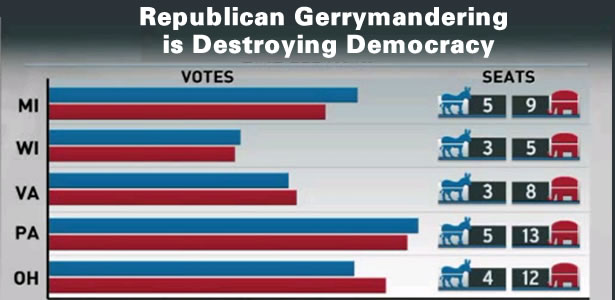
When Republicans swept the midterms nationwide in 2010, they were able to lock in gerrymanders that lasted a full decade. Since then, demographics in the South and Southwest have changed rapidly, and almost all of the growth of the eligible voting population comes from communities of color. But that growth could mean very little for the political power of these communities, with partisan gerrymandering still threatening to diminish, or even erase, their political power. Florida, Georgia, North Carolina, and Texas are at particular risk of abuse.
What makes the upcoming process more challenging than the last?
As Ronald Brownstein describes in his Atlantic piece covering our new report, it will be the first since the Supreme Court’s 2013 decision in Shelby County v. Holder that gutted the Voting Rights Act. Prior to the decision, the law required that states with a history of racial discrimination (including those at-risk states) receive preclearance from the Justice Department for changes in their election laws, including redrawn maps. This redistricting cycle will be the first since the Voting Rights Act was passed in 1965 where communities of color will lack this protection. It’s one of many reasons why Congress must pass the John Lewis Voting Rights Advancement Act (VRAA) and the For the People Act.
While there may not be enough time to fully restore the preclearance process before map drawing begins, certain provisions of the VRAA would at least give judges more leeway to block racially biased maps. And in the short run, the For the People Act would have an important positive impact on the upcoming redistricting. By establishing uniform rules for drawing districts, banning partisan gerrymandering, and requiring more transparency in the map-drawing process, it could protect against the gravest threats to fair map drawing across the country.
The upcoming redistricting process isn’t all bleak. As Li writes, “expect a tale of two countries.” Newly enacted reforms in much of the country will make it harder to force through partisan gerrymanders or racially discriminatory maps. But in other states, there may be even greater room for unfair processes and results than in 2011. Unless Congress passes the For the People Act and the VRAA.