
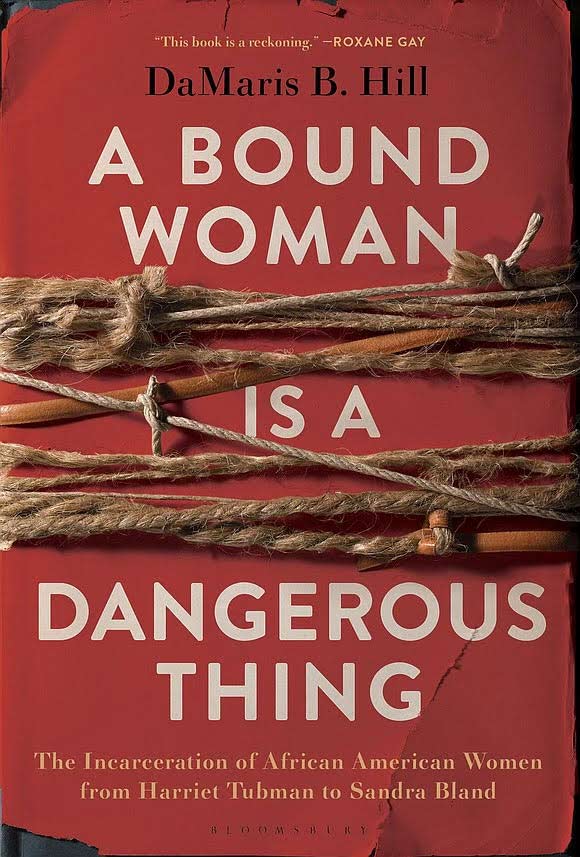
The Incarceration of African American Women from Harriet Tubman to Sandra Bland
A Bound Woman is a Dangerous Thing: The Incarceration of African American Women from Harriet Tubman to Sandra Bland – By DaMaris B. Hill
Bloomsbury Publishing, 163 pages. 2019
“In these poems, the legacy of these women’s lives chases me like a strong wind. This book is a love letter to women who have been denied their humanity.”
DaMaris Hill’s A Bound Woman is a Dangerous Thing: The Incarceration of African American Women from Harriet Tubman to Sandra Bland (Bloomsbury, 2019) is a narrative in poems and prose that is a testament to women who have engaged in acts of resistance as a result of enslavement, domestic violence, rape, incarceration, and the liberation struggle.
Hill encapsulates the stories of these women in poetry, prose, first-person testimonies, and photographs that capture the pain, grief, and determination of Black women who have been wounded spiritually, emotionally, and physically. Some of the women portrayed are from Kali Nicole Gross’s book Colored Amazons: Crime, Violence, and Black Women in the City of Brotherly Love, 1880-1910.
Readers will be witnesses to the stories of women such as Harriet Tubman, Ida B. Wells, Fannie Lou Hamer, Sandra Bland, Claudia Jones, and Assata Shakur. Hill’s poems are testaments to the passion exhibited by these women in their fight against injustice. She is not concerned with their political affiliation or their politics.
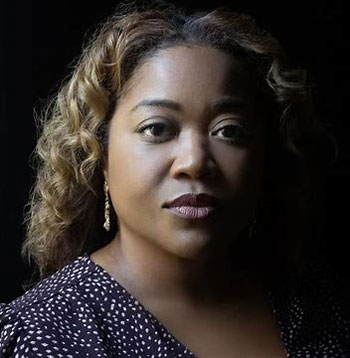
Her lifting of the voices of these women demonstrates her commitment to ensuring that all voices are represented and heard in the struggle for human rights. In response to the question of what it means for a Black woman to engage in resistance, Hill states: “It means that I must give myself permission to love, weep, grieve, call on ancestors, and begin a daily ritual of resistance, even if it is rooted in my fears.”
Hill introduces the women in the book with black and white photographs that symbolize the period in which the woman lived, a short statement on the woman’s life, and a poem or poems that illustrate an act of resistance taken by the woman. Laura Williams, for example, is a Black woman who was convicted and imprisoned in 1887. She dies of tuberculosis one month before her sentence ends. In the poem “Stewing,” the speaker utters her despair.
Tuberculosis fevers stew my pain.
Curdle my stomach’s bile.
Vomit creeps.
I dream of hounds.
Their teeth loose in my veins.”
Several verses highlight Hill’s poems on the activism of Ida B. Wells, journalist, educator, and suffragist. “Calculations” exposes the horror and brutality inflicted on Black men who are lynched.
In the 1862nd year of the
year of our Lord,
there were 241 lynched
torn from wives’ arms and
wedding chambers
Multiply that by the rope. Count the
trees they strung from
The torches. All of this
done under the armor of white supremacy
mob violence
One of the women highlighted for her political activism in A Bound Woman is Claudia Jones. A Trinidadian-born journalist and activist, Jones began engaging in activism at the age of 21. She worked with organizations that aided the Scottsboro Boys and later became a member of the Young Communist League, USA.
During her life, she spent time in prison after being falsely accused and found guilty for violating the McCarran Act (a requirement that Communist organizations register with the United States Attorney General). An excerpt from Hill’s poem “Claudia Jones” highlights Jones’s impact as an activist.
Trinidad’s daughter, justice’s
town crier and good good girlfriend
of Amy Ashwood Garvey . . . .
How many ways did you right women?
In “This Granny is a Gangster,” Hill describes the activism of Sonia Sanchez, who at 82, along with eleven other grandmothers, staged a sit-in protest at a large military recruitment center in Philadelphia. She and the other activists disrupted the recruitment station and motivated others to join the protest against the Iraq War. Hill states:
She wields protests like wind. At 82
she marches like she is leading
a second line. Awe at her knees.
With her cane
she cracks blessings and calls your
nearest kin.
Shespeaks peace in a cadence of
prayers.
Hill’s poem in memory of Sandra Bland will resonate with many. She pens the words:
It could have been me,
like Sandy, I would have missed them
dashes in the road.
The ways I skirt around
corners under the cover of the sun.
I fleeing
an interview happy to have
some means, pockets fluffy
with promises.
The symbolism of A Bound Woman is a Dangerous Thing: The Incarceration of African
American Women from Harriet Tubman to Sandra Bland speaks to the many ways that women have been bound and “scarred” in America. Hill’s documentation of these voices in verse creates a space for valuing the humanity of these African American women.
DaMaris B. Hill. poet and creative scholar, is chair of the English and World Languages Department at Morgan State University. A Bound Woman Is a Dangerous Thing is her first poetry collection. Her most recent book is Breath Better Spent: Living Black Girlhood.
Dr. Brenda M. Greene is Professor Emerita and Founder and Executive Director Emerita of the Center for Black Literature at Medgar Evers College, CUNY. For more information, visit https://www.drbrendamgreene.com