
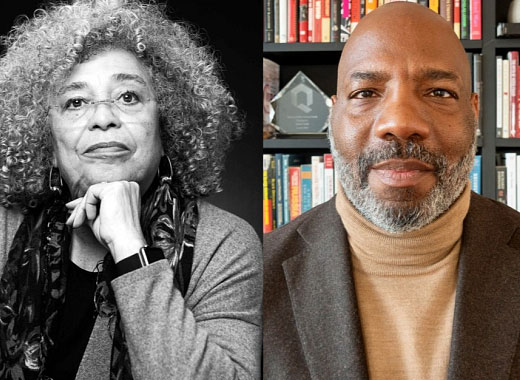

In a milestone recognition of the 250th anniversary of the founding of the United States and the signing of the Declaration of Independence, the Brooklyn Public Library’s 2026 Kahn Humanities Series invited two of the country’s leading scholars and educators, Angela Y. Davis and Jelani Cobb, to share thoughts about the document and the celebration.
Framed by activist Professor Davis’s extensive work and commitment as an advocate of the oppressed and civil rights, human rights, and women’s rights activist for more than six decades, the conversation was guided by Pulitzer-nominated journalist-historian Professor Cobb, Dean of Columbia School of Journalism.
The series attracted hundreds to the library and had a profound impact on the audience of all ages and cultures. Pre-teen Janiyah and her mother, Maria J. Hackett, offered reflections exclusively to Our Time Press on an event that will change their lives.
The full conversation can be viewed on YouTube or the BPL Presents Instagram page. The following are excerpts:
Jelani Cobb:
Commemorations are often as much about the current moment as they are about the moment that is being commemorated.
We talk about the contradictions of the Declaration of Independence and the Constitution, which led directly to the Civil War. And when you look at the Civil War, the kind of summation we make of it is that there’s one side that’s fighting to preserve slavery; the other side fighting to preserve the Union. Both staked a claim to 1776. (We) Rarely grapple with the Confederate argument that they were the true heirs to what the founders had been trying to create in 1776.
Angela Davis:
Remember the collective sentiment in 2020 when more people than ever before in the history of this country went out into the streets to stand up against racism. And, you know, of course, we can talk about all of the moments that led to that surge.
This may be a somewhat simplistic analysis, but it felt like masses of people in this country, stimulated by the possibility of real democracy, were really ready to move forward, to take that step. But we hadn’t really taken into consideration what would be necessary in order to challenge counter forces.
There were others who were very much aware of the potential of what was happening. Conservative forces have been planning, you know, for decades to try to seize the time, to grab the reins of history.
I think we were kind of naive. We weren’t really doing the work that would allow us to counteract the counter-revolutionary forces. I think we need to learn from that. Because that was a moment when we really could have seized the time. But if we didn’t do it in 2020, there may come another conjuncture. And we need to be more prepared.
If we want to talk about the promise of the Declaration of Independence, the promise of democracy, it has been black people and other people of color, it has been women of all racial backgrounds, it has been working-class people, regardless of their racial background, who have actually pushed for the broadening of the sense of democracy that is installed by the Declaration of Independence.
Jelani Cobb
So, I think one of the interesting paradoxical points here, is that there are these obvious contradictions. In the first draft of the Declaration, Jefferson lists a litany of offenses that warrant separation from the British crown; mentions the transatlantic slave trade, which he refers to as an execrable traffic in human beings.
And then they copy-edit that line out. So that the version of the document that is signed does not have any objection to the transatlantic slave trade. And he does that to make the document more palatable to Southern colonies, to make sure that they’re willing to sign on to this.
But at the same time, here’s the paradoxical part. The Declaration is cited in the Haitian Revolution, the French Revolution, by Ho Chi Minh, and the Vietnamese struggle against the French before the Americans were even involved in that conflict. The Declaration is cited by independent strugglers throughout Latin America. This idea of anti-colonial consciousness connects to that document.
Angela Davis
Let’s also remember that the (document) is cited in relation to women’s suffrage (and) the 1905 Niagara Movement’s “Declaration of Principles,” the Black Panther Party’s 10-point program. So how does that work? I think that it’s about ways of finding potential, of finding promise.
It is the founding document of this place that we inhabit. We have a responsibility not only to try to understand it, but also the ways in which it has been utilized, both productively and sometimes quite unproductively.
I would suggest that we try to hold on to the tension and the contradictions that are inherent. As people who live in the United States, we’ve been educated to want to find ways to move beyond contradictions, to find an analysis and an approach that doesn’t require us to take note.
We look at these moments of promise that only apply to a limited number of people, and we demand an expansiveness of the very freedom that is narrowed in that document.
In the words of Mariame Kaba (paraphrasing), ‘Hope is not just a feeling. Optimism is not a feeling. It’s a practice. It’s discipline.’ And I’ve concluded that one of the tasks of the organizer is to create that hope, is to help generate that hope, to help people acquire a sense of the collective power they wield.
I’ve been accused of being an inveterate optimist, but I’m not an optimist who does not pay attention to the need to do the kind of cold analysis that allows us to recognize where we are.
(To Be Continued)
Bernice Elizabeth Green/Legacy
Editorial Curation