

Book Review
By Dr. Brenda M. Greene
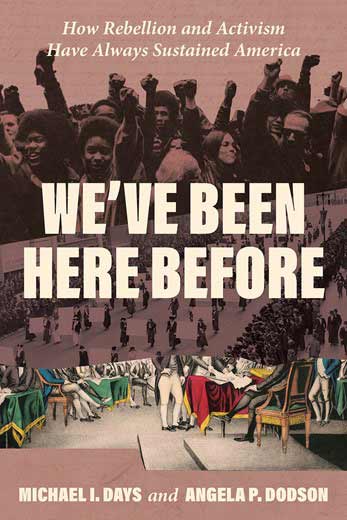
Angela Dodson’s and Michael Day’s We Have Been Here Before: How Rebellion and Activism Have Always Sustained America (Broadleaf, 2026) provides a compelling counternarrative on the history of enslaved, disenfranchised, and subjugated people in our nation. Through an examination of constitutional laws, newspapers, decrees, letters, fiction, poetry, and firsthand testimonies, readers gain an understanding of an American narrative that is much more complicated than the narratives we see in the history books of our educational institutions.
Days and Dodson remind us that as we observe the erosion of democratic principles on the semiquincentennial of the United States, we should remember that this is not a new story. There have been significant key revolutionary movements that illustrate how movements have been fought and sustained in the midst of contradictions.
The founding of the Constitution is one such critical defining moment in the fight against colonialism. Frederick Douglass’s response to the celebration of the founding of this country illustrates the contradictions inherent in this celebration for enslaved Black people.
In June 1852, Frederic Douglass delivered an Independence Day address to the Rochester Ladies’ Anti-Slavery Society. Douglass asks in his address: “Fellow-citizens, pardon me, allow me to ask, why am I called upon to speak here today? What have I, or those I represent, to do with your national independence?” He had been asked to speak on the day celebrating the founding of the Constitution, when the principles on which the Constitution was founded had been compromised. His address exposes the contradictions and hypocrisy of the founders who were still enslaving millions of Black people.
Days and Dodson provide examples that extend the argument laid out by Douglass. Beginning with the story of an enslaved Angolan named John Bunch from Africa who is sold as an indentured servant upon his arrival in Virginia in 1619, they recount that when Bunch attempts to escape with other White indentured servants, he is captured and given a life sentence of slavery, while the White indentured servants have their indentured service extended to more years. This practice continues in the colonies.
White indentured servants eventually gained their freedom, while Africans were held in slavery for life.
Acts of resistance to slavery are numerous and, in the chapter “Response to Enslavement: Rebellion, Self-Emancipation, and the Underground Railroad,” Days and Dodson cite examples that include more than 250 rebellions; the numerous escapes through the Underground Railroad; and detailed descriptions of how Denmark Vesey, Nat Turner, Henry Box Brown, Sojourner Truth, and John Brown responded to enslavement.
The contradictions to this initial experiment in democracy continue, and Days’ and Dodson’s chapter “In Search of Religious Freedom” references Jay Mibrandt’s They Came for Freedom: The Forgotten, Epic Adventure of the Pilgrims (Norton Books, 2017). Published during the Reagan era, this book highlights the paradoxes of the founding of a country by immigrants and the ongoing current debate on whether the country should continue to support immigrant refugees.
In the chapter, “Indigenous People: Resisting Colonizers,” the treatment of Indigenous people from the 1600s highlights the long history of abuse and exploitation by the United States and speaks to why many Indigenous groups view Thanksgiving as a “Day of Mourning.” Despite a Thanksgiving celebration that reflected the coming together of “Indians and Europeans,” 700 Indigenous Pequot people were massacred in 1637 as part of a Thanksgiving celebration in the Massachusetts colony.
Indigenous people also faced the destruction of family systems harmed by addictions to drugs and alcohol, abandonment, and the removal of their children to boarding schools. And although President Biden apologized for the government’s running of boarding schools while he was in office, there are still ongoing fights by Indigenous people for land rights and self-determination.
Days’ and Dodson’s chapters in We Have Been Here Before are not just a recounting of historical events that helped to shape this country. Rather, each chapter provides an overview of the people, policies, and events that shaped this country and presents readers with an analysis of resistance, persistence, and ongoing struggles to uphold the principles of a democratic society framed by institutionalized racism. Readers will come away from this text with a deeper understanding of the need to contextualize our history in order to move forward strategically.
Journalist Michael Day transitioned while completing the final stages of the production of We Have Been Here Before. He served as Vice President for Diversity and Inclusion of the Philadelphia Media Network and as editor of the Philadelphia Daily News. Angela P. Dodson, the wife of Michael Day, is a former senior editor for the New York Times, a former Executive Editor of Black Issues Book Review, and editor of We Refuse to Be Silent: Women’s Voices on Justice for Black Men.
Dr. Brenda M. Greene is an Author, Professor Emerita, and Founder and Executive Director Emerita of the Center for Black Literature at Medgar Evers College, CUNY. For more information, visit https://www.drbrendamgreene.com