

By Kazembe Batts IG: @kazbatts
Restaurants, sports bars, lounges, and pop-up street corner watch parties throughout New York City are giving people an excuse to get “outside,” network with friends, and enjoy the world’s most popular sporting event, the FIFA World Cup.
As you watch the matches, one thing becomes immediately obvious: many of the traditional soccer powerhouses in Europe and South America feature numerous African or Black players. That reality reflects centuries of migration, colonial history, and the globalization of professional football.
Yet while many African stars wear the jerseys of France, England, Portugal, Belgium, and other football giants, the FIFA World Cup remains a nation-state competition, where players represent the countries, they are eligible to call home. With that in mind, it is worth taking a closer look at the remarkable rise of Africa’s national teams.
For decades, African football was often viewed as talented but inconsistent—a collection of gifted athletes capable of brilliant moments but lacking tactical discipline. That perception has changed dramatically. Today’s African teams are organized, technically sound, and capable of defeating the world’s elite.
The last three FIFA World Cups tell the story of a continent steadily closing the gap with football’s traditional powers. The biggest story of the 2026 World Cup may not be one individual team, but an entire continent.
The expanded 48-team tournament gave Africa ten qualifying places, and African nations have made the most of the opportunity. Nine of the continent’s ten representatives advanced from the group stage into the Round of 32, the strongest collective World Cup performance in African football history.
Their success has strengthened arguments that Africa deserves even greater influence within FIFA and international football. The World Cup itself is also big business. FIFA expects the 2026 tournament to generate approximately $12 billion in revenue, making it one of the most lucrative sporting events ever staged.
As television audiences and commercial sponsorship continue to grow, debates surrounding FIFA governance, regional confederations, and financial transparency remain part of the global conversation.
One controversy leading into this year’s tournament has centered on FIFA’s decision to expand the World Cup from 32 to 48 teams. Ghana coach Carlos Queiroz questioned whether easier qualification diminishes the prestige of reaching the tournament.
Others argue the expansion simply recognizes football’s growing global competitiveness and allows deserving nations from Africa, Asia, the Caribbean, and elsewhere to compete on the world’s biggest stage.
Success did not happen overnight. At the 2018 FIFA World Cup in Russia, Africa was represented by Egypt, Morocco, Nigeria, Senegal, and Tunisia. None advanced beyond the group stage, but several came painfully close.
Senegal was eliminated only because of FIFA’s Fair Play disciplinary tiebreaker after finishing level with Japan on points, goal difference, and goals scored—the first time that rule determined advancement. Morocco also impressed despite facing Spain and Portugal in a difficult group, hinting that something special was developing.
That possibility became reality four years later in Qatar. Morocco produced one of the greatest Cinderella stories in World Cup history, becoming the first African and first Arab nation ever to reach the semifinals. The Atlas Lions defeated Belgium in the group stage before eliminating Spain in a dramatic penalty shootout and stunning Portugal in the quarterfinals.
Led by goalkeeper Yassine Bounou, captain Romain Saïss, midfielder Sofyan Amrabat, and a disciplined defensive system, Morocco inspired millions across Africa and the Arab world. Although France ended the dream in the semifinals, Morocco’s fourth-place finish remains the greatest achievement ever by an African nation at a FIFA World Cup. Other African teams also left their mark in Qatar.
Senegal reached the Round of 16 despite missing injured superstar Sadio Mané. Cameroon shocked Brazil with a memorable victory, Tunisia defeated France, and Ghana narrowly missed advancing.
Together, these performances demonstrated that African football had entered a new era. Four years later, Morocco’s achievement no longer appears to be an isolated miracle. Instead, it has become the foundation for an African football renaissance.
Africa’s 2026 World Cup participants are Morocco, Senegal, Ghana, Egypt, Algeria, Ivory Coast, South Africa, DR Congo, Cape Verde, and Tunisia. By the time you read this article, some teams may already have been eliminated. Nevertheless, the continent’s representatives have already made history.
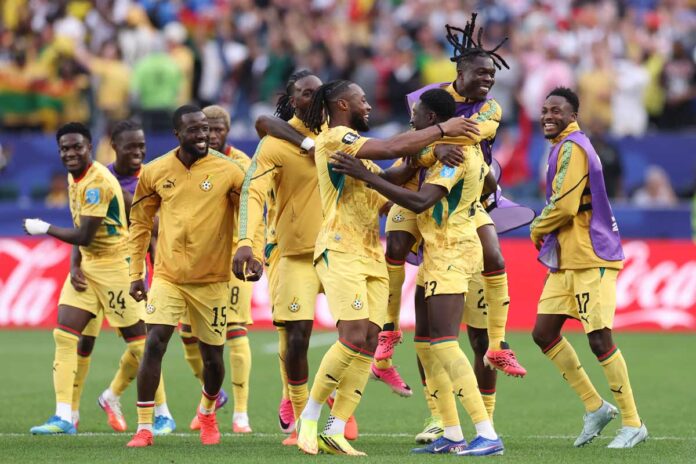
Morocco continues to carry Africa’s highest expectations following its historic semifinal appearance in 2022. Senegal combines athleticism with technical quality and tournament experience. Ghana is rebuilding around an exciting younger generation, while Egypt remains one of Africa’s traditional football powers.
Algeria has returned with a technically gifted squad capable of upsetting anyone, and Ivory Coast enters the tournament as the reigning African champion. South Africa has completed an impressive rebuilding project after years away from football’s biggest stage.
DR Congo has returned to the World Cup for the first time since 1974, while Cape Verde has become one of the tournament’s biggest surprises by reaching the knockout stage in its World Cup debut. Tunisia once again demonstrated the disciplined, organized football that has become its trademark.
The Caribbean also has reason to celebrate. Haiti returned to the World Cup for the first time since 1974, bringing speed, creativity, and tremendous national pride. Curaçao qualified for its first FIFA World Cup after years of investing in youth development and recruiting dual-national professionals playing throughout Europe.
Together, they symbolize the steady rise of Caribbean football on the international stage. African & Caribbean football is no longer asking the world for recognition—it is earning respect through results.
As coaching improves, youth academies expand, domestic leagues become more competitive, and more players gain experience in the world’s top professional leagues, the future looks brighter than ever. Morocco showed in 2022 that an African nation could compete for a World Cup championship.
The performances of African teams in 2026 suggest that Morocco’s historic run was not the exception—it was the beginning of a new chapter. Africa’s World Cup moment has arrived, and the rest of the football world is finally taking notice. NYC is still the Capital of the World and readers are urged to embrace the joy as the FIFA World Cup continues!