

By Mary Alice Miller
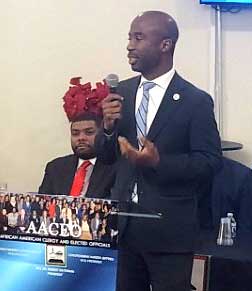
The African American Clergy and Elected Officials organization began the new year and new mayoral era with greetings from the new Schools Chancellor Kamar H. Samuels and the First Deputy Police Commissioner Tania Kinsella, the first woman of color to hold the second-in-command position in the NYPD.
Chancellor Samuels told AACEO attendees of how he was arrested during his senior year at Baruch College at age 20 when he unwittingly accepted a package delivered to his apartment. Samuels thought is was a CD (back in the day when CDs were popular), but it actually contained two pounds of marijuana.
“They put me in front of the judge the next morning. My mom hired a lawyer. I was the only person out of about thirty with a private lawyer,” said Samuels. “The first thing my lawyer said is ‘His mom is in court.’ The second thing my lawyer said is ‘He is a senior in college.’”
Samuels said, “That is the first time the judge looked up from her papers and looked in my eyes. The entire room changed.”
The Chancellor said that was the beginning of his path into education.
“When we talk about what education means when everything is stacked against you, especially as a black boy or girl, you need your army,” said Samuels. “Every single black girl or boy needs to get that second look. My goal is to do every single thing I can to make sure they get that second look.”
Samuels continued, “Of course, I want schools to be safe, I want schools to be rigorous, I want schools to be truly integrated so that people understand the wonderful, beautiful nature of our city. It does take a village.”
Public Advocate Jumaane Williams acknowledged that New York City is the safest it has been with a decrease in shootings and murders.
Williams then talked about the need to stick together.
“Y’all see what is happening out there with Trump, Kristi Noem, and Pam Bondi. Too many of us drank some of that orange kool aid and our communities picked it up because we thought it was going to happen to other people,” said Williams.
“That is a lesson we have to learn,” Williams said. “If you draw a line of bias, it gives people permission to draw a line of bias against you. You see they killed a United States citizen. A white woman was shot in the face by ICE. ICE is coming and they are not caring about who is a citizen and who is not, they are coming for everybody.”
Williams said he wanted to see more people of color on the streets.
“Please, when we are making a call for folks to come out, do whatever you are comfortable doing: pray, sing, bring a sandwich, bring some water, you can just be present to witness,” said Williams.
Williams concluded, “The only thing that can help us is the Most High and us.”
Brooklyn District Attorney Eric amplified the historic safety levels in Brooklyn and New York City.
“Things are improving in terms of our safety. Our kids are able to get to school and home safely. People are able to walk on the streets and not worry about violent crime as often. It is citywide,” said Gonzalez. “Brooklyn has the best news of any borough.”
Gonzalez reminded the audience that he lost a brother to gun violence. “I was committed as district attorney to reducing gun violence for our families. We’ve worked with our police department, our violence interrupters, our community, our clergy, our community activists. We have all figured out different strategies to get young men in particular to leave those guns behind and not shoot. We’re benefitting from a peace dividend,” said Gonzalez.
“When one young person decides not to shoot their rival, then that rival and their friends don’t have to retaliate and shoot back,” he said. “We are all safer because we are not caught in the crossfire. I am grateful to the police department and all of you who have done this work together. Brooklyn is the safest it has ever been.”
Gonzalez spoke about his focus on violence prevention.
“District Attorney’s have historically used their office for one purpose: to prosecute and put people in jail. We have to hold people who harm our community accountable, we have to make sure people face consequences when they violate the law,” said Gonzalez. “But I believe since the time I worked with Ken Thompson – I was his Chief Assistant – that we have to focus our efforts on prevention.”
Gonzalez launched Project Restore in the 79th and 81st precincts focusing on young men most likely to either be a victim of gun violence or a perpetrator of gun violence.
“We took the men most likely to be involved in shootings and we showed them love, gave them programming, and people thought I was crazy that I would put $2.3 million towards these young men.
These are the young men nobody really cared about. These are young men that didn’t have jobs, drivers licences, bank accounts, not in school, not working,” said Gonzalez.
“These young men have done so well. They are in school, they are working, they are having families. Since the program started almost three years ago, only one of them has gotten in trouble again,” Gonzalez said. “Because it has worked so well in Brooklyn, that the City of New York has said they want to use Project Restore in the Bronx.”
Gonzalez said he is planning to bring back Begin Again to address the 1.000,000 New Yorkers who have low level summons warrants. “Last time we did it we were able to clear about 600,000 warrants in New York City,” Gonzalez said.
Chief of Brooklyn North Mark Vazquez spoke about Brooklyn’s phenomenal ComStat numbers.
“We have a lot of work to do with our youth. We rolled out our school zones where our kids are going to and coming from school to make sure we have the right police presence and interactions with our youth,” said Vazquez. “Some of our kids get in trouble. It doesn’t mean the end for them. We want them to succeed. We don’t want to see our children going into the system.”
Assemblywoman Stefani Zinerman spoke about everybody having their assignments in 2026.
“We have someone who has proven he does not see you or care about you. Everything we fought for in this country has gone away by executive order, by executive order, by executive order,” said Zinerman. “We don’t have four years. It’s now.”
Zinerman continued, “June and November are the most important benchmarks this year. We have to make sure people win their primaries and win the general election. We cannot afford to have Donald Trump with unfettered power beyond next November.”