
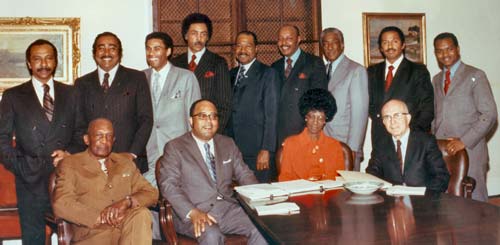

Shirley Chisholm was a founding member of the Congressional Black Caucus in 1971.
A Footnote in History
Chisholm was assigned to the House Agriculture Committee. Given her urban district, she felt the placement was irrelevant to her constituents. When Chisholm confided to Rebbe Menachem M. Schneerson that she was upset and insulted by her assignment, Schneerson suggested that she use the surplus food to help the poor and hungry. Chisholm subsequently met Robert Dole, and worked to expand the food stamp program. She later played a critical role in the creation of the Special Supplemental Nutrition Program for Women, Infants and Children (WIC) program. Chisholm would credit Schneerson for the fact that so many “poor babies [now] have milk and poor children have food”. Chisholm was then also placed on the Veterans’ Affairs Committee. Soon after, she voted for Hale Boggs as House Majority Leader over John Conyers. As a reward for her support, Boggs assigned her to the much-prized Education and Labor Committee, which was her preferred committee. She was the third highest-ranking member of this committee when she retired from Congress.
Chisholm only hired women for her office; half of them were Black. Chisholm said that she had faced much more discrimination during her New York legislative career because she was a woman than because of her race.