
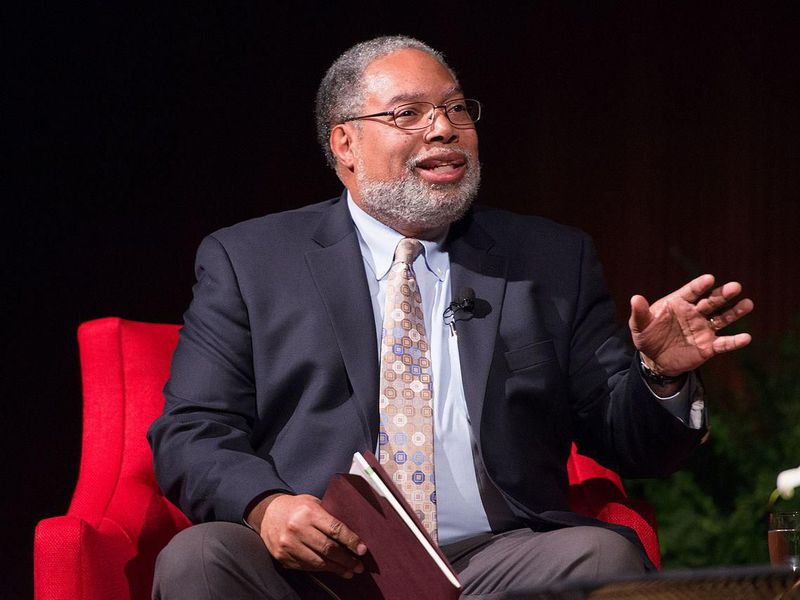

especially the Smithsonian
Institution. I like to say that I
am the only person who left
the Smithsonian twice—and
returned,” said Lonnie Bunch, who
was appointed today to be the
Smithsonian’s 14th Secretary.
Photo: Lauren Gerson/LBJ Library )
smithsonianmag.com
The Founding Director of the National Museum of African-American History and Culture, Bunch represents the first insider to lead the Institution in decades
The Smithsonian today named Lonnie G. Bunch III as the 14th Secretary of the Smithsonian Institution. Bunch is the Founding Director of the National Museum of African American History and Culture (NMAAHC), a position he has held since 2005. Prior to that, Bunch served as the President of the Chicago Historical Society. He succeeds David J. Skorton as Secretary and will be the first African-American to hold the position.
In a Smithsonian press release announcing the new appointment, Bunch said, “I am excited to work with the Board of Regents and my colleagues throughout the institution to build upon its legacy and to ensure that the Smithsonian will be even more relevant and more meaningful and reach more people in the future.”
Bunch was born in Newark, New Jersey in 1952 and attended Washington, D.C.’s Howard University before transferring to American University where he earned his Bachelor’s and Master’s degrees in American History and African History. His ascent at the Smithsonian includes posts as historian, curator and director. The opening of NMAAHC in 2016 represented a monumental achievement for the Smithsonian, one accomplished thanks to the Herculean efforts of Bunch.
In the Smithsonian press release, John G. Roberts, Jr., the Chief Justice of the United States and Smithsonian Chancellor said, “Lonnie Bunch guided, from concept to completion, the complex effort to build the premier museum celebrating African-American achievements.”
“This is a great moment for America,” says Kinshasha Holman Conwill, NMAAHC’s Deputy Director. “It’s really the validation of the concept of what it means to achieve in this country. But the main thing is that this is one of the most distinguished historians on the planet. It’s a great moment for the humanities because for someone steeped in history to run this institution, it’s so exciting. It’s hard for me to put in words. There’s no one on earth I admire more.”
It was the former Apollo 11 astronaut Mike Collins, the Director of the National Air and Space Museum at the time, who first brought Bunch to the Smithsonian, hiring him as a historian at the museum in the 1970s. In 1983, Bunch moved across the country to become the first curator at the California African-American Museum in Los Angeles. But in 1989, the Smithsonian once again beckoned Bunch back with an offer to join the curatorial staff of the National Museum of American History, where he served for five years, collecting one of the museum’s most iconic artifacts, the Greensboro Lunch Counter, and curating one of its most popular ongoing exhibitions, “The American Presidency: A Glorious Burden.” In 2000, he left the Smithsonian again to become the President of the Chicago Historical Society.
“In college and graduate school, I trained as an urban historian, specializing in the 19th century. And while I taught history at several universities, I fell in love with museums, especially the Smithsonian Institution. I like to say that I am the only person who left the Smithsonian twice—and returned,” he wrote.
At the American History Museum, Director Roger Kennedy, known for his ambition and brash manner, became Bunch’s mentor, teaching him how to navigate a bureaucratic operation and instilling in him the tools for leadership. If you stick to official channels, Bunch recalled Kennedy telling him, “progress will be glacial.” Despite sometimes biting off more than he could chew, Kennedy made the museum “a great place of possibility,” Bunch recalled. “He brought forward ideas.”
When Bunch got the nod in 2005 to become the Director of the National Museum of African-American History and Culture, he was staggered by the overwhelming task, noting with characteristic self-effacement in an essay for Smithsonian magazine that all that was left yet to do “was to articulate a vision, hire a staff, find a site, amass a collection where there was none, get a building designed and constructed, ensure that more than $500 million could be raised from private and public sources, ease the apprehension among African-American museums nationwide by demonstrating how all museums would benefit by the creation of NMAAHC, learn to work with one of the most powerful and influential boards of any cultural institution and answer all the arguments—rational and otherwise—that this museum was unnecessary.”
In little more than a decade, Bunch accomplished his list, bringing together dozens of influential curators and educators, amassing a collection of more than 35,000 artifacts housed in a 400,000-square-foot world-class, $540 million, LEED-certified museum on the National Mall and within sight lines of the Washington Monument and the Lincoln Memorial. Last week, the museum, in partnership with the Alabama Historical Commission and SEARCH, Inc., a group of maritime archaeologists and divers authenticated and confirmed the finding of one of America’s last-known slave ships. The Clotilda arrived illegally in the United States in 1860, long after the International Slave Trade was banned, enslaving 109 Africans from the Kingdom of Dahomey. Working closely with a community of the ship’s descendants still living together in Africatown, Alabama, the museum is working to preserve their history and the story of the Clotilda.
Spencer Crew, a former Director of the Smithsonian’s National Museum of American History, will be the Interim Director of the National Museum of African-American History and Culture