
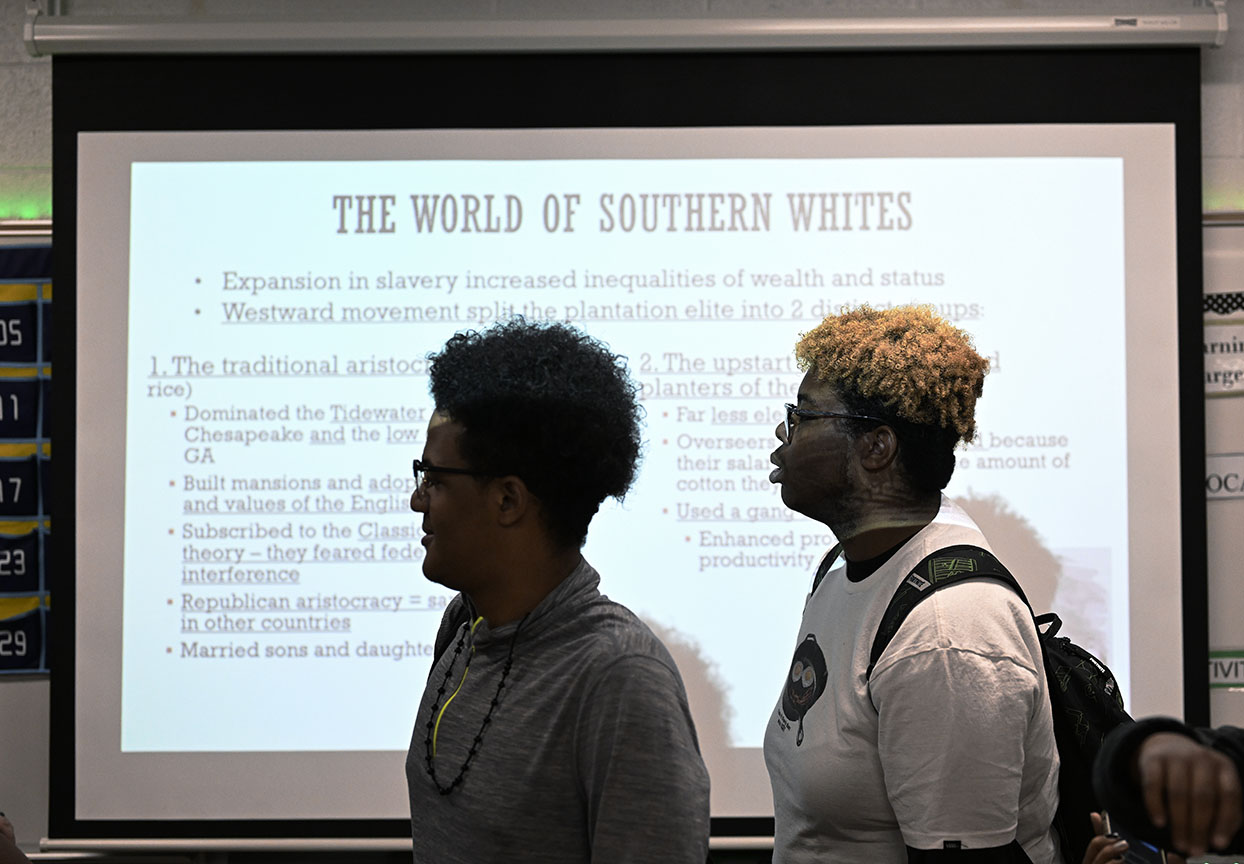

AURORA, COLODARO – NOVEMBER 1: Hijab Tekle, 17, left, and Nehemiah Young, 18, leave AP African-American Studies at the end of class at Overland High School on November 1, 2022 in Aurora, Colorado. The AP African-American Studies course is part of a national pilot class that about 60 schools nationwide are participating in. (Photo by RJ Sangosti/MediaNews Group/The Denver Post via Getty Images)
By Fern Gillespie
The College Board kicked off Black History Month 2023 by launching its long-awaited Black History A.P. course for high school students and kowtowing to right-wing zealots by deleting crucial post-1980s monumental African American movements and thought-leaders from the curriculum.
The final 234-page curriculum is currently in a pilot program in 60 schools, including Brooklyn Preparatory High School. More than 300 professors of African American studies, including faculty from dozens of HBCUs, were consulted during the development of the course framework, which was completed in December. The content encompasses African kingdoms, slavery, reconstruction, Jim Crow, the civil rights movement, Black Panthers, the Black Arts Movement, select American writers and activists on racism and anti-Black violence, the founding of historically Black colleges and universities, Black Caribbean migration to the United States, Black inventors and the arts.
However, critical post-1980s issues, including Black Lives Matter, affirmative action, queer life, reparations and Black feminism, criminal justice, and Black healthcare, are downgraded. The subjects are no longer part of the exam and are offered on a list of options for a required research project.
The New York Times points out that some of the expunged writers and scholars include Kimberlé W. Crenshaw, a law professor at Columbia, which touts her work as “foundational in critical race theory”; Roderick Ferguson, a Yale professor who has written about queer social movements; Ta-Nehisi Coates, the author who has made a case for reparations for slavery and bell hooks, the writer who shaped discussions about race, feminism, and class.
The “anti-woke” DeSantis’ Florida administration was instrumental in the final curriculum edit disposing of intersectionality and activism, Black queer studies, Movements for Black Lives, Black feminist literary thought, reparations, and Black study and Black struggle in the 21st century. DeSantis, a former history teacher hawking Western history study in Florida schools, believes these teachings violate state laws.
Professor Crenshaw told the New York Times she was stunned when she saw that the Florida Department of Education had targeted topics related to intersectionality, Black feminism, and queer theory. “African American history is not just male. It’s not just straight. It’s not just middle class,” she said. “It has to tell the story of all of us.”
Evelyn Brooks Higginbotham, professor of history and African and African American Studies at Harvard University and an architect of the A.P. course, finds it ironic that DeSantis dismisses Black history because Florida had the first African settlement with the Spaniards, which predated the British 1619. “Did you know that in 1528, Africans were part of an expedition to settle in an area near present-day Tampa Bay? It’s not until 1565 that St. Augustine is established [in present-day Florida],” she told TIME Magazine. “Well, St. Augustine is the oldest surviving city in the United States. Enslaved Blacks and some free Blacks were crucial in building that city, along with whites and some native indigenous people.”
More than 200 faculty members in African American studies condemned Governor DeSantis’s interference in the A.P. course in a letter published in Medium. They accused him of censorship and trying “to intimidate the College Board into appeasement.”
Acceptance of the new curriculum is essential to the nonprofit College Board because A.P. courses constitute a significant source of revenue. The Board took in more than $1 billion in program service revenue in 2019, of which more than $490 million came from “AP and Instruction.