
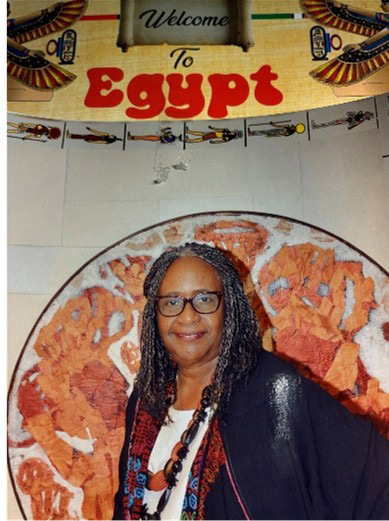

By Dr. Brenda M. Greene
As we read and meditate on our shared history and cultural experiences and on books, art, and images we see, these meditations leave imprints in our dreams and become part of our personal consciousness; however they do not become firmly etched in our memories until we find ways to connect them to past and present experiences, to the places we visit, and to the people with whom we interact.
Traveling to Egypt had always been on my bucket list, and when I formally retired, I determined that I would take this journey. Plans to make this journey during the first year of my retirement came unexpectedly.
I had just visited the Flight into Egypt: Black Artists and Ancient Egypt, 1876-Now exhibit at the Metropolitan Museum of Art with two of my friends. As we were on our way back home, my friend said an email announcing a 10-day tour to Egypt with a three-night cruise on the Nile had just popped into her inbox.
This was synchronicity in the making; I began to envision the fulfillment of my trip to Egypt. We had an option to take the trip in fall 2025 and decided that making this journey would be a great way to celebrate our birthdays, which would occur respectively in October and November. We had been members of the young adult division of the National Association of Negro Business and Professional Women’s Clubs in the 1970s and collectively embarking on a trip five decades later would be a full circle moment for us. Fast forward, we recruited five others for the trip, and on November 15, seven Black women left for Cairo, Egypt.
We became part of a racially and ethnically diverse tour group that included us (seven professional Black women), two Chinese couples, one Korean couple, one White couple, and one White woman. Our tour guide was an Arab Egyptologist who motivated us to connect with each other by telling us that we would be his family for the next ten days.
Like many, my initial impressions of Egypt and the continent of Africa while growing up in the 1950s were formed by Hollywood. My knowledge of Egyptology and Ancient Africa evolved as I began to read scholarship on African history, art, religion, and philosophy while in college and over my years as a university professor and scholar in Black literature and culture. I had read and researched scholars who included Chancellor Williams, Anthony Diop, Ben-Jochannan, John Henry Clarke, John Mbiti, Clinton Crawford, and Chester Higgins, among others.
I also worked in and visited the Brooklyn Museum of Art, where I had an opportunity to view and study the museum’s extensive collection of Egyptian artifacts. The information that I gained from reading and digesting scholarship on Ancient Africa and Egyptology was stored in my memory; however, the content of this scholarship did not excite my intellectual consciousness and impact my emotional consciousness until I visited and witnessed the majestic pyramids, temples, colossal stone Gods, and Ancient Egyptian deities in all their original splendor.
Viewing the pyramids, tombs, and temples up close and observing firsthand the encryptions, hieroglyphics, and detailed drawings on the walls of the tombs and temples touched my spirit and stirred my emotions. I could never have imagined being able to walk into the Great Pyramid of Giza.
Dr. Brenda M. Greene is Professor Emeritus and Founder and Executive Director Emeritus of the Center for Black Literature at Medgar Evers College, CUNY. For more information about Dr. Brenda M. Greene, visit www.drbrendamgreene.com.