Home Blog Page 846

Putting a Halt to Elder Abuse


By Akosua K. Albritton

An African proverb wisely advises: Your children are your social security.  This means parents can be confident that their adult children will keep them housed, fed, and clothed in their golden years, so treat them well when they are growing.  But is this proverb true in today’s society?  Sadly, many elders must continue to work beyond age 65 and, even sadder, too many suffer in silence due to neglect and outright abuse by their adult children.


Take JJ (full name withheld), a man in his early 60s, who battles with his two brothers over the care of their elderly mother and father.  JJ’s parents have experienced abuse and neglect at the hands of his brothers who reside in the family home.


“My parents own a home in St. Albans, Queens in which my brothers live.” One brother is 60 years old, a functioning alcoholic, who holds a therapist position at a medical center in Brooklyn.  The other brother, 58, is unemployed.  JJ knows of incidents of verbal abuse meted on his father, now age 85, and mother, 83.


In 2012, he had his mother moved to a nursing home due to a chronic condition.  In 2013, JJ was awarded power-of-attorney for his parents.  “My brothers were not cleaning the home nor cooking for our parents,” is an example he gave of the neglect and abuse.


January 2016, he relocated his father to the same nursing home as his mother.  Since this move, JJ has worked methodically to remove his brothers from the family home.  He tried physical efforts which legally backfired on him.  Hence, his latest strategy is shutting off the utilities.  Mid-April 2016, the water was turned off.  Within the first week of May 2016, the electricity will be turned off.


These elders are fortunate that at least one child struggles to correct the situation.  What happens when all the adult children take advantage of an aging parent?  “Mary Jackson” (not her real name), a woman in her late 50s who lives in Bedford-Stuyvesant, Brooklyn (east of Malcolm X Blvd.) recalls the life of an elderly neighbor who lived in her block.


“It was drug related.  Her kids were addicted to crack and alcohol.  The lady, in her late 60s or early 70s, suffered with alcoholism that brought on a stroke.  This made her stop drinking.”    She used a walker within her rented home and was pushed in a wheelchair when moving outdoors.


The period in which “Mary Jackson” tried to intervene was between 2008 and 2010.  The [adult children] were in the house using crack, abusing and threatening her for money, explains “Jackson.”  This older woman had four adult children ranging in age from late 20s to 40s.


“The lady wouldn’t admit to the stealing and demands.  I noticed it going on for a couple of years before approaching her.”


Many elders tend to want to keep their household tumult under wraps even when it tumbles into the street.  “Mary Jackson” persisted in her inquiries, but the woman continued to deny any problems.


“I would visit her in her home and find the refrigerator empty. Her response was “I eat” and “Nobody is taking my money,” recollects Jackson.  The elder did ask Mary Jackson to buy her cigarettes and candy which were opportunities for Jackson to check on her physical and housing conditions.


“After so many declines for help, I eventually stopped asking about it but did call abuse hotline.  They did come one time, recalls Jackson.  The elder died in 2010.


Note: Both JJ and “Mary Jackson” are actual people who were interviewed.  They shared their experiences under the condition of anonymity.  The ages, locations, conditions, and dates of the elder abuse cases are their accounts.


Apparently, the tug of the umbilical cord in mothers and even fathers is too great to seek help and/or safety from abuse by family and acquaintances.  However, there is help and protection available.  NYC Department for the Aging (DFTA) offers several resources.  There are the senior clubs and senior centers located throughout the five boroughs.  Besides nutritious meals, comradery, exercise, trips, lectures, and arts and crafts, these centers are oases from harm.  The center directors and program assistants help the seniors to put pride aside to get the life-saving assistance they need.


DFTA’s website (www.nyc.gov/html/dfta/html) contains many uploaded publications.  Titles include The United States Department of Justice, Elder Justice; NYS Office of Victim Services; and Under the Radar: Elder Abuse Prevalence in New York StateUnder the Radar, published in 2011, identified New York City as having the highest reported rate of documented elder abuse (3.8 per 1,000).  Call 311 to connect with DFTA or visit a local senior center.


The NYS Office for the Aging’s (SOFA) website (www.aging.ny.gov) has a downloadable publication entitled Older New Yorkers Guide to Resources.  It has chapters devoted to legal assistance, nutrition, crime, and consumer complaints.  SOFA’s website has a link to NYS Office of Children and Families Services (OCFS, http://ocfs.ny.gov/main/psa/adultabuse.asp) regarding adult abuse.  Adult Protective Services is the division responsible for handling reported adult abuse.  There are six forms of adult abuse including financial exploitation, active & passive neglect, physical abuse, emotional abuse, self neglect, and sexual abuse.  DFTA is the local arm of SOFA. Call 311 to reach Adult Protective Services or DFTA.


In search of legal services for the elderly, this reporter sought out Bedford Stuyvesant Community Legal Services located at Restoration Plaza to learn this organization had recently merged with Brooklyn Legal Services (BLS) and renamed such.  The receptionist there explained they had an Elder Law Unit, headed by Frady Nachman, which operates from the 105 Court Street office.  Further, the receptionist acknowledged JASA Legal Services for the Elderly and Family Justice Center for their strong competencies in resolving elder abuse cases.


Police Officer Convicted of Assault for Stomping on Suspect’s Head in Bedford-Stuyvesant


Kings County District Attorney Ken Thompson. Photo:Fred R. Conrad/The New York Times

Incident Caught on Cell Phone Video

Brooklyn District Attorney Ken Thompson today announced that a New York City Police Officer has been convicted of misdemeanor assault for stomping on the head of a suspect while he was face down on the ground, in the process of being handcuffed by other officers.


District Attorney Thompson said, “This police officer, in broad daylight and in front of a crowd of people, stomped on the head of a suspect while he lay on the ground, subdued and surrounded by other officers.  That’s why he was indicted, put on trial and convicted.  His conduct was simply outrageous”.


The District Attorney identified the defendant as Joel Edouard, 38, of Elmont, NY who was assigned to the 81st Precinct at the time of the incident. He was found guilty today by Brooklyn Supreme Court Justice Alan Marrus of one count of third-degree assault, a misdemeanor, after a non-jury trial. The defendant is facing a maximum sentence of one year in jail and a minimum sentence of a conditional discharge when he is sentenced on June 10, 2016.


The District Attorney said that, according to trial testimony, on July 23, 2014, at about 7:30 p.m., in the vicinity of 223 Malcolm X Boulevard, in Bedford-Stuyvesant, Brooklyn, the defendant and his partner observed Jahmi-El Cuffee, 32, drinking on the sidewalk and possessing what appeared to be marijuana. Cuffee resisted arrest and tussled with the officers. Additional officers arrived on the scene to assist Officer Edouard and his partner.


The District Attorney said that, according to the evidence, a witness to the incident captured a cell phone video which depicts Cuffee on the ground, facedown and being subdued by several officers. Also depicted on the video is Officer Edouard briefly pointing his gun at Cuffee, walking away from the scene of the arrest and then walking back and stomping on Cuffee’s head as he lay on the ground. Cuffee’s head then hit the concrete, causing him to suffer a contusion and later dizziness, headaches and nausea.


The case was investigated by Sergeant Amy Morin of the New York City Police Department’s Internal Affairs Bureau, under the supervision of Deputy Commissioner of Internal Affairs Joseph Reznick.


The case was prosecuted by Assistant District Attorney Marc Fliedner, Chief of the District Attorney’s Civil Rights Bureau and Assistant District Attorney India Sneed, also of the Civil Rights Bureau, under the overall supervision of Executive Assistant District Attorney William E. Schaeffer, Chief of the District Attorney’s Investigations Division.


#


New Billboards to Collect Data from your Cell Phone

Schumer: Spying Billboard Is Clear Sign Privacy Could Be At Risk; Feds Should Investigate

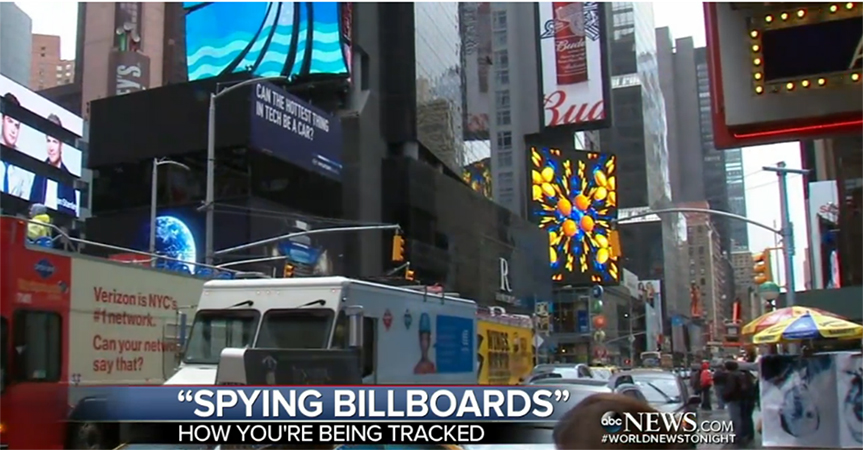
U.S. Senator Charles E. Schumer today urged the Federal Trade Commission (FTC) to investigate the use of “spying billboards”, which are popping up in cities across the country. Specifically, the new billboards have the ability to track a person’s every move using locational data on a person’s mobile device. Companies often use locational data as a way to boost their consumer information base that can be used to market goods and services to these consumers or as data to sell to other companies. Schumer said that the collection of such data may violate the privacy of Americans and therefore, constitutes a deceptive trade practice because most consumers do not know that they are being tracked. To combat this invasion of privacy, Schumer is urging the FTC to require that billboard companies, like Clear Channel Outdoor, offer an opt-out option for consumers who do not want to be monitored or tracked.


“A person’s cell phone should not become a James Bond-like personal tracking device for a corporation to gather information about consumers without their consent,” said U.S. Senator Charles Schumer. “No one wants to be followed or tracked throughout their day, electronically or otherwise, so these new billboards not only raise eyebrows, but they raise some serious questions about privacy. New Yorkers and tourists in Times Square could be giving up a treasure trove of personal information without even knowing it. With tens of thousands of these new spying billboards popping up in cities across the country, including right here in New York City, the feds should step in and investigate. Moreover, companies should be required to offer an opt-out option for consumers who feel this violates their privacy.”


Clear Channel Outdoor Americas recently partnered with several companies to create Radar, an initiative to track an individual’s travel patterns and behavior through the locational data on their mobile device. Clear Channel Outdoor has tens of thousands of mobile and digital billboards across the United States, including some in New York City. The company plans to provide advertisers with data on individuals who pass by these billboards – some of which are equipped with small cameras that collect information. Its RADAR initiative has already begun in New York and Los Angeles, and plans to target other cities across the country this year. Schumer explained that by using the data and analytics, Clear Channel can amass a collection of information such as the average age and gender about individuals who view a particular billboard, in a certain place, at any given time.


According to its website, Clear Channel Outdoor says that “using anonymous aggregated data from consumer cellular and mobile devices, Radar measures consumers’ real-world travel patterns and behaviors as they move through their day. Analyzing data on direction of travel, billboard view ability and visits to specific destinations. This movement data has been mapped against Clear Channel’s displays, allowing advertisers to plan and buy, to reach specific behavioral audience segments. Radar can also help advertisers measure consumer behavior following exposure to an out-of-home ad, allowing them to quantify campaign return on investment…” Clear Channel Outdoor says that its initiative can measure the impact of “Out of Home” advertising on multiple consumer actions.


Schumer today urged the FTC to allow consumers to opt out of the billboard tracking program. Schumer explained that this could be a step too far because individuals are unaware that their movements are being tracked and urged the FTC to make companies notify consumers if they use this technology.


Realities in Black and Brown: Critical Concerns and Common Ground

Dr. Maulana Karenga

There is no easy way or walk to freedom; no shortcuts to justice; no quick fix for conceiving and constructing the good and sustainable society and world we all want and deserve to live in. Indeed, to achieve the good we all want in the world, we must work and struggle long and hard for it, i.e., we must be in it for real, in it for the good and for the long. And it is always good to remember and remind each other of this in our constant reasoning and wrestling with the urgent issues of our time. Certainly, Black/Brown relations are one of these critical issues. And how we work out our relations with each other will determine the quality of life of our communities and this country, and our capacity to realize the just and good society we’ve fought so long for.

Our challenge is to think in new, different and more depthful ways not only about Black/Brown relations, but also how to carefully craft social strategies and policies directed toward collaboration and cooperation for the common good of all. To do this, we must give up ideas riveted in racist interpretations of human reality which are preached and practiced by the established order under an endless number of disguises, deceptions and excuses. We must, as Fanon says, think new thoughts, reach inside ourselves and bring forth the best of our ethical insights and aspirations and dare lay the foundation and framework for a new history of humankind.

Latinos and Blacks, facing each other across the table of media misinformation, manipulated resources, contested space and limited power, often misinterpret both the problems and possibilities before them. They often fail to appreciate and act on the fact that they have it in their hands to demand and achieve through struggle, along with other progressive allies, a just society committed to a more egalitarian distribution of wealth and power and devoid of the mutually destructive contention over crumbs people of color have been too often reduced to. The task is to develop a mutually beneficial set of cooperative projects and then to organize and engage in cooperative practice to collectively complete them.

In order to build on the cooperative possibilities of Black-Brown relations, avoid mutually destructive conflicts and pursue collectively the quest for a just and good society, several things are necessary. The first of these is the development of a new language and logic of ethnic relations, a new way of talking and thinking about difference and the rights, needs and dignity of everyone. It must initiate and include conversation which recognizes and respects the presence, rights and essential relevance of each ethnic group in the awesome task of radically changing the way we do things and treat people in this country.

Secondly, we need to cultivate and demand a leadership worthy of its claim; a leadership that is morally sensitive to the needs and aspirations of our diverse communities; that is sensitive to human suffering; and profoundly committed to the pursuit of justice, the work of peace and the struggle to end inter-ethnic conflict and police violence so that our peoples can live in security in their homes and walk without fear in their streets. It will be a leadership not looking for back-patting approval or bankrupt ideas from the established order, but one which values the voice and vision of the people and struggles with them to achieve the conditions and means of a good life.

Moreover, we need a protocol of exchange, regular and established ways and means to talk often and productively with each other, ways to negotiate, discuss, problem-solve, intervene, introduce initiatives and learn a deeper knowledge and appreciation of the way each people understands and asserts itself in the world. We need in-place structures and planned strategies which anticipate what happens and expect what occurs and thus contain readied responses for a wide range of possibilities.

Nowhere are these structures and strategies more necessary than on the two major issues that threaten to shape our relations in unhealthy ways from which it will be difficult to recover. There must be a collaborative and collective response to stop the various forms of inter-ethnic hostility and violence that have too often plagued our peoples. Indeed, it has already destroyed and ruined too many lives and once threatened to turn neighborhoods into zones of racial violence resembling the practices of a people that have savaged us both. And although it has diminished from prior levels, it still needs to be a constant concern on the activist agenda.

Then there is the urgent immigration issue, clearly larger than Latinos, but now made, in too many places and dialogues, into a Latino issue alone, leaving out consideration of Continental Africans, Caribbean Africans, especially Haitians, as well as Asians, Native Americans and others. We must not let even well-meaning progressives define the issue for us, reducing it to simple support for some immigrants (Latino) with little or no consideration or concerns for Africans and others. We must insist on adequate attention to other immigrants also and especially to the meaning and consequences of massive immigration for the receiving and impacted communities.

Especially, we must define and discuss the issue as an issue of justice for all involved and affected. We cannot allow others to deny, devalue or discredit the legitimate concerns and apprehensions of African people under the guise of being progressive. We must advance our concerns as a matter of justice. For as we’ve continually argued and reaffirmed, there is no justice in denying, dismissing or failing to deal equitably with the clear needs and pressing concerns of fellow African-Americans and other co-workers and neighbors who are also working hard to provide for their families, send their children to school, pay their taxes, secure a decent and living wage, live a good and meaningful life and build the just and good society we all want and deserve. And in this context, we can support a just immigration policy, equitable political representation, quality education and the struggle for a living wage and an equitable share of jobs, contracts and training, and leadership opportunities and positions in unions.

Finally, it is important also to make sure that our current and urgent focus on Black/Brown relations not obscure or minimize the need to involve all other groups in this cooperative social project. The challenge posed here is undoubtedly an awesome one, but these are the demands of history which must be met in order to create a context for the justice we seek, the peace we pursue and the good life we want and work and struggle for ourselves and future generations.


Dr. Maulana Karenga, Professor and Chair of Africana Studies, California State University-Long Beach; Executive Director, African-American Cultural Center (Us); Creator of Kwanzaa; http://www.officialkwanzaawebsite.org/; http://www.maulanakarenga.org/.


Medgar Evers Community Council Annual Spring Luncheon

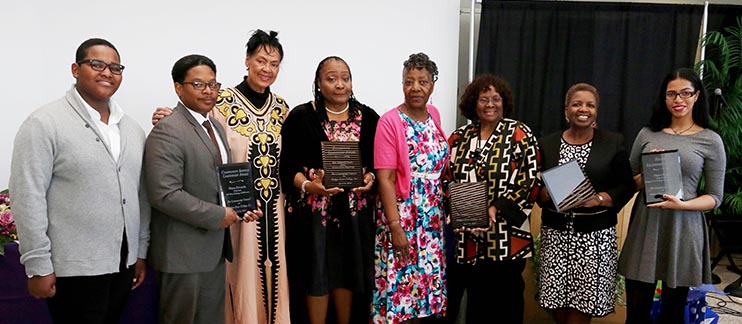
— Charles E.H. Ross-Ripley, Event Welcome Speaker (Council-Youth Member); Wayne Devonish, Chairman, 500 Men Making A Difference(Community Service Award); Dr. Marceline Watler, Master of Ceremonies; Rev. Elizabeth Butler, Pastor, Church of New Beginnings(Ecumenical Award); Katie L. Davis, President, Council; Dr. Eda Harris- Hastick, Medgar Evers College Professor & Director of Social Work Programs (Education Award); Celeste Morris, President, Morris Allsop Public Affairs (Business Award); and Danica Fouad, Class of 2016, Medgar Evers College Preparatory School (Youth Award).

Community Council for Medgar Evers 2016 Annual Spring Luncheon for Scholarship and Leadership will be held at Medgar Evers College Science Building Atrium Cafeteria. The council serves as an advisory body to the president and college through community support with fundraising and forums. The council started in 1980 and has provided more than $250,000 in scholarships.