Home Blog Page 842

WHAT’S GOING ON

By Victoria Horsford


NEW YORK CITY

 The 5/29 NY Sunday Times news section cover story,  “Dreams Stall as City’s Engine of Mobility Sputters: Woes at CUNY Mirror a Trend in Higher Education,” is a disturbing account of public college culture.  the essay gives a laundry list of woes, not the least of which is the ongoing political feud between NYC Mayor Bill de Blasio and NYS Governor Andrew Cuomo.   Class overcrowding, adjuncts overseeing classrooms, and some CUNY schools can lose accreditation this year.  Opened in 1847, what is now the City University of NY was tuition free system until 1976.  It was often known as the poor man’s Harvard.


The 5/29  NY Times Sunday Review opinion piece  THE END OF BLACK HARLEM by agent provocateur Michael Henry Adams, is a good  polemical read  for students who follow  the intersections of  preservation, culture,  politics and gentrification. Adams wrote the meticulously researched book, HARLEM: LOST AND FOUND.


The Brooklyn Community Services,  BCS, organization celebrates its 150th Anniversary at a kick-off Gala,  on June 6,  at the Brooklyn Marriott.  The BCS  Benefit  honorees are philanthropists Charles J and Irene Hamm; Chirlane McCray, NYC First Lady;  Forest City Ratner Companies;  Lanetta Darlington; and Ellen Fine Levine, BCS Vice Chair.  The BCS  works with low-income communities and promotes economic self sufficiency.  Visit  wearebcs.org.


CARIBBEAN AMERICANS

June is Caribbean American Heritage Month. The following is a Caribbean-American WHO’S WHO directory.

LAW:   Franklyn Hernandez, Jr; Adrienne Lopez; Afua Mensah; Melanie Okpaku; Ernst Perodin;  Michele Rodney;   California AG  Kamala Harris; Nathanael Wright

MEDICINE/HEALTH:  Dr. Michelle Alexander,  Dr. Samuel Daniel, Dr. John Mitchell, Eddie Mandeville,   Dr. Cheryl Smith, Dr. Kevin Martin Roslyn Woods Cabbagestalk, RN; Joycelyn Valentine, nutritionist

 EDUCATION:  Dr. Lorraine Monroe; Fern Khan, dean emeritus Bank Street; Professor Carole Boyce Davies,  Professor Clarence Jones,   Wanda Ballard Wingfield;  Carrie Simpson, Kenneth Thomson.

ARTS/CULTURE:   Joseph Bethune;  Bette Byer;  Clifton Davis; Pearl Duncan;   Joy Elliott; Melanie Edwards;   Vy Higginsen, Anna Maria Horsford;  Queen Latifa; Debra Lee, BET;  Iyaba Ibo Mandingo; Nia Long;   Sharon Lopez, Nia Long, Hakim Mutlaq;  Anderson Pilgrim;  Jada Pinkett Smith;  Voza Rivers;  Eric Tait, Ramona Wall, Kerry Washington; Randy Weston.

CORPORATE AMERICA: Ursula Burns, Xerox Chairman/CEO; George Hulse, Healthfirst; Franklyn Thomas, Ford Foundation and BedStuy Restoration.

ENTREPRENEURS:  Jason Benta,  Benta’s Funeral Home;  Laurent Delly, IDEACOIL, IT company and real estate;    Bryan Benjamin, Genesis Companies, real estate;  Al Cunningham, real estate;  Eugene Giscombe Real Estate; Earl Graves, Black Enterprise;  Lowell  Hawthorne, Golden Krust;  Frank Hernandez, Tridez, Robert Horsford, Apex Building Co; Maurice Grey, Edward Sisters Realty;  Garry Johnson;  Paula Walker Madison whose family business is  Williams Group Holdings, LLC;  Roy Miller, Jamerica;   Charles Richardson; Alyah Sidberry, Cove Lounge;  Karen Soltau, real estate; Yvonne Stafford Real Estate.

MEDIA:    Rushell Boone, NY1;  David Greaves, Our Time Press, Brittany King;  Karl and Faye Rodney and Karlisa Rodney,  NY Carib News; Sylvia Wong Lewis;  Errol Louis, NY1;  Lester Holt, NBC;   Joy Reid, MSNBC, Sheryl Huggins Salamon; Jean Wells, Positive Community Magazine;  Constance White

POLITICS: Nicole Benjamin, Cordell Cleare, Leroy Comrie, Denny Farrell,  NYS Assembly Speaker  Carl Heastie, David Paterson  Basil Smikle,   Roy Paul,  Jumanne Williams,  Charlie Rangel, Keith Wright,  Mathieu Eugene,  Ambassador Patrick Gaspard, Ny Whitaker

GOVT/COMMUNITY:  Rev.  Jacques DeGraff;  Rev. Dennis Dillon;  Chirlane McCray, Stanley McIntosh,  Lloyd Williams, Greater Harlem Chamber of Commerce;  Dr. Keith Taylor, PhD;  Susan Taylor;  Rev. Dr. Michael Walrond


EDUCATION UPDATES


The NY Urban League’s (NYUL ) NEXT Academy  invites 8th graders and their parents to  its  Summer STEM  (Science, Technology, Engineering, Math) Program.   The Next Academy is a community STEM engagement program composed of two summer learning academies with a parent and student track.  Courses will be held at NYUL office at 204 West 136 Street Harlem.  Students begin classes on July 11 and run for 6 weeks,. Courses for parents begin on July 18.  Application deadline is June 10.  Visit www.nyul.org/next or call 212,926.8000, X136.


The UNCF  “A Mind Is …..Hampton’s Summer Benefit” will be held on Saturday,  August 6  from  6-9 pm. Filmmaker Reginald Hudlin, Hudlin Entertainment President; Cathy Hughes, Radio One, Inc.;  and Dereck Jones,  managing director GCM Grosvenor Private Markets are the Gala honorees  The evening unfolds with a jazz combo, a fashion show, networking.  The United Negro College Fund is the nation’s largest and most effective “minority education” organization having raised more than $4.5 billion since it was founded in 1944.


BLACK MUSIC MONTH


The Uptown Dance Academy, UDA,  hosts its 21st Anniversary Gala,  honoring its  benefactor PRINCE, at the Hostos  Center for Arts and Culture,  at 450 Grand Concourse, Bronx,  on June 3, 7:30-9:30 pm.  Based in East Harlem, the UDA was founded by dancer, Ms. Robin Williams, who is its artistic director.   Conceived as a dance school for urban youth,  it offers classes in ballet, tap, modern, jazz, Hiphop, and African dance forms. Music man, PRINCE  Roger Nelson  donated $250,000 to UDA.  Visit uptowndanceacademy.com, call 917.202.1601.


The Duke Ellington Center For the Arts revives Ellington’s First Sacred Concert on its 50th Anniversary,  at the Grace Congregational Church, located at 310 West 139 Street, Harlem,  on June 4/5.  The sacred concerts were Ellington’s way of bringing the Cotton Club revue to the church, which was usually Grace Congregational.  Virtuoso musicians will provide accompaniment for vocalists Chantel Wright, Tammy McCann, Brandi Sutton  and for  dancers  Maurice Hines and Savion Glover.


The  “Lush Life, Celebrating Billy Strayhorn” concerts, with the Jazz At Lincoln Center Orchestra with Wynton Marsalis, joined by vocalist pianist Johnny O’Neal,  completes  the JALC’s  2015/2016 season, will be held on June 10/11 at the Rose Theater, at Jazz At Lincoln Center, on Broadway at 60 Street. Visit jazz.org.


The annual “Invincible: A Glorious Tribute to Michael Jackson” concert, returns to the northeast, on June 11, from 5-11 pm,   at the NJ  Performing Arts Center, in Newark.   Show stars MJ impersonator Michael Trapson and is produced by Darrin Ross, the MJ choreographer for 23 years.  MJ classics like “Thriller,” “Billy Jean,” “Beat It”  will be performed, and a re-imagining of MJ works and how they would play today is part of the INVINCIBLE  plan.  Call 917.416.1745.


ROOTS


It is hoped that everyone saw the ROOTS miniseries remake which was broadcast simultaneously on the A&E, Lifetime and History Channels, from May 30 through June 1.

The first  segment was poignant, visceral and addictive.  Many scenes were cathartic to a Black viewer.  The story opens on location in Africa, the genesis of modern history’s greatest tragedy, the enslavement of African people by Europeans, who brought them to the appropriately named New World. ROOTS unfolds in early 18th Century Virginia.   To be sure,  the cable channels will rerun the series regularly.


A Harlem-based writer, Victoria Horsford can be reached at victoria.horsford@gmail.com



Common Core: A Worm in the Apple for the Teacher, Pt. II

By Akosua K. Albritton

The week of May 23, 2016 was an eventful one in the world of education.  Columbia Professor Celia Oyler was e-mailed questions from the upcoming fourth-grade reading assessment, scheduled for May 23, 2016 – June 10, 2016, from an anonymous teacher who also gave a critique of the questions.  Professor Oyler posted the e-mail on her blog.  Her readers, in turn, posted it on other blogs and Tweeted it. The forwarding caught on like wildfire wherein there were far too many unknown people who have seen the questions and the critique to render the assessment useless.

Less than one year after the New York Common Core Task Force moderated public comments, MaryEllen Elia, New York State Education Department Commissioner, did her own listening tour throughout the state.  During her stop in Staten Island, May 23, 2016, she told the press the New York Common Core Curriculum Standards needed to be revamped.  The revising “will be done in two committees, one for English Language Arts and the other for mathematics, to include school leaders, educators, parents, students, business leaders and community officials”.  The Board of Regents will then vote on the revised standards.  Afterwards, one year will be dedicated to incorporate the new standards into the curriculum by training teachers.


Even Governor Andrew Cuomo admitted to rushing the institution of New York Common Core Standards in 2010. Cuomo agreed to the examinations being shortened; students taking as much time as they need to finish the assessment, and will include “more age-appropriate questions”.


So other New Yorkers must thank the anonymous teacher and Professor Oyler for influencing the governor and NYSED Commissioner to overhaul New York Common Core State Standards’ assessment questions to ensure age-appropriateness.  Further the some 200,000 parents across New York who opted out of the assessment for grades 3 – 8 need to be acknowledged for standing up to the system.


Tameka Mingo, a teacher at a public school in Bedford-Stuyvesant, probably is breathing easier.  Ms. Mingo teaches grades third through fifth.  She explained that “Common Core is a set of standards divided by grade level to set expectations for what students should know in each content area”.  She said, “The ultimate goal is to be prepared for college, more so, and career [upon high school graduation]”.  So New York Common Core “is creating a pathway to college”.


Her college education did not prepare her to teach New York Common Core State Standards.  Rather, she learned New York State Performance Standards which Mingo sees similarities between the two; however, “Common Core wants the children to think deeper”.


“The opposition to it is the testing.  It is more complex,” asserts this educator.  For many people, Common Core is more high-stake testing that brings on high anxiety in the pupils and in their parents.


Imagine going to school Monday through Friday; September through June each year where a student comes to class, participates in lessons, does homework, completes projects and takes quizzes and tests.  All of this knowledge acquisition and effort may be dashed if the student’s performance on the assessment, administered over 13 school days, is low.  That young person may have to redo the grade.  Mingo said, “There is no more social promotion”.  So having high social emotional intelligence will not pass a student onto the next grade level.  For some corners, laying to rest social promotion is a blessing.


When a family opts out of the assessment, the school must create a portfolio to evidence what progress a student made in a subject matter.  With sufficient consideration into lesson planning for the school year, the portfolio will be strong evidence that a pupil has gained competency in the learning standards for a subject at a particular grade level.


Mingo refers to the website Corestandards.org to determine whether her lesson plans meet standards.  She, like many other teachers, inserts the subject and grade-specific objectives of Common Core into her daily lesson plans.  Though this teacher studies this website to ensure she is in alignment with Common Core Standards and practices, Ms. Mingo has been warned by her principal that too many of her students hadn’t passed the last two assessments.


Given the admissions of Governor Cuomo and Education Commissioner Elia, Mingo, other teachers and principals will contemplate the changes Common Core has brought.  Have education professionals been feeling anxiety over the high-stakes Common Core?


Elementary and Middle School Family Leadership Coordinator for School District 18 (SD 18) Ivie Bien-Aime is tasked with informing and enabling parents to be active in their children’s schooling.  Bien-Aime holds workshops and retreats to build leadership qualities in the parents.  She is critical of the rollout of New York Common Core State Standards.


“The weaknesses of the introduction of Common Core includes not explaining it to the general public or the pupils’ families.  Then the implementation of it was not properly done with the teachers,” posits Bien-Aime.  “It isn’t the Common Core Curriculum Standards that are being objected, it is the testing or assessments that is at issue.”


There is a history of resistance to standardized assessment. However, academic performance testing is a lucrative industry. Lobbyists are well-paid to visit state Assembly and Senate chambers as well as local elected officials to ensure standardized testing remain part of the teaching-learning landscape.


Bien-Aime agrees with the shared learning standards that have come to the United States. “Previously, the United States didn’t have federal standards for each grade level and a state could acquire assessments that weren’t aligned to that state’s particular standards.  This is not the case now.  42 states adopted the standards and a state can obtain assessments from any vendor as long as the assessments are in alignment with Common Core State Standards.”


She balances her criticism of the implementation of New York Common State Standards with her observation of teaching practices in New York City.  “Many teachers have not established real goals [for a semester or the year], nor are they doing lesson planning.”


Bien-Aime criticizes teachers for visiting Corestandards.org and EngageNY.org but does not offer alternatives for obtaining the professional development needed to lead learning under the new model.  She is concerned also about “the lack of differentiating students in a given class”.


While Mingo and Bien-Aime may disagree on teachers accessing Corestandards.org, they do agree on the insidious results of establishing charter schools.  For Mingo, charter schools rid schools of unions.  For Bien-Aime, charter schools rid schools of black educators.


To Be Continued

Wellsprings of Faith:  “Pastor and People Caring Enough to Care”

 The Rev. Dr. Curtis L. Whitney, retiring after 32 years in the pulpit of Mt. Sinai Baptist Church in Clinton Hill, was born in Ivor, Virginia, is a graduate of Queens College with a Bachelor of Arts degree in Psychology and holds a Master’s of Divinity from Union Theological and a Dr. of Divinity from Drew University.   


Our Tim Press

Sir,  Ivor Virginia.  Population 309 in 1930.  What was it like growing up around there?


Pastor Whitney

Oh, it was different.  It was different.  It was, you know, sometimes very lonely.  It’s only a few people that we knew and they were people that they said we were related to, in a sense.  We stayed in our part of the, you know, town.  Community, it was not really a town because they had one grocery store, one clothing store.  And so, you know, we only went there weekends.  It was, as I said before, it was very. Our activity was school and church.

OTP

School and church?

Pastor Whitney

School and church.

OTP

Was your time in the Army the first time you were really leaving there?

Pastor Whitney

Actually, the day I graduated from high school I have already determined I was not going to stay there any longer than that. I was going to venture out and see what the rest of the world looked like. I had my bags packed and I remember so vividly that my dad took me into Route 460. That was the main highway that was in Petersburg to Norfolk. [Route 460] And there was a certain spot where the Greyhound bus stopped. And it was that day my dad took me and I waited about 15 minutes and I see this bus and even though there were seats available in the front of the bus, I had to go way to the back. And I looked out of that back window and did that (waves his hand)… my dad.

OTP

And you were going off to…

Pastor Whitney

I was going off to the, at that point, I was going to an elderly great-great aunt–95 years old. Owned her own home right on the campus of Virginia Union. In fact, there was a big, maybe 10-12-foot fence that divided her house on the campus and students had a way of making a hole. It was like a shortcut. So they had a hole made in that fence where they can take that shortcut. And I stayed with her for a while until I decided I was going to go further and that’s when I went to New Jersey and went into the service. Signed up for, did not get a draft call but I knew it was coming so I went and boosted my draft.

OTP

So as they say, you can’t keep ‘em down on the farm after they’ve seen Paris. You decide to stay in the big city. What brought you to the ministry?

Pastor Whitney

Well, when I came out of the service, I was what you might classify as a 90-day wonder. In fact, I was almost ready to re-enlist and go back in the service. But I happen to see a buddy that I met in service and he always told me about the church that he was going to and that he always wanted me to visit. And I did. And it was at that time I really was exposed to a level of Christianity that I had never been exposed to before. And I began to do a lot of introspective study myself.


OTP

Now you’ve been here for thirty…

Pastor Whitney

32 years.

OTP

2 years. A lot of times, if you will, First Ladies of the Church, people don’t understand how much they contribute. Can you speak for a moment about what your First Lady has been doing supporting you with the church.

Pastor Whitney

Yeah. That’s a good, good question. She had grown up around a minister and Leading Lady, First Lady. In Newark, New Jersey. And she had seen what they went through and she and her girlfriend had decided they would not come anywhere near a minister. They didn’t want no parts of it. But guess what?  She and her girlfriend both end up marrying ministers. And it took her a little while to get accustomed to it. And even now, there’s some issues that she’s still dealing with. But she accepted the call. And then she got involved. She became president of the New York State Interdenominational Minister’s Wives Association. So she’s been very, very, we both have been very, very busy in our extension of our service to the community.

OTP

There’s a, now there was a time when religion was the nearest thing black people had to being free. What is the role of the church now in the African-American life? What do you see? What role is the church playing now in the African-American life.

Pastor Whitney

I think now more than ever, church has a responsibility and role of going out in the community and making a positive impact in the lives of the people in that community. The Scripture talks about, a beacon light, or a city that is set on the hill that cannot be hid. Having a light that cannot be hid. A city that sits upon a hill and people can come for restoration, people can come for encouragement and guidance. And that’s my raison d’être That’s a (French) word meaning “reason for being”. Raison d’être. My reason for being is to make a positive impact upon the lives of the people. And help them come to grips with the heart issues of life that face them on a daily basis. In other words, “it goes beyond the four walls”.

OTP

How’s that been expressed here at Mount Sinai. I know you have a food program, that kind of thing. But what physically on the ground does the church do to achieve that?

Pastor Whitney

One of the things we have is a program for AIDS. We have a HIV and AIDS ministry. And many of the activities that have developed had their genesis here at Mount Sinai. And we got a grant which gives us more leverage in helping those persons.


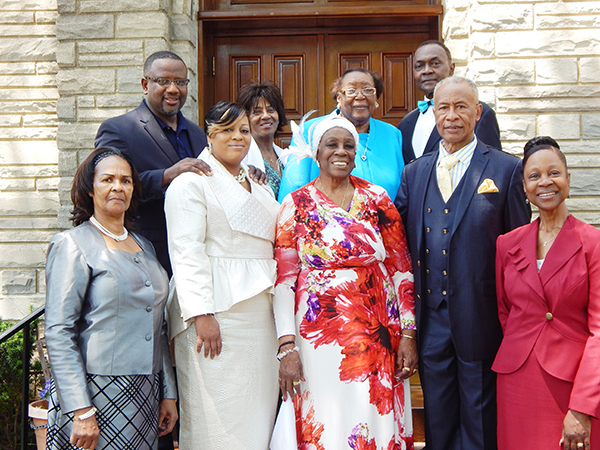
Front: Min. Monica Johnson, Loretha Maxwell, First Lady Center Ridge Missionary Baptist Church; Dr. W. Ruth Whitney, First Lady of Mt. Sinai Baptist Church; Rev. Dr. Curtis L. Whitney, Sr. Pastor of Mt. Sinai Baptist Church; Min. Gail Fleming Back: Randy S. Maxwell, Pastor/Teacher of Center Ridge Missionary Baptist Church of Little Rock, Arkansas; , Deaconess Joyce McIver, Min. Estelle Smart, Bro. Richard Simpson

Our Time Press:  Changing times… after your 32 years here, how has the congregation changed? How has the environment changed around here? What effect is all this having on the church?

Pastor Whitney: That’s one of the issues that I have wrestled with. Number one, this church, Mount Sinai Baptist Church, has predominately attracted people from the South. At a point in time there was a, especially after the 10-year mark and the work of my predecessor, there was a great influx of people from places like North Carolina, South Carolina, Georgia, Florida. Those places. So much so that they had clubs. The North Carolina club, South Carolina club and so forth and so on. And when I arrived here, it was apparent that there were members of this congregation that did not fit in any of those big clubs. Number one and number two, people in those clubs were beginning to migrate back South. Those that had reached retirement age, they were going back South. So that trend of influx coming in just flipped around and was the opposite.

I came up with the notion of the 12 Tribes of Israel. And everybody in the congregation–whether they were from Georgia, Mississippi or wherever–were a part of those 12 Tribes. And the way we separated it was by birth month. If a person was born in January, they were automatically part of the tribe of Benjamin. And so that, some had resistance on the part of something, the congregation, because they had that club mentality. And they thought that pastor was breaking up that club. But I did it by default because the clubs were becoming so small they did not justify their existence.


Migrating back South

And so that was one of our main challenges, to make sure that everybody felt a part of one of these tribes. And by virtue of their birth month, everybody was in a tribe. So it eventually caught on. But at the same token, people were still migrating back South. You know, families… I mean whole families migrating South. And also the congregation was an elderly congregation. So between the migration back South and people that were passing on to the great beyond, the congregation began to dwindle. And people were not that active in joining.  We’d get a few here and there. But for the most part, we were losing more than what we were taking in.
Challenges to Face

And then with the building of the Barclays Center, the neighborhood, the landscape of Bed-Stuy, began to change radically. The housing that was being built, a lot of our people could not afford it. And so they ended up moving out. So the whole landscape of our community is completely changed. We have whites that have moved across the street, in the back of us. They have completely taken the area over. And that’s a real challenge.

OTP: How do you meet that challenge? What do you, for the folks coming up behind you, how would you want them to meet that challenge?

Pastor Whitney: I would want them (first of all) to continue to be active in the community, organization, their block association. Having extra services here just to have like a town hall, if you will. Making sure that the congregation is feeling the pulse of the community. In my messages, I always share with them that we have to remember that our community is changing and we’re going to have to begin looking at ways that will draw these people so that they can become a part of ours… There were a few that have been coming, you can tell they’re looking. And they would come and sit in our service, then they will go.

OTP: Are you talking about white folks?

Pastor Whitney:  Yes.

OTP: Now you talk about the rising prices of keeping a congregation in place. I know you’ve done work with affordable housing. Is there a role for the church to play in this whole housing situation that folks are facing?

Pastor Whitney: Yes, absolutely. That is why I would strongly recommend, we don’t have it, but this is something that I’ve been working on is developing housing. We have the property. As a matter of fact, we are property rich and cash flow poor. And nonetheless, we’ve been looking at meeting with developers, we’ve been meeting with consultants, that will help us…politicians to focus on developing adequate housing for our people. It’s a shame that we have the property but we don’t have anything on the property and we have people that need housing.

OTP: And as you go through that process is it always the concern that, with the hundreds of millions of dollars of responsibility of the, trustees of the churches, how do you protect yourself when you’re working with developers and that kind of thing…How are you dealing with that?


Pastor Whitney: Well, number one, they know what our mission is to be a positive role model in helping develop the community having facilities where the community can get involved. Through the food program, the soup kitchen, the clothing drive, each ministry is to let them know that we’re not just a Sunday church.

We’re going to look after the soul as our prime responsibility, but secondary we can’t tell people about their soul when (physically) their needs are not being met. And so I try to present a holistic approach to ministry. Ministry is not being served as much as it is to serve. And that’s what I think it’s important for the congregation to be encouraged to continue the community service. To continue the involvement with the political people in the area. And doing networking, networking is a key here.

I don’t know if you ever heard of Industrial Areas Foundation, it’s called IAF. And the originator of this community-based organization was a guy out of Chicago by the name of Saul Alinsky. He developed that model. Getting congregations involved in the community. So we had our congregation involved in that for a period of time. And then we left the IAF and we joined up with another similar organization called PICO, Pacific Institute of Community Organizing. And this is where all the churches came together and developed the laypeople so that they could go out in the community. Confront the powers that be. If there was a red light that needed to be put up on the corner right here, we would go down to City Hall and we would protest. Speak with the person that would represent us. And those were the kinds of things we did.


Development Portfolio Transferred

And part of that came out of what I’m just about ready to relinquish. ABCCD –  Association of Brooklyn Clergy for Community Development. Actually, Dr. Herb Daughtry, Russ Roman, they were former founders of this organization. And we saw a strong need for the church to be involved in the community. And that is when we came up with ABCCD. Which at one point had a working staff of about 30 people in Restoration. We had a community health sector, HIV-AIDS, and housing. We had a mental health piece, we had housing development, and during that time Herb Daughtry was the chair.  (Mayor) Giuliani and Herb did not see eye to eye. And Giuliani had made it clear that if Herb Daughtry remained as chair, ABCCD was going to close up. Because when Herb was really in full force, was when Dinkins was in (Mayor David Dinkins). And anything that came through the pipeline came down eventually through to ABCCD. But when Giuliani came in, that’s when the organization began to flounder. In spite of that, we were able to do at least 250 units of affordable housing, we had all of our housing as part of the tax credit program. That at the end of 15 years, it would either roll over or we would transfer to another community development corporation. And that’s what has happened.

Our whole portfolio, was transferred over to Pratt Area Community Council (Now IMPACCT). And believe it or not, it still has not completely been finished yet. But we’re just at the point now of dissolving ABCCD and completing the complete transfer of the portfolio. We’ve been doing this for the last six years. And now we are talking about closing the latter part of June.


Brooklyn Ballers


New York Yankees relief pitcher Dellin Betances (61) delivers home in the 9th inning. New York Yankees against the Los Angeles Angels at Yankee Stadium.


By Eddie Castro

The 2016 High School baseball season in our borough has come to an end. Powerhouse teams like Grand Street and Telecom had their seasons end short with early playoff exits but schools like Poly Prep and Xaverian put their marks this year. Led by Mr. Brooklyn himself Rob Calabrese, of Poly Prep, won its fourth straight Ivy League Championship this year. His outstanding batting average of .422 had a lot to do with it. Then you had a Cinderella-like team in Xaverian, who caught the baseball world off-guard (you can say) as they captured the Catholic High School Athletic League city title. Although no player from the borough was selected in the Major League Baseball Draft, there was and still remains a lot of talent here in Brooklyn.


League MVP: Let’s get back to Mr. Brooklyn for a second: Poly Preps’ Rob Calabrese was a four-year starter winning four championships during his play. With that said, it’s hard not to name him as this year’s Most Valuable Player. With his .422 batting average, he hit two home runs to go along with 35 RBI’s and 36 runs scored in 33 games played. Although he wasn’t drafted this year, his name will surely be a name to watch for. Rookie of the Year: This year’s Rookie of the Year winners went to Calabrese’s teammate pitcher/outfielder Nick Storz. He earned this award in many ways but I’ll name you a few stats. As the team’s closer, Storz posted a 2.61 ERA (earned run average) and struck out 59 batters in just 51 innings pitched. He can also swing the bat, hitting .260 with a home run. You also had talented first-team players like Grand Street’s Marcus Chavez, Telecom’s first baseman Austin Ruiz, New Utrecht’s Andrew Nathan, Midwood’s Robert Feldman and Lafayette’s Davian Droz.


Baseball is on the rise in our borough and by the looks of things, it will be flooded with star talent for many years to come. Some will be competing for an MVP award, some will help their team to a state title, and some will hear their name announced by Major League Baseball’s commissioner in future drafts. Hey! It has happened before, just ask Grand Street alumni and current Yankees star relief pitcher Dellin Betances, who was drafted out of high school in 2007.


Sports Notes: (Basketball) The New York Knicks have announced that former Utah Jazz player and former Phoenix Suns head coach Jeff Hornacek will be the team’s new coach.


A Worm in the Apple for the Teacher

By Akosua K. Albritton

New York City and the whole of the United States are experiencing another shake-up in the education of American youth stamped the Common Core State Standards Initiative. The “Common Core” is not a body of knowledge or subject content. Rather, the “Common Core” is the development of intellectual faculties or skill sets applied to English Language Arts (ELA), history/social studies, science & technical subjects and mathematics.

The essential standards for mathematics include:

  • To make sense of problems and persevere in finding the solution.
  • To reason abstractly and quantitatively.
  • To construct viable arguments and critique the reasoning of others.
  • To model with mathematics.
  • To use appropriate tools strategically.
  • To attend to precision.


The essential standards for ELA, history/social studies include:

  • An increased level of complexity to what students are expected to read and a progressive development of reading comprehension so that students can gain more from what they read.
  • A progressive sophistication of logical arguments based on claims, solid reasoning and relevant evidence. The writing also includes opinion writing, even within the K–5 standards.
  • Students gain, evaluate and present complex information, ideas and evidence specifically through listening and speaking.
  • Vocabulary instruction in the standards takes place through a mix of conversations, direct instruction and reading so that students can determine word meanings and can expand their use of words and phrases.


These standards ought to result in the development of logical minds and critical thinkers. These attributes are in great demand in this nation. The force behind the Common Core Standards Initiative is to prepare America’s youth to be ready for work upon graduation from high school or ready for the rigors of college.


Some corners state this initiative—without shared content—will have this nation competitive with other advanced nations. Other corners contend it is long overdue for the US to have educational standards across state borders. Still, others contend the educational standards void of content for each subject area is akin to taking an anatomy course that studies only the skeletal system: what of the cells, connective tissue, muscles, glands, nervous system and organs that comprise the human body?


The Common Core State Standards Initiative is skirting the duty of building a common core of knowledge that age-appropriately informs, engages and enables every child enrolled in an American public school. What may be at issue is the American heterogeneous population is competing with more homogenous nations. Therefore, the homogeneity permits a national narrative to be readily accepted by the public that becomes part of school literature, history and social studies courses. For the United States, history persists in stating Barack H. Obama is the first US President of African descent. In fact, there were at least seven presidents of African ancestry before President Obama.

To Be Continued