Home Blog Page 803

A Youth Movement

27

 By Eddie Castro

Being raised in the Bedford-Stuyvesant section of Brooklyn, one of my favorite memories as a kid was waking up on the first Sunday in November and awaiting the courageous runners who took part in the New York City Marathon. I remember gathering a roll of cups with my friends and filling them with water as I handed them to the participants as they ran through Classon Avenue. I would then run a few blocks to keep up with some of the runners and then when I hit Nostrand Avenue, I realized I couldn’t complete a few blocks, let alone a few boroughs. Nevertheless, it reminded me of the enjoyment I had helping the men and women to stay hydrated, and not to mention to myself that yes, Christmas is upon us.

 One athlete reminded me of my younger years and me wanting to run with the other racers. How many people can say they not only participated at the NYC Marathon, but that they won it all at age 20? Yes, that’s exactly what happened this past Sunday as Eritrea’s Ghirmay Ghebreslassie became the youngest male champion ever to win the event. He (Ghebreslassie) completed the five-borough race clocking in at 2 hours, 7 minutes and 51 seconds, making him the third-fastest runner in the marathon’s 46-year existence. Ghebreslassie made more history becoming the first runner to come from Eritrea to win the race, a statistic that he said he is “very proud” to have accomplished.

On the woman’s side, a familiar face was yet again crowned as Kenya’s Mary Keitany, 34, added another first-place finish, which is now her third consecutive victory at the marathon. She clocked in at 2 hours, 24 minutes and 26 seconds.

If there’s anything we learned from this year’s NYC Marathon it’s that no matter how young you are, if you work hard anything is possible. If you stay hungry, you can win any event more than once. Overall, it was a great time to be a New Yorker.

Never Forget From Whence We Came

First Mohonk Conference on the Negro Question, held at Lake Mohonk, Ulster County, New York, June 4, 5, 6, 1890. Reported and edited by Isabel C. Barrows

Judge A. W. Tourgee, of Mayville, N.Y. speaking.

So much has been said this morning about the industrial deficiencies of the colored people of the South that I have been greatly surprised at the omission of any reference to the other side of the question, — their industrial excellences.  I have always been less impressed with the industrial needs of the colored man than his industrial achievements. From 1865 until 1880, I had a peculiarly good opportunity for observing his qualities both as an agricultural and mechanical laborer, having first and last had some hundreds in my employ, and during much of the time each year travelling in different parts of the State in which I then lived.

As a result of constant study of their conditions since emancipation, I do not hesitate to say that the colored people of the South have accomplished more in twenty-five years, from an industrial point of view, than any people on the face of the earth ever before achieved under anything like such unfavorable conditions.

The manner in which they live and the things they do not do have been alluded to here as if they were racial qualities, and not fortuitous, resulting conditions. I was much impressed with the suggestions of more than one who has spoken, as to what they should be taught to do, as if they were industrial babes. I would like to see any of their advisers give the colored man lessons in the management of a mule, or teach him to raise a crop of corn or cotton or tobacco, or work a bad hillside at the South. In those forms of industry which they have had an opportunity to acquire, they have shown an aptitude and success which are simply amazing, when we consider their previous lack of opportunity to learn management, thrift, and economy. The Northern man is always prompt to criticize their agricultural methods; yet the Northern farmer who goes South and relies upon his own judgment and his own labor is very generally a failure.

So, too, in comparison with the “poor whites” of the South, the landless cropper-class, it is unquestionable that the Negro has excelled them greatly in industrial progress since his emancipation. In five of the heaviest cotton-growing counties of five States of the South, it is estimated that from four to six per cent, of the heads of

families among colored people live now under their own roof-trees.

In the regions where agriculture is more varied, the proportion is much greater. Probably six per cent, is a fair average. Now, if, under the conditions prevailing in 1865, two in a thousand had housed themselves in twenty-five years, it would have been regarded, by the observant political economist, as nothing short of an industrial

miracle. I have no doubt that five times as large a proportion of them have become home-owners and self-employers as of the “poor whites,” who most nearly approach them in educational and financial conditions, and with whom alone they can be justly compared.

Indeed, they already stand above the average of the white race in some industrial conditions. There is only half as large a percentage of paupers among them as among the whites of the eight States of the ” black belt ” of the South, and the proportion of paupers among the whites of the South is much less than at the North. It has been claimed that the reason of this is that the old masters support the aged and infirm who have been slaves. No doubt, this is sometimes true ; but, even in slave times, it required special statutes in every Southern State to prevent the masters from abandoning such infirm slaves to live by their own devices, and it is not reasonable to suppose that the white man would support the infirm freedman and send the disabled ones of his own race to the poorhouse. It is simply a remarkable economic fact which establishes beyond controversy the remarkable economic value of the colored man as an industrial element of American life.


NYCHA Meets with Tenants

By Akosua K. Albritton

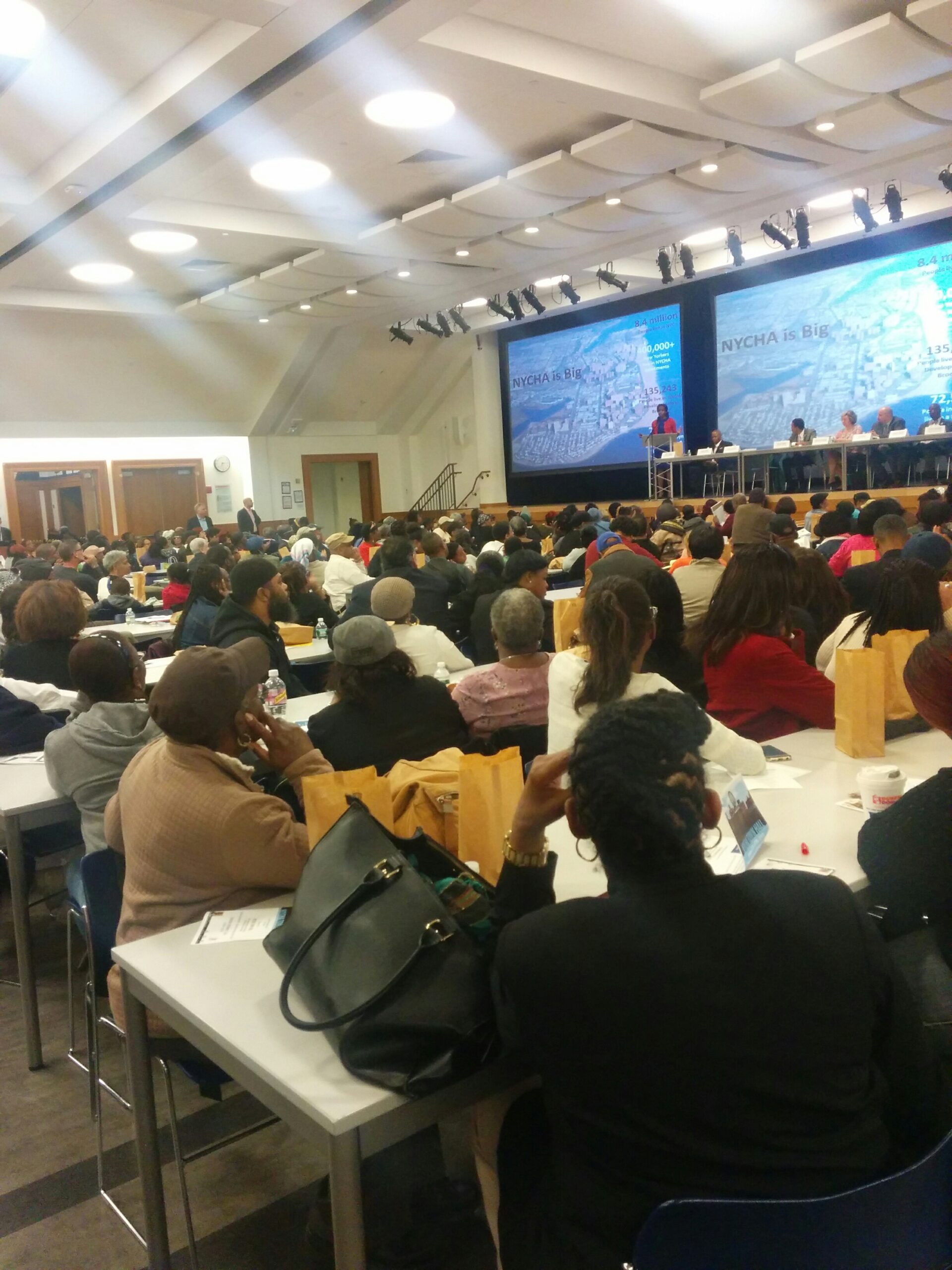
The lobby area in front of UnCommon High School’s auditorium buzzed from arriving New York City Housing Authority (NYCHA) tenants, the press, community activists, public officials and community service representatives striving to promote themselves to the public on November 3, 2016. There were three sign-in tables each manned by three workers to ensure all attendees wrote their contact information on the sheets and to bring attention to the 4”-x-6” blank index card inside the NYCHA Town Hall program. The workers consistently encouraged people to fill the index card with their questions or comments about NYCHA projects and residential units.

The first half-hour of the town hall was designated for filling the cards with one’s thoughts. Given the event’s time slot was 6:30 PM to 8:30 PM, Brooklyn Borough President (BP) Eric Adams and NYCHA Chief Executive Officer (CEO) Shola Olatoye may have agreed the completed cards ensured those who wanted to give “their five cents” would be collected and as many as time permitted to be read aloud and responded to by Ms. Olatoye.

Office of the Special Counsel/Outreach’s Kathleen Daniel successively jogged through the room to collect the completed cards and then delivered them to BP Adams who stood on the stairs to the stage. He, in turn, handed the cards to Ms. Olatoye.

During this period, this reporter interviewed Serena Sears, a resident of Albany Houses. Ms. Sears’ reason for attending this event is that she “missed the emergency tenant association meeting last Thursday about NYCHA buildings being sold. They sold Weeksville and moving some people [to other locations]”. Ms. Sears had heard “studio apartments would go for $1,300 and two-bedroom apartments for $1,700; and there’s a source offering to give $5,000 to assist households to move”. When asked the name of the source, Ms. Sears did not know the name. Not knowing and wanting clarity were the things that motivated her to come with her young son to the NYCHA Town Hall.

Another woman was approached to get her comments. She asked that she be unnamed. She lived in Albany Houses, too. This unnamed woman said, “The tenant association leaders could make life difficult for her, though she believed the leader discussed unrelated matters. What propelled her to attend the town hall was that Albany Houses was being referred to as ‘Albany Shelter’”. She pointed to “a lot of young people had moved from a nearby shelter to here”. When asked about the conditions of the building, she described “dog mess and human feces in the stairwell. Many crackheads were around due [the building] to not being supervised the way it used to be. Further, she complained of “being charged for water, though she doesn’t have a washing machine or air conditioning”. “When you complain to the rent office, you’re directed to call 311” was her last statement.

The Borough President made welcoming remarks around 7:00 PM, introducing those on the dais to the attendees. CEO Olatoye attended with Sideya Sherman, Exec. V.P. for Community Engagement and Partnership; Gerald Nelson, V.P. of Safety and Security; Luis Ponce, Sr., V.P. for Resident Outreach; and Deborah Goddard, Exec. V.P. of Capital Projects in tow. Though silent throughout the town hall, these four NYCHA executives were the people every person concerned about the state of NYCHA property would need to contact.

BP Adams expressed his concern over the facts and rumors swirling around Brooklyn’s NYCHA holdings. Adams praised Ms. Daniels for “knocking on 27,000 doors” and transitioned to the conditions existing on NYCHA properties. Adams said, “NYCHA was not only to serve the brick and mortar needs but also people…You deserve to be in an environment that is healthy. Where the elevators work, the walls are clean and no rodents are running around”. Adams made a link between food and mental issues.

He closed by pledging to work to make substantive changes and reminded the attendees of service to Brooklyn as a Police Captain, State Senator and now as Brooklyn Borough President. Once Deputy Borough President Diana Reyna came to the dais, BP Adams introduced and then left the auditorium.

City Council member (CM) Richie Torres from the Bronx, chair of the Public Housing Committee, followed behind Adams. CM Torres stated that he grew up in NYCHA property. He estimated “$100 million was needed to repair roofs because the root cause of mold in apartments was the condition of the roofs”.

“Since 2001, the federal government drained $1 billion from NYCHA funding. The government has failed you. It is the elected officials that have failed you—the federal, state and city elected officials, posited Torres.”

CM Torres was followed by the NYCHA CEO Ms. Olatoye presenting a PowerPoint talk that covered 40 years of federal and state government disinvestment, a major capital improvement plan and a fundraising strategy to cover rehabilitation costs.

Olatoye said, “The overall goal was to preserve public housing in New York City. We have to go back to basics [by focusing on] being the landlord and we need adequate funding to do it. For example, Albany Houses needs brick work and roof replacement”. She proposed “cutting some expenses of senior-level management and using three million square feet of nonresidential space to generate revenue”. Olatoye pointed to “40,000 square feet in Manhattan that would be converted to a public library” as an example of revenue generation. Another revenue-generating strategy was to build market-rate housing near subsidized housing. This section of the town hall would have been more effective if the NYCHA CEO chose fewer objectives and strategies to discuss (this article does not cover all the objectives). One attendee remarked that the slides moved too quickly.

The event’s last hour was designated for reading and responding to the audience’s statements on the index cards. This time, moderated by DBP Reyna, was marked by shouting and interruptions from the audience. The interruptions came primarily from women seated in the front and one woman in the back. Their preference was to call out their questions. Given the event was fashioned to read the cards, there was not a microphone set on the auditorium floor. Ms. Olatoye shared her microphone with the audience. The audience asked whether Weeksville Gardens and Albany Houses had been sold. Olatoye said, “They were still managed by NYCHA. Albany Houses, nor any other sites, are being sold”. When the group rebuffed her statement Olatoye said, “Whoever is telling you, that is wrong. I am the person that would sign off on property sales and I haven’t done so”.

Other questions from the floor included: “Why must my overtime pay be calculated in my annual income. I don’t always get overtime and why do we get rent increases even though we don’t have increases in our income?” DBP Reyna managed to read two to three questions from cards but, in the main, those determined to get their voices heard were addressed by Ms. Olatoye.

Dr. Lenora Fulani, whose press people distributed a notice about NYCHA property up for sale, shared her observations during a telephone conversation on November 4, 2016. “I thought the meeting was great in that when people are stepping on your rights, it is your right to stand up and say no.” The tenants taking control of the meeting [by asking from the floor] is what I think was a good consequence. The attendees were saying, ‘We want a conversation with you and not listen to the responses to the questions you select to answer”.

It is unfortunate the unnamed female resident of Albany Houses maintained her anonymity. When queried about the “calling out” from the front center table, she first looked keenly at the table and stated, “I recognize some of the women over there. They are Albany Houses Tenant Association leaders. This happens at our meetings”.

Transcript: President-Elect Donald J. Trump’s Victory Speech

President-Elect Donald J. Trump’s Victory Speech

compiled by Federal News Services.

Watch Video Here:


TRUMP: Thank you. Thank you very much, everyone.

(APPLAUSE)

Sorry to keep you waiting; complicated business; complicated.

(APPLAUSE)

TRUMP: I’ve just received a call from Secretary Clinton.

She congratulated us — it’s about us — on our victory, and I congratulated her and her family on a very, very hard-fought campaign. I mean, she — she fought very hard.

Hillary has worked very long and very hard over a long period of time, and we owe her a major debt of gratitude for her service to our country.

I mean that very sincerely.

Now it’s time for America to bind the wounds of division; have to get together. To all Republicans and Democrats and independents across this nation, I say it is time for us to come together as one united people.


It’s time. I pledge to every citizen of our land that I will be president for all Americans, and this is so important to me.


For those who have chosen not to support me in the past, of which there were a few people. . .

. . . I’m reaching out to you for your guidance and your help so that we can work together and unify our great country.


As I’ve said from the beginning, ours was not a campaign, but rather an incredible and great movement made up of millions of hard-working men and women who love their country and want a better, brighter future for themselves and for their families.


It’s a movement comprised of Americans from all races, religions, backgrounds and beliefs who want and expect our government to serve the people, and serve the people it will.


Working together, we will begin the urgent task of rebuilding our nation and renewing the American dream. I’ve spent my entire life and business looking at the untapped potential in projects and in people all over the world. That is now what I want to do for our country.


Tremendous potential. I’ve gotten to know our country so well — tremendous potential. It’s going to be a beautiful thing. Every single American will have the opportunity to realize his or her fullest potential. The forgotten men and women of our country will be forgotten no longer.


We are going to fix our inner cities and rebuild our highways, bridges, tunnels, airports, schools, hospitals. We’re going to rebuild our infrastructure, which will become, by the way, second to none. And we will put millions of our people to work as we rebuild it.

We will also finally take care of our great veterans.


They’ve been so loyal, and I’ve gotten to know so many over this 18-month journey. The time I’ve spent with them during this campaign has been among my greatest honors. Our veterans are incredible people. We will embark upon a project of national growth and renewal. I will harness the creative talents of our people and we will call upon the best and brightest to leverage their tremendous talent for the benefit of all. It’s going to happen.


We have a great economic plan. We will double our growth and have the strongest economy anywhere in the world. At the same time, we will get along with all other nations willing to get along with us. We will be.


We’ll have great relationships. We expect to have great, great relationships. No dream is too big, no challenge is too great.

TRUMP: Nothing we want for our future is beyond our reach.

America will no longer settle for anything less than the best.


We must reclaim our country’s destiny and dream big and bold and daring. We have to do that. We’re going to dream of things for our country and beautiful things and successful things once again.

I want to tell the world community that while we will always put America’s interests first, we will deal fairly with everyone, with everyone — all people and all other nations. We will seek common ground, not hostility; partnership, not conflict.

And now I’d like to take this moment to thank some of the people who really helped me with this, what they are calling tonight, very, very historic victory.

So, it’s been what they call a historic event, but to be really historic, we have to do a great job. And I promise you that I will not let you down. We will do a great job. We will do a great job.


I look very much forward to being your president, and hopefully at the end of two years or three years or four years, or maybe even eight years. . .


. . . you will say, so many of you worked so hard for us, but you will say that — you will say that that was something that you really were very proud to do and I can. . .

TRUMP: Thank you very much.

And I can only say that while the campaign is over, our work on this movement is now really just beginning.


We’re going to get to work immediately for the American people. And we’re going to be doing a job that hopefully you will be so proud of your president. You’ll be so proud. Again, it’s my honor. It was an amazing evening. It’s been an amazing two-year period. And I love this country.

Thank you. Thank you very much.


Thank you to Mike Pence. Thank you
A nation gone wrong in a world gone crazy: A first reckoning with how the hell this happened

A global wave of rage hits America, and I won’t pretend I saw it coming. Now we must face the unthinkable

By Heather Digby Parton, Salon.com

November 8, 2016 - File - DONALD TRUMP defeats H. Clinton to become 45th President of the United States. Pictured: October 27, 2016 - Geneva, Ohio, U.S. - Republican presidential nominee Donald Trump appears at a campaign event in Geneva, Ohio. (Credit Image: © Carlo Allegri/Reuters via ZUMA Press)
0049 size-medium” src=”http://ourtimeathome.com/wp-content/uploads/2016/11/Pg3_DonaldTrump-300×200.jpg” alt=”November 8, 2016 – File – DONALD TRUMP defeats H. Clinton to become 45th President of the United States. Pictured: October 27, 2016 – Geneva, Ohio, U.S. – Republican presidential nominee Donald Trump appears at a campaign event in Geneva, Ohio. (Credit Image: © Carlo Allegri/Reuters via ZUMA Press)” width=”300″ height=”200″ /> November 8, 2016 – File – DONALD TRUMP defeats H. Clinton to become 45th President of the United States. Pictured: October 27, 2016 – Geneva, Ohio, U.S. – Republican presidential nominee Donald Trump appears at a campaign event in Geneva, Ohio. (Credit Image: © Carlo Allegri/Reuters via ZUMA Press)

When I’m wrong I’m wrong. Yesterday I woke up thinking that the United States would elect a new president and remain a mostly respected world superpower and a reasonably stable global economic leader. I looked at the polls and believed that the chances of Donald Trump winning were so remote that it was not worth thinking about, so I wrote a piece assuming that Hillary Clinton would win, something I am usually careful not to do. So, of course, the unthinkable happened.

On the news that Donald Trump will be the next president of the United States, stock market futures nosedived, the dollar plunged and the whole world is in shock. We wake up today to a fundamentally different world than the one in which we woke up yesterday. The nation our allies looked to as the guarantor of global security will now be led by a pathologically dishonest, unqualified, inexperienced, temperamental, ignorant flim-flam man. Things will never be the same. And we have no idea at the moment exactly what form this change is going to take, which makes this all very, very frightening. Read more