Home Blog Page 709

Panel for Educational Policy to Vote on WEB DuBois & Brownsville Academy Consolidation

0

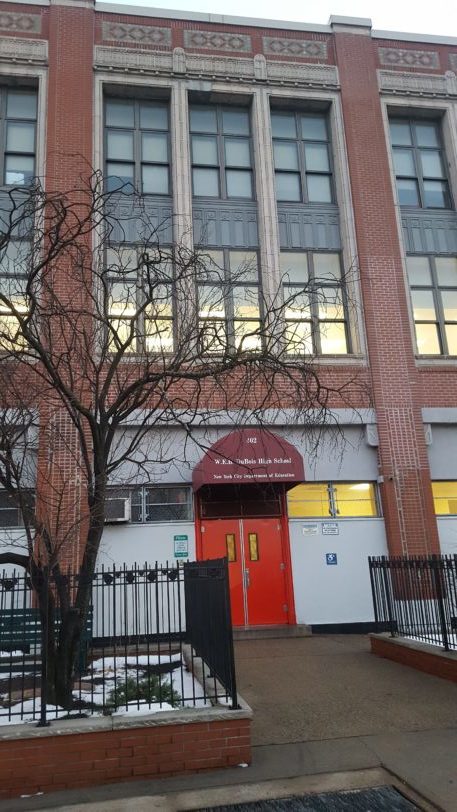
The Panel for Educational Policy (aka NYC Department of Education) has scheduled a meeting on January 24, 2018, 6:00 PM at PS 20, the Anna Silver School, located at 166 Essex Street, New York, NY, wherein the panel will vote on the consolidation of WEB DuBois Academic High School (17K489), located at 402 Eastern Parkway, with Brownsville Academy High School (17K568), located at 1150 East New York Avenue (K907). Both are transfer schools that serve “overaged and undercredited students who seek to attain high school diplomas”. The grounds for the consolidation are both schools are underenrolled. Each currently has under 200 students.

The Panel for Educational Policy’s (PEP) notice describes, “WEB DuBois and Brownsville Academy have persistently struggled with low enrollment, each serving fewer than 200 students per year over the last five years. Enrollment at WEB DuBois has declined by 46% in the last five years and enrollment at Brownsville Academy has declined by 29% in the last five years”. Enrollment numbers directly affect school budgets and therefore, the programming provided to the pupils.

WEB DuBois High School, where Dr. Catherine Costa is Principal, currently shares 402 Eastern Parkway with a suspension center and Restart, an alternative high school. WEB DuBois offers music and video production, intramural basketball, student government, career readiness services and academic tutoring. Should the consolidation go through, there is no other transfer school to serve the western portion of School District 17. Further, there are no plans to bring in another school at 402 Eastern Parkway at this time.

Brownsville Academy High School, where Ms. Carol Ying is Principal, is located also in School District 17, in the eastern portion. It offers the Learn to Work Initiative, College Now at Brooklyn College, college tours, dance, drama, cheerleading, tennis, chess, internships and the school newsletter. It shares space with Unity Preparatory Charter School, CAMBA, a nonprofit service agency, and the Executive Superintendent of Equity and Access. CAMBA is in the building as a result of Brownsville Academy High School being selected into the NYC Community Schools program in 2014. The NYC Community Schools program provides a wraparound of services for the students and their families.

The public review period for this proposal spans from November 30, 2017 through January 23, 2018, 6:00 PM. Public hearings were held on December 13, 2017 at WEB DuBois Academic High School and December 14, 2017 at Brownsville Academy High School.

WEB DuBois’ Principal Dr. Catherine Costa is not in agreement with the consolidation on many grounds. One concern is W.E.B. DuBois High School and Brownsville Academy are the only two transfer high schools located in District 17. However, Brownsville Academy is located on the border of District 23.

W.E.B. DuBois High School is home to the New York City WEB Center, The Reverend Clarence Norman Recording Studio and the W.E.B. DuBois Television Studio. The WEB Center is a digital lounge equipped with Apple desktops, laptops and iPads. The recording studio and television production studio are equipped with professional-grade music and video production equipment. Further, W.E.B. DuBois High School recently received funding in the amount of $250,000 from St. Assemblyman Walter Mosley to replace obsolete computers, laptops and smart boards. Eliminating W.E.B. DuBois High School would eliminate student access to these amazing resources.

It is unlikely that eliminating W.E.B. DuBois High School will increase enrollment at Brownsville Academy High School. We have surveyed 100% of our student population about their thoughts on the proposed consolidation. 100% stated that they do not think consolidation is a good idea and 100% stated that if the consolidation is approved, they will not attend Brownsville Academy High School.

W.E.B. DuBois High School is located in the 71st Precinct. Brownsville Academy High School is located in the 73rd Precinct. CompStat data provided by the New York City Police Department indicates that the crime rate in the 73rd Precinct increased by 2% in 2017, whereas the crime rate in the 71st Precinct decreased by 3.5%.

Brownsville Academy Principal Ms. Carol Ying was not available for comment due to leaving the high school early due to illness.

Note: Given Rev. Clarence Norman, Sr.’s work to establish WEB DuBois Academic High School, this writer sought comments from his son, former Assembly member Clarence Norman, Jr. He has not been available for comment.

Slavebreeding in the South’s “Peculiar Institution”

By Professor Milfred Fierce

Thomas Jefferson Randolph, nephew of Thomas Jefferson, speaking to the same Virginia legislature during the winter of 1831-1832, boldly asserted: “The exportation has averaged 8,500 for the last twenty years. It’s a practice, and an increasing practice, in parts of Virginia to rear slaves for market. How can an honorable mind, a patriot and a lover of his country bear to see this ancient dominion coverted into one grand menagerie, where men are to be reared for market like oxen for the shambles?”

Randolph is also credited with having shown that the Black population of eastern Virginia increased 186 percent from 1790 to 1830, while the white population in the same region increased only 51 percent. 3 In a speech on the same subject, to the same audience and delivered at the same time and place, Henry Berry of Jefferson County estimated that the annual exports would be not less than 10,000 – Bancroft says 9,500.32 Thomas Marshall of Fauquier, son of Chief Justice John Marshall, reportedly offered a still higher number. According to Jesse Burton Harrison, “Virginia has a greater number of slaves than any other state in the union – and more than Louisiana, Mississippi, Alabama and Tennessee all put together; and more than four times as many as either of
them”. (34) In 1840, the Anti-Slavery Society estimated that there were 80,000 slaves exported annually from the more Northern states to the South.35 While no estimate is given for individual states, it is generally accepted that Virginia was the leading exporter, therefore, she must have had a sizeable portion of this estimated 80,000.36 I am not concerned here and now with whether the number of slaves marketed for profit was 6,000, 8,000, 10,000 or 20,000 annually. If the repeated citations of civic and political leaders, guardians of Southern civilization, can be accepted – it tends to adduce that shred of evidence that U.B. Philips and his colleagues indicated could not be found.

The attestations of two additional individuals might be helpful here. With a quotable invective regarding the evils of slavery in Virginia, the South and the possibility of its extension into the territories, Thaddeus Stevens discusses the glorious days of the republic led by Virginia and guided by such patriots as George Washington and Thomas Jefferson. Now Virginia is reduced to the humiliating business of breeding slaves.

“The learned and able gentleman from Virginia (Mr. Meade) in a pamphlet which he laid upon our table, takes the same view of it. He says: ‘Virginia has a slave population of nearly half a million, whose value is chiefly dependent on Southern demand.’ Let us pause for a minute over this humiliating confession. In plain English, what does it mean? That Virginia is now only fit to be the breeder, not the employer of slaves. That she is reduced to the condition that her proud chivalry is compelled to turn slave traders for a livelihood! Instead of attempting to renovate the soil, and by their own honest labor compelling the earth to yield her abundance – instead of seeking for the best breed of cattle and horses to feed on her hills and valleys and fertilize the land, the sons of this great state must devote their time to selecting and grooming the most lusty sires and the most fruitful wenches to supply the slave barracoons of the South! And the learned gentleman pathetically laments that the profits of this genteel traffic will be greatly lessened by the circumscription of slavery. Reacting to a revenue tariff passed in the mid – 1840’s and in an attack on Pennsylvania Democrats, Joshua Giddings states: “Are the liberty-loving Democrats of Pennsylvania ready to give up the tariff? To strike off all protection from the articles of iron and coal and other productions of that state in order to purchase a slave market for their neighbors who … breed men for market like oxen for the shambles.” (37) Anticipating the incredulity of some, even though the declarations of Olmsted, Dew, Thaddeus Stevens and others unquestionably affirm the omnipresence of commercial slavebreeding in the “Old Dominion”, there are a host of current scholars who also confirm the existence of systematic slavebreeding: Dr. John Hope Franklin, Chairman of the History Department at the University of Chicago, a leading United States Historian and the Dean of Black Scholars, was a special consultant to a New York City Board of Education publication designed for teachers which states, “The systematic breeding of slaves appears to have been widely practiced and openly admitted by a number of prominent slaveholders. (emphasis mine) In The American Negro Reference Book, Dr. Franklin notes that because of the illicit foreign slave trade and slavebreeding, plus the normal excess of births over deaths, Black population in the United States increased steadily during the first half of the nineteenth century”. In 1790, there were 604,000 slaves. By 1808, there were about 1,000,000. In 1830, there were 2,156,900, and by 1860, the number had increased to 3,953,760. Virginia continued to lead with 549,000. (40) Professor Franklin continues in From Slavery to Freedom that Southerners feared that the supply of slaves would run out while there was still such great demand. He elaborates on the slaveholder’s solution: “The systematic breeding of slaves is one of the most fantastic manipulations of human development in the history of mankind. Despite the denials and apologies of many students of the history of American slavery, there seems to be no doubt that innumerable slaveholders deliberately undertook to increase the number of salable slaves by advantageously mating them and by encouraging prolificacy in every possible way experiments in slaverearing were carried on, albeit surreptitiously, in much the same way that efforts were made to discover new products that would grow on the exhausted oil.” (41) (emphasis mine)

Lerone Bennett, Jr. is no less consistent than John Hope Franklin remarking that “some masters sanctioned polygamy and polyandry”. Others kept “Stud Negroes” and bred slaves for the market. He follows with several pages of testimony to slavebreeding practices in the antebellum South. The late Dr. E. Franklin Frazier, eminent Black sociologist and Howard University Professor suggests that on most antebellum plantations mating varied from purely forced physical contacts to associations of genuine sentiment. Harold D. Woodman offers a new introduction to the 1969 revival of a work originally published in 1862, The Slave Power by John Elliot Cairnes. “The old states undertook the part of breeding and rearing slaves until they attained to physical vigor and of using up the development of their virgin resources the physical vigor which had been thus obtained.” Cairnes adds that “the whole business of raising slaves in the border states is carried on with reference to their price, and that the price of the slaves in the border states is determined by the demand for them in the Southern markets”. (44) Edward Byron Reuter commenting on the American race problem writes that slavebreeders had more aristocratic status than overseers or slavetraders even though their business was purportedly considered more ominous. As mentioned earlier, Reuter maintains that all slaveowners were slavebreeders and that commercial slavebreeding was an incidental by-product of the system.45 Charles Nichols, in his recent book entitled Many Thousand Gone, discusses the auction block and the kinds of questions planters and speculators would ask the slaves, notes that females were asked how many children they could turn out per year.46 Stanley Feldstein in Once a Slave talks about a slaveowner who kept fifty to sixty slaves for breeding alone. “No other slave was allowed near them, for they were reserved for the whites. From twenty to twenty-five children a year were bred on this plantation, and as soon as they were ready for market, they would be taken away and sold. (47) References such as these could go on ad infinitum. Moreover, the frequency with which politicians, planters, academicians and common folk referred to slavebreeders and slavebreeding states, convinces me, beyond a reasonable doubt, that commercial slavebreeding was a very popular business in the antebellum South. And Virginia, as Charles Henry Ambler’s vitriolic pen reveals, slavebreeding “enabled the inhabitants to keep the wolf from the door, and to maintain a semblance of their former hospitality”. Turning briefly to slave narratives, Mary Agnes Lewis illustrates the communication between a runaway slave and his former mistress. The mistress, Sarah Logue, asks J. W. Loguen to return home or send her $1,000 for her loss. She insisted that she raised the slave as she did her own children. However, the runaway asks, “Woman, did you raise your own children for the market”? (49) According to Paul Jacobs, Frederick Douglass, most famous of the runaway slaves speaking about his former master, reports: “In pursuit of this object {wealth}, pious as Mr. Covey was, he proved himself unscrupulous and baseless as the worst of his neighbors. In the beginning he was only able – as he said – ‘to buy one slave’, and scandalous and shocking as is the fact, he boasted that he bought her simply ‘as a breeder’. … No better illustration of the unchaste, demoralizing and debasing character of slavery can be found than is furnished in the fact that this professedly Christian slaveholder, amidst all his prayers and hymns, was shamelessly and boastfully encouraging and actually compelling in his own house, undisguised and unmitigated fornication as a means of increasing his stock. It is the system of slavery which made this allowable, and which condemned the slaveholder for buying a slave woman and devoting her to this life no more than for buying a cow and raising stock from her and the same rules were observed with a view to increasing the number and quality of the ‘one as the other’.” (50) American Slavery As It Is, the monumental collection by the West’s leading abolitionist, is virtually inundated with notations on slavebreeding and slavebreeders. One section in particular reviews the testimony to slavebreeding in Virginia and the denials are described as “ridiculous and contemptible”. (1) The question then, bears repeating. To what extent was the practice of slavebreeding the exception, and to what extent was it the rule? Or, exactly how widespread was slavebreeding in Virginia? Or, to posit the question by way of illustration, using Virginia as an example, what proportion of the slaveholders {with let us say, more than a dozen slaves} consistently bred them for market and resale to the lower South? Three-fourths, one-half, one-fifth, one-twentieth? To answer this elusive question in terms of proportions or percentages will require investigation and sophistication
which goes far beyond the natural limits of this brief conspectus. Moreover, the mission is exacerbated by the fact that research of this scope and depth has never been published.

Therefore, the scholar who is interested in resolving this issue must do all pioneer work, Frederick Bancroft notwithstanding. However, the “scientific search” can commence where discourse ends.

For my part, “scientific” population statistics; plantation, county or state if they can be found, which would supposedly demonstrate widespread slavebreeding, would only reconfirm that which has already been satisfactorily confirmed, albeit empirically. To be sure, the discussion which appears here, the dutiful testimony and repeated observations of leading spokesmen of the period, the remarks by current scholars, the presence of an overwhelming number of slaves in Virginia where commercial agriculture, to all intents and purposes, was bankrupt, and the reasonable explanation for the existence of the domestic slave trade–in the face of maximum efforts to leave no records – argues persuasively that widespread slavebreeding was a reality. Taken separately or in isolation, perhaps none of these factors is convincing evidence for the popularity of slavebreeding. However, when consolidated, they leave little room for disclaimers regarding a Southern predilection for wholesale exploitation of African man by European man (slavebreeding), “the hallmark of a capitalist society”. (2)

A note of advice for further investigation

After completing a thorough review of what literature there is, the investigator might compile a list of the leading planters and slaveowners in antebellum Virginia. Then proceed to make a county-by-county examination of the slave population statistics. From plantation to plantation, farm to farm and year to year from whatever records are available. Of course, if the statistics show an unusual increase {beyond what is considered the natural increase}, it will then be necessary to prove that this abnormal rise in slave population cannot be explained elsewhere; i.e., the “illicit slave trade”. Not satisfied here, the investigator can examine the state of Virginia population statistics from year to year for clues. Needless to say, the question of reliability as well as the validity of statistics must be dealt with by the student. The researcher can delve into materials on the domestic slave trade. An examination of the size and nature of slave sales – source destination, etc. – from the upper South to the lower South should reveal whether the traffic was heavy or light from Virginia. If the theory holds up that one major source of supply might have been a series of slavebreeding farms which contemporaries often made reference to.

For more help the scholar can conduct an intensive exploration of abolitionist literature. Although perhaps not as scientific as population or domestic slave trade statistics, the writings and speeches of Arthur and Lewis Tappan, the Grimke sisters, the Lovejoys, Charles Stuart, Garrison, Weld, Giddings, Adams and a host of others should turn up something. Abolitionist newspapers such as the Liberator, Emancipator or North Star cannot afford to be overlooked. Early periodicals owned and operated by free Blacks such as Freedom’s Journal, The National Watchman and Mirror of Liberty should be seen. Slave narratives can be a source for future consideration. If it is discovered that a substantial portion of the slaves who left narratives referred, repeatedly, to breeding practices they witnessed, it would be a valuable addition to the investigation.

As I see it, there can be no more reliable sources than the writings and speeches of contemporaries like Harriet Martineau, Olmsted, Henry Berry, Thomas J. Randolph, Thaddeus Stevens, plantation owners, overseers and “Southern gentlemen”. Everything they wrote and said must be gleaned for clues. I haven’t mentioned the larger newspapers and periodicals earlier because information gathered from the above sources are very likely to appear in the leading newspapers. However, some idea of the attitude of Southerners toward slavebreeding can be found in organs like the Richmond Enquirer, Richmond Whig or Charleston Mercury, plus many others.

Finally, I do not want to create the impression that one needs to be limited to these brief suggestions. On the contrary, they represent merely some place to begin and are more selective than exhaustive. Certainly, many more areas for perusal will reveal themselves once the task has begun.

It is most difficult to distinguish between what is considered the natural increase and what could be considered a forced increase. Assuming that promiscuity among Africans was a little different from that of Europeans, any disproportionate rise in the Black population during this period might be considered a coercive or forced increase. (2) Matthew Hammond, The Cotton Industry: An Essay in American Economic History (New York, 1897), McMillan Company 54, rpt. 1966 Johnson Reprint Corp.
 

This Haiti Earthquake Anniversary, Black Immigrants are Under Threat

by Luce Janvier

In so many ways, our lives as immigrants in the United States are the same as anyone who works hard to take care of their families. My story is an example of this.

I first visited the U.S. in 2004, amidst the coup d’etat against President Jean-Bertrand Aristide. I didn’t know at the time that I would have to stay here. But by the time Aristide was ousted from power, I was forced to seek refuge in this country because I feared for my life. As someone who belonged to a community group that supported his political party (Lavalas), I became a target.

When I started to build a life here, it was very difficult. Within a year, Hurricane Wilma damaged the house where I was staying, and I lost my papers in the storm. During that time, I started going to a Catholic church, where I found a school whose staff told me where to go for help. The school helped me get a bus card so that I could get back and forth and they also helped me find a lawyer who informed me that I was here too long to file for asylum.

In order to feed myself and support my family in Haiti, I had to work in the bean fields for two years. It was very difficult work, at times my lips would crack and bleed from the products they used.

Eventually, a lawyer helped me file for a work permit that enabled me to find a job as a housekeeper and rent a room to live in. But I still didn’t have enough to eat. I would go to church and school on an empty stomach. The minimum wage I made was just enough to pay for transportation and to send money for my three kids in Haiti.

Then the earthquake struck. It destroyed the home in Delmas (in the greater Port-au-Prince area) where my kids lived. So for several months they had to live in a tent. My son’s foot was injured, almost broken in the earthquake. My family didn’t receive any of the aid that was sent to support survivors. And because I didn’t have all my papers, I couldn’t be there with them. All I could do was send money.

Things began to turn for the better once I found out about TPS (Temporary Protected Status). Through my church, I got connected with Catholic Charities, which helped me file for TPS. For the first time in 12 years, I would be able to travel and see my children.

And then I applied for permanent residence. Though I built my life here and paid taxes, there were some basic services I still didn’t have full access to. For example, I couldn’t afford health insurance so I couldn’t go to the doctor. I haven’t been able to afford a decent apartment, so I still have to rent a room.

I’m sharing my story for one simple reason: to let you know that immigrants like me want what every person wants and deserves. We want to live and work to provide for our families. And for those of us who have made our lives here, we want a path to permanent residence and a path to citizenship. We want to live with dignity, not just to survive.

As we work towards that permanent solution, we’re asking you to stand in solidarity with us now.

Thousands of residents are fearful that they may lose their jobs because they haven’t been able to renew their work permits. The Department of Homeland Security neglected to provide Haitian TPS holders with updated information on the work authorization renewal period. We need the Department of Homeland Security to update the Federal Register, with the start date the 60-day re-registration period beginning on the day the Federal Register is updated.

We also need Congress to enact legislation that provides a humane, holistic solution for Haitians and other TPS holders. We need legislation that formalize what TPS holders already are—permanent residents of the United States.

Luce Janvier is a Haitian North Miami resident, a member of the Black Alliance for Just Immigration (www.BAJI.org) and recipient of Temporary Protected Status. This essay was written as part of a national initiative of the Black Immigration Network (www.blackimmigration.net).


Haiti: The tip of Freedom’s Spear in North America

Allow me to tell you a wonderful story about a most productive and resilient island in the Caribbean. The island was called Hispaniola and the colonization of this island was shared by Spain, who owned two-thirds, and France who owned the remaining third. For those of you not aware, colonization was an imperialist strategy that Europeans instituted for around four hundred years. Basically, it’s when Europeans “discovered” your land, began to settle on it and then enacted laws to control you; to decimate your sovereignty and to simply utilize the idea of manifest destiny as an impetus to usurp all of the resources from your land for profit.

In 1789, North America and the entire Caribbean Sea were engulfed in centuries of colonization. The French controlled their portion of Hispaniola, calling it Saint-Domingue. This little territory was the most prosperous colony in the entire Caribbean. No Caribbean colony churned more profit in 1789 than Saint-Domingue. 60% of the world’s coffee and 40% of the world’s sugar came out of that colony. Slavery, the primary commodity of the time, was solely responsible for the economic boom in Saint-Domingue. French plantation owners imported tens of thousands of Africans for slavery annually. For example, in one year the French delivered 20,000 slaves to Saint-Domingue. Comparatively, in that same year, 38,000 slaves were delivered to every other Caribbean island. A big reason for the influx of slaves into France was the fact that during this time the yellow fever was rampant throughout the island. Slave owners would bring in more and more slaves in order to cover the ones they assumed would die after contracting the illness. It made great business sense, allowing the French slave owners to push out tons and tons of raw material for use in the European world. However, the aggressive stockpiling of slaves led to some very uneasy numbers with regards to population. In Saint-Domingue in 1789, African slaves outnumbered whites by a ratio of 10:1.

It was a combination of the horrible treatment of the slaves by the French, the persistence of free men of color in Saint-Domingue and the ideas of enlightenment which called into question the practice of slavery which put in motion the gears that grinded into revolution on the island. In April of 1791, slaves in Saint-Domingue revolted against slave owners. In just two months, 4,000 whites were murdered by a slave revolt that counted as many as 100,000 members. In a year, slaves owned almost half of Saint-Domingue. The siege would become known as the Haitian Revolution. Jean-Jacque Dessaline named the island Haiti in 1804. Haiti was the first independent nation in Latin America, and the first post-colonial independent Black state in the world. Haiti is the only place that took their independence through a slave revolt.

In 1825, the French Government demanded that Haiti pay an “independence debt”, basically offering reparations to France for their economic losses which stemmed from the loss of the island. France placed warships at the ready, making it hard for Haiti to refuse. The fee was 150 million francs, a figure that would represent trillions of dollars today. The debt crippled Haiti’s economy for a whole century. Finally, in 1947, they were able to pay in full. Ten years later, the ushering in of the Duvalier family and Papa Doc as President led to enormous economic upheaval for Haiti, as the Duvaliers took incurred loans that at one point were responsible for 40% of Haiti’s debt. Between the “independence debt” and the Duvaliers, Haiti was constantly robbed of their resources and kept an unstable country due to corruption. Eventually, Papa Doc’s son, Baby Doc, was kicked out of Haiti and sent into exile. This began a turn for Haiti which now has the country currently coming together after over a century of mismanagement and corruption.

When Baby Doc left Haiti though, he rested comfortably for a time in a lavish apartment at Trump Tower. Our president sold the Haitian dictator a condo on the 54th floor of the building in 1983. Baby Doc owned the place until Ronald Reagan froze his assets in 1987. Still, Baby Doc counted Trump as a friend.

Trump was quoted this week, calling Haiti and countries in Africa “shithole countries”. I guess now that his friend isn’t in charge anymore he could care less about the place. Funny thing is that the more he talks, the less we all could care about him.

What’s Going On

USA/CURRENT EVENTS

The Trump Presidency is consistent, consistently offensive to people of color. Take last week’s talks about immigration to a bipartisan group of legislators at the White House. The president was referencing Haitians, El Salvadorans and African countries when he said, “Why are we having all of these people from shithole countries come here?”   He continued. “We should bring more people from countries like Norway…..and we would be more open to immigrants from Asian countries because I feel that they help the U.S. economically.”  Trump denies making the shithole remarks. I believe Senators Dick Durbin and Lindsey Graham do not dispute the Trumpian shithole remarks. Racist?! That’s a rhetorical question.

It is hard to respond to ignorance and stupidity. Where do you begin? Does Trump know that until about 5 years ago, Africans were the best formally educated of all immigrants to the USA. Yes, they believe in Ph.Ds. They excel in engineering and many are superstars on Wall Street. Does he know that Africa is also the richest piece (re: natural resources) of real estate on the planet. He needs to check with some of his “really rich” white American or European buddies, the Fortune 500 gang to test their knowledge and interest in Africa and Africans.

When a country or a continent has something that your corporate denizens want, you adopt liberal immigration policies for their citizens.  Africa is also a continent crucial to US security and defense strategies.   Perhaps, Trump should read a few Africom bulletins. Or just read some US Department of Defense files about the critical roles of Africa. Last year, Trump said that the US was changing its Africa policy, decreasing if not eliminating humanitarian aid, and focusing instead on strengthening local militaries. Did I mention that Africa is the home of civilization, including European civilization. Read my Haiti remarks under Foreign Affairs.

I suspect that President Trump’s behavior, outbursts and chaos explains the book industry’s fascination with the USA’s close encounters with disaster during his term in office. War brinksmanship, polluting the air and the waters, dismantling public education.   David Frum’s book, “TRUMPOCRACY: The Corruption of the American Republic”, hits bookstores this week. Trump also disrespected Dr. Martin Luther King, Jr.’s holiday by playing golf! POTUS 45 is not good for the national health of America and the world really misses Barack Obama and his presidency when he did his best to help make the USA and the world a better place.

NY POLITICS


Jumaane Williams

Councilman Corey Johnson is the new NYC Council Speaker. A politician with a progressive agenda who named committee chairmen and party leaders.  Rafael Salamanca, Jr. (Bronx) chairs Land Use; Daniel Dromm (Queens) chairs Finance; Ydanis Rodriguez (Manhattan) chairs Transportation; Andy King chairs Juvenile Justice; Richie Torres chairs Oversight and Investigations; Laurie Cumbo is new Majority Leader; and Councilman Jumaane Williams (Brooklyn) seems to be the only one who ran against Johnson for the Speakership who was not awarded a chairmanship.    Not to worry. Williams has set his sights much higher….initially for the governor spot. Now his interest is the Lieutenant Governor Kathy Hochul’s job. Congressional Minority Leader Nancy Pelosi wants Hochul back in Congress. NYS Dems are courting Rochester Mayor Lovely Warren as a LG hopeful.


BUSINESS MATTERS

Richelieu Dennis

Liberian-born businessman Richelieu Dennis, founder of Essence Ventures, recently purchased Essence Communications from Time Inc. for an undisclosed amount. The sale included Essence magazine and the Annual Essence Festivals, held in New Orleans since 1995 and in South Africa since 2016. Essence magazine was founded in 1970 by Ed Lewis and a team of Black male entrepreneurs.  Essence President Michelle Banks joins the Essence Ventures Board, as does a Black female-led executive team who will have equity in the enterprise. Richelieu Dennis launched the successful Shea Moisture brand, a hair and skin care line which he recently sold. He also entered into a business deal with Barbara Ann Teer’s National Black Theatre building in Harlem on Fifth Avenue at 125th Street.

Wonder if Mr. Dennis has some surplus funds from his Shea Moisture revenues to buy Johnson Publishing’s iconic brand, Ebony magazine. Johnson Publishing magazines were sold to Michael Gibson’s Black-owned private equity company CLEARVIEW, which had no publishing background. I have not seen an Ebony hard copy in months. What passes as news from the site is salacious celebrity gossip, disseminated about twice a week. Ebony has been reduced to a blog!

Register for the free NY State MWBE workshop on January 25th from 9:30 am to 11:30 am at the Adam Clayton Powell, Jr. State Office Building, located at 163 West 125th Street, Harlem, 2nd Floor Art Gallery. Registration necessary. [Contact Harlem CDC at 212.961.4100 or harlemcdc@esd.ny.gov]

Brenda Brunsen Bey

Brenda Brunson’s Tribal Truths fashion emporium in Brooklyn closed on January 14.   A fashion designer and stylist, Brunson is a household name in New York’s women’s fashion circles, couture and rtw, for those disposed to drama, lyricism, Afrocentricity or all of the above. A Brunson design is its own statement. It is wearable art. Tribal Truths was housed at 117 So. Oxford Street. We all wait with baited breath for Brunson’s next chapter or sequel to Tribal Truths.

FOREIGN AFFAIRS

FORBES magazine just published its list of 23 African billionaires. Nigerian cement and commodities businessman Aliko Dangote tops the list for the seventh consecutive year with a net worth of $12.2 billion.   Other Black African billionaires in the Forbes firmament include Zimbabwe’s Strive Masiyiwa, Econonet; Angolan Isabel Dos Santos and Nigerian Folorunsho Alakija. Like their American counterparts, their net worth is guestimated by Forbes.

 HAITI celebrated its 214th Independence Day on January 1, 2018. The enslaved Africans in Haiti emancipated themselves and declared independence from Napolean’s France, which boasted one of Europe’s most formidable armies. The African Haitians were the only New World Blacks who snatched their freedom.   Therein lies its problem to this day.  Wonder if Trump remembers Haiti’s last legitimate democratic election when Jean-Bertrand Aristide became president. What happened? The US, France and Canada removed him from office and relocated him to the Central African Republic. A screenwriter could not conjure up a scenario like that. A superpower act like that threatens political stability. Then came the 2010 earthquake with recovery pledges and commitments just north of $5 billion.   Where did the money disappear to? Certainly not to Haiti’s treasury. P.S.– Who is collecting the Haitian gold mine revenue?

HEALTH WATCH

CEMOTAP (Committee to Eliminate Media Offensive to African People) hosts a FORUM, “African Guide for Physical, Mental and Spiritual Health”, featuring scholars/healers Dr. James McIntosh, MD; Dr. Arthur Lewis and Professor James Small on Saturday, January 27 at 2 pm at the CEMOTAP Center, located at 135-05 Rockaway Boulevard, South Ozone Park, Queens 11420.   Free admission, registration required, call 347.907.0629.

A Harlem-based management consultant, Victoria can be reached at Victoria.horsford@gmail.com.