Home Blog Page 697

Black Minds Matter March and Rally

Harkening back to the effort to institute the Curriculum of Inclusion of the 1980s, New York lawmakers state Senator Jesse Hamilton and state Assembly member Diana Richardson advanced legislation requiring the NYS Board of Regents to incorporate New York State’s Black History in the New York City school curricula for kindergarten to 12th grade. The two lawmakers made their intentions public in May 2017 and continue to realize Black History in New York City public schools today. On January 3, 2018, Hamilton sponsored S5454A in the New York Senate and it was placed in the Education Committee. S5454A “relates to establishing the Commission on African-American History and Achievement.” Co-sponsors include Marisol Alcantara (D), 31st SD; Velmanette Montgomery (D), 25th SD; George Latimer (D),? Senate District; and Diane J. Savino (D, IP, WA), 23rd SD. The state Assembly version of the bill is A7192.

An hour-long documentary on Chamique Holdsclaw, the basketball star once called
“the female Michael Jordan,” will screen at the 2018 ReelAbilities Film Festival this
week and next. The film follows the phenom’s rise from her Queens hometown to
the WNBA, to Rookie of the Year and eventually an All-Star and a Gold Medalist with
her team at the Olympics. Meanwhile, her hidden struggle with mental illness led to
some dramatic lows and legal charges before she found her mission as a mental
health advocate. Showtimes and venues at REELABILITIES.ORG/NEWYORK.

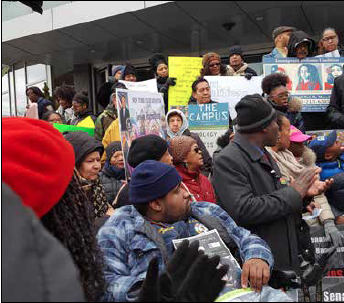
On Sunday, March 4, 2018, Senator Hamilton held the “Black Minds Matter March and Rally.” The rally was held on the steps of Medgar Evers College School of Science, Health and Technology at 1638 Bedford Avenue. It was a cold, breezy day; however, Brooklyn United Marching Band, a teen ensemble, led community leaders and residents along the march route, which was the circumference of Medgar Evers College Administrative Building at 1650 Bedford Avenue to return to the steps of 1638 Bedford Avenue to allow the 15 invited speakers to orate. District Leader Geoffrey Davis stated, “We want Black History in public schools.” Norelda Cotterel, PTA President of Medgar Evers College Preparatory High School, informed the body that “Medgar Evers College [College Preparatory High School] is under attack by the [New York City] Department of Education. Teachers are being sanctioned for adding Black History items in the different subjects. This high school is an Early High School, Early College School where the student body moves on to graduate from such Ivy League schools as MIT.”

The Black Institute Executive Director Bertha Lewis remarked, “In the 60s and 70s we were fighting for a Black curriculum, and in the 2010s we are still fighting for a Black curriculum. We are given the shortest month, which is the coldest month of the year, to celebrate. When are we going to get Black education?” Jamila Davis, author of She’s All Caught Up and who was sentenced to 12½ years in prison for a bank fraud scheme, remarked, “While I was sentenced to 12½ years behind bars, my accountants who prepared my tax filings, were given 2½ years. Davis told the crowd that during her imprisonment, she completed high school, earned her bachelor’s and master’s degrees. Davis’ presence at the rally was to wake up youth and adults to the allure of street life and fast money.

Nation of Islam Minister Paul Muhammad attended the march and rally in support of the state Senator. Muhammad said, “We have our own school, 50 years and counting.” This statement was made to encourage private citizens, civic organizations and houses of worship to commit to “collective work and responsibility” and building the institutions a community requires to survive and thrive. Altogether, 14 people were scheduled to talk. The last two speakers were state Senator Marisol Alcantara, a S5454A co-sponsor, and state Senator Jesse Hamilton. Senator Alcantara explained the legislation to the public. St. Senator Hamilton’s (IDC) comments were of a humanistic nature. Highlights of his speech include, “Gentrification can only happen if you’re undereducated. We have a struggle in front of us…keep fighting. We are taking a stand: Black Minds Matter.” The senator noted that the Working Families Party had an office on Bedford Avenue, in close proximity to the Medgar Evers College campus. Hamilton remarked, “Working Families Party says they are for us but they are not here today.” Hamilton said that his effort to include Black History in the curriculum of New York State’s most populous city has won him much hostility. The state senator has received telephone calls from people who curse and disparage him. These incidents give him the resolve to continue until the bill is voted into law and signed off by the governor. Hamilton’s essential statement is, “We have to have Black History in our public schools.”

 

Second-Guessing

0

With the 2018 NFL Draft a little over a month away, the New York Giants will have the second overall pick and many sources indicate they will indeed draft a quarterback. Or would they? In a previous story I did about a month ago, I touched on the fact that due to his age and the team having that second pick, quarterback Eli Manning has perhaps played his last game as a member of the New York Giants. However, when I wrote that piece regarding Manning’s future in New York, the team had just fired Head Coach Ben McAdoo and General Manager Jerry Reese. In comes new GM Dave Gettleman and Head Coach Pat Shurmur. Both Gettleman and Shurmur have given Manning a “vote of confidence” and have gone on record saying they believe he will be the quarterback for “years to come.” Which begs the question, “Who will the Giants draft at number 2?” I’ve narrowed it down to two players.

The logical move for the Giants is to select UCLA quarterback Josh Rosen. With Manning at center stage let’s say for the next 2 years, you give a young Rosen to hold a clipboard and learn from a 2-time Super Bowl-winning champion. I mean, after all, it paid off quite well when Aaron Rodgers learned from the great Brett Favre in Green Bay. It would not be a situation where Manning would be benched and you are throwing a 21-year-old rookie into a potential lion’s den. Rosen stands at 6-foot-4 inches tall and 218lbs. He has a great frame and a heck of an arm to go with it. Option two for the G-men can be Penn State’s Saquan Barkley. Barkley, 21, had quite the season in his last year at Penn State and opened eyes at the NFL combine. Barkley became only one of three players 230 pounds or more to run the 40-yard dash at 4.4 seconds. He followed that with 29 bench reps and a 41-inch vertical leap. If the Giants decide to go with Barkley at number 2, it may very well be the beginning of something dangerous. The team will then be set with a three-headed monster of Manning, Barkley and, let’s not forget, they still have Odell Beckham, Jr. The Giants will have a proven quarterback with receivers he can throw to and rely on, to go along with a now-revamped running attack with Orleans Darkwa already in the fold, and now Saquan Barkley.

The Giants are a team that can afford to pass on a quarterback with Eli Manning still having the ability to win big-time games and play quarterback at an “Eli-te” level. If Manning were to be ineffective, the team has Davis Webb, who the organization is pretty high on as far as life after Manning goes. I’d roll the dice and select Barkley with the second pick. We’ll see what the Giants decide to do. Regardless of who it will be Rosen or Barkley, the Giants should get a franchise-type of player that can be productive for the next 10 years!

Sports Notes: (Baseball) Spring training has begun. E-mail me at Castroeddie714@gmail.com and hear what players I think will have breakout seasons for both the Yankees and Mets. My answer just might surprise you.

Right to Record Bill Reintroduced

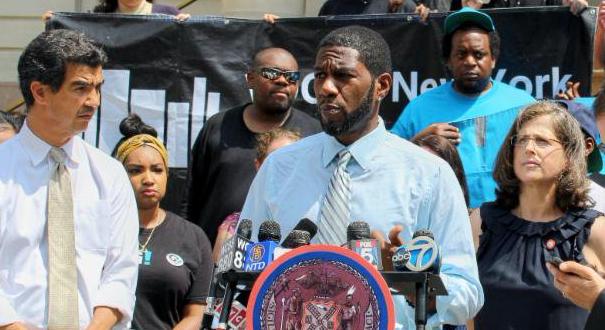
NEW YORK, NY: Wednesday at City Hall, Council Member Jumaane D. Williams (D-Brooklyn), reintroduced legislation commonly referred to as the ‘Right to Record’ Act. The bill, which was initially introduced during the summer of 2016, can now be considered by the New York City Council in this term.

The bill, now designated as Intro 721, and co-prime sponsored by Council Member Williams and Council Member Helen Rosenthal (D-Manhattan) would prohibit New York City police officers or peace officers from taking any steps to prevent the recording of their activities, unless such recording would constitute the crime of obstructing governmental administration in the second degree. The bill also allows any individual who is prevented or discouraged from filming such activities to sue the City in state court.

The issue of civilians recording police activity, and its role in identifying police misconduct, has risen to prominence in recent years, notably in the cases of Eric Garner, Philando Castile, and others who have died during encounters with police officers. The NYPD, and other departments across the country, have also implemented their own recording practices using body cameras- with Mayor de Blasio promising to expand usage of body cameras by the NYPD to 18,000 cameras by the end of 2018, which would equip all officers on patrol. There have been questions raised about the selective release of the footage collected by body cameras.

Council Member Williams has been an advocate for policing reform throughout his time on the New York City Council, including his work on the Community Safety Act, which helped to address the abuses of stop, question and frisk and curtailed bias-based policing practices.

“While we have made significant progress in policing practices in the last several  years, there are two areas in which have not seen improvement; accountability and transparency.” said Council Member Williams. “Recent revelations about the lack of substantial accountability for officers who have committed serious offenses serve to accentuate the need for the kind of public transparency that civilian recording can provide. The people have a right to record officer activity, and that right must be codified and protected.”

“New York City residents have a fundamental constitutional right to document their interactions with local law enforcement in public spaces — using photos, video or other means. The Right to Record Act reaffirms our First Amendment rights, helping to ensure that civilians who record police activity are not harassed or otherwise stopped, and I’m proud to support it,” said Council Member Helen Rosenthal.


How will you speak of what once was?

I am Old Brooklyn. Allow me to qualify this moniker for you.

Marketing of new developments is a sign of
changing times.

My mother was born in Kings County Hospital. She was raised at 1302 Pacific Street–living there from 1956 until we moved to Greene Avenue in 1990. My father was born in the Jewish Hospital that used to be on Prospect Place and Classon Avenue. He grew up on Madison Street and Nostrand Avenue. His mother moved into 751 St. Marks Place in 1969, and she lived there until she died in 2008. My parents were born and raised in the same neighborhood that I was born and raised in. That’s Old Brooklyn. I can remember being a child and walking through the neighborhood time and again with either my parents or my uncles and aunts. I can remember the stories–all of the stories that shaped the beginnings of my intimate familiarity with my community. Maybe it was just me, but when I was a kid I enjoyed being able to associate places in my neighborhood to experiences and stories that my family shared. Has to be the writer in me. I mean, even as an 8-year-old, I was always interested in the backstory. The Lerner’s that used to be in Restoration? My mom worked there when she was young. (925 Prospect Place?) That was where my father’s friend, Arthur Miller, used to live. He was killed by the police in 1978. That storefront on Nostrand? Family friend Richard Anderson’s father used to have a store there. These stories, they added context to the neighborhood for me, providing my book of life with the necessary prelude. Here is what has happened. This is why your story is even more important.

 I am always walking in this community. The other day, I walked from Marcus Garvey Blvd. and Jefferson Avenue, all the way to the Atlantic Center Mall. I could remember when that mall area was barren, except for rail yards and the welfare hotel across the street. Along the way, I must’ve seen a dozen examples of new developments, cumbersome edifices rising out of the debris of Old Brooklyn. As I walked, I began to tell myself the stories of these spaces, just like my family would, squinting my eyes hoping that the story combined with my focus would help me to see it as it once was, before it wasn’t anymore. Tompkins between Halsey and Hancock? The building that they tore down to build on that land used to be a paint store. The last time I was in there was years ago, my nana sent me to pick out paint for her kitchen. There was a tall woman that used to work there back then. I saw her recently, she owns a hardware store on Nostrand now. I didn’t speak to her, but I remember her.

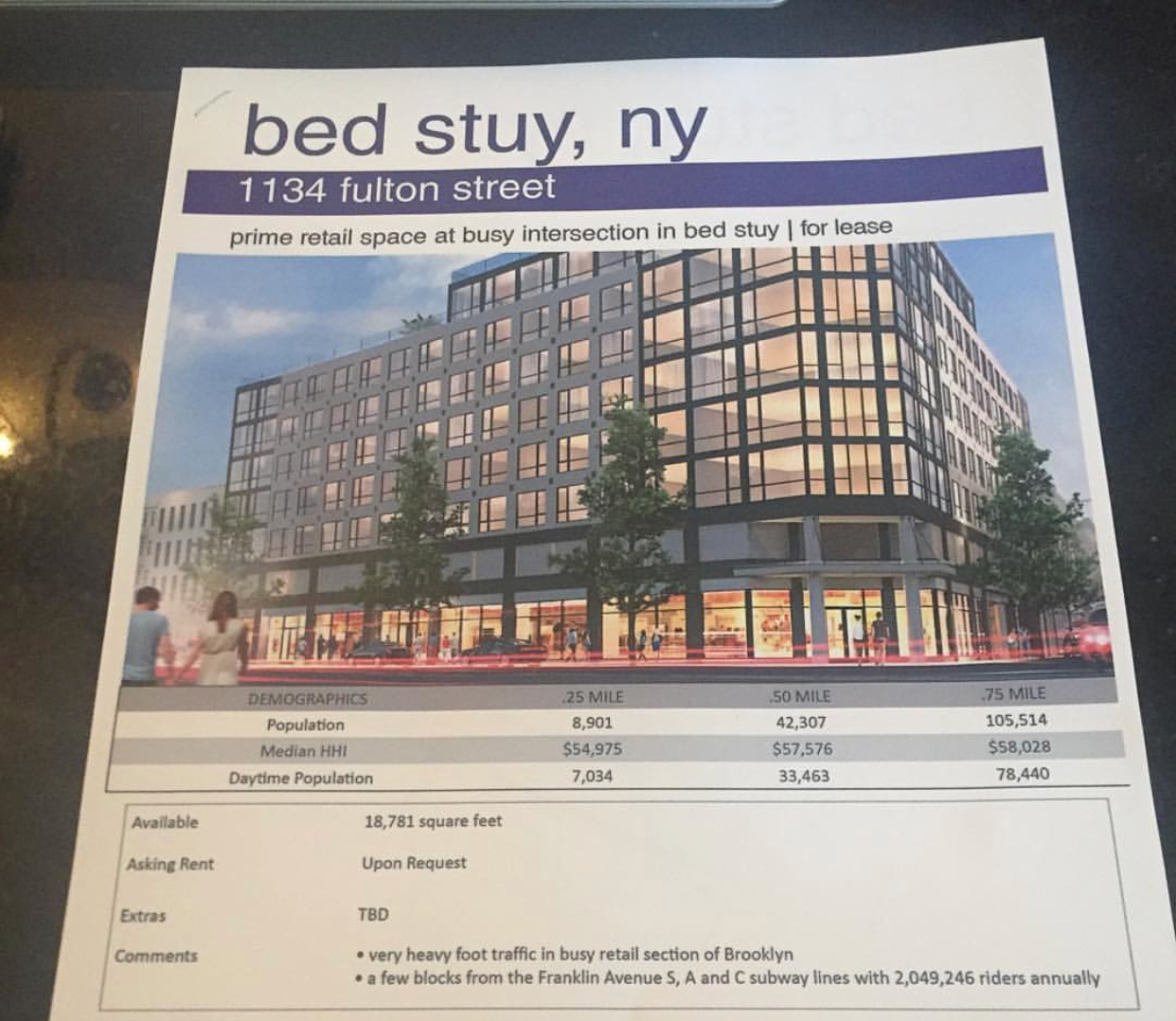
They are building on Franklin and Fulton, too; they tore down almost half a block worth of buildings to erect their new mixed-use space there. The biggest business to be moved from there was Key Food. Truth be told, I never shopped at that Key Food much, but it was humungous, so big that the entrance was on Fulton Street but the loading area for the food trucks was around the corner on Franklin. A couple of small restaurants, a health food store and a barber shop were some of the other businesses along that strip that were destroyed in order to build anew. Two years ago, I was the general manager at Melba’s Restaurant in Harlem. One day, a developer came into the place before we opened. He wanted to talk about this new development going up in Brooklyn. It was going to be commercial businesses along the ground floor and eight stories of residential space above. He was inquiring as to Melba’s interest in placing a soul food restaurant in the building. He pulled out the renderings, and lo and behold, it was the development on Franklin and Fulton! Melba and I laughed about that. The renderings had the building complete and depicted what would be a “normal” day in the community, people walking to and what not. The renderings were nice, except for one thing. There were no Black people in them. I kept the package that he left us, renderings and all. Years from now, when I’m walking in this community with my children, I will tell them that story. Just as my parents did for me, I will provide to their book of life a necessary prelude. It will say, “Here is what has happened. This is why your story is even more important.”


Will the Runner-Up Prove to be the Remedy?

By Maitefa Angaza

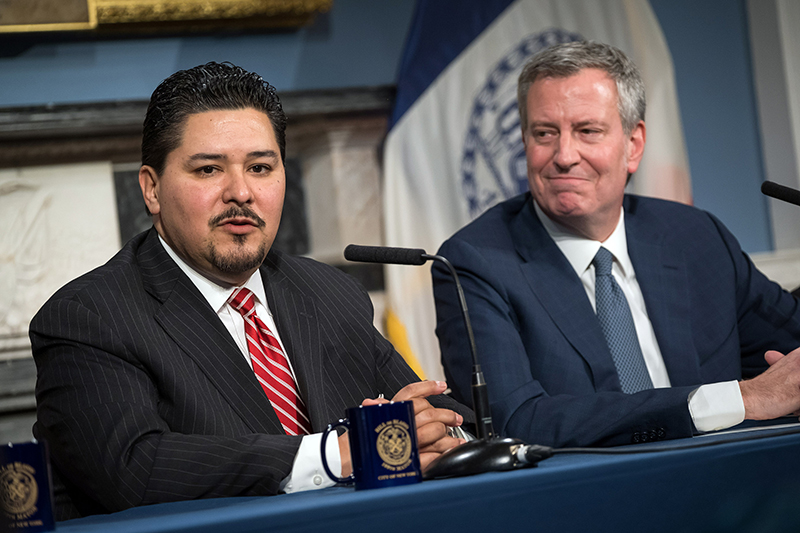
As we know, Mayor Bill De Blasio’s last choice for the new Schools Chancellor stood him up. So, we’d expect that this time, Bill De Blasio would think carefully about who he invites to the dance. He claims to have done his homework, even as word makes its way from Houston and San Francisco that Richard Carranza may not be the answer to our prayers. Some say that he did not do enough to advance access to quality education for Black and Latino students in those cities; others in those locales sing his praises.

There will always be detractors, of course, but what seems to be missing is the weigh-in we should have had from our own seasoned New York City education professionals. A few of them have polite praise for Carranza, while some would have preferred Caravalho. But, as Errol Louis said in a recent Daily News opinion piece, the Mayor would have done well by seeking the input of the people whose job it is to know what – and who—makes for a good chancellor.

“Places like NYU, Teachers College and the Bank Street College of Education are literally stuffed with people who possess sharp minds, broad vision and, collectively, millennia of experience in how to educate the young,” said Louis. “Their insights are de Blasio’s for the asking. If only he would ask.”

But, the Mayor did not ask, and now New Yorkers will see the answers to their questions unfold in real time. Carranza arrived on schedule for a press conference the other day to be interviewed beside his wife. The mayor spoke glowingly about him, Carmen Farina signaled her approval, and Carranza appeared delighted at his new appointment. Back in Houston, though,

‘’There is no daylight between Mayor de Blasio and myself in terms of what we believe in or what our aspirations are for the children of New York City,” Mr. Carranza said, a lifelong educator, said. “My word is my bond, we shook hands,” he said. “I’ll be in New York City as long as you’ll have me.”

Carranza, like outgoing Chancellor Carmen Farina, is no big fan of charter schools, a stance that does not thrill Eva Moskowitz. And he and the mayor are of the same mind about keeping guns out of schools. Two important issues that can help us to read his compass in the upcoming weeks.

Let’s hope the words of Evan Stone, co-founder and co-CEO of Educators for Excellence, a teacher advocacy group, are prove prescient:

“In selecting Richard Carranza, Mayor de Blasio has chosen a lifelong educator and a proven leader with a track record of leading large and diverse school districts, seeking the input of communities and teachers and focusing on improving outcomes for students who have been historically underserved – experiences that should set him up for success in our nation’s largest school district. We are also excited by Mr. Carranza’s history of coupling improved student achievement with a reduction in punitive discipline.