Home Blog Page 686

Lawsuit Demands that NYC Do the Math on Class Size

0

The City of New York has been charged with reducing class sizes since 2008 when then-Public Advocate Bill de Blasio promised to be a nuisance until it was accomplished. The historic 13-year Campaign for Fiscal Equity had recently been victorious in State Supreme Court and the state gave NYC $1.5 billion to abolish disparities between schools upstate and down. $750 million of that money was earmarked for reducing class sizes by hiring more teachers, among other planned initiatives. But class sizes only continued to grow. Fast-forward to the present and de Blasio is now the mayor as a brand-new lawsuit is brought to force the city to do what it has repeatedly and dismally failed to do.

The current lawsuit, filed in Albany on April 12thand demanding that class sizes be reduced in NYC public schools now, is brought by two advocacy groups – Class Size Matters and Alliance for Quality Education – along with nine parents whose children attend schools across the five boroughs. Named in the suit are: Schools Chancellor Richard Carranza, the Department of Education and NY Education Commissioner MaryEllen Elia.

The mayor, former City Council Speaker, former Schools Chancellor and UFT leaders have pushed Gov. Cuomo and the state to release the remainder of funds owed to the city. But parents and educators want more. Last July, they asked Commissioner Elia to enforce the law established by the Campaign for Fiscal Equity by requiring New York City to follow through on the reduction of class sizes. But Elia ruled that the city’s obligation had expired, even though the class-size provision of the law remains in effect. So parents and advocates are asking the court to overturn the commissioner’s decision and order New York City to fulfill its obligations under the law to reduce class sizes over the next five years.

“The law remains on the books and New York City must live up to its duty to comply with the law and effectuate the constitutional rights of city school children,” said Wendy Lecker, senior attorney at the Educational Law Center.

Leonie Haimson, Executive Director of Class Size Matters said, “It is unconscionable that the state and the city have flouted the law and are subjecting over 290,000 students to overcrowded classes of 30 students or more. Class-size reduction is one of only a handful of reforms that have been proven to work to boost student learning and narrow the achievement gap.  The fact that NYC test scores have stalled over the last four years, according to the most reliable national assessments, shows that our students desperately need smaller classes.”

“Studies have shown us time and time again that when class sizes are too big, children do not get the attention and resources they need to thrive,” said Public Advocate Letitia James. “Despite a legal obligation to reduce class sizes, the Department of Education has continued to allow classes in New York City to grow substantially, denying our children the education they deserve and putting far too much pressure on teachers. I am proud to continue standing with Class Size Matters and parents until the city makes good on their commitment to our children.”

“My daughter has been in huge classes since kindergarten,” said Naila Rosario, a plaintiff whose children attend public schools in Brooklyn. “This year, in fifth grade, her class size is 34. Like other children, she needs and deserves more personal attention and feedback to thrive.”

JoAnn Schneider, a Queens parent and plaintiff, agreed: “The other day I encouraged my son to raise his hand during 5th-grade math. He had just received a “0” for participation. In a class of 32 kids, his chance to participate and his chance to learn has been squashed. He needs a smaller class size now.”

“Planning to Learn,” a newly released report by the New York City Council, acknowledges that “NYC has still not met the agreed-upon class-size reduction goals established in 2007.”
Highlights of Brooklyn CB8’s April 2014 General Meeting

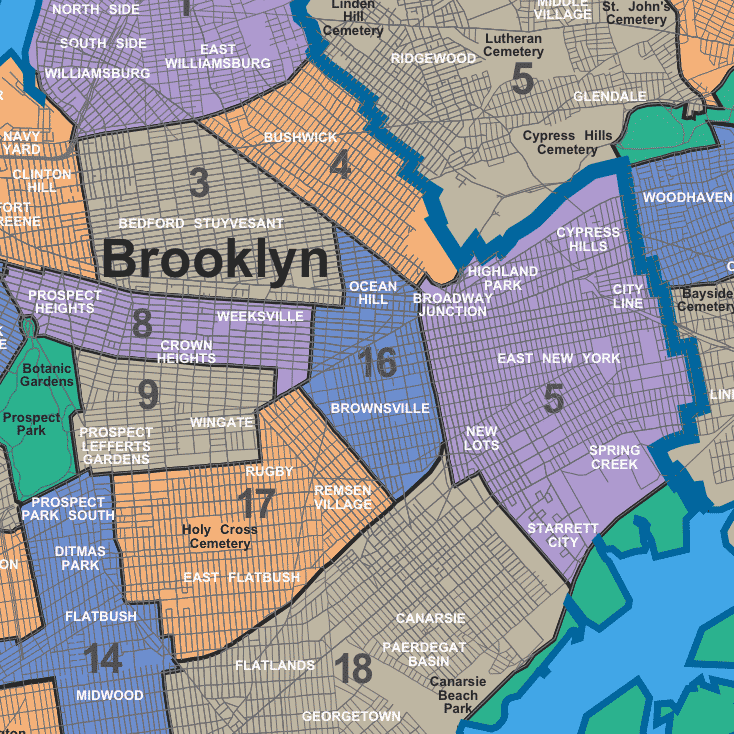
On April 12, 2018 Brooklyn Community Board 8 (BK CB8) came together at Weeksville Garden Community Center to do the important work of improving the quality of life for the residents, nonprofits and businesses within its borders. Diederville, from NYS Assemblywoman Diana Richardson’s office, notified BK CB8 that Richardson will host an EFV Overdose Prevention and Intervention seminar on April 24, 2018, 10:00 am at East Flatbush Village, 309 Clarkson Avenue in Brooklyn. During the seminar, attendees will be trained in administering “Naloxone,” which is a nasal spray that reverses the effects of an opioid overdose.

Free intervention kits containing Naloxone will be distributed to the seminar attendees. Assemblywoman Richardson is on record for her concern over the drug epidemic in New York City and New York State as a whole. Richardson has brought to fore that drug abuse had been dealt with as a criminal justice issue for many years.

The assemblywoman is on record for asserting during the rampage of crack cocaine, “People were arrested and jailed; families were ripped apart and people received criminal records.” In more recent years, however, the opioid crisis is handled as a health issue. Richardson has requested restorative justice be instituted for those who went through the criminal justice system due to substance abuse.

On any given commercial corridor in New York City, people can spot white placards embossed with New York State’s insignia placed at the front windows of bars, lounges and eateries. These placards display the letter A, B or C to denote the enterprise’s sanitation grade. Keri Crayne, Special Projects and Communications Director of NYC DOHMH’s Bureau of Food Safety and Community Sanitation (Bureau of Food Safety), came before BK CB8 to explain how the bureau goes about inspecting all food services throughout the five boroughs to ensure food safety requirements are enforced.

The essential mandates include keeping food at the right temperatures, hand washing is consistently practiced, food is stored properly, inspecting for the presence of vermin, waste lines are covered, and that toilet facilities are maintained to a high standard. Ms. Crayne asked that New York City’s food industry work in alliance with the Bureau of Food Safety rather than avoid it. One way to establish this partnership is for restaurants and bars to elect for the bureau to perform consultative inspections. Crayne explained consultative inspections give restaurant owners the opportunity “to receive an inspection, ungraded and penalty-free to receive tailored advice about maintaining the best food safety practices at their establishments.” This type of inspection helps restaurants prepare for future inspections. The owners get information to improve their chances to earn an “A” rating.

Further, Crayne revealed that “there are uneven skill levels” within the body of inspectors which may keep the public guessing about just how clean is the kitchen, storage room, eating utensils are at a given establishment. New York City’s bars and eateries are critical to the tourism industry.

There are also supervisory inspections. These inspections operate wherein an inspector performs his/her duties and are followed up later by a bureau supervisor. Crayne pointed out that supervisory inspections have such snags as the time between the field inspector’s review and the supervisor’s review may record varying conditions at the time of the respective visits.

St. Senator Velmanette Montgomery attended this BK CB8 meeting to make a periodic report to the community. Montgomery commended BK CB8’s efforts in marketing the NYS Historic Residential Homeownership Rehabilitation Tax Credit (RHRTC).

This tax credit is available to “homeowners and is allowed a federal credit for the qualified expenses relating to the rehabilitation of a certified historic structure located in New York State, and all or part of the rehabilitation project is located within a census tract that is identified as being at or below 100% of the state median family income.” Over 130 RHRTC applications were approved for homeowners within the North Crown Heights Historic District. The state senator notified the body of the upcoming 2020 Census. Montgomery stated the need for more households to respond to the mailed survey instrument or the canvasser. Dreams YouthBuild is an educational and vocational program in service to young adults designed to lead them to self-sufficiency and higher education. Montgomery informed the body that the Dreams YouthBuild budget for New York State increased from $300,000 to $600,000. Further, an important win was made for health care services to low-income youth and immigrant youth. School principals may elect to construct School-Based Health Centers (SBHCs). The principal must secure construction or renovation funding. There exists currently 28 such centers throughout the five boroughs. At least six operate from Brooklyn schools. Interested school leaders ought to confer with NYC Education Department’s Office of School Health. BK CB8’s Livable Streets Committee—formerly the Transportation and the Sanitation & Environment Committees—reported on the state of Flatbush Avenue since the institution of the Mayor’s Clear Curb Initiative. Chairman Robert Witherwax stated this initiative entailed no parking or standing on Flatbush Avenue from Grand Army Plaza to Tillary Street for private and commercial vehicles during the 7 AM – 10 AM and the 4 PM -7 PM periods. The committee believes Clear Curb Initiative is deleterious for the businesses that operate on Flatbush Avenue because the two time periods are when most businesses get deliveries in the morning and when residents are shopping and businesses receive deliveries in the evening. The rationale for “Clear Curb” is to reduce road congestion by parking automobiles elsewhere.  The fact is the initiative moves parked cars from Flatbush Avenue—a major four-lane thoroughfare—onto residential roadways that are primarily one lane that provide sufficient passing space for passenger cars, delivery trucks and emergency vehicles. This is counterintuitive to road hierarchy. The committee intends to make a motion to rescind the Clear Curb Initiative and request the NYC Department of Transportation to work with the North Flatbush BID and BK CB8 to develop an alternative plan.

Redlining Blues

Redlining is an illegal practice in real estate. It involves lenders that refuse to lend money or extend credit to borrowers in certain areas of a city. Typically, these areas are home to low-income households and/or the majority of the households are people of color. These communities of color may be low income or households that are financially solvent and well-off with good credit ratings.

Redlining’s genesis is from One Hundred Years of Land Values in Chicago: The Relationship of the Growth of Chicago to the Rise of Its Land Values, 1830-1933. This is the title of Homer Hoyt’s dissertation published in 1934. Hoyt put different human races and places of origin “by order of desirability.” Anglo-Saxons and Northern Europeans were most desired and were assigned the color green. Next in desirability were the Northern Italians, Czechs, Polish and Lithuanians, assigned blue. Greeks, Russian Jews and Southern Italians were the third tier, assigned yellow; and Negroes and Mexicans made up the fourth tier; i.e., the least desired and were assigned the color red. Homer Hoyt’s career path landed him in the position of chief economist of the Federal Housing Authority.

Investopedia.org explains that the term “redlining” was coined by sociologist James McKnight in the 1960s based on how lenders “would literally draw red lines on a map around neighborhoods they would not invest in based on demographics.” The Community Reinvestment Act of 1977 was established to end the practice of redlining; however, the practice still exists.

One local advocacy and research organization that stays on top of inequalities in education, housing, voting activity and the local economy is Medgar Evers College Center for Law and Social Justice. In 1988, this center published Race and Mortgage Lending in New York City: A Study in Redlining. A search on the World Wide Web will bring up dozens of current books and online publications that cover redlining issues in various US metropolitan regions.

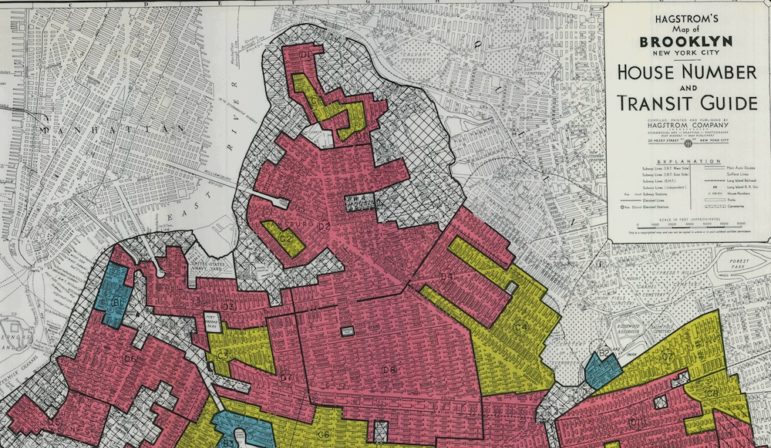
Due to attending the African-American Genealogical Society (AAGS) meeting held in the Macon Branch of the Brooklyn Public Library on March 24, 2018, this writer became acquainted with Walis Johnson, creator of The Red Line Archive. Ms. Johnson distributed postcards that promoted the project at the end of the AAGS meeting. The Red Line Archive is a website and a mobile display of her family’s ephemera—photographs, bric-a-brac, a redlined map of Brooklyn and items she collected on her walks through Brooklyn. Ms. Johnson was motivated to construct the mobile display after she received a note from a stranger who wanted to buy her family’s residence. This note was sent shortly after her mother had died, October 24, 2013. This was a situation of “not allowing the body to get cold.”

Her explanation for launching the project is: “The thing that got me hooked was the issue of generational wealth and how, because of redlining, Black people have been deprived of property ownership across generations. When I started to think about my family history of property ownership I knew I had landed on a great story that needed to be told. I wanted to tell it in a way that was personal and politically engaging. Socially engaged art leaves an opening so that people are activated to understand their own experience and imagine a different future.”

The public art mobile display began as an MFA thesis project in the spring of 2016. Johnson started by taking the Red Line Archive out to public spaces in Bedford-Stuyvesant and ClintonHill/Fort Greene. Later, Johnson did a project in Crown Heights and Weeksville. Johnson chose a mobile display after finding and studying the Brooklyn 1938 Red Line Map during one of her walks. She believed that including group walks would compliment her stationary talks. The mobile display is set up also indoors. For example, it was shown in a gallery at Wagner College in Staten Island.

The Red Line Archive has had Johnson log in many miles and stay in shape. I followed the map and walked through Greenpoint, Williamsburg, Bedford-Stuyvesant, East New York, Crown Heights, Fort Greene and DUMBO. As I walked, I collected soil samples, photos and other ephemera to see where traces of redlining are still visible in the landscape today.

One takeaway for Johnson during the project’s development is that African-Americans ought not blame themselves for their economic situation:

I’ve really absolved Black people from blame for our condition in this country and around the world. It’s not our fault. I don’t mean that we can’t change or take control of our communities, but the first thing that we need to do is to understand and accept on a profound level what has happened and who we have become as a result before we can begin to change things. It is more than a struggle for maintaining cultural identity. The effects of redlining remain acute until we forgive ourselves. We didn’t cause it. We can’t cure or control it.


The Road to Wakanda: Census 2020

Does your community need more affordable housing units? Maybe you need more garbage collectors or more day care centers. Are there enough senior housing units in your community to accommodate the residents who live there? Perhaps you are considering opening a business and want to target a specific group. How many of them live in the community? What are their ages, ethnic group, education level? What percentage are gainfully employed?

An accurate census helps answer the above questions and more so that businesses and government can make informed decisions. “An accurate census helps provide funding for schools, health care, libraries and services in your community,” proclaims a brochure entitled “CountNYC,” provided by NYC Planning. In addition to English, it is written in 10 additional languages. The alarm has sounded. It is critical everyone is counted in Census 2020.

If the census numbers come in lower than what is actual, so will many other numbers like the electoral college votes. John Flateau, Medgar Evers College, reminds OTP readers that Clinton lost the election because she had fewer electoral college votes (https://goo.gl/5pk36H).

The census will determine how many electoral votes are assigned to each state. Right now, New York State is assigned 29 electoral votes and Florida is also assigned 29. Don’t forget President Trump won Florida and Clinton won New York. Do we want to run the risk of having fewer than 29 votes because our people have been undercounted?

President Trump plans to add a question to the census: “Is this person a citizen of the United States? Yes or No?” Even though the Census Bureau is forbidden from sharing data with the Immigration Department, the question scares the public. Many will not complete the census because of it. Politicians understand that, and New York is leading 17 states in a lawsuit against Trump to get the question removed even though the actual counting doesn’t begin until 2019.

In the last few weeks we have been inspired by “Black Panther” and visions of a Wakanda. We have been elevated by the oratory and mission of Dr. Martin Luther King. And Google celebrated Maya Angelou with a recording of “Still I Rise.” Let’s not fool ourselves. An empowered community will remain a fantasy, Dr. King’s speech will always be a dream, and we will never rise if communities are inaccurately counted. Empowering our community will take more than fantasy, oratory and poetry. Action is required. Making sure everyone is counted in the census is a critical step in that direction.

What you need to know about Census 2020:

  1. MAKE SURE YOU AND EVERY MEMBER OF YOUR FAMILY IS COUNTED IN THE 2020 CENSUS
  2. THE CENSUS IS TAKEN EVERY 10 YEARS. (Do we want to wait until 2030 to get it right?)
  3. ENUMERATORS ARE NEEDED (High School diploma and citizenship are the requirement. GOOGLE FOR DETAILS.)
  4. ANSWER THE DOOR WHEN ENUMERATORS/CENSUS TAKERS COME CALLING.

Government with, by and for the people only works when all the people are counted.


Do Not be Afraid of Tomorrow

We were in the office of Professor Christopher Boxe, to discuss an upcoming event being produced for the Magnolia Tree Earth Center of Bedford Stuyvesant by Bernice Green of Project Green Global. Dr. Boxe, Deputy Chair of Medgar Evers College of Science and Research was speaking about being “solutions-driven,” and how young people were working on projects confronting pollution and climate change in creative ways, benefitting both the planet and the lives they want to live.

It was Claudette Spence, board member, Magnolia Tree Earth Center of Bedford-Stuyvesant, Bernice Green and myself, Magnolia Board Chair, who were struck by the passion of Dr. Boxe as he took the opportunity to give us a deep look into process and the time necessary to bring science programs specifically designed to develop and widen the horizons of the generation in our schools today.

A colleague in the department, Dr. Dereck Skeete, stopped by and they both emphasized the importance of students being exposed to the value of taking the time to learn the enabling tools for self-development. Knowledge that creates the opportunities for personal achievement, also strengthens the village that raises a child to be propelled forward, attitudinally and technologically equipped, to do psychological and economic battle in the most competitive city in an increasingly competitive and rapidly changing world.

And in that fight, they can draw from the reservoir of understanding that they follow in the footsteps of the scholars and business people of Timbuktu in West Africa, and the hundreds of thousands of manuscripts they left from the 12th century, giving evidence to a thriving intellectual state, the Wakanda of its day.

If our young people are to pick up the threads of that legacy, it will be men and women like Drs. Boxe and Skeete and who will be with others leading the way to tomorrow.

A President Furious

Donald Trump is as mad as any Mafiosi would be if his consiglieri’s office was raided.   The wheels of justice are inexorably grinding and they have put President Donald J. Trump in a trick bag. In the course of the investigation by the special counsel, other potential crimes have been uncovered and now the career investigators of the Southern District of New York have reviewed the evidence that Trump and his lawyer Michael Cohen were involved in a criminal act and no client privilege applies and Trump is naked before the law.  This accountability is driving him crazy. He has not yet grasped that because he appoints people to a government position that they are not to be loyal to him but rather to the country.

Trump’s learning that now and he knows where this train is headed, and he knows he’s strapped to the front.   If the special counsel continues his investigation, Trump knows what he’s done and is certain he’d be impeached by the House and judged guilty by the Senate. If he fires the special counsel, he probably will be impeached and maybe not found guilty by the Senate. Those are bad options between the rock of Robert Mueller and the hard place of the Constitution, but Trump has put himself there.  We can only pray that there is a level of sanity in the chain of command as this emotionally-driven man contemplates using the tools of war.