Home Blog Page 46

Choosing Faith Over Hustle: Redefining Success, Masculinity, and the Pace of Life

By: Curtis Bryant

In a world that celebrates busyness as virtue, it’s easy for men to believe their value is found only in what they produce. Hustle becomes identity. Work becomes worth. And success is measured by how loud, visible, or financially impressive your grind appears to be.

But what if some of the greatest forms of elevation aren’t loud at all?

What if a man’s becoming looks less like constant motion—and more like stillness, faith, and a refusal to force?

There’s a quiet shift happening among many men right now. A dismantling of the need to chase, perform, or promote. It may not look like “success” in the traditional sense, but it’s a deeper kind of becoming. One that isn’t driven by proving anything, but by trusting everything.

Rewriting the Script of Manhood
For generations, the definition of manhood has been painfully narrow: a man must provide. A man must protect. A man must work hard and wear the hustle like a badge of honor.

And when a man isn’t doing those things—when he’s between seasons, choosing a slower pace, or building something that doesn’t pay out right away—he’s often made to feel like he’s failing.

But this limited view of masculinity doesn’t leave much space for softness, rest, or spiritual obedience. It doesn’t leave room for men who lead with love, or faith, or creativity. It doesn’t leave room for those who are choosing to live well instead of living fast.
So What Does It Look Like to Step Off the Track?

It looks like choosing not to define your worth by your bank account, your job title, or how “productive” you feel.
It looks like trusting that provision will find you—not because you hustled for it, but because you were aligned when it came.
It looks like honoring your emotional and spiritual needs, even if that means disappointing someone else’s idea of who you should be.

This shift can be uncomfortable—especially in a culture where a man’s usefulness is often confused with his masculinity. You may feel unsure. You may question if you’re doing something wrong. You may even pull away from dating or relationships, wondering: What do I have to offer if my currency is faith and not finances?

But you’re not alone.

You’re part of a larger undoing. A sacred rebellion. A generation of men who are choosing to move differently.

Breaking Generational Patterns
Some of us have watched our fathers exhaust themselves trying to provide while missing opportunities to be. To be present. To be emotionally honest. To be proud of themselves beyond what they could offer.

Some of us have carried unspoken guilt for not choosing the same path, for not wanting to replicate the obsession with work. And others of us have struggled to feel “man enough” because we chose artistry, spiritual depth, caregiving, or slower forms of success.

But here’s the truth:

You are not less of a man because you chose rest.
You are not less of a man because your life doesn’t revolve around producing or procreating.
You are not less of a man because you lead with softness, prayer, or stillness.

You are a whole man. Even when you’re waiting. Even when you’re building slowly. Even when your life doesn’t look loud.

So for the man who is redefining success…
For the one choosing silence over strategy…
For the one learning to live softly in a hard world…

You’re not behind. You’re not broken.
You’re being built differently.

AI Transforms Education, Finance, and Recruitment

by Pojanee Fleury

Artificial Intelligence (AI) is reshaping industries across the board, and its impact is particularly profound in education, finance, and recruitment. By leveraging intelligent algorithms and data processing capabilities, AI is unlocking efficiencies, improving personalization, and driving innovation in ways that were unimaginable just a decade ago. Below, we explore how AI is transforming these three key sectors.

AI in Education: Tailored Learning Experiences
AI is revolutionizing education by enabling personalized learning experiences tailored to individual student needs. Adaptive learning platforms, such as those powered by AI, assess a student’s strengths, weaknesses, and learning pace. This allows educators to deliver customized lessons and exercises. For instance, platforms like DreamBox Learning and Khan Academy use AI to adjust content difficulty in real time, ensuring that students remain engaged and challenged.

Children as young as 5 have been receiving tablets in schools nationwide since before the pandemic, while first graders and older students now use free school issued laptops equipped with AI learning tools. From math lessons to digital state testing, technology has significantly reshaped classrooms. While teachers remain essential, the direct integration of technology by state education boards has dramatically changed how many children are being taught.

Looking ahead, AI is poised to bridge educational gaps globally. Through language translation technologies and accessibility-focused innovations, education can become more inclusive and available to underserved populations.

AI in Finance: Smarter, Safer Transactions
Few industries have embraced AI as swiftly as finance. With massive volumes of transaction data generated daily, AI-driven tools are essential for detecting patterns and anomalies. One notable application is fraud detection. Algorithms designed to identify unusual transaction behaviors can flag potential fraud in real time, protecting consumers and institutions alike.

Robo-advisors, such as Betterment and Wealthfront, have also changed how people manage investments. By analyzing market trends and individual risk tolerance, these tools provide tailored financial advice that was once only accessible through human advisors.

Despite its benefits, integrating AI in finance is not without challenges. The complexity of AI systems can make them opaque, raising questions about accountability when errors occur. Furthermore, balancing innovation with regulatory compliance remains an ongoing struggle.

AI in Recruitment: Streamlining Talent Acquisition
The recruitment landscape is undergoing a significant transformation, thanks to AI. Traditional hiring processes that relied on manual resume reviews and subjective decision-making are being replaced by AI-powered solutions for greater efficiency and fairness. For example, tools like HireVue use video interviews combined with AI analysis to evaluate candidates based on their verbal and non-verbal cues. Slightly intrusive, but likely to become standard as businesses prioritize efficiency.

AI also excels at streamlining candidate sourcing and screening. Platforms such as LinkedIn Talent Insights use machine learning to identify top talent, predict industry trends, and even assess skill gaps within organizations. These innovations not only save time but also help companies uncover candidates who might otherwise go overlooked.

The Road Ahead
AI’s influence in education, finance, and recruitment is undeniable, and its potential continues to grow. While the opportunities are vast, so too are the challenges that come with deploying such powerful tools. Companies and stakeholders must prioritize ethical implementation, transparency, and inclusivity to ensure that AI benefits everyone.

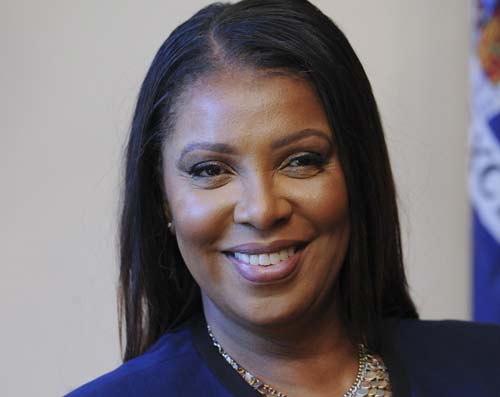
Trump’s Revenge Machine Targets NYS AG Letitia James

By Mary Alice Miller
Remember those pre-Apprentice days when tabloid gossip columnist Liz Smith dished the dirt on Trump, helping to boost his image as one of the world’s wealthiest real estate moguls?


No one knew it at the time, but Trump, his sons, and several business associates colluded to inflate the value of Trump real estate holdings to get favorable rates from banks and insurers while undervaluing Trump Organization properties to reduce New York State property taxes.


Numerous twists and turns later, New York State Attorney General Letitia James successfully brought fraud charges against the Trump Organization, culminating in February 2024 with a $354.8 million penalty. That judgment has grown to a current $478 million, including penalties.


In addition, Trump was barred him from running a business in New York for three years. Trump is appealing the verdict.
Trump posted a $175 million bond to prevent the state from seizing his assets to collect what he owes.


Trump’s two adult sons, Eric Trump and Donald Trump Jr., executive vice presidents of the company, were banned from running New York companies for two years. Both were fined more than $4 million each.


A court-appointed monitor was placed to oversee the company’s operations for three years, and requires Trump Organization to seek the monitor’s approval prior to submitting any financial disclosure to a third party.


Former Trump Organization executive Allen Weisselberg was fined $1 million.
Trump has not forgotten. He has a history of holding grudges against those he perceived as doing him wrong, even while he is wrong.


Last Friday, word leaked that the Department of Justice is in the beginning stages of an investigation into the office of NYS Attorney General Letitia James.


“Any weaponization of the justice system should disturb every American,” said Geoff Burgan, spokesperson for the attorney general’s office. “We stand strongly behind our successful litigation against the Trump Organization and the National Rifle Association, and we will continue to stand up for New Yorkers’ rights.”


The U.S. Attorney’s Office for the Northern District of New York – which covers the Capitol region – is leading the investigation. Acting U.S. Attorney John Sarcone’s office issued the subpoenas. In 2022, Sarcone withdrew from the Republican state attorney general nomination during James’ run for her second term.
The probe’s focus is whether James violated Trump’s civil rights related to the civil fraud lawsuit.


Additionally, the investigation will look into the NYS Attorney General’s office fraud case against the National Rifle Association (NRA), in which longtime CEO Wayne LaPierre was accused of financial mismanagement and lavish spending of the organization’s funds. The NRA is incorporated in New York.


“Investigating the fraud case Attorney General James won against President Trump and his businesses has to be the most blatant and desperate example of this administration carrying out the president’s political retribution campaign,” said James personal attorney, Abbe D. Lowell.


““Weaponizing the Department of Justice to try to punish an elected official for doing her job is an attack on the rule of law and a dangerous escalation by this administration,” Lowell added. “If prosecutors carry out this improper tactic and are genuinely interested in the truth, we are ready and waiting with the facts and the law.”


The Trump Organization had a lot to hide.
Suspicions were raised as to what he had to hide when during the 2016 presidential election Trump refused to release his tax returns. It took years of stonewalling and a 2022 Supreme Court ruling that rejected Trump’s request to block the disclosure of his tax returns to the House Ways and Means Committee and a 2021 SCOTUS decision that allowed the Manhattan District Attorney’s to subpoena Trump’s financial records, including tax returns as part of a grand jury criminal investigation.


There is no legal requirement for a president or presidential candidate to disclose their tax returns, since they are private information. Released tax returns can help expose conflicts of interest and tax compliance, and help the public evaluate those seeking the office of president. The practice became tradition since 1968.


The former Manhattan District Attorney Cy Vance was investigating hush money payments to adult film star Stormy Daniels and former Playboy playmate Karen McDougal, both of whom said they were paramours of Trump, as well as financial and insurance fraud by the Trump Organization.


In James’ case against the Trump Organization, Trump’s financial statements claimed that his triplex in Trump Tower was 30,000 square feet, when the true size is 11,000 square feet based on a 1994 document signed by Trump. The valuation of Trump’s Florida property Mar-a-Lago was found to be fraudulent for 10 years, from 2011 to 2021. One commercial property total square footage was inflated 300%. Rent-controlled buildings were valued equally to market rate buildings.


Trump’s defense claim was no one, not the banks nor the public, were harmed by the inflated valuations. During a campaign event in Iowa, Trump said, “I did nothing wrong” and later opined, “… the judge and the AG should be arrested and punished accordingly.”
Reacting to the attorney general’s civil prosecution of his businesses, Trump called it “a New York political scam” and described James as “racist.”


The Trump DOJ is investigating James for mortgage fraud related to a property in Norfolk, Virginia. The DOJ is examining whether James signed documents attesting that the property is her primary residence. But James made it clear the property would not be her primary residence.

The Critical Mass Black Agenda and the NYC Mayoral Election

By Nayaba Arinde
Editor-at-Large

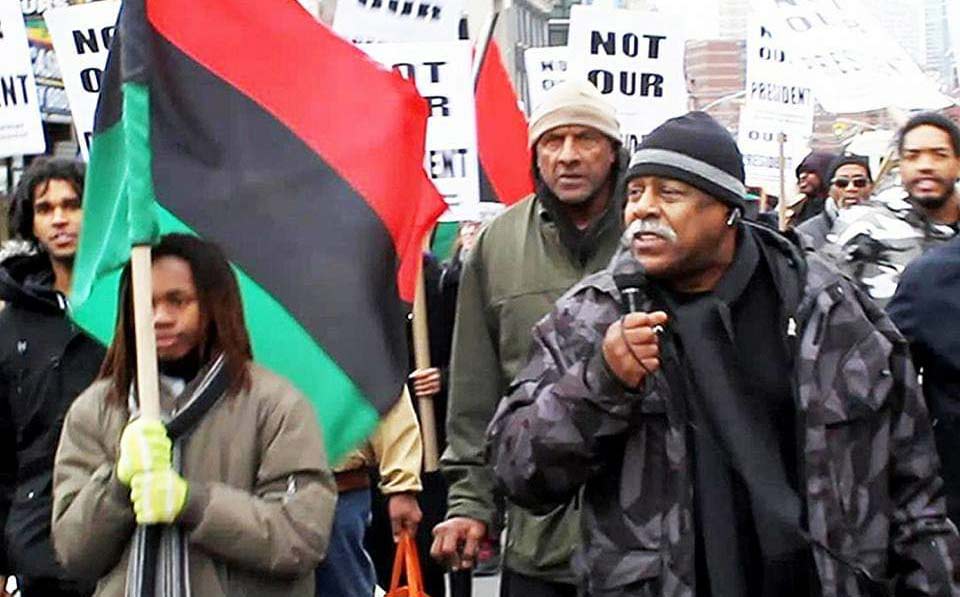
“Like each and every other community we expect our issues to be addressed,” veteran activist Omowale Clay told Our Time Press. “With our Black Solidarity Coalition we are trying to create our Black Agenda to present to whomever will become the mayor of New York City.”


The latest Siena Research Institute poll has Democratic Party nominee Zohran Mamdani at 44%, independent Andrew Cuomo is at 25%, Republican nominee Curtis Sliwa is at 12% and independent Mayor Eric Adams at 7%.


Meanwhile, using disputed crime rates as his impetus President Donald Trump is threatening to federalize policing in New York City, as he has done in sending National Guard–to other Black mayor-led cities such as Mayor Karen Bass’s California, and deploying 800 National Guard troops in Mayor Muriel Bowser’s Washington, D.C., where he has also federalized the Metropolitan Police Department temporarily.


Mayor Bowser said that crime is going down, and, “While this action today is unsettling and unprecedented, I can’t say that given some of the rhetoric of the past that we’re totally surprised.”


Mamdani says he will hire 200 lawyers to tackle any fallout from federal force boots on the ground. Adams said that the increased law enforcement presence in the city could help with the City’s gang issue.


Brooklyn’s international activist and educator Dr. Rosemari Mealy told the paper that according to NYC stats “approximately 22.7% of the population identifies as Black or African American alone.

That means a Black political Agenda must address this vulnerable population by: ensuring better maternal health care for Black women; address the issue that NYC’s Black students are selectively being denied admission to the city’s specialized high schools; reparations–as a part of any candidate’s Black Agenda can translate into exposing the thievery of the developers and Deed Thieves who have and are contributing to the housing crisis faced by Black People.”


“The Black Agenda is pressing us to resolve some of the basic issues that have been confronting us,” said Clay, chair of the Brooklyn-based December 12th Movement. “The first thing the Black Agenda has to be is led by a Black leadership that is independent of the political machine.

It can operate in that context, but it must not be a prisoner–specifically of the Democratic machine, which has been an entry point of the rise of the right in this country.


Our vacillations around the question of the demands for what our people need–and the conciliation on that part at the risk of losing one’s election, has compromised the legitimacy of our demands.”
Clay began the list of most relevant demands.


Stopping Deed Theft
“Number one is the stopping of deed theft, and it is stoppable, but it has to require tremendous struggle and exposure on our part.

It cannot be tied to whether the machine is going to fund you to be elected again. It cannot be tied to whether the machine and outside interests from other groups who have other priorities, are the ones who dictate, and influence what our elected officials do.


People are stealing our peoples’ homes left and right in a conspiracy not only between insurance companies and landlords, and real estate agencies, but with judges in our city; to acquire private property from us.
Bed Stuy is a central point where that is going on.”


The liquidation of public housing
Clay declared, “The Black Agenda in our community has to be our coming together, breaking down some of these organizational differences, and barriers to our collective unity. A Black Agenda can only come about with collective unity.

There has to be a critical mass of our people who can agitate, and get the attention of our people to focus on what our agenda is.


So we can talk about the privatization of public housing. It’s really the liquidation of public housing. The liquidation of Section 9 – which was a government subsidy for affordability, is now being replaced with Section 8, which is finding for landlords.


“What determines what is affordable? A Times article said it is not years away, but decades away. We have some work to do right now. This mayoral race is one of the expressions where we are able to do that. Some people have laid out what they will and won’t do because they have done it in practice already. We have to look at new voices to hold accountable to that.”


Mamdani has pledged to build 200,000 affordable homes. Adams “City of Yes for Housing Opportunity” plan, cites the creation of over 100,000 new homes over the next 15 years.


MTA AND CHILDCARE
With a transport fare increase to $3 possibly imminent Clay continued, “Take the MTA. We have our ongoing Fair Fares campaign. They are raising the price of people going to work, to school, to the hospital, for people who can’t afford it.

Who determines affordability? Can we afford it? No. There has to be a restructuring of mass transit. Here everybody has to pay the same fair, but do not make the same income. It hurts, Black, Latino, people of color, and the poor working class.”


As Mamdani rolls with his universal childcare plan with “free childcare for every New Yorker aged 6 weeks to 5 years;” Adams pushes his additional $80 million in funding to expand access to childcare and early childhood education.


“People have raised this issue of universal childcare,” said Clay. “That should be a no-brainer. How can you go to work if your children have not been taken care of and educated? That should be a priority.


The Agenda is about things that we have not had resolved like single payer healthcare, things people don’t think will be done. The government will not do anything that we are not collectively organized to make them do.”


Black solidarity and Black unity are more important now than ever, according to this senior community advocate, “because they are trying to disappear us on every level. We have to build real friends, and real allies, and expose real enemies of our people at every level, at every color.

Liberal Democrats have laid the basis for the beginning of the motion of the right by appeasing and compromising, and never being clear about whose interests they are operating in.

Now Trump has nationalized the police in DC, and launched this question to take over the cities not to make them better, but to try and marginalize us even before. He is talking about coming to New York, Baltimore and Chicago, wherever people of color are, who can be a distraction to his own issues and white supremacy.”


The focus goes beyond this November’s General Election, said Clay.
“We are building a Black Solidarity coalition not just for this year, but for the years to come. Some of us remember the Freedom Party. We have to build a political structure for us to unite on, debate on, and move as one with.”


Attorney General James Sues Company Behind Zelle for Enabling Widespread Fraud

0

NEW YORK – New York Attorney General Letitia James today sued Early Warning Services, LLC (EWS), a company owned and controlled by a group of the largest banks in the United States that was tasked with developing and operating the electronic payment platform Zelle, for failing to protect its users from massive amounts of fraud.

An investigation by the Office of the Attorney General (OAG) revealed that EWS designed Zelle without critical safety features, allowing scammers to easily target users and steal over $1 billion between 2017 and 2023.

EWS knew from the beginning that key features of the Zelle network made it uniquely susceptible to fraud, and yet it failed to adopt basic safeguards to address these glaring flaws or enforce any meaningful anti-fraud rules on its partner banks.

Attorney General James filed this lawsuit after the Consumer Financial Protection Bureau (CFPB) abandoned a similar lawsuit, filed in December 2024, following the change in the federal administration.

With this lawsuit, Attorney General James is seeking restitution and damages for affected New Yorkers, as well as a court order mandating Zelle maintain anti-fraud measures necessary to protect its users.


“No one should be left to fend for themselves after falling victim to a scam,” said Attorney General James. “I look forward to getting justice for the New Yorkers who suffered because of Zelle’s security failures.”


EWS is a financial technology company owned and controlled by a group of the country’s largest banks, including JPMorgan Chase, Bank of America, Capital One, and Wells Fargo. Those banks tasked EWS with hastily launching an electronic payment platform to compete with payment apps like Venmo, PayPal, and CashApp, which were not controlled by banks.

In their rush to launch, EWS prioritized attracting new users through a simple registration process and quick transfers that left consumers vulnerable to scammers.


Zelle’s advertisements misleadingly promised safe and secure money transfers. In reality, Zelle failed to adopt basic anti-fraud safeguards.


Beginning in 2017, the year Zelle launched, anyone with a U.S. bank account could enroll in Zelle and send or receive near-instant money transfers through linked email addresses or U.S.-based mobile phone numbers.

Scammers could sign up through a quick registration process that lacked important verification steps, allowing them to utilize misleading email addresses such as those associated with trusted businesses or government entities.

Zelle’s emphasis on immediate and irreversible transfers means that by the time consumers realize they have been targeted by fraudsters, their money is often already gone.


As a result, Zelle quickly became a hub for fraudulent activity. The most common scams involved fraudsters gaining access to users’ accounts and making unauthorized transfers, and scammers convincing users to send funds under false pretenses, for example by offering non-existent goods or services or by impersonating a trusted institution like a bank or government office.


In one example of a common scam using Zelle, a New York user received a call from an individual impersonating a Con Edison employee advising that the consumer was delinquent on his energy bills and that his “electricity was going to be shut off that day” unless he paid Con Edison via Zelle.

The fraudster identified “Coned Billing” as the name associated with the account. The consumer transferred $1,476.89 to a Zelle account named “Coned Billing,” but after realizing the call was a scam, was told by their bank, JPMorgan Chase, that the bank “can’t get [him] that money back.”


The OAG’s investigation revealed that EWS and its partner banks knew for years that fraud was spreading on Zelle and failed to take meaningful action to stop it. When participating banks received complaints from Zelle users about fraud, EWS allowed banks to report that fraud to EWS long after it occurred, which enabled bad actors to scam additional consumers.

In fact, when Zelle launched, EWS did not require participating banks to report scams like the “Coned Billing” scheme in which fraudsters convinced users to send funds under false pretenses.

Even when EWS did receive reports of fraud, it failed to promptly remove the fraudsters from the Zelle network or require banks to reimburse consumers for certain scams. EWS developed basic safeguards to address these issues as early as 2019, but failed to adopt them.

EWS failed to meaningfully enforce even the limited, inadequate anti-fraud rules that it did have in place against participating banks despite knowing of widespread violations of those rules.


EWS aggressively marketed Zelle to New Yorkers, promising safety and security. However, EWS’s failures enabled fraudsters to run rampant on the Zelle network, leading to millions of dollars in losses for New Yorkers.


Attorney General James alleges that EWS violated New York law by creating a payment platform highly susceptible to fraud and doing little to stop it for years while falsely marketing it as a safe and secure service.

With this lawsuit, Attorney General James is seeking restitution and damages for all affected New Yorkers and court orders mandating EWS maintain necessary anti-fraud safeguards and take other steps to protect their customers from fraud.

Attorney General James is a national leader in protecting consumers. In June, Attorney General James sued payday lending companies DailyPay and MoneyGram for exploiting workers with predatory loans.

In May, Attorney General James sued Capital One for misleading its customers and cheating them out of millions of dollars of interest payments. In January 2024, Attorney General James sued Citibank for failing to protect its customers from fraud.

In April 2022, Attorney General James led a multistate coalition of attorneys general in calling on the CEOs of JPMorgan Chase, Bank of America, U.S. Bank, and Wells Fargo to eliminate all overdraft fees on consumer bank accounts.

Attorney General James encourages all consumers who have lost money to scammers through Zelle to report their experiences to the OAG’s Consumer Frauds Bureau.

This matter is being handled by Assistant Attorneys General Chris Filburn and Christian Reigstad with the Consumer Frauds and Protection Bureau. The Consumer Frauds and Protection Bureau is led by Bureau Chief Jane M. Azia and Deputy Bureau Chief Laura J. Levine, and is a part of the Division of Economic Justice, which is overseen by Chief Deputy Attorney General Chris D’Angelo and First Deputy Attorney General Jennifer Levy.