and bring about a Human Rights based System of Public Education for NYC
*Originally drafted in 2014 by the Coalition for Public Education (CPE) and updated in 2021 by the Coalition to Finally End Mayoral Control 2022.
Submitted by Sam Anderson For Coalition to Finally End Mayoral Control 2022
Appreciating the Historical Moment
We are living in an era of diminished democracy and of assault on the public institutions on which our civic, economic, health and intellectual lives depend. The gap between the wealthy and the poor is growing ever wider and the middle class is sinking into a state of permanent economic insecurity. The ability of governments to redress imbalances and foster genuine development has been crippled by Big Money flooding elections in return for which politicians have turned over public goods and functions to private interests to be run for profit.
Social control is exerted through the demands of the Security State. This is a worldwide phe- nomenon that has given rise to public push-back movements and support for the Black Lives Matter and Yellow Jacket protests in France.
The assault on the New York City public education system is a vivid example of the current historical moment. In the months after 9-11 when civil and human rights were succumbing to the rising Security State, the legislature of New York State handed over the city’s Board of Education over to its billionaire mayor, Michael Bloomberg.
This was done at the explicit request of a powerful corporate lobby, the Partnership for New York City, in return for which the lobby promised to permit greater funding to flow to the city’s schools. In fact, the infusion of funds did not reach the classroom but instead attracted a feeding frenzy of privatization as consultants, testing companies, educational management companies, and charter school operators received contracts from the education system now in the mayor’s hands. The corporate lobby also demanded, and received, an end to elected com- munity district school boards instituted during the Civil Rights Era that had functioned as community counterweights to central authority.
The outcome of mayoral control of the education system has been disastrous.
Mayoral control of large urban school systems is inherently racist as it disenfranchises the Black, Latinx, and Asian populations that compose America’s largest cities.
No matter what a mayor’s political views, the structure of mayoral control makes a school system highly susceptible to outside political forces. In fact, most American school systems are governed by nonpartisan elected school boards precisely to keep public education safe from political pressures as well as closer and more responsive to the communities they serve.
The State Law giving the NYC mayor control of our children’s education is due to sunset in June 2022. This is an opportunity for the people of New York City to take back their edu- cation system and build it with a brand new, human rights framework.
A Human Rights Based Education System is an viable and urgent alternative to Mayoral Control.
This new bill based on Human Rights principles not only offers a democratic alternative governance structure but, as perhaps more importantly, lays out the values and principles required to govern a new human rights based system of public education for New York City.
Educating our children is too important a job to be left to the control of just one elected mayor and his appointed Board no matter what that mayor’s politics may be.
This new bill lays out a set of coherent ideas that will function as an educational constitution for the City of New York. It will inform and guide parents, educators, community leaders and elected officials as they work together to formulate and implement an educational system that will enable government to fulfill its obligation to provide a sound basic education ensuring that all of our children reach their highest potential.
Why a Human Rights Based System of Public Education?
The Human Rights framework provides a powerful, coherent, equitable and deeply democratic vision for a new kind of public system. Its foundational concepts serve to guide policy and practice at all levels of the school system, from the classroom upwards to the overarching city level. Its twin aims are the full development of every child and the civic engagement to support an excellent public education for all New York City children.
With these ideas embedded in State law and implemented by an elected People’s Board of Education working collaboratively with the mayor, chancellor, educators and our communities, these umbrella Human Rights concepts will guide policy and practice at the classroom, school, district and citywide levels. This Human Rights focus is sorely needed now given both the lack of teaching and learning during the pandemic, and the utter failure of previous attempts to provide a rich holistic education to every young person, or even to close the achievement/ opportunity gaps.
A thorough Human Rights audit of the current system would help to pinpoint areas in need of improvement and set the direction for system change. Without a thorough understanding of
how discriminatory school and societal policies and practices affect the lives of our children, our education system can not fulfill its promise to build an informed citizenry capable and willing to sustain our democracy in all its aspects.
What Human Rights Principles apply to Education?
General Aims of Education
The aims of education must be directed toward the holistic and highest development of each child’s personality and potential so they can live productive and meaningful lives. This means developing an ability to critically investigate and understand themselves and the world around them so that they are prepared to participate as informed citizens in society; and are able to engage effectively with others.
It also means being able to both access work that is rewarding and adequately remunerative, and are able to cultivate personal interests and aesthetic sensibilities. A human rights approach to education allows all of these aims to be fulfilled.
Human Rights Conceptual Framework for Education
Right of Access to Education
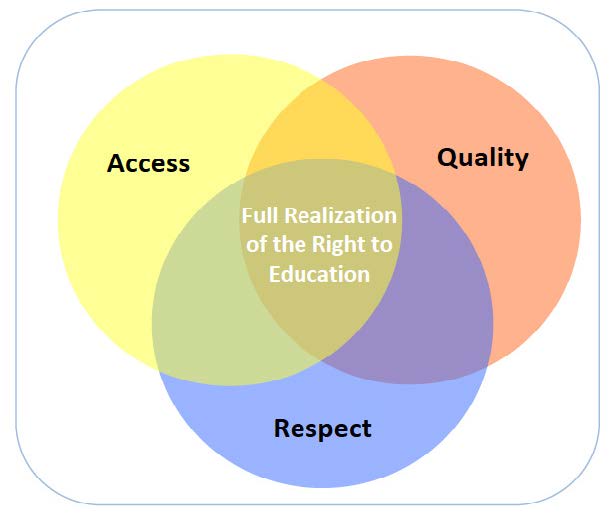
A human rights based approach to education derives from a conceptual framework that guides actions and decision making in promoting the full realization of all children’s right to education. The approach inherently affords targeted consideration and action for children who are marginalized, discriminated against, or who are otherwise oppressed. Three interlinked and interdependent dimensions make-up the framework including: the right to access, right to quality, and the right to respect within the learning environment.
Every child has the right to education on the basis of equality of opportunity. Many children, due to race, class, poverty and other factors, are being marginalized or discriminated against in the realization of this right. Those factors have to be dealt with directly in order to have true equal access to high quality educational opportunities.
Right to Quality Education
It is not enough to provide access and equal opportunities to education. The education within schools also has to be of the highest quality to help every child reach their highest potential. Quality education is broadly understood to incorporate the opportunity for both effective intellectual learning, together with opportunities for creative and emotional development. That quality should be consistent across all settings and populations. All children should be provided with child friendly, culturally sensitive, and inclusive school environments, which are basic to promoting educational achievement.
Right to Respect in the Learning Environment
All children within the education system should be free of institutionalized discrimination and stereotyping.
No child should feel they need to assimilate or should be marginalized and excluded due to their race, nationality, sexual orientation, class or other status or circumstances. All children’s voices should be respected and heard, and the needs of all children and their families should be taken into consideration. Human rights are inherent to each human being. As in all other contexts, they must be respected within learning environments. In order to realize the right of all children to education, other key rights must be respected, including:
- Respect for racial, cultural or other identity and language;
- Respect for participation rights, with involvement in matters concerning education;
- Respect for integrity and protection from all forms of violence.
Using this framework, the human rights principles that are at work in public education and are most material to education reform in New York City and elsewhere in the United States are as follows:
RIGHT TO ACCESS
Economic Equity and a Focus on Human Well Being
Human well being should be the central subject of development. Economic and social systems, safety nets and support, should facilitate that development and the fulfillment of all human rights for individuals, and communities — especially marginalized and discriminated groups. Systems have to be in place to eliminate socio-economic barriers to accessing quality education.
This means for instance ensuring/providing adult education, generating work opportunities, and other vehicles for economic advancement. Poverty hinders access to education; governments have an obligation to deal with it. This means upholding the right to attaining the highest level of health through numerous initiatives including the universal provision of adequate health care, and nutrition.
In order to eliminate poverty as a barrier, the right to adequate housing also has to be upheld, and every child should have access to free high quality preschool. Additionally for equal access to education to be realized the neighborhood environments have to be safe, and have sufficient attendant recreational spaces.
For all of these factors to be eliminated as barriers to access, inter-agency cooperation will be necessary, at the school level, district level, state level and so on. All of these rights and provisions should be implemented universally, but with special targeting of communities and groups that are most oppressed, marginalized and discriminated against.
Equitable Educational Financing
The current financing system in place transfers funds to schools and districts based on the property tax base in a specific community is inherently inequitable. The financing of schools and school districts should be restructured according to the best practices of equitable educational financing. There must be equitable distribution of resources in education across communities according to need so that communities with the highest need receive the greatest resources.
RIGHT TO QUALITY EDUCATION
Human Rights & Child Friendly Schools/Preschools
A school’s climate matters. Creating child friendly learning environments, reflecting human rights principles, and taking a holistic approach toward child development and education can ensure quality in education. The multitude of children’s rights should be addressed within school environment. Links between the school, family and communities are an integral strategy in ensuring all rights are upheld within the school environment. Children should not only gain academic knowledge but should also be enabled through a child-friendly environment to be agents of their own future and become promoters of human rights, social justice, tolerance and peace.
The holistic approach in creating human rights based child friendly schools requires that:
- Schools should be inclusive of children of all backgrounds and with varying learning styles and levels of learning aptitude.
- They should also be gender and sexual orientation sensitive, promoting gender equality for both boys and girls and addressing the varying needs of each.
- The teaching and learning processes should be of the highest quality, providing individuated, participatory and inclusive education adapted to meet the individual needs of each child according to varying abilities and capacities.
- Child-centered pedagogy should be practiced within schools, with children as active participants in their education and not just passive recipients.
- Curriculums should be broad relevant to all children, and inclusive—reflecting a diversity of cultures, histories, and nationalities. It should also be relevant to the needs of the community, society and labor market, and cover developmental areas such as life skills, social relationships, conflict resolutions and critical thinking.
- Assessment of learning should also be aligned with human rights principals. Learning assessment should take into account a diversity of cultural contexts, and linguistic differences amongst others and should not be the central focus of education.
- Teachers should understand child development and be highly trained. They should have both the highest quality, rigorous, relevant and effective pre-service training and continuous in-service training aligned with the principles in this bill—incorporating child centered teaching, human rights, multiculturalism, gender awareness, and promotion of tolerance and inclusivity. Their positions as teachers should be held in the highest esteem and should be adequately remunerated.
- Schools should be safe, and healthy environments both in structure and in climate. All children should feel physically and emotionally secure. They should be ensured, through inter-agency approaches, that they are in the best of health and are receiving proper nutrition, in order to maximize their educational experience. Diversity and tolerance should be promoted and bullying not be tolerated under any circumstances.
- Schools should have all of the appropriate, well-maintained and designed facilities and materials for sanitation, nutrition, recreation, and learning. In order for schools to be child friendly it is required that they be democratically run, closely linked with their surrounding community, and flexible; with the cooperation of all of those associated with the holistic development of the child namely— the children, families, communities. Schools should also be linked with other services, social services/government agencies, and CBOs, amongst others.
Committing to human rights values leads to developing “human rights friendly schools” where human rights are used as the criteria for on-going evaluation. (One such framework called, “A Guide for Becoming a Human Rights Friendly School,” has been developed by Amnesty International in Great Britain.)
With human rights as the value system, an inclusive and nurturing school-learning climate will enable us all to grow more respectful of one another, and provide for the rich, full
development of every young person under our watch.
RESPECT FOR THE RIGHTS WITHIN THE LEARNING ENVIRONMENT
Respect for Dignity, Physical and Personal Integrity
Schools must respect the inherent human dignity and value of every child and group in order to create an environment of mutual respect and valuing. It is critical to prevent practices and disciplinary policies that cause physical harm or humiliation to children. Conversely it is critical to promote practices that enhance self-confidence and self-expression.
Promotion of Non-Discrimination and Appreciation of Diversity
Within education, the right to respect for each child’s identity, culture and language has to be observed and supported. The government must ensure that the human right to education
“will be exercised without discrimination of any kind as to race, color, gender, sexual orientation, abilities and socio-economic background, language, religion, political or other opinion, national or social origin, property, birth or other status.”
This obligation includes respectful treatment and valuing of multiculturalism, different group identities and heritages, and appreciating that each member of the human family has multiple affiliations.
An environment of inter-cultural communication and understanding within schools has to be promoted in order ensure the best chances for success of all children. This means putting in place appropriate policies and mechanisms, including mechanisms by which children and parents can register complaints.
Democratic Governance and Participation within a Human Rights Framework
Students, parents and communities have the right to participate meaningfully in decisions that affect their right to education and their schools. Rich participation by all parties (rights’ holders), including students to the extent they are able, should govern educational decision making at all levels. Teacher’s voices should also be given a platform to be heard. Mechanisms to facilitate participate at all level from school, to district and city level, to state level, should be established.
A vehicle for such participation is the establishment of Parent and Student Unions at each school that will have representation at the district and city levels. The Parent and Student Unions represent the voices of their members and will provide the education, training and support for their members to assume decision-making and leadership roles.
School Leadership Teams will hire their principals and work together to become a Human Rights Friendly School. At the district level, Community Education Councils will be composed of parents elected by parents, students elected by students and community members elected at large. CECs from around the city will elect the People’s Board of Education composed of
parents, students and appointees of elected officials including the mayor, comptroller, public advocate and city council education committee.
The People’s Board will also select experts in Human Rights and Urban education as non- voting members.
Respect for Labor Rights
Teachers and others employed by the school system have the right to see their labor rights respected by public school systems and charter school operators—including the rights to free association and collective bargaining, fair and adequate remuneration, mechanisms for dispute resolution, adequate rest and recreation, and favorable working conditions.
The Transition Process
Making change in a large complex system cannot happen overnight. The bill provides for a transition process that will end as soon as the first People’s Board is elected (approximately 24 months). A Transition Commission composed of urban education professionals, Black, Latinx and Asian studies experts, parents, students and human rights specialists will put the systems in place to:
- form the citywide Parent and Student Unions;
- arrange the procedures for electing the CECs and the Peoples Board of Education; and,
- begin the professional development and capacity building process for administrators, teachers, parents, students and support staff to understand the human rights framework and to detect and eliminate unintended bias at the personal and system levels.
The Transition Commission will have the support of system change professionals.