NEW YORK – New York Attorney General Letitia James earlier this week announced that she has reached an agreement on proposed relief from conspiracy theorists who launched a robocall campaign designed to prevent Black New Yorkers from voting by mail ahead of the 2020 election.
In March 2023, a federal judge ruled in Attorney General James’ favor and found Jacob Wohl and Jack Burkman liable for targeting Black voters and transmitting false and threatening messages intended to discourage voting. Under this agreement, Wohl and Burkman will pay up to $1.25 million for their wrongdoing.
“The right to vote is the cornerstone of our democracy, and it belongs to everyone. We will not allow anyone to threaten that right,” said Attorney General James. “Wohl and Burkman orchestrated a depraved and disinformation-ridden campaign to intimidate Black voters in an attempt to sway the election in favor of their preferred candidate.
Now they will pay up to $1.25 million to my office, the National Coalition on Black Civic Participation, and the individuals who were harmed by their scheme. My office will always defend the right to vote.”
Attorney General James filed a lawsuit against Wohl and Burkman in May 2021 after an investigation by the Office of the Attorney General (OAG) found that they violated state and federal laws. While hiding behind their sham organization “Project 1599,” Wohl and Burkman orchestrated robocalls to threaten and harass Black communities with disinformation, including claims that mail-in voters would have their personal information disseminated to law enforcement, debt collectors, and the government.
In August 2022, Attorney General James announced a settlement with robocalling platform Message Communications for its role in sending out the illegal robocall designed by Wohl and Burkman.
The Wohl and Burkman robocall campaign, which reached approximately 5,500 New Yorkers. During the summer of 2020, voters received automated calls falsely claiming that voting by mail would cause the voter to be tracked for outstanding warrants, credit card debt, and mandatory vaccines, for example: “Hi, this is Tamika Taylor from Project 1599, the civil rights organization founded by Jack Burkman and Jacob Wohl. Mail-in voting sounds great, but did you know that if you vote by mail, your personal information will be part of a public database that will be used by police departments to track down old warrants and be used by credit card companies to collect outstanding debts?
The CDC is even pushing to use records for mail-in voting to track people for mandatory vaccines. Don’t be finessed into giving your private information to the man, stay safe and beware of vote by mail.”
One New York voter who received the threatening robocall suffered severe anxiety and distress, and ultimately withdrew his voter registration. After voters received the robocall, the National Coalition on Black Civic Participation (NCBCP) was forced to redirect considerable resources to address the false claims made in the call.
Under the agreement, Wohl and Burkman conceded a $1 million judgment to OAG, NCBCP, and individual plaintiffs. If Wohl and Burkman fail to pay at least $105,000 by December 31, 2024, and do not address the failure to pay within 30 days, the amount will increase to $1.25 million. Attorney General James urges voters with election-related concerns to contact OAG by submitting a complaint online or calling 1-800-771-7755.
The OAG litigated this case alongside co-plaintiffs comprised of voters who received the robocall and NCBCP, all of whom are being represented by the Lawyers’ Committee for Civil Rights Under Law and the law firm of Orrick, Herrington & Sutcliffe LLP.
“This groundbreaking settlement should send an emphatic message to anyone who aims to prevent Black people from exercising their right to vote,” said Damon T. Hewitt, President and Executive Director of the Lawyers’ Committee for Civil Rights Under Law. “Voter suppression and voter intimidation are illegal, immoral, and anti-democratic.
Regardless of whether the perpetrators are government actors or private citizens, your actions will have consequences, and you will be held accountable to the fullest extent of the law.
At a time when orchestrated voter intimidation and disinformation campaigns are on the rise, we must all remain vigilant in working to ensure that access to the ballot is fair, easy, and accessible.”
“These men engaged in a conspiracy to suppress Black votes in the 2020 general election,” said Melanie Campbell, President/CEO of NCBCP. “They used intimidation and scare tactics, attempting to spread harmful disinformation about voting in an effort to silence Black voices. Their conduct cannot and will not be tolerated.
This settlement serves as a marker for those who seek to engage in such efforts. There will be consequences for their actions. They will pay for the harm they cause to our democracy.”
By Charlene Crowell Each spring, many aspiring students and their families begin receiving college acceptance letters and offers of financial aid packages.
This year’s college decisions will add yet another consideration: the effects of a 2023 Supreme Court, 6-3 ruling that ended the use of affirmative action. No longer can race be considered as one of many other factors to reach college admissions decisions.
Writing for the majority, Chief Justice John Roberts said in part, “In these cases we consider whether the admissions systems used by Harvard College and the University of North Carolina, two of the oldest institutions of higher learning in the United States, are lawful under the Equal Protection Clause of the Fourteenth Amendment.
These cases involve whether a university may make admissions decisions that turn on an applicant’s race.”
“[T]he Harvard and UNC admissions programs cannot be reconciled with the guarantees of the Equal Protection Clause,” continued the Chief Justice. “Both programs lack sufficiently focused and measurable objectives warranting the use of race, unavoidably employ race in a negative manner, involve racial stereotyping, and lack meaningful end points.
We have never permitted admissions programs to work in that way, and we will not do so today.”
A strongly-worded dissenting opinion by Justice Sonia Sotomayor, challenged the majority, asserting that affirmative action remains both viable and necessary.
“This limited use of race has helped equalize educational opportunities for all students of every race and background and has improved racial diversity on college campuses,” wrote Justice Sotomayor.
“Although progress has been slow and imperfect, race-conscious college admissions policies have advanced the Constitution’s guarantee of equality and have promoted Brown’s vision of a Nation with more inclusive schools.”
“The Court subverts the constitutional guarantee of equal protection by further entrenching racial inequality in education, the very foundation of our democratic government and pluralistic society.
Because the Court’s opinion is not grounded in law or fact and contravenes the vision of equality embodied in the Fourteenth Amendment, I dissent,” concluded Sotomayor.
In the aftermath of this consequential decision, as many as 30 states have now either filed or enacted new laws against teaching Black history or ‘other divisive concepts’, as well as defunding or outright ending diversity, equity and inclusion initiative.
Counted among these states are Alabama, Florida, and Texas where multi-million Black residents are directly affected.
While many might presume widespread unity in Black America over the Supreme Court ruling, a survey analysis by Gallup’s Center on Black Voices published earlier this year shows a distinct and disturbing generational divide on affirmative action.
Survey respondents were asked about the effect the affirmative decision may have in four specific areas:
Higher education in general;
Educational opportunities for Blacks;
The ability of people of one’s own race/ethnicity to attend college; and
Diversity of college campuses. Numerically, 56 percent of Black adults aged 40 and older mostly view the decision negatively. But among younger Black adults, aged 18 to 39, the affirmative action reversal is viewed positively by 62 percent. Moreover, many younger Blacks anticipated the decision will have no impact at all on their educations and futures.
Another new and related survey reflects a growing political divide. Jointly released by the Associated Press and the University of Chicago’s National Opinion Research Center (NORC), the survey asked the question, “Do you think each of the following is doing a good job or a bad job or neither upholding democratic values in the United States?”
Respondents were asked to share their views on government – including the Supreme Court, as well as Congress, and presidential candidates. Overall, 45 percent said the nation’s highest court was doing a poor job. But when responses were screened by party affiliation, 68 percent of Democrats said the court was doing a poor job, compared to 21 percent of Republicans agreeing.
A coalition of 12 national civil rights advocates including the National Urban League, National Action Network, NAACP, National Coalition on Black Civic Participation, Lawyers’ Committee for Civil Rights Under Law, NAACP Legal Defense and Educational Fund, Leadership Conference on Civil and Human Rights, and the National Council of Negro Women, also said the nation’s highest court is the problem when it comes to affirmative action, saying its decision, “serves as a distressing reminder of the uphill battle we continue to face in dismantling systemic racism and the potential implications this decision can have on diversity, equity, and inclusion efforts in the workplace.”
Whatever solution(s) are needed, one thing remains clear: America’s constitution may have promised that all are created equal; but in education, the fulfillment of that promise has yet to become real.
#
Charlene Crowell is a senior fellow with the Center for Responsible Lending. She can be reached at Charlene.crowell@responsiblelending.org
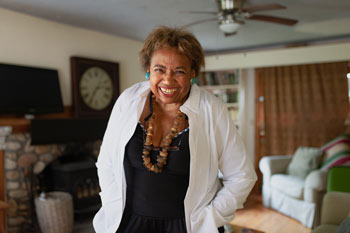
By Fern Gillespie Lifelong Martha’s Vineyard resident, Abigail McGrath, believes there is a special intellectual, cultural, and historical energy that attracts Black visitors to Martha’s Vineyard–especially during the summer.
In recent years, the island has swelled as a summer destination for Black visitors for events like the Martha’s Vineyard Black Film Festival, book and art shows, and HBCUs, sorority, and fraternity unions.
Abigail McGrath photo by Christine Sargologos
There are sightings of the Obama family and even a television drama and reality show dedicated to Black Martha’s Vineyard.
“In 1907 my family began visiting the island. At that time, it was a place where there was no pre-judging people of color. There was a sense of freedom that they did not have in Boston where many had their homes,” recalled Abigail, author, filmmaker, and playwright who is the founder of the Renaissance House Retreat for Writers and Artists.
“The island itself is so magical. People read books instead of watching television. It’s an intellectual dream come true.”
Over the last 24 years, the Renaissance House Retreat for Writers and Artists has gained a reputation as a space designed for issue-oriented writers, writers of color, and writers of social justice.
This June, Renaissance House is hosting two commuter weeklong writers workshops on June 17 and June 24, 2024. These Renaissance House Writer’s Workshops on Social Issues will be held in historic Oak Bluffs, Monday through Friday from 9:00 am to 5:00 pm.
The application deadline is April 22 to: Aplyrenhse@aol.com or contact Renaissancehse@aol.com Renaissance House was inspired by Abigail’s Aunt Dorothy, Dorothy West, the author of the award-winning novel and Oprah Winfrey mini-series The Wedding, and Abigail’s mother renowned poet Helene Johnson, West’s cousin.
Both women were famous writers and part of the legendary Black literary elite during the Harlem Renaissance.
“These were two women who were already noted as being special writers. Yet, they had to take menial work because women of color simply could not get jobs that a White woman could get. Therefore, they had to take lesser jobs,” explained Abigail.
“Dorothy worked as a cashier in the restaurant and wrote a column for the Martha’s Vineyard Gazette. My mother worked as a correspondent for Consumer Reports. They would do their writing in their spare time at night.”
Abigail’s life was the inspiration for The Wedding, but former First Lady Jackie Kennedy Onassis was the Doubleday editor who brought the story to the public.
“If Dorothy had not written the column in the Gazette that Jackie Kennedy Onassis read, she still would not have been noticed to this day,” said Abigail. “That’s what we call magical. Thank God Jacqueline Kennedy had the insight to see that she was a good writer.”
At Renaissance House, writers pen their stories in a house where cousins Dorothy West and Helene Johnson would spend time writing.
“It’s a place where writers have the time to write. Our writers span different stages in their careers—from emerging writers who work at 9 to 5 jobs to notable award winners,” explained Abigail “They work on fiction, non-fiction, creative non-fiction, poetry, essays, scripts and issue-oriented works. At the workshops, writers will have one-on-one editorial advice, and most importantly–time.”
Renaissance House programs have featured writers’ workshops with Martha’s Vineyard literary giants such as Jill Nelson, Jessica Harris, Kate Feiffer, Susan Klein, Robert Hayden, and others.
Renaissance House is also renowned as a summer destination for the annual July 4 public reading of Frederick Douglass’ powerful speech “What to the Slave is the Fourth of July?” This year it will be held at the historic Trinity Park Tabernacle Pavilion in Oak Bluffs.
Readers of all ages are invited to help bring the words of Frederick Douglass to life. Each volunteer reader will recite different sections of the 10,000-plus word address Douglass wrote during American slavery in 1852.
Although it’s been over 170 years since Frederick Douglass delivered his Fourth of July speech at a convention in Rochester, New York, the message is especially resonating during today’s turbulent political era.
The director-editor-producer of Renaissance House’s annual Frederick Douglass speech is Makani Themba, a writer and social justice innovator in the field of change communications and narrative strategy.
The public is invited to the dramatic staged presentation, which begins at 11:00 am. Volunteer readers are requested to arrive by 10:30 am. Martha’s Vineyard Community Television (MVTV) will tape the presentation for a special broadcast on July 4th evening. Readers can register at Renaissancehse@aol.com
“Being at Trinity Park Tabernacle Pavilion we can hold the reading in all types of weather. We’re not weather dependent,” said Abigail. “The Tabernacle is haunted with spirituality. When Frederick Douglass came to the island it’s possible that he had gone to the Tabernacle at some point.”
By Marlon Rice, Guest Editor Brooklyn, New York, if it were its own city, would be the fourth largest city in America. It would be larger than Houston, larger than Phoenix, larger than Philadelphia. The 97 square miles that makeup Kings County hold a deep and abiding history of agriculture in America.
How deep? In 1879, Kings County was the second largest county in terms of market garden production in the entire nation. Even as recently as 1959, Kings County was responsible for the production of over 325,000 gallons of milk.
Today, Brooklyn has over 200 community gardens – each garden serves as a vital green space amidst the backdrop of an urban environment. These gardens provide opportunities for community engagement, they provide spaces for residents to hone their green thumb, but most importantly they provide opportunities for environmental education for the surrounding community.
Of those 200 plus community gardens in Brooklyn, 37 of them rest in Bedford Stuyvesant. It is the largest concentration of community gardens in the entire city – and, many of Bed Stuy’s gardens in particular arose out of the revolutionary act of concerned residents repurposing abandoned lots and havens of chaos to create these green spaces, a process that is now called guerilla gardening.
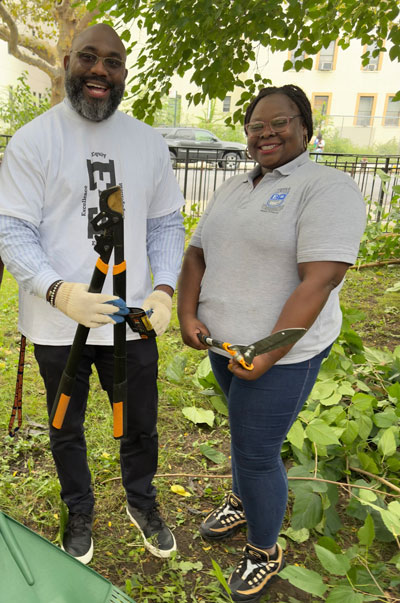
District 16 Superintendent Brendan Mims with coworker.
Of those 37 Bed Stuy gardens, Ena McPherson is either the Founder or the Operating Coordinator of 4 of them. A feisty elder, with a generous spirit and the disposition of a college professor, Ena has been able to witness the full breadth of the movement of community gardening – from an act of defiance against poverty into a dedicated community system that includes the input of government agencies.
Two of the gardens, T&T Vernon Community Garden, located at 200 Vernon Avenue, and V&T Vernon Community Garden located at 257 Throop were born out of the guerilla garden model in the late 60s. In the early 80s, both of these gardens were made protected by the City’s Parks Department.
Their success led Ena to look into grabbing another lot in the community, right on the corner of Willoughby and Throop.
“I found the lot and did the proposal to create the garden with Green Thumb. Green Thumb gave us a provisional license in 2010. We had to get permission because the lot had been vacant for 30 years. HPD had authority over the land.
There is an agreement between HPD and Green Thumb. When gardeners find a vacant lot, they can petition HPD through Green Thumb to use the space as a community garden. So, we received our provisional license and broke ground on Tranquility Farm in 2010. The garden officially opened in 2011.”
In 2014, HPD came back to Ena and told her that they wanted the land back. Ena and the farmers fought for an entire year to keep the space. And, in 2015 Tranquility Farms was one of 34 gardens that were conveyed to the Parks Department.
While bureaucracy and licensing dictate the process of creating community gardens, the Department of Education owns 19 school buildings in Bed-Stuy, and each of those buildings also has space allotted for gardening.
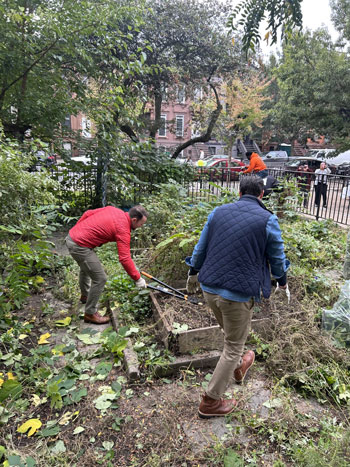
Volunteers doing the work to clear the garden for planting.
Unlike community gardens that are curated by residents, many of the school gardens in Bed Stuy are either maintained by an outside community organization, or simply dormant.
District 16 Superintendent Brendan Mims hit the ground running when he accepted the position in 2022. A former Earth Science teacher, Mims immediately set his focus on ways in which he could kickstart the use of school gardens as a tool for education. For Bed Stuy, each school garden truly represents a different layer of the community.
So, while some school gardens like PS 44 sit aside brownstone-lined streets, one block away from a supermarket and surrounded by resources, the school garden at PS 81 sits in the middle of a food desert.
This means that for some of the students in this community, Urban Agriculture isn’t just about growing and cultivating food, it’s also about learning the pillars of nutrition, and what healthy eating looks like.
Mims is clear on the issue, “We have school grounds that are not being taken advantage of in a way that could activate inner city agriculture as well as partnerships in the community.
The vision that I have isn’t just about beautification. It’s about bringing in the parents into the fold, with the youth, and with the community partnership.”
Just 4 blocks from Superintendent Mims’ office, Ena McPherson is steeped in community-supported agriculture. “I’m in four gardens. I’m the founder of two, and I coordinate efforts in all four. We function in collaboration. We don’t have separate meetings.
We operate as a unit, and that is very important to the ethics of how we want these gardens to run. Individuality may work in your personal life, but it doesn’t work in the community. It has to be a collaborative process.”
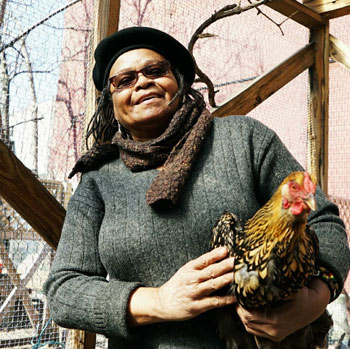
Ena McPherson
Ena’s sentiment echoes Mims’ vision. “I just want to give each school the opportunity to reimagine what agriculture and gardening can look like at the school level, then we look to partner with local organizations, and then we bring parents in with the kids so that our community partners are building the parent’s capacity and the student’s capacity to fortify the school and the community at the same time.”
The true potential of the urban agriculture palette in Bedford-Stuyvesant hasn’t yet been witnessed. While community gardeners like Ena McPherson work to keep their gardens up and running while battling a lack of membership retention and a lack of hands-on labor, plant boxes on school grounds across the district are empty.
The rank-and-file gardeners can barely handle the work of their own gardens, much less spend time building out curriculums to utilize gardens on school campuses. And the teachers in the schools are overwhelmed with the rigors of educating students.
To create a truly symbiotic relationship between the knowledge base of community gardens and the untapped potential of school gardens, you need a third party that can build that bridge.
Enter Magnolia Tree Earth Center. The Magnolia Tree Earth Center is a nonprofit environmental education organization that was founded out of the mindset of a pioneering environmentalist named Hattie Carthan. Hattie is responsible for the block association that led to the birth of the gardens that Ena McPherson oversees, but Hattie was also an educator of young minds.
She created the Tree Corps in the 70’s and educated dozens of students on how to properly care for the tree pits in the neighborhood. In total, through the course of her life Hattie Carthan is credited for the planting of over 1,500 trees in Brooklyn.
Over the last few years, like many other community-based organizations, Magnolia Tree has also seen its struggles to maintain and to survive. But, those struggles don’t stop Board Chair Wayne Devonish from understanding and pointing the organization towards Hattie’s vision.
A recent meeting between a Board member of Magnolia Tree and Superintendent Mims was the spark needed to begin the work of reimagining the relationship between community partners and school gardens.
Wayne explains, “One of our board members had run into Mims and told him that she was from Magnolia Tree. She spoke to him about our work, and he told her that a lot of his schools have unkempt garden spaces. In fact, the school that his office is at had a garden that was in pretty bad shape.
So, I sat down with Mims and we began talking about how we could collaborate. One of the low-hanging fruit missions was right in front of us, and that was to beautify the garden space at the school where his office sits.
So, we were able to execute that, but even better we are working on offering gardening classes for parents utilizing the garden spaces at his schools. It’s something we are working on.”
An organization like Magnolia Tree Earth Center is the perfect organization to stand in the gap. Magnolia Tree has open communication with the heads of all the community gardens in Bed Stuy. They have space to invite parents in to learn about gardening concepts, and they have the legacy of Hattie Carthan to center their work.
Wayne understands this, “We need to give our schools support so that their garden spaces are properly maintained, utilized, and made alive. These schools are mandated to educate our children, and if any part of their work falls into neglect, like the gardens, then the village should get involved. It’s our duty.”
For Mims, the village help is like a life-saver being thrown to someone lost at sea. It is a godsend. “I’ve thought about the approach we are taking with organizations like Magnolia Tree, that have classes that they can offer and to pair those classes with the parents.
So, now it’s a matter of having conversations with the local community farms so that they too can see the vision that we are talking about on how we can tap into the green real estate that our schools have. So, if we can match a community gardener with a school garden, we can start the work as a pilot program, and eventually scale to other schools.”
Ena knows the history of the school gardens very well, and she sees funding as the enemy of progress. “This is the problem. Green Thumb, at one point, had a very vibrant school garden program. They had lots of funding, and they were really doing a lot. They had a partnership with Grow NYC, and they were doing a lot of garden work in schools.
But all of that has fallen by the wayside because of funding. The DOE isn’t equipped to take on that work. The teachers are already burdened with the regular curriculum.
If you add the component of Urban Ag, it’s not going to work. And, you can’t ask community gardeners to simply take on that task. Now, we have a strong component of education attached to all of our gardens. We have the ability for students to tour our gardens and we’ve been doing it for years.
We know that there is a direct correlation between children’s nutrition and their education. And yes, I think that every community garden should be connected to a school. It is a sad situation though.
The community gardeners cannot take on the task of cultivating school gardens. You need a paid staff that can run the Urban Ag programs and teach these children. We can support, as we do now. We can consult, as we do now. But the work of those gardens has to come through funding.”
For Mims, a perfect situation would be one of shared accountability – where community partners and gardeners worked together with parents and with the schools. “You would have shared accountability, shared ownership.
You’d have the district office, the PTA, Community Partners, the Block Association, and the Community Gardeners as the point person, all working to reimagine the story and existence of school gardens as community gardens. The buy-in comes from what it looks like when everybody chips in. A nice school garden rebrands the community.
When someone walks by the school garden and it’s beautiful and they see people from that community working that land, it speaks even stronger to what Bed Stuy is and what Bed Stuy stands for.”
Community gardens might not be school gardens. But school gardens are community gardens. And the work involved with bringing ideas into creation as it relates to the future of school gardens in New York City continues.
However, in Bedford Stuyvesant there is a symbiotic relationship building between the District Superintendent, the Community Gardeners, and Community Partners. And, with the right buy-in and framework, the sky is the limit.
Marlon Rice has been deeply rooted in the vibrant culture and community of Central Brooklyn for a lifetime. His connection with Our Time Press began far before he ever wrote a word as a columnist.
Project Green, an initiative created by Bernice Green, inspired Marlon to educate himself on Urban Agriculture.
That decision eventually lead to Marlon serving as Executive Director of Magnolia Tree Earth Center. During his tenure, he created a curriculum to teach 2nd – 5th graders about Urban Ecology. As a DOE Vendor, he has been teaching our community’s children that curriculum since 2018. Marlon is also certified to teach hydroponics, and has curated multiple school gardens in the District. Marlon is centered firmly in this new Bed Stuy Green Movement.
By Bernice Elizabeth Green This is not a pretty picture, and this young man is not a healthy kid. It is not an exaggeration to conclude that the many thousands of microplastic bacterium-sized particles he’s breathed, ingested, or touched logjammed his bloodstream and invaded his brain. We speak past tense purposefully. We wonder, did he ever get the chance to grow up? Also, this photo was an Our Time Press cover for an April 2016, Earth Month story.
A study found that the average person eats at least 50,000 particles of microplastics a year. A Washington Post story stated, “Plastic fibers have even been found in more than 80% of tap water around the world.”
This year the Washington Post reported that “chemicals found in plastic and some food packaging has been linked to many health issues, including nervous system problems, hearing loss and cancer” and “it also has been linked to harmful health effects to a weakened immune system, reproductive problems and more.”
Also, there’s evidence – in animals that “mothers may be able to pass microplastics through the placenta to a developing fetus.” That’s one side. Zoom outside the body and into the world’s big picture and the evidence is clear: islands of garbage and trash are floating in the oceans.
According to an AtlasandBoots.com November 2021 report, “Plastic waste is polluting the entire planet. It has been found in the Mariana Trench (the deepest point in the ocean), falling from the sky in Arctic snow, embedded in Antarctic ice, and secreted in the Alpine soils of Switzerland.
“The UN Environment Programme has said that if current trends continue, our oceans could contain more plastic than fish by 2050.”
And it’s not as if our astute visionaries and friends Yonnette Fleming, American urban farmer and community earth steward; Dr. Reginald Blake, the highly honored geophysicist and climate change specialist; and the distinguished scientist Dr. Christopher Boxe, and others, did not try to tell us. They did.
Yet, for the 54th year in a row, Earth.org will be making great noise to increase awareness of Earth’s critical issues and everyone’s role in preserving it. This year the theme is “Planet and Plastics,” and a lot of talk will revolve around who’s to blame for the mess in our oceans, air, earth, and within us.
According to www.AtlasandBoots.com, “a recent report drawing on World Bank data and published in the Science Advances journal suggests that the United States and Great Britain produce the most plastic waste per person than any other major country.”
In related earth news, through compiled reports, we will introduce Nzambe Katee, Founder, Gjenge Makers, and Lorna Rutoh, Founder, Ecopost, young women plastics recycling ecopreneurs of Kenya who are dealing with the crisis, and at the same time, empowering their communities.
Earth Month arrived quietly on a rainy, windy Tuesday but it will roar to its official culminating day, April 22, alive with global activity (Earth.org). And if you really want to get your kids of all ages interested in nature and loving it so much that by next year, they’ll want to join you at the 2025 Earth celebration activities, check out what two genius artists, writer/author Jamaica Kincaid and fine artist Kara Walker have seeded possibly the Best New Book-for-All- seasons (launching in May).